
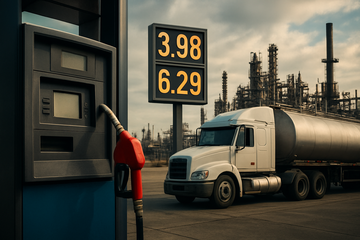
Regular gasoline fell to $3.98 a gallon on November 10, down 8.9% in five weeks, while on-highway diesel held at $6.292 — unchanged since the September average. Nothing about the refining system changed in those five weeks, so the gasoline move was a crude move and the diesel firmness is a crack story. That distinction decides what the next inflation print looks like, who is collecting the refining rent, and what a December rate hike is actually betting on.
US retail gasoline, national average
$3.98/gal
AAA national average, November 10, 2026; $4.37 a month earlier
US on-highway diesel
$6.29/gal
EIA weekly average, week of November 2, 2026; identical to the September monthly average
Diesel crack, monthly average
$110.84/bbl
September 2026, a record, calculated from EIA spot prices
US gasoline refinery yield
Under 45%
Average January–August 2026, below the five-year low every month
CPI gasoline, 12-month change
+34.2%
BLS Consumer Price Index, September 2026, released October 14, 2026
Federal funds target range
3.75–4.00%
FOMC decision of October 28, 2026, held 10–2 with two dissents for a hike
Price action
Gasoline Broke $4 and Diesel Didn't Move
The pump is now running two speeds, and only one of them moved. AAA's national regular gasoline average dropped to $3.9788 a gallon on November 10 from $4.3669 a month earlier, while EIA's weekly on-highway diesel figure was $6.292 in the week of November 2 — the identical number EIA published for the September monthly average. Gasoline has retraced to roughly where the EIA's October outlook expects the full 2026 average to land at $3.91; diesel is still $1.49 above its own 2026 average of $5.19.
| Measure | Latest print | Comparison | What it says |
|---|---|---|---|
| Regular gasoline, AAA national average | $3.9788/gal on November 10, 2026 | $4.3669 a month earlier; $3.0707 a year earlier | Down 8.9% in five weeks, still 29.6% above a year ago |
| On-highway diesel, EIA weekly average | $6.292/gal, week of November 2, 2026 | $6.29/gal September average; record $6.5276 on September 22 | Flat for two months, 3.6% off the record |
| WTI crude | $84.26/bbl on November 10, 2026 | Down 10.1% over the past month; EIA spot $103.37 on October 27 | The leg that actually moved the pump |
| Diesel crack versus crude | $110.84/bbl, September average | Prior record $94.94/bbl in October 2022 | The leg that did not move |
| Gasoline crack versus crude | $46.92/bbl, September average | Record $56.60/bbl in June 2022 | Less than half the diesel crack |
| 3-2-1 composite crack | $68.23/bbl, September average | Highest monthly average since June 2006; $47.54 in the week to October 23 | Already cooling from the peak |
- AAA's national average fell 8.9% in five weeks to $3.9788 a gallon on November 10, from $4.3669 a month earlier.
- On-highway diesel sat at $6.292 in the week of November 2, identical to the $6.29 September monthly average and only 3.6% below the $6.5276 record set on September 22.
- Crude did the work: WTI fell 10.1% over the past month to $84.26 a barrel on November 10, after EIA's spot series printed $103.37 on October 27.
- Even at $3.9788 the pump remains 29.6% above its year-ago level of $3.0707, so a cheaper pump is not the same thing as a cheaper year.
Refining
Refiners Cut Gasoline Yields — They Did Not Rotate Into Them
The profitable rotation ran the other way. EIA refinery yield data show gasoline yields averaging under 45% from January through August 2026 and falling below the five-year low every month, while distillate yields ran above the five-year average every month and jet fuel yields cleared 12% of US output for the first time in March 2026. US refiners ran at an unseasonally high 95% utilization in the third quarter, processing the most crude for a third quarter since 2019, with refining capacity only about 4% above 2019 levels. They were already flat out and still could not make enough distillate.
Where the crack went in September 2026
September 2026 average crack spreads against crude, calculated from EIA spot prices. The composite 3-2-1 crack averaged $68.23 a barrel, the highest monthly average since June 2006, against $29.06 a barrel in the week to February 27, 2026.
Unit: $/bbl crack versus crude
Diesel
September monthly record
110.8
Heating oil
Highest since 1986
103.7
Jet fuel
Highest since 1990
87
Gasoline
Below the June 2022 record of $56.60
46.9
| Slate | What US refiners did in 2026 | September 2026 crack versus crude |
|---|---|---|
| Diesel | Distillate yields ran above the five-year average every month, January to August | $110.84/bbl, a record |
| Heating oil | Crack set a September monthly record for the series | $103.70/bbl, highest since 1986 |
| Jet fuel | Jet fuel yields cleared 12% of US output for the first time in March 2026 | $86.99/bbl, highest since 1990 |
| Gasoline | Gasoline yields averaged under 45% and fell below the five-year low every month | $46.92/bbl, under half the diesel crack |
- Valero Energy completed its St. Charles FCC unit optimisation in the third quarter, adding capacity for gasoline and alkylate — large refiners are hedging both ends of the slate, not betting on one.
- Distillate and jet fuel crack spreads almost tripled their year-earlier levels in the third quarter, with distillate the highest and jet fuel second highest on EIA's New York Harbor measures.
- Gasoline output fell to 1.40 million barrels a day at Valero Energy against 1.16 million of distillate in the third quarter, a mix that earns a $39.24-a-barrel margin precisely because the cheap barrel is scarce.
Earnings
The Crack's Rent Was Real, and the Market Is Pricing Its End
Third-quarter results proved the margin was not a forecast. Valero Energy reported $8.8 billion of refining operating income on a $39.24-a-barrel margin against $13.14 a year earlier, and Phillips 66 turned $131 million of quarterly net income into $5.61 billion. The market's verdict sits in the multiples: peak crack earnings are capitalized at 2.1x to 5.7x EBITDA, which is a bet that the shortage ends before it does.
Who captured the crack, and who paid it
Change in third-quarter 2026 operating income versus the third quarter of 2025. Refiners and upstream captured the crack's rent; the airline paid it.
Unit: % change in operating income versus Q3 2025
$2.10B against $0.29B
635%
$6.40B against $0.90B
610%
$9.07B against $1.51B
501%
$2.67B against $0.56B
373%
$11.37B against $4.30B
165%
$5.52B against $2.76B
100%
$1.45B against $1.68B
-14%
| Company | Q3 2026 net income | Diluted EPS, Q3 2026 vs Q3 2025 | EV/EBITDA | Net debt/EBITDA | Days of inventory |
|---|---|---|---|---|---|
| Valero Energy | $6.83B | $23.89 vs $3.53 | 4.8x | 0.06x | 22.4 |
| Phillips 66 | $5.61B | $14.08 vs $0.32 | 5.7x | 0.65x | 15.3 |
| PBF Energy | $1.53B | $12.54 vs $1.45 | 2.1x | 0.04x | 33.4 |
| HF Sinclair | $2.00B | $11.38 vs $2.15 | 3.0x | 0.01x | 42.9 |
| Marathon Petroleum | $14.63B (TTM) | $51.13 (TTM) | 5.2x | 0.86x | 25.2 |
Supply chain
Distillate Is the Print That Doesn't Break
The distillate squeeze is a capacity problem, not a price event, and capacity problems do not unwind with crude. Global gasoil exports averaged 4.7 million barrels a day over the first nine months of 2026, 10% below a year earlier, and East Coast distillate stocks sat 32% below the 2021-25 average in September, with the EIA expecting them to stay 10% to 30% below average through 2027. The EIA raised its fourth-quarter Brent forecast by $14 a barrel to $105 precisely because diesel tightness pulls crude demand, so the shortage shows up in the oil price as well as the barrel.
- The International Energy Agency expects global diesel consumption to fall 2.6 million barrels a day in 2026 to 102.4 million and not grow again until 2027, so the crack's demand side erodes while its supply side stays tight.
- IEA world oil supply is projected down 5.7 million barrels a day, about 6%, in 2026, and global inventories fell 3.1 million barrels a day in August.
- China eased November diesel loadings to about 500,000 tonnes on thin domestic stocks, and Seoul rejected calls for higher diesel exports, with second-half Korean diesel exports down 3.4% year over year to 129.82 million barrels — two of the world's largest refining systems are holding barrels at home.
- S-Oil earned KRW 690.4 billion of refining operating income in the third quarter, up 29.7% from the prior quarter, while Sinopec sits on the other side of the same shortage as the swing supplier of last resort.
Inflation and policy
A $4 Pump Is Not the Print December's Hike Is About
Two governors already broke ranks. On October 28 the FOMC held the target range at 3.75% to 4.00% on a 10-2 vote, with Lisa Cook and Beth Hammack dissenting in favor of a quarter-point increase, and the statement's own words were that inflation remains elevated. All 100 economists in a Reuters poll expect a hike at the December 8-9 meeting, which carries a fresh projections package. But the gasoline line they would cite is now the weakest part of the inflation picture, and the line that keeps their case alive is a crack.
- September's headline CPI rose 0.6% against a 0.3% core print, with the gasoline index up 9.1% in a month and 34.2% over the year, so gasoline did more than half of that month's work.
- Producer prices rose 1.3% in September, with gasoline up 20.3% accounting for about half of the increase in final demand goods — the goods-price channel still runs through the same barrel.
- With the pump at $3.98 the annual gasoline rate cools but stays near 30%, so a fuel-disinflated printremoves the easiest argument for tightening without resolving the core rate at 2.6%.
- Consensus for the October CPI published November 10 is a 0.3% headline and 0.2% core, with the market still treating a December hike as likely.
Days to quarters
Near Term: Four Dates Between Now and December 9
- October CPI, published November 10 at 8:30 a.m. ET — the first read on whether the pump relief reached the print.
- EIA's November Short-Term Energy Outlook, published November 10, arrives with a fourth-quarter Brent forecast of $105 a barrel that predates the crude slide.
- The FOMC on December 8-9, with a projections package that will show the committee's own 2027 energy assumptions.
- Any White House decision on a 90-day diesel export ban, which the president said on September 28 he was \"very seriously\" considering.
Numbers to keep in view
EIA retail gasoline forecast, 2026
$3.91/gal
Pump already at $3.98; 2027 projected at $3.56
EIA retail diesel forecast, 2026
$5.19/gal
2027 projected at $4.49, still above $4 through 2027
East Coast distillate stocks
32% below average
September 2026, against the 2021-25 average
US refinery utilization, Q3 2026
95%
Most crude processed for a third quarter since 2019
Next FOMC decision
December 8-9, 2026
With a projections package
One to three years
Long Term: The Crack Has to Normalize Before 2027
Over a one-to-three-year horizon the question is not whether the crack falls but who owns the barrel when it does. The market's answer is visible in the multiples: refiners at 2.1x to 5.7x EBITDA are priced for a shortage that fades, and the marginal barrel of crude no longer carries a war premium now that WTI has given back more than 10% in a month. Inventories, not cracks, become the swing factor in the next two reporting quarters.
- East Coast distillate inventories bottom at 22.6 million barrels in April 2027, 21% below the five-year average, so the physical squeeze runs into next spring.
- IEA expects the global diesel market to stay short into 2027, which gives refiners several more quarters to collect the rent before the crack turns.
- Inventory days are the fourth-quarter tell: HF Sinclair carries 42.9 days and PBF Energy 33.4 against Phillips 66's 15.3, so a sustained crude decline hits reported margins hardest at the most levered names.
- The real risk to the crack thesis is demand: the IEA has diesel consumption falling 2.6 million barrels a day in 2026, which a sustained crack would have to outrun.
Transmission
Who Collected the Crack's Rent and Who Paid It
| Layer | Company | Q3 2026 evidence | Read |
|---|---|---|---|
| Upstream crude | ConocoPhillips | Operating income $5.52B vs $2.76B a year earlier; EPS $3.34 vs $1.38 | Diesel tightness pulls crude demand; EIA lifted its 4Q26 Brent forecast $14/b to $105 |
| Upstream crude | Chevron | Net income $9.92B vs $3.54B; EPS $5.06 vs $1.82 | Same bid on a much bigger base |
| Refining | Valero Energy | Refining operating income $8.8B; margin $39.24/bbl vs $13.14 | Largest single winner of the record distillate crack |
| Refining | Phillips 66 | Net income $5.61B vs $131M; EPS $14.08 vs $0.32 | Least crude inventory in the group at 15.3 days |
| Refining | PBF Energy | EPS $12.54 vs $1.45; operating income up 635% | Highest torque to the crack and to the crude slide |
| Integrated refining and retail | Marathon Petroleum | Trailing operating income $21.02B; diluted EPS $51.13 | A record crack and a $3.98 pump reach one income statement |
| Fuel retail | Casey's General Stores | Revenue $5.68B, up 24%; same-store fuel gallons down 0.3%; fuel margin 47.8 cents, up 6.8 cents | High prices already cost gallons; a lower pump should win them back |
| Freight | Old Dominion Freight Line | Revenue $1.59B, up 13.1%; operating ratio 71.5% from 74.3%; EPS $1.65 | Fuel surcharge carried the quarter; management flags fuel and health costs in Q4 |
| Airline | Delta Air Lines | Revenue $20.19B, up 21%; operating income $1.45B, down 14%; EPS $1.15 vs $2.17 | Average fuel price $3.80/gal vs $2.26 a year earlier; $4.25 assumed for Q4 |
The investable map of a two-speed fuel market
- Q3 2026 refining margin of $39.24 a barrel against $13.14 a year earlier shows earnings track distillate, not gasoline.
- The market capitalizes record crack earnings at 4.8x EV/EBITDA, with net debt at 0.06x EBITDA and 51% return on equity.
- Fourth-quarter refinery runs are planned at 96% to 99% of capacity, and EIA sees East Coast distillate stocks 10% to 30% below average through 2027.
- Over one to three years the thesis holds only while the crack does; an export ban would end it overnight.
- Trailing operating income of $21.02 billion and diluted EPS of $51.13 capture a record distillate crack and a $3.98 retail pump at once.
- Blends refining margin with branded fuel retail, so the crack and the pump hit the same income statement from two directions.
- Trades at 5.2x EV/EBITDA with 0.86x net debt/EBITDA and 76.6% return on equity.
- Near term the risk is a diesel export ban; a year out, crack normalization is the main earnings risk.
- Q3 2026 net income of $5.61 billion against $131 million a year earlier, with diluted EPS of $14.08 versus $0.32.
- Carries the least crude inventory in the group at 15.3 days, so a falling crude price does less damage to fourth-quarter margins.
- At 5.7x EV/EBITDA it is the most expensive of the five refiners, which is also the cleanest earnings.
- Watch refinancing: 0.65x net debt/EBITDA and a 12.5% free cash flow yield keep it insulated from a December rate hike.
- Third-quarter diluted EPS of $12.54 against $1.45 a year earlier, with operating income up 635%.
- Trades at 2.1x EV/EBITDA, the lowest multiple in the group — the market pricing these as peak earnings.
- Carries 33.4 days of inventory against 15.3 at Phillips 66, so a sustained crude slide hits reported margins hardest here.
- Mixed over the next two quarters: record distillate earnings pulling one way, crude and inventory marks pulling the other.
- Same-store fuel gallons fell 0.3% in the quarter ended July 31, 2026 while the fuel margin widened 6.8 cents to 47.8 cents a gallon.
- A sub-$4 pump hands volume back to the retailer but compresses cents per gallon — elasticity has to show up faster than margin gives up.
- Inside same-store sales rose 3.2% on revenue of $5.68 billion and EPS of $7.37, so the store business is carrying the fuel business.
- At 19.3x EV/EBITDA with a 2.5% free cash flow yield, the market already pays for the fuel margin.
- Q3 2026 revenue rose 21% to $20.19 billion while operating income fell 14% to $1.45 billion.
- Paid a record $86.99-a-barrel jet fuel crack, with the average fuel price at $3.80 a gallon against $2.26 a year earlier.
- A sub-$4 gasoline pump does nothing for jet fuel: the crack premium, not crude, sets the fuel bill, and Q4 assumes $4.25 a gallon.
- Relief requires global refinery output to recover, which the IEA expects to drag into 2027.
- Refining segment operating income of KRW 690.4 billion in Q3 2026, up 29.7% from the prior quarter.
- Seoul has rejected calls for higher diesel exports, and second-half Korean diesel exports fell 3.4% to 129.82 million barrels.
- Record global pricing meets policy-capped volumes, so the export allocation calendar is the swing factor, not the crack.
- Mixed: the price is right, the volume ceiling is not; watch Korea's monthly export decisions into 2027.
- China eased November diesel loadings to about 500,000 tonnes on thin domestic stocks, making Beijing the swing supplier.
- Decides whether the $110.84-a-barrel crack compresses — more Chinese barrels in December hit every refiner in this trade.
- Sinopec's exposure is the export window rather than the domestic pump, so the allocation calendar is the catalyst.
- Watch: the next monthly export allocation is a binary event for the crack and for the trade.