
Russian crude shipments, four-week average
3.63M bpd
Bloomberg tanker-tracking, reported Nov 10, 2026
ESPO premium to Brent, Nov–Dec cargoes
$23–27/bbl
Reuters, Oct 23, 2026; two offers above $30
Urals discount to Brent
≈$19/bbl
Urals $72.96 vs Brent $91.95, Nov 9–10, 2026
Kozmino loading status
Halted, temporarily
Bloomberg, Nov 10, 2026; cause most likely maintenance
Aframax freight, Kozmino to China
$10M → $2M
Per-voyage peak in October 2026, Reuters, Oct 23, 2026
Russian crude output
8.64M bpd
September 2026, lowest since mid-2020
The event
One Jetty Went Quiet, and the Export Curve Tilted
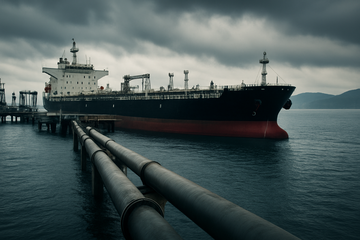
Loading at Kozmino — the Black Sea terminal that ships ESPO crude 10,000 km to Asian refiners — stopped in the week before Nov 10, 2026. Bloomberg put Russian crude shipments at a four-week average of 3.63 million barrels a day, and described the weekly slump as the likely result of maintenance work at the Pacific terminal, with western ports also loading less. Kozmino is a single-asset chokepoint: ESPO Blend exports from there ran close to 1 million barrels a day in March 2026, near the port's capacity, and there is no substitute jetty for the same grade pipeline.
- Kozmino is the terminal of the Eastern Siberia–Pacific Ocean pipeline, so its loading capacity, not Russia's production, sets how much ESPO can reach China.
- A halt there removes the only outlet for barrels that were priced at a record premium; Sokol-grade cargoes from De-Kastri, the other Pacific terminal, fell 35% month-on-month on unloadings in September 2026.
- Weekly Russian crude shipments had already fallen to 3.13 million barrels a day, the lowest since March, in the week to Oct 18, 2026 — before the Kozmino pause.
- September output of 8.64 million barrels a day was the lowest since mid-2020 and the tenth consecutive monthly decline, so there was no spare upstream capacity to backfill the lost jetty.
The mechanism
Policy Went Soft, So the Steel Got Hard
Washington has spent2026 unwinding the legal architecture around Russian oil. General License 134, dated Mar 12, 2026, authorised delivery and sale of Russian crude already loaded on vessels, including flagging, insurance, classification and crewing services, and expired on Apr 11, 2026. On Oct 9, 2026 Washington and Moscow agreed a diesel deal to stabilise the fuel market, and by Oct 15 US officials were weighing removing sanctions on some shadow-fleet vessels. The effect has been to convert enforcement from signature to hardware: what survives is the physical plant, the hulls and the ports.
| Layer | Status in 2026 | Effect on Russian barrels |
|---|---|---|
| Price cap | Cut from $47.60 to $44.10 per barrel effective Jan 31, 2026 | Excludes most Western service providers; pushes cargoes onto shadow tonnage |
| General License 134 | Temporary waiver of Mar 12, 2026, expired Apr 11, 2026 | Unblocked cargoes already afloat, not new ones |
| Diesel carve-out | US–Russia diesel deal agreed Oct 9, 2026 | Freed product barrels, not crude |
| Shadow fleet | US considering lifting sanctions on some vessels, Oct 15, 2026 | Adds tonnage, pressures freight down |
| Terminal hardware | Kozmino loading halted in the week to Nov 10, 2026 | Removes the only ESPO outlet, with no backfill capacity |
That shift shows up in the two grades of Russian crude trading at opposite ends of the same benchmark. ESPO Blend loaded at Kozmino was offered for November and December delivery to China at $23–27 per barrel above Brent, with two December–January offers above $30, against a $12 premium for November cargoes only a month earlier. Urals, meanwhile, traded at $72.96 against a $91.95 Brent, a discount near $19 per barrel. The barrel with a physical bottleneck is scarce and expensive; the barrel with spare tankers is discounted and unsold.
Upstream and downstream
The Chain Runs From a Dead Jetty to Chinese Refining Margins
Upstream of Kozmino sits a pipeline, a producer base and a fleet that is94% more than 15 years old. Downstream sit Chinese refiners competing for light, sweet Russian grades because Middle East supply is throttled by the Iran conflict. Between them sits the insurance market: Russia's reliance on Western maritime services has fallen to 37%, and no crude exported through the Black Sea ports moved on IG P&I-insured tankers in September, against 40% in August. A halt at one terminal therefore transmits straight to the buyer's input cost, because the alternative barrels are the ones carrying Hormuz and Red Sea risk.
- Upstream: Transneft operates the ESPO pipeline and the Kozmino terminal; Russia's crude output fell for a tenth straight month to 8.64 million barrels a day in September 2026.
- Upstream fleet: 141 shadow-fleet tankers loaded Russian ports or did ship-to-ship transfers in September 2026,94% of them over 15 years old; 687 tankers were sanctioned by G7 and allied jurisdictions by Oct 14.
- Downstream: Chinese refiners Sinopec and Yulong Petrochemical bought the bulk of the ESPO Blend exported from Kozmino, with Shandong independent refiners locking in more than two-thirds of the cargoes in August.
- Downstream alternative: China's Persian Gulf imports reached 2.1 million barrels a day, surpassing Russian supplies for the first time since March, while China cut Russian seaborne crude by 10% month-on-month to 1.5 million barrels a day.
The companies that actually move these barrels are earning the most from the dislocation. Frontline reported its best quarterly profit ever for the second quarter of 2026, at $659.2 million or $2.96 a share on $943.3 million of revenue, with record VLCC time-charter equivalent rates of $152,700 a day. Teekay Tankers' second-quarter net income of $225.9 million on $379.5 million of revenue tells the same story. Falling freight costs are now the single largest swing factor, and the tonne-mile that Russia adds is what the market is paying for.
Second-order effects
Refiners With Deep Pockets Are Buying the Scarcest Barrel
The interesting equity consequence is that a sanctions-driven premium is a margin transfer. When ESPO trades at $23–27 above Brent and Urals at $19 below, the refiners who can switch grades capture the spread and the ones locked into a single cargo lose it. Marathon Petroleum's third quarter shows the receiving end of this: refining and marketing adjusted EBITDA of $9.9 billion, a $45.70 per barrel segment margin and revenue of $56.03 billion.Deep-pocketed buyers of heavy grades profit while single-cargo buyers of Russian light sweet pay the premium.
Russian crude grades price on opposite sides of Brent
ESPO offers to China are premiums to ICE Brent; Urals is a discount to Brent. Nov 9–10, 2026.
Unit: US$ per barrel vs ICE Brent
ESPO, Nov–Dec cargoes
Premium to ICE Brent, Reuters, Oct 23, 2026
25
ESPO, Dec–Jan top offers
Two offers above this level
30
ESPO, Nov cargoes (Sept pricing)
Premium, per Reuters, Oct 23, 2026
12
ESPO, Sept cargoes (July pricing)
Discount of $1–3 per barrel
-2
Urals to Brent, Nov 9–10
Urals $72.96 vs Brent $91.95
-19
Chinese refining margins are where this bites. Sinopec's third-quarter net profit rose 57.2% year-on-year to 13.36 billion yuan on better margins and higher oil prices, but that gain was earned while its Russian Far East feedstock was priced at a modest premium. Rongsheng Petrochemical, a buyer of discounted sanctioned barrels, reported third-quarter net profit of 2.90 billion yuan against 286 million a year earlier, with revenue down 19% year-on-year at 64.19 billion yuan — a margin story that depends on buying cheap, not on cheap freight. With ESPO offers at record premia and freight from Kozmino to China collapsing from about $10 million to $2 million a voyage, the buyer of the marginal barrel faces the worst possible combination.
Horizons
What Actually Moves From Here
- Days to weeks: whether Kozmino resumes loading and at what rate; Bloomberg called the pause most likely maintenance, and a single week of lost loading is roughly 1 million barrels of ESPO not shipped.
- Days to weeks: US decisions on which shadow-fleet vessels come back into the mainstream; added tonnage pushes tanker rates down and pulls Brent back toward $90.
- One to three years: whether Asian refiners keep paying $23–27 above Brent for Russian light sweet when Middle East barrels carry conflict risk; the premium is the clearest live measure of the Pacific bottleneck.
- One to three years: production at 8.64 million barrels a day is the hardest number to fix — a tenth consecutive monthly decline and the lowest since mid-2020 leaves no buffer for a second terminal outage.
For the KSE Institute's Russian oil tracker, the two-to-three-year range is where the sanction regime gets its price tag. Its base case puts Russian oil export revenues at about $200 billion in 2026 falling to $159 billion in 2027, with weaker enforcement sustaining $198 billion in 2027 and stronger pressure cutting them to $126 billion, against cumulative oil export losses of $213 billion since March 2022. The spread between those two enforcement paths is larger than the entire annual revenue of the Pacific terminal's buyers, which is why the next hardware failure, not the next press release, is the swing factor.
Where the Pacific Bottleneck Shows Up in Listed Companies
- Best quarterly profit ever in Q2 2026 at $659.2 million, $2.96 per share, on record VLCC TCE of $152,700 a day.
- Freight is the swing factor: VLCC Gulf of Oman–China rates fell to about 776 Worldscale from 841 in the week to Oct 16, 2026.
- A Russian outage adds Pacific tonne-miles but also risks the tankers' earnings peak reversing as more shadow-fleet tonnage returns.
- Next 1–3 years: replacement of a 94%-over-15-years-old shadow fleet is the demand story, not Russian volumes.
- Q2 2026 net income of $225.9 million on $379.5 million of revenue, with TTM EPS of $17.04.
- Long-haul Pacific exposure captures the tonne-mile when Russian crude reroutes toward Asia at record premia.
- Aframax freight from Kozmino to China fell from about $10 million to $2 million a voyage — the risk case for spot-exposed earnings.
- Watch Russian loading plans rather than headline sanctions for the next quarter's rate fixings.
- Q3 2026 net profit rose 57.2% year-on-year to 13.36 billion yuan on stronger refining margins and higher oil prices.
- Buys the bulk of ESPO Blend exported from Kozmino, so a jetty halt cuts its cheapest sanctioned-light-sweet feedstock.
- With ESPO at $23–27 above Brent and China's Gulf imports at 2.1 million barrels a day, switching costs, not cargoes, cap the upside.
- Next 1–3 years: a persistent $20-plus premium is a structural margin tax on one of its largest supply grades.
- Q3 2026 net profit of 2.90 billion yuan versus 286 million a year earlier, with revenue down 19% year-on-year at 64.19 billion yuan.
- Earnings depend on buying discounted sanctioned barrels, and Urals at roughly $19 below Brent is where that discount lives.
- A Kozmino halt removes premium-priced ESPO from the menu and pushes single-cargo buyers toward costlier alternatives.
- TTM net debt to EBITDA of 6.3 times leaves no room for a sustained input-cost shock.
- Q3 2026 refining and marketing adjusted EBITDA of $9.9 billion on a $45.70 per barrel segment margin.
- Lower freight and a weaker Urals-type discount pull heavy-crude input costs down for buyers with flexible slates.
- Freight retreating from record highs is what pulls crude back toward $90, supporting refining margins on non-Russian barrels.
- Next 1–3 years: a persistent premium on Russian light sweet shifts the marginal barrel toward US producers.
- Owns a 68-vessel fleet, exposed to the same freight normalisation that has already pulled supertanker rates off record highs.
- Product tanker economics depend on Russian diesel and fuel-product arbitrage that the Oct 9, 2026 US–Russia deal reopened.
- Watch whether the diesel carve-out adds Russian product cargoes at scale; nothing has reached the US market yet.
- Next catalyst: confirmation of the size of the shadow-fleet relief package.
- Q3 2026 revenue of 11.97 trillion won and net income of 1.44 trillion won, against 632 billion won a year earlier.
- S-Oil benefits when discounted sanctioned crude widens its input cost advantage against spot buyers.
- But a Brent pullback toward $90 compresses the absolute value of any discount it captures on sanctioned barrels.
- TTM EV/EBITDA of 4.75 times and net debt to EBITDA of 1.85 times leave room for the differential to stay wide.