
Brick share of new US homes
16.8%
Principal exterior wall material, homes started 2025; Census Bureau characteristics of new housing, published July 1, 2026
Wood-framed share of new single-family homes
94%
2025 completions, roughly 947,000 homes; concrete 5%, steel 0.5% (NAHB analysis of Census data, September 2026)
Brick price index, change since 2019
+35%
Producer price index for building or common brick: 269.6 in September 2026 versus a 199.0 average in 2019
James Hardie siding and trim gross margin
40.2%
Quarter ended September 30, 2026, up 5.4 points year over year
Labor share of an installed brick veneer wall
62%
$6.70 of $10.84 per square foot of wall area, RSMeans residential siding cost study, September 2023
Acme Brick Jonesboro plant shutdown
Dec 31, 2026
27 jobs affected; plant realignment with market conditions, announced October 26, 2026
The mix shift
What Vanished Was the Wall, Not the Brick
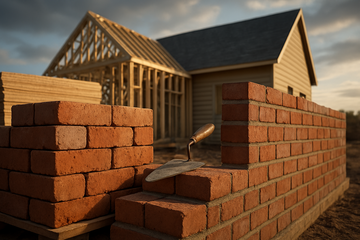
The brick look is not disappearing from American houses; the wall behind it is. Brick or brick veneer was the principal exterior wall material on 16.8% of homes started in 2025, down from almost a quarter in 2012, yet 94% of single-family completions were framed in wood and only 5% in concrete. Those two Census Bureau series describe the same house: a light frame wearing a brick skin. Brick has been demoted from structure to cladding
Principal exterior wall material, homes started 2025
Vinyl, stucco and fiber cement took the wall in the 2010s; brick is now the fourth most common exterior on a new American home. Census Bureau characteristics of new housing for 2025, as analyzed by NAHB in July 2026.
Unit: % of single-family starts
Vinyl siding
27.7%
Stucco
24.1%
Fiber cement siding
22.6%
Brick or brick veneer
16.8%
Wood and wood products
5.9%
Each housing cycle has handed the wall to a different material, and this one handed it to fiber cement and stucco. Vinyl peaked near 40% of new homes in 2001 and has been broadly flat since 2015; fiber cement passed stucco in the Mountain division at 42%, the first time in Census data that runs back to 2000.
| Census division | Dominant exterior wall material | Share of new homes |
|---|---|---|
| West South Central | Brick or brick veneer | 54% |
| Middle Atlantic | Vinyl siding | 73% |
| New England | Vinyl siding | 72% |
| East North Central | Vinyl siding | 71% |
| East South Central | Vinyl siding (first time since 2020 it passed brick) | 39% |
| Pacific | Stucco | 65% |
| Mountain | Fiber cement siding (first time since 2000) | 42% |
The structure under the cladding carries the durability story. Of single-family homes completed in 2025, 94% — about 947,000 homes — were wood-framed, 5% (about 53,000) were concrete-framed, and 0.5% (about 5,000) were steel-framed, the fastest-growing method at 25% more homes than a year earlier. Concrete framing was 9% of completions in the South, where roughly 60% of all steel-framed homes were built, because resilience requirements push builders away from the standard wood frame.
| Framing method | Share of completions | Homes completed | Change vs. 2024 |
|---|---|---|---|
| Wood frame | 94% | ~947,000 | -1% |
| Concrete frame | 5% | ~53,000 | -4% |
| Steel frame | 0.5% | ~5,000 | +25% |
Price and capacity
Brick's Price Rose 35% as Its Share Fell — That Is a Supply Story
Brick's price and brick's share moved in opposite directions. The producer price index for building and common brick rose from an average of 199.0 in 2019 to 269.6 in September 2026, a 35% gain, while brick's share of new homes fell roughly eight points between 2012 and 2025. Prices do not rise in a market that is simply getting weaker; they rise when supply is removed. Brick's price strength is evidence of capacity discipline, not of demand strength
Producer price index for building or common brick
Annual average of the monthly index, December 1984 = 100; 2026 is the January-September average. Source: Bureau of Labor Statistics producer price index for clay building material and refractories manufacturing.
Unit: Index, Dec 1984 = 100
2019
199
2020
203.5
2021
213.2
2022
232.9
2023
249.9
2024
261.3
2025
266.3
2026 (Jan-Sep)
269.2
The capacity is going now. Acme Brick will end production at its Jonesboro, Arkansas plant on December 31, 2026, cutting 27 jobs, and said the closure is about aligning operations with market conditions. The volume slump shows up abroad too: Forterra reported revenue down 13.5% in the first half of 2026 while UK brick dispatches ran 8% lower through May, leaving brick consolidating into a smaller, higher-priced industry.
Material price was never the reason builders walked away. A brick veneer wall system costs $10.84 per square foot of wall area, and $6.70 of that is installation labor — 62%. As a share of total construction cost for a two-story 2,700-square-foot home, brick veneer runs7.7% against 6.6% for wood siding and 5.8% for fiber cement, so brick lost on labor and cycle time rather than on the price of clay.
| Exterior wall system | Share of total construction cost | Total home cost vs. brick veneer |
|---|---|---|
| Brick veneer | 7.7% | Baseline |
| Stucco | 6.7% | 6.7% cheaper than brick veneer |
| Wood siding | 6.6% | 1.4% cheaper than brick veneer |
| Fiber cement siding | 5.8% | 2.4% cheaper than brick veneer |
Where the margin lands
The Rent Goes to the Manufacturer Who Can Price a Spec Change
The rent from the spec change goes to the manufacturer who can price it. James Hardie's siding and trim segment net sales rose 15% to $880.3 million in the quarter ended September 30, 2026, and segment gross margin widened 5.4 points to 40.2%. The company credits higher exterior volumes, an annual price increase and easier comparisons after dealer destocking, and in the same filing calls new construction soft in many markets, notably the South Central region. Its deck business grew 51% to $387.0 million, helped by expanded distribution including an initial load-in at Boise Cascade. Pricing power is expanding while the end market is shrinking
James Hardie segment net sales, quarter ended September 30, 2026
Year over year: siding and trim +15%, deck, rail and accessories +51%, Australia and New Zealand +21%. Segment gross margin: siding and trim 40.2% (up 5.4 points), deck 35.7% (up 13.9 points). Source: Form 10-Q filed November 5, 2026.
Unit: $ millions
Siding and trim
880.3
Deck, rail and accessories
387
Australia and New Zealand
160.9
The same trade runs through wood. LP Building Solutions set a record for siding net sales at $473 million in the September 2026 quarter, up 7%, with a 5% price increase and 2% volume growth, while OSB net sales barely moved at $180 million and OSB equipment effectiveness slipped to 78% from 81% — adding price while volume stayed thin. In the June2026 quarter, James Hardie grew North American fiber cement net sales 20% organically on consolidated net sales of $1.475 billion.
Even the winner is cutting capacity. Nichiha closed its Macon, Georgia plant in October 2025, cutting 171 jobs, which says fiber cement's share gains are being fought over a shrinking new-home pie rather than a growing one. Single-family starts ran at a 232,000 annual rate in the September 2026 quarter, slightly below the 235,000 of a year earlier, leaving the leader pricing while smaller plants close.
The middle of the chain
The Distributor and the Cement Get Nothing
The middle of the chain gets nothing. Builders FirstSource reported third-quarter 2026 revenue of $3.85 billion, down 2%, with gross margin down to 27.8% from 30.4% and operating income down 57% to $99 million. Eagle Materials, the cement behind stucco and concrete masonry, grew revenue 2% to $653 million in its September 2026 quarter but saw gross margin fall to 26.8% from 31.3% and earnings per share fall to $3.64 from $4.23. The spec change creates a price umbrella, and it accrues to brands rather than to the channel or the commodity behind the wall.
- Distribution is paid per unit of a shrinking market: single-family starts ran at 232,000 in the September 2026 quarter, and Builders FirstSource's gross margin fell 2.6 points in the same window.
- Commodity cement cannot hold the increase: Eagle Materials' revenue grew 2% while gross profit fell 12.5%, from $199.7 million to $174.7 million, with diesel and freight doing the damage.
- Only a manufacturer with a specified system can price: engineered wood siding raised its net selling price 5% in the September 2026 quarter, and fiber cement prices were raised on an annual basis.
- The investable map is domestic and Japanese: every producer with a documented line into the US exterior wall sits in the United States or Tokyo, with no Korean, Chinese or Hong Kong listing carrying a verifiable stake.
Who pays for longevity
The Insurance Bill Is the Part Nobody Priced
Here is the part of the mix shift that nobody priced. The National Association of Insurance Commissioners' consumer guide to home insurance states that the premium usually is lower for homes primarily made of brick or masonry than for wood frame homes, because insurers rate construction class before anything else. Most of the 16.8% that look like brick are wood frames wearing a brick veneer, so the durability advantage left the building and stayed with the minority that kept the structure.
That matters far more in 2026 than it did in 2012, because insurance is the binding constraint on housing affordability. Home insurance costs nationwide spiked nearly 20% in two years, and the NAHB notes that homes certified to the FORTIFIED Gold standard — engineered continuous load paths, stronger exterior sheathing, pressure-rated windows — can earn significant discounts in some states. Builders that keep the structure keep the discount; the ones that drop it hand the bill to the homeowner.
| Payer | How the cost arrives | Evidence | Next signal |
|---|---|---|---|
| Builder | Absorbs the insurance gap in incentives or margin, or keeps the structure and pays for masonry | D.R. Horton gross margin 20.5% in the fiscal 2026 fourth quarter versus 21.7% a year earlier | January 2027 incentive load |
| Homeowner | Annual premium difference between frame and masonry construction class | NAIC: premiums usually lower for brick or masonry than for wood frame homes | State rate filings in Florida, Texas and California |
| Insurer | Reprices construction class and rewards engineered, certifiable systems | NAHB: home insurance costs up nearly 20% in two years; FORTIFIED Gold discounts | 2027 state rate filings |
| Wall manufacturer | Keeps the price umbrella and the margin | James Hardie siding and trim gross margin 40.2%, up 5.4 points | Third-quarter fiscal 2027 results, February 2027 |
D.R. Horton is the cleanest read on who absorbs the difference. In its fiscal 2026 fourth quarter, revenue fell 3% to $9.37 billion, gross margin slipped to 20.5% from 21.7%, and earnings per share fell to $2.67 from $3.04. Demand did most of that damage, not the wall. The narrower point still sits awkwardly for the mix-shift bulls: the exterior is now a cost line the builder must either defend to the buyer or absorb in incentives.
Horizons
Short-Term Catalysts, Long-Term Fault Line
- December 31, 2026: Acme Brick stops production in Jonesboro — watch brick price indexes and regional delivery lists for the supply response.
- January and February 2027: D.R. Horton, Builders FirstSource, Eagle Materials and LP Building Solutions report December-quarter results; incentive load and distribution margins show whether the wall cost is being passed on.
- February 2027: James Hardie's third-quarter fiscal 2027 results; siding and trim gross margin holding above 37% keeps the pricing thesis intact.
- July 1, 2027: the Census Bureau publishes characteristics of new housing for 2026 — the brick share print is the cleanest single test of the trend.
| Date | Event | What it settles |
|---|---|---|
| Dec 31, 2026 | Acme Brick closes Jonesboro plant | Whether brick prices hold without volume |
| Jan 2027 | D.R. Horton fiscal 2027 first quarter | Whether builders price the insurance-class gap into incentives |
| Feb 2027 | James Hardie third-quarter fiscal 2027 results | Whether 40% siding gross margin survives a soft new-construction market |
| Feb 2027 | LP Building Solutions and Builders FirstSource fourth-quarter results | Whether engineered-wood price gains hold when starts are flat |
| Jul 1, 2027 | Census characteristics of new housing for 2026 | Whether brick's 16.8% share keeps sliding |
| 2027 | State insurance rate filings | Whether frame construction keeps a construction-class penalty |
Over one to three years, the likely end state is a wall market with fewer, bigger plants and a wider price spread. Brick retreats to a regional and luxury niche — it still takes 54% of new homes in the West South Central division — carrying a price index 35% above 2019 on a shrinking producer base. Fiber cement consolidates around one leader able to price a specification and cut costs when demand softens. The genuine structural growth sits in the 5% and 0.5% — concrete and steel framing — because those are the homes that keep the construction class insurers reward. The mix shift is a transfer of durability value rather than of volume, which leaves the durable winners as the names that can price it.
Downstream, the listed builders carry the spec. Sekisui House paid $4.95 billion for M.D.C. Holdings in January 2024, doubling its US footprint to 16 states with a goal of 10,000 homes a year, and from 2026 runs Woodside, Holt, Chesmar and Richmond American under a single Sekisui House U.S. company — concentrating US material and insurance decisions in one balance sheet.
- Brick's national share re-accelerating above 20% in the 2026 Census data would break the schedule-and-labor explanation and point to a consumer preference recovery.
- James Hardie's siding and trim gross margin falling below 37% while price increases continue would show the pricing umbrella being competed away.
- Insurers beginning to price brick veneer distinctly from other frame construction would narrow, or close, the wedge that makes the shift expensive.
- Builders advertising insurance-savings packages would prove the wedge is being priced and passed on, which changes who captures it.
The trade
Own the Specification, Not the Square Foot
Siding returned to volume growth in the third quarter and set a new record for net sales.
The exterior wall of a new American home has become a financial instrument: cheap to specify, expensive to own, and controlled by a handful of brands. Brick lost the wall and kept the price. Siding took the volume and kept the margin. The channel lost margin on a shrinking pie, and the homeowner inherits the construction-class penalty that a builder's spec decision created. The trade is to own the pricing power and to watch the insurance filings, because the day that gap stops being priced, the wall moves back. It is a long-duration bet with a short memory: the wall is decided every quarter, but the consequences last decades.
Investable consequences of the wall spec shift
- Siding and trim gross margin hit 40.2% in the September 2026 quarter, up 5.4 points, as new construction stayed soft — pricing power holds in a shrinking market.
- North American fiber cement net sales rose 20% organically in the June 2026 quarter while brick fell to 16.8% of new homes, so the spec shift pays the specified brand.
- Fiscal 2026 net sales reached $4.84 billion, yet net income fell to $104 million from $424 million: bought growth diluted margin, so read segment gross margin rather than earnings per share.
- Catalyst: the February 2027 third-quarter print; siding and trim gross margin below 37% with continued price increases would break the pricing thesis.
- Siding net sales hit a record $473 million in the September 2026 quarter, up 7% on 5% price and 2% volume — wood-frame share compounds the siding line.
- OSB is the drag: OSB net sales were $180 million, up 1%, with equipment effectiveness down to 78% from 81%, so OSB cannot offset the siding franchise.
- Over one to three years, 94% wood framing makes engineered-wood siding a structural gainer; the risk is single-family starts at 232,000 in the September quarter versus 235,000 a year earlier.
- Cement rides stucco and concrete framing as both take share from brick; Eagle's September quarter revenue rose 2% to $653 million — volume without pricing power.
- Gross margin fell to 26.8% from 31.3% and earnings per share to $3.64 from $4.23 as diesel and freight rose, so the commodity layer cannot keep the wall's price increase.
- Over one to three years, concrete framing at 9% of Southern completions is the durability hedge if insurers keep discounting masonry.
- Third-quarter 2026 revenue fell 2% to $3.85 billion and operating income fell 57% to $99 million as gross margin compressed to 27.8% — the channel is paid for volume that no longer exists.
- Swapping brick for fiber cement changes the spec, not the units moving through distribution, so the shift is invisible in a per-unit revenue model.
- Catalyst: the February 2027 fourth-quarter print; further margin compression turns the wall shift from a mix event into a volume problem.
- The builder pays last: fiscal 2026 fourth-quarter revenue fell 3% to $9.37 billion and gross margin slipped to 20.5% from 21.7% — the cheaper wall returns through incentives.
- If insurers keep pricing wood frame above masonry, builders either absorb the premium in incentives or keep the structure, and the second costs more to build.
- Catalyst: the January 2027 first-quarter incentive load; builders advertising insurance-savings packages would show the wedge being priced and passed.
- Nichiha USA closed its Macon, Georgia plant in October 2025, cutting 171 jobs — fiber cement is cutting capacity too.
- As a non-James Hardie fiber cement supplier, Nichiha cannot price like a 40.2% gross margin leader, and US demand tracks single-family starts of 232,000.
- Over one to three years, the 22.6% fiber cement share of new homes is defended by the leader's pricing, and Nichiha funds the share.
- Sekisui paid $4.95 billion for M.D.C. Holdings in January 2024, doubling its US footprint to 16 states with a 10,000-home goal — heaviest listed bet on US build-to-order.
- From 2026, Sekisui House U.S. runs Woodside, Holt, Chesmar and Richmond American as one company, concentrating US material and insurance decisions.
- Catalyst: US orders and closings with fiscal 2026 results; the West South Central market, where brick still takes 54% of new homes, is where the shift bites hardest.