
What happened
United Did Not Ban AI — It Banned the Checkout
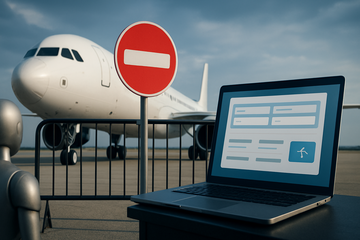
On November 11, 2026, United Airlines said it would restrict unauthorized third-party AI assistants from acting on its digital platforms, and would do the same indirectly through travel agencies and aggregators. Agents can still surface United flight options and prices. What they can no longer do is complete a reservation, change a ticket, or check a bag.
- United is updating its booking, ticketing and distribution policies, covering its own website and app as well as agency and aggregator channels.
- The stated reason is credential exposure: sharing login details with an assistant can trigger unintended purchases, account changes, and MileagePlus miles usage.
- The regulatory reason is check-in: only a human can acknowledge that checked baggage contains no prohibited items, so the airline argues an automated agent cannot lawfully complete that step.
- Agent bookings made before November 11, 2026 are not being cancelled, so the policy is prospective rather than retroactive.
The framing matters. United is not opposing artificial intelligence; it sells plenty of its own. It is objecting to a specific architecture in which a third party holds the customer's credentials, decides which airline wins the comparison, and captures the transaction. Airline distribution has always included intermediaries. Agentic search simply moves the point of control upstream of the booking screen.
Market reaction
The Market Read It as an Intermediary Gift
Expedia Group shares rose as much as 3.1% and Booking Holdings as much as 1.1% in the session after the announcement, while other large U.S. carriers did not follow United's policy. The trade was not about air travel demand at all; it was about who owns the customer interface when a machine is doing the shopping.
United's new policy suggests the company wants to retain control over the customer booking process.
One large carrier explicitly allows AI assistants to complete a booking, and other airlines have said they will let the customer decide how they transact. That divergence is the substance of the event. A uniform ban would be a regulatory matter; a unilateral ban by the network's premium-leaning operator is a competitive position, and it is the first time a seller has tried to fence off machine traffic rather than simply refuse to pay for it.
The economics
Near Term, Agent Volume Cannot Move a Line Item — Which Is Why This Is a Positioning War
United's Q3 2026 distribution expense was $632 million, up 13.9% year over year, against total operating revenue of $17.9 billion. That single line is the toll being contested. Agents do not remove distribution cost today; they relocate who gets paid for it, and who holds the customer relationship attached to it.
United Q3 2026: pricing power carried the quarter, capacity did not
Year-over-year change, Q3 2026 vs Q3 2025
Unit: percent
Passenger revenue
Q3 2026, $16.24B
17.6%
Total operating revenue
Q3 2026, $17.9B
17.4%
PRASM
Passenger revenue per ASM
16.1%
TRASM
Total revenue per ASM
15.9%
Distribution expense
$632M in Q3 2026
13.9%
Capacity (ASMs)
88.5B ASMs
1.3%
The scale of agent traffic is still negligible. Expedia Group told investors on its Q3 2026 call that agent traffic to its sites is small but high intent, that it does not appear to cannibalize direct traffic, and that the volume is too small to draw conclusions. Travelers still prefer to complete a purchase with a trusted brand, and bookings made through agents have yet to catch up.
Supply chain
The Layer That Actually Moves the Fee Pool Is the Rails, Not the Airline
Upstream, the agentic booking stack is already live and commercial. Sabre, PayPal and MindTrip launched travel's first end-to-end agentic flight booking experience in May 2026: MindTrip's conversational interface queries Sabre's Mosaic inventory APIs for more than 420 airlines, and PayPal's agentic commerce infrastructure completes checkout inside the conversation. Amadeus, the other large GDS, is positioning as the neutral execution layer for MCP and Google's Universal Commerce Protocol, processing roughly three billion flight searches a day across more than 400 airlines.
- Sabre supplies inventory through Mosaic APIs and is the content layer in the first shipped conversational booking flow.
- PayPal supplies identity and payment inside the agent conversation, so it captures transaction economics even when the airline's website is never opened.
- Amadeus is pushing the protocol layer — MCP plus Universal Commerce Protocol — as the neutral plumbing between suppliers, sellers and AI assistants.
- Downstream, Expedia and Booking Holdings both integrate with OpenAI, Google and Meta surfaces, and Expedia reported leading U.S. citation share for travel queries in third-party data.
- Metasearch is migrating too: Skyscanner shipped a dedicated ChatGPT app for flight search in February 2026 as part of a shift from form-based search to conversational discovery.
That structure is why the ban lands where it does. If the agent assembles the itinerary and the payment rail closes it, the airline becomes a supplier to a transaction it does not control — and the intermediary in the middle captures the fee. United's answer is to deny the transaction, which pushes the booking toward aggregators and OTAs that hold the relationship, or toward rivals that still accept agent checkout.
Causal chain
Why Check-In, Not Privacy, Is the Load-Bearing Constraint
Two motives are bundled in the announcement, and they have very different implications. The credential argument is real but soft: it can be engineered around with scoped tokens, delegated sessions and agent identity protocols, and vendors such as Cloudflare-style bot management and the payments and GDS rails are already building exactly that. The check-in argument is harder. Baggage acknowledgement is a human affirmation of a prohibited-items statement, so no amount of protocol elegance lets an autonomous agent discharge that duty.
That distinction explains the shape of the policy: the ban lands on booking, modification and servicing, where a human can still be inserted at the confirmation step, rather than on the fare-comparison step, where search is legally and commercially ordinary. It also explains why airlines can differ. A carrier that lets an agent complete a purchase accepts a specific, checkable exposure that a carrier quoting fares and handing off to a human does not.
Second-order effect
United's Own Agents Can Now Quote United Flights and Sell Someone Else's
Here is the cost that does not appear in a policy statement. An agent that surfaces United fares but cannot transact leaves the traveler mid-funnel with a live comparison. Where an agent can close the booking on a competitor's inventory, that competitor wins the sale. So United's restriction is most likely to leak precisely the highest-intent traffic in the system — travelers who asked a machine to do the work and were ready to hand over a card.
The same logic runs through the intermediaries. United said it would restrict agent access indirectly via agencies and aggregators, which pushes compliant agent bookings away from United inventory and toward carriers that will close the transaction. For an OTA, that is a modest volume gain; for United, it is a slow, low-visibility bleed of the most valuable segment of demand in an industry where unit revenue is already doing all the work.
| Company | Q3 2026 revenue | Operating margin | Position on agent transactions |
|---|---|---|---|
| United Airlines | $17.9B | 8.1% | Blocks third-party agents from transacting, directly and via agencies/aggregators |
| Delta Air Lines | $20.2B | 7.2% | Among carriers that let AI assistants complete bookings |
| Expedia Group | $4.9B | 26.9% | Integrates with OpenAI, Google and Meta agent surfaces |
| Booking Holdings | $8.9B | 38.4% | Partners with OpenAI, Google, Anthropic and Amazon on AI distribution |
| Sabre | $738M | 14.8% | Supplies inventory to the first live conversational booking flow |
| PayPal | $8.6B | 16.3% | Handles checkout and identity inside the agent conversation |
| Alphabet | $127.6B | 31.8% | Co-develops Universal Commerce Protocol; AI Mode travel integration |
| Meta Platforms | $64.6B | 20.1% | Muse agent spans shopping surfaces, with retailers split on access |
Expedia's Q3 gross bookings of $34.0 billion, up 11%, with B2B gross bookings up 19%, is the scale at which the intermediary layer operates. Booking Holdings' Q3 revenue of $8.9 billion at a 38.4% operating margin shows what an interface business earns when it owns the transaction. United, at an 8.1% operating margin, has far less room to give away control of the customer without giving away economics.
Horizons
Days-to-Quarters: Watch the Copycats, Not the Holidays
- If Delta or another large carrier formally adopts comparable terms in the holiday quarter, the agent-mediated booking flow becomes a multi-carrier question and the shift toward OTAs accelerates. Watch for published distribution-policy language rather than press statements.
- United's Q4 2026 revenue guidance and any change in distribution expense give the first hard read on whether blocked agent traffic stayed on United or migrated to rivals.
- Agents booking before November 11, 2026 remain valid, so servicing and disruption handling of those bookings becomes an operational and legal test case in the near term.
- Any Department of Transportation or FAA guidance on agent check-in and prohibited-items acknowledgement would harden or dissolve the regulatory premise of the ban across the industry.
The near-term risk to the thesis is that nothing happens: agent volume stays immaterial, carriers do not copy, and the policy reads as a press release rather than a fork in the road. Expedia itself said agent volume is too small to draw conclusions. That is the correct reading of the next two quarters.
Long term
One to Three Years: The Transaction Layer Reprices Before the Volume Does
The structural question is not whether agents will book flights; it is who holds the customer when they do. If protocols such as MCP and Universal Commerce Protocol standardize, and if agent identity is solved with scoped credentials, then the entity that brokers the transaction — an OTA, a GDS, or a payment rail — captures the fee and the data. Airlines that block will be suppliers inside someone else's checkout flow, and the direct-channel premium they have spent a decade defending becomes negotiable at the interface.
The counter-case is equally concrete. Airlines have the scarcest asset in the equation — physical seats with hard capacity — and they can simply refuse to sell to machines that behave badly. United has demonstrated the option is real. The likely equilibrium is not a ban or a free-for-all but a tokenized, permitted agent channel in which airlines set the terms and the toll goes to whoever holds the customer relationship. Under that equilibrium, the winners are the parties that can authenticate a transaction quickly, and United's ban is best read as pricing that option before anyone else did.
Where the fee pool moves
- United's channel-level block routes agent demand toward intermediaries, and Expedia Group shares rose as much as 3.1% on the announcement.
- Q3 gross bookings of $34.0 billion, up 11%, with B2B gross bookings up 19%, give it the volume to absorb redirected machine traffic.
- Expedia says agent traffic is high intent and non-cannibalistic, but too small to change2026 numbers — upside is a 2027 story.
- Near term the catalyst is a peer carrier copying United's policy; longer term it is agent share of gross bookings.
- Booking Holdings is the clearest margin beneficiary of sellers fencing off machine traffic, since agent bookings land on intermediaries that monetize every transaction.
- Q3 2026 revenue of $8.9 billion at a 38.4% operating margin means incremental agent bookings arrive at very high contribution margin.
- Its partnership set with OpenAI, Google, Anthropic and Amazon positions it as the default inventory for agent surfaces.
- Risk to the call: if agent volume stays immaterial for years, the re-rating never arrives and the ban remains noise.
- United Airlines protects credentials and holds a defensible regulatory argument on human-only baggage acknowledgement, which protects the direct channel.
- But its own agents can quote United fares while being unable to close, so the highest-intent machine traffic leaks to carriers that allow agent checkout.
- Distribution expense of $632 million in Q3 2026, up 13.9%, is the toll at stake if interface control shifts to OTAs.
- Near-term watch item: whether rival carriers copy the restriction in the holiday quarter, which would blunt the leakage; over one to three years, the direct-channel premium is the exposed asset.
- Sabre already supplies the inventory behind the first live conversational booking flow, but carriers restricting agent transactions cut off the path from that inventory to a completed sale.
- Q3 2026 revenue of $738.4 million came with a $25.2 million net loss and net debt to EBITDA near 37x, leaving little room to fund an agentic pivot.
- Its capital-light content position is the asset at risk: if airlines fence off machine sales, GDS distribution fees are levied on a shrinking machine-mediated channel.
- The upside case needs Sabre to win the protocol layer outright; the announced MindTrip and PayPal flow shows the technology works even as policy closes around it.
- PayPal sits inside the agent conversation as the identity and checkout layer, so it earns on transactions the airline's own website never sees.
- Q3 2026 revenue of $8.6 billion at a 16.3% operating margin means incremental agentic volume lands on a platform with scale.
- Agentic commerce is a product line for PayPal, not an experiment, and the Sabre and MindTrip launch shows it shipping in travel.
- The bear case is disintermediation: if agents negotiate away payment economics, the rail captures less per booking even as volume grows.
- Alphabet co-develops Universal Commerce Protocol with Shopify, backing from Amazon, Microsoft, Meta, Stripe and Salesforce, which positions it as the plumbing for machine commerce.
- Q3 2026 revenue of $127.6 billion and a 31.8% operating margin give it room to subsidize travel discovery while agent volume is small.
- Its AI Mode integration with Expedia gives a live, high-intent travel funnel that does not require the airline's consent.
- If airline bans push discovery toward assistant surfaces, Alphabet captures the intent while airlines retain only the fulfillment economics.
- Delta Air Lines is among carriers that let AI assistants complete bookings, so it is the natural substitute destination for traffic United's policy diverts.
- Q3 2026 revenue of $20.2 billion at a 7.2% operating margin means incremental agent-sourced bookings carry real margin leverage.
- The named catalyst is regulatory or competitive convergence: if DOT or FAA clarifies agent check-in, or another carrier copies United, the policy gap closes.
- Watch for evidence that agent-sourced bookings actually materialize, since no carrier has disclosed agent booking volumes.