
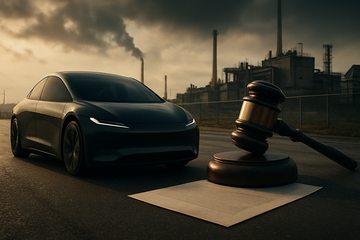
On September 10, 2026, NHTSA Chief Counsel Peter Simshauser signed a Special Order to Tesla demanding the company show, under oath, that its two-seat Cybercab — a vehicle with no steering wheel, no brake pedal, no accelerator pedal, and no conventional mirrors — actually complies with the Federal Motor Vehicle Safety Standards (FMVSS) Tesla certified it against a week earlier. The order gives Tesla until September 30, 2026 to answer 21 detailed requests, signed by a corporate officer under penalty of perjury, with civil exposure of $27,874 per day up to a $139,356,994 cap for a related series of violations and criminal exposure of up to 15 years for falsifying or withholding information.
The Self-Cert Bet Is Now the Self-Cert Risk
Tesla told NHTSA the Cybercab complies with every applicable FMVSS — and is therefore not subject to the 2,500-vehicle-per-year cap that comes with a Part 555 exemption petition. That bet lets Tesla scale the program to roughly 1,000 vehicles in Austin and beyond without the multi-year rulemaking pause that a Part 555 path would impose. The Special Order makes that bet the central question: if NHTSA concludes the Cybercab relies on determinations that certain FMVSS are inapplicable rather than on actual compliance, the self-cert posture collapses.
- The 21 requests probe which FMVSS Tesla deemed inapplicable, not just whether the company met the ones it claims apply — Request 10 explicitly asks Tesla to list every passenger-car FMVSS it contends does not apply and to explain why.
- Request 19 is the kill shot on the foot brake. FMVSS No. 135 S5.3.1 requires the service brakes to be \"activated by means of a foot control.\" The Cybercab has no foot control. NHTSA asked Tesla to explain how it certified anyway.
- Requests 5 through 7 set the \"make-inoperative\" trap. If Tesla used temporarily attached human-driver controls (steering wheel, pedals) during certification, removing them to deliver a production Cybercab could violate 49 U.S.C. § 30122(b), which prohibits disabling required equipment.
- Request 21 corners Tesla on the Part 555 question, asking how the Cybercab can be sold without a Part 555 exemption and citing NHTSA's own March 2022 modernization position (87 Fed. Reg. 18560). Tesla does not have a Part 555 exemption.
What NHTSA Is Actually Asking For
Beyond the FMVSS trap, Requests 1 and 2 force Tesla to disclose its Operational Design Domain — the maximum speed, road type, geography, time-of-day restrictions, and environmental conditions under which each deployed Cybercab actually operates. That's the data point that tells investors whether the Cybercab is a real commercial fleet or a geo-fenced pilot dressed up as one.
| Request | Standard / Issue | Why It Matters |
|---|---|---|
| 1–2 | Operational Design Domain (max speed, geography, time-of-day, road type) | Reveals whether the \"fleet\" is a real commercial service or a fenced pilot |
| 3–4 | Which FMVSS Tesla deemed applicable vs. inapplicable | Tests the legal foundation of self-certification |
| 5–7 | Temporarily attached human-driver controls + § 30122(b) \"make-inoperative\" | If certification used human controls, removing them may itself be noncompliance |
| 8–10 | Method of compliance + inapplicability contentions | Forces Tesla to defend engineering analyses vs. physical tests for every standard |
| 11–18 | FMVSS 101 (controls/telltales), 102 (shift position), 108 (turn signal), 111 (rearview), 126 (ESC) | Each is a standards clash with a vehicle that has no steering wheel, pedals, or mirrors |
| 19 | FMVSS 135 — \"service brakes shall be activated by means of a foot control\" | Direct collision: Cybercab has no foot control |
| 20–21 | Touchscreen occupant controls + Part 555 exemption analysis | Asks why Tesla needs no exemption when NHTSA's own 2022 rulemaking says it should |
The Unit-Economics Clock Just Got Shorter
The Special Order lands with Tesla already spending at a rate that assumes Cybercab revenue hits in 2027. Q2 FY2026 revenue was $28.24 billion, up 25.5% year over year, but operating income collapsed 57% to $398 million while R&D expense surged 49% to $2.37 billion — much of it going to Optimus, FSD, and the Cybercab/Robotaxi program. Capex is on track for $25 billion in 2026, roughly $6.7 billion a quarter, and free cash flow turned negative $1.12 billion in Q2 FY2026 alone. The Services & Other segment, which is where Cybercab rides ultimately book, posted a record $4.58 billion (+50% YoY) at a 14.1% gross margin — but that segment is still overwhelmingly the Supercharger network, insurance, and used-car financing, not robotaxi fares.
Tesla Q2 FY2026 revenue
$28.24B
+25.5% YoY, reported Jul 23, 2026
Q2 FY2026 operating income
$398M
down 57% YoY, per Tesla 10-Q filed Jul 23, 2026
Q2 FY2026 R&D expense
$2.37B
up 49% YoY, includes Optimus / FSD / Cybercab
2026 capex run rate
$25B
reiterated on Q2 FY2026 earnings call
Cybercab fleet in Austin
~45
registered to Tesla Robotaxi, LLC as of late Aug 2026
Cybercab scope of AQ26002
~1,000
vehicles in the audit per NHTSA Special Order
Musk's 2027 narrative leans on three numbers: a sub-$30,000 Cybercab sticker, 50,000-unit annual capacity at Gigafactory Texas, and customer deliveries by end-2026. Every one of those depends on the Cybercab being a saleable, FMVSS-compliant passenger car — not an exempt test fleet. If NHTSA forces a Part 555 petition, Tesla caps near 2,500 vehicles per year, the Giga Texas line idles below capacity, and the per-unit economics Musk pitched collapse.
What the Supply Chain Has to Defend Against
Tesla's self-certification gamble is upstream of every component spec on the Cybercab bill of materials — the dual-motor drive, the 4680 cells that just started a dedicated ramp at Giga Texas, the camera-only perception stack that lets the company skip lidar, and the infotainment computer that doubles as the only occupant interface. A retroactive recall would touch them all. Downstream, the Austin Robotaxi fleet operator, fleet buyers Tesla started courting in early September, and any state-level AV permits piggybacking on federal FMVSS compliance all move together.
- Upstream — 4680 cell ramp. Tesla said in the Q2 FY2026 update it is \"increasing production of 4680 cells to support production ramps of both Cybercab and Tesla Semi.\" A Cybercab cap means 4680 demand from the program disappears and the cell line eats fixed cost on Semi alone.
- Upstream — Camera-only perception. Self-cert depends on FMVSS compliance without lidar, radar, or ultrasonic redundancy the standards imply. If NHTSA pushes back, every AV supplier with a multi-modal stack gets a tailwind.
- Downstream — Austin fleet operator. Texas DMV records show roughly 45 Cybercabs registered to Tesla Robotaxi, LLC, plus 269 Model Ys in the supervised fleet. A fleet recall would freeze the commercial service.
- Downstream — Cybercab fleet sales channel. Tesla opened Cybercab fleet sales to businesses in early September 2026 per industry reporting; if FMVSS compliance is reopened, those purchase orders face cancellation risk.
The Competitive Frame: Waymo's Permitted Lead, Mobileye's New Bid
The Special Order sharpens a competitive gap that already existed. Alphabet's Waymo runs roughly 450,000–500,000 paid rides per week and is on track for its stated goal of 1 million weekly rides by year-end 2026 — at an implied quarterly GMV run rate near $260 million assuming a $20 average fare. Waymo's vehicles (Jaguar I-PACE based) are estimated to cost around $150,000 each, but the unit economics are irrelevant while the service runs in permitted cities with NHTSA-acknowledged autonomous-vehicle programs. Tesla's path was to skip that permitting queue via self-cert — and that is the path NHTSA is now contesting.
Mobileye made the opposite bet. On June 16, 2026 it announced a vertically integrated robotaxi business, complementing the Mobileye Drive Level-4 stack it already sells. The company guided to a projected $24.5 billion revenue pipeline through 2030 at its CES 2026 update and posted $558 million in Q1 FY2026 revenue (+27% YoY). Mobileye's pitch to OEMs is the very thing the Cybercab order puts in question for Tesla: certify the stack, not the car.
What Has to Happen Next — and What Could Go Wrong
On the September 30 deadline, Tesla faces three forks: a clean, complete answer that lets NHTSA close AQ26002; a partial answer that triggers follow-up requests and pushes the clock into 2027; or a contested answer that leads to civil penalties and a recall demand. The cleanest outcome for Tesla is the least likely: Requests 5–7 and 19 force Tesla to either concede the Cybercab needs human-driver controls it doesn't have, or to argue inapplicability for FMVSS 135 — both of which undermine the self-cert posture.
- Best case (days–quarters): NHTSA accepts Tesla's inapplicability theory for FMVSS 135 and a handful of others, allowing commercial operations to continue while opening a narrow rulemaking conversation.
- Base case (quarters): NHTSA forces a Part 555 exemption petition, capping the Austin fleet near 2,500 vehicles and pushing any scaling past 2027.
- Worst case (quarters): NHTSA demands a recall of deployed Cybercabs, triggering the $139 million civil-penalty cap and a public FMVSS-compliance fight that bleeds into the 2027 production ramp.
- Tail (1–3 years): NHTSA finalizes its AV-modernization rulemaking with permanent FMVSS updates — which would re-legalize the Cybercab by 2028–2029, but two years too late for the 50,000-unit target.
Stocks Most Exposed to the Self-Cert Path
- Q2 FY2026 capex of $25B annual run rate and operating income down 57% YoY leave zero margin for a Cybercab recall — a forced Part 555 cap near 2,500 vehicles per year breaks the 2027 unit-economics pitch.
- Services & Other segment grew 50% YoY to $4.58B in Q2 FY2026 at a record 14.1% gross margin; Robotaxi/Cybercab revenue still a sliver, so the order is forward-looking, not reported.
- Base case: NHTSA forces a Part 555 exemption by Q1 2027, pushing the 50,000-unit Giga Texas ramp to 2028 and compressing automotive gross margin further.
- Waymo's 450,000–500,000 weekly rides (target 1M by year-end 2026) run under permitted AV programs, not contested FMVSS self-cert — the Cybercab Special Order widens Waymo's regulatory moat in 2026.
- Estimated ~$150,000 per-vehicle cost limits Waymo's capex leverage, but a Tesla Cybercab delay lets Waymo capture robotaxi pricing into 2027.
- Other Bets losses are not the story; Waymo's $260M quarterly run-rate GMV against Alphabet's overall revenue keeps it a small-but-growing optionality driver.
- Mobileye launched its own robotaxi business on June 16, 2026 — a Cybercab stumble directly hands market share to Mobileye Drive / Mobileye Chauffeur reference designs.
- Guided $24.5B revenue pipeline through 2030 at CES 2026 and Q1 FY2026 revenue of $558M (+27% YoY) anchor the medium-term thesis; near-term, NHTSA's FMVSS focus validates the \"certify the stack, not the car\" pitch.
- Best near-term: NHTSA's FMVSS 135 focus on foot-control braking pushes OEMs toward Mobileye's Chauffeur platform with a defined human-controls handoff.
- Industry reporting puts Uber's robotaxi commitments at roughly $500M per partner; a Cybercab delay lengthens the window where Uber's hybrid human+AV fleet can price competitively.
- Uber's $300M Rivian robotaxi deal and VW/Mobileye LA 2026/27 partnership compound — a Tesla Cybercab recall or Part 555 cap tilts those partnerships back toward Uber's favor.
- Risk: if Tesla abandons the Cybercab timeline, Uber's longer-dated AV capex commitments absorb more of the multi-year robotaxi bill — upside is from pricing power, not cost savings.
- The Cybercab AI4 / FSD computer is purpose-built silicon — an NHTSA-mandated Cybercab recall or cap does not directly hit Nvidia's data-center or Drive automotive revenue line.
- Indirect upside: any AV program that loses a camera-only stack and adds redundancy benefits multi-modal perception suppliers, a category where Nvidia Drive is sold.
- Watch the Q3 FY2026 (reported Nov 2026) Automotive segment commentary — Nvidia rarely discloses Cybercab specifics but the segment is on track for record revenue on ADAS demand.