
What actually happened today
The Handshake Happens Thursday. The Positioning Already Moved.
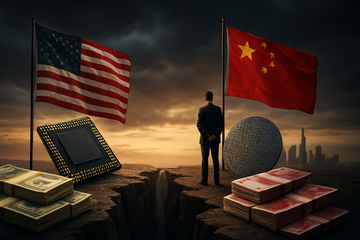
Reuters reported today that with two days to go before the Sep 24 Trump–Xi meeting in Washington, capital on both sides of the Pacific is positioning for outcomes rather than waiting for them. The article frames investors as deliberately playing both tracks: US banks have been bookrunners on 19 Chinese high-tech equity deals worth $17.2B so far this year — nearly a third of the sector's total issuance — while Chinese outbound mutual funds now run roughly $150B of assets, with US stocks making up nearly half of the book. US equity held by Hong Kong residents and mainland Chinese crossed $750B, up 23% in a year.
That positioning matters because the Bessent–He Lifeng talks that wrapped in New York on Sep 20 did not deliver what NVIDIA bulls were hoping for. Eight hours of negotiation produced a \"very successful\" label and a brand-new US-China AI dialogue with a notification system for serious AI incidents, plus a Board of Trade to work on tariffs — but US Trade Representative Jamieson Greer explicitly said chip and equipment export controls were not part of the mechanism. For the H200 pipeline, that is no movement at all.
The chip math
NVIDIA's $108B Quarter Already Bakes In Zero China
NVIDIA Q3 FY27 revenue guide
$108.0B
±2%, reported Aug 26, 2026; assumes zero Data Center compute revenue from China
NVIDIA Q2 FY27 revenue (reported)
$96.2B
+106% YoY, +18% QoQ; Data Center $89.0B
H200 licenses issued by US
~10 firms
Approved buyers include Alibaba, Tencent, ByteDance, JD.com; distributors Lenovo and Foxconn; cap of 75,000 units per firm
H200 deliveries to date
Zero
Per May 2026 Reuters reporting; Beijing has not approved a single H200 purchase
Trump revenue share on China H200 sales
25%
Surcharge structure announced Dec 8, 2025
KeyBanc H200 demand estimate
~1.5M units
Roughly $30B of revenue if all Chinese demand is fulfilled
NVIDIA's Aug 26 quarterly release is the anchor for the bull-bear split. Q3 revenue guidance of $108.0B ±2% explicitly assumes no Data Center compute revenue from China. That is the floor; any chip deal that actually ships chips is incremental upside that the guide does not capture. The reported Q2 of $96.2B (+106% YoY, Data Center $89.0B) shows what demand looks like without China — the company is still growing faster than any other in the S&P 500 — and the $5.5T market cap reflects the premium investors pay for that trajectory.
Why the deal is stuck
China Holds the Real Leverage: Rare Earths
The reason chip controls were kept off the table in New York is the leverage on the other side. Per AlixPartners data cited by Reuters, China controls up to 70% of global rare-earth mining, 85% of refining capacity, and roughly 90% of rare-earth alloy and magnet production — and those magnets go directly into the precision robotics, defense electronics, EV drivetrains, and chip manufacturing equipment that the US is trying to onshore. When Beijing restricted seven rare earths and the permanent magnets made from them last year, the licensing bottleneck that followed was the catalyst for the original Busan truce in October 2025.
That constraint is what makes the 25% US revenue cut on H200 sales politically durable. It monetizes chip exports for the Treasury without crossing Beijing's red lines, but China has responded by simply not issuing its own approvals. May 2026 Reuters reporting showed that despite ~10 H200 licenses being cleared by Washington, not a single H200 had been delivered — and a Barron's piece published this week noted Chinese authorities have allowed ByteDance and Tencent to receive only around 10,000 H200s each, well under the 75,000-unit cap.
Supply chain
The Map Behind the AI Trade
The summit's impact cascades in both directions through a tightly mapped supply chain. On the upstream side, Taiwan Semiconductor (market cap ~$2.3T) sits as the foundry choke point — its August 2026 monthly revenue of NT$514.8B was up 53.3% YoY, with Jan-Aug 2026 revenue +39.3% YoY. ASML (market cap ~$659B) remains the only producer of EUV lithography machines China cannot domestically replace, with TTM revenue of $35.3B and a 52.5% gross margin. In memory, SK Hynix and Samsung Electronics are the HBM stack that feeds NVIDIA's accelerators.
| Company | Ticker | Mkt cap | Trailing P/E | Gross margin (TTM) |
|---|---|---|---|---|
| NVIDIA | NVDA | $5.49T | 28.8x | 74.7% |
| Microsoft | MSFT | $3.68T | 27.9x | 67.9% |
| Alphabet | GOOGL | $4.30T | 17.8x | 60.9% |
| TSMC | TSM | $2.31T | 33.1x | 64.2% |
| ASML | ASML | $660B | 57.8x | 52.7% |
| Tencent | TCEHY | $503B | 14.7x | 56.2% |
| Alibaba | BABA | $277B | 25.6x | 38.1% |
| Samsung Electronics | 005930.KS | ₩1.82T | 12.2x | 56.9% |
| SK Hynix | 000660.KS | ₩1.31T | 8.1x | 76.2% |
| Baidu | BIDU | $31.4B | n/m | 40.8% |
On the downstream side sit the Chinese hyperscalers that are licensed to buy but cannot receive: Alibaba, Tencent, ByteDance (private), and JD.com. Both Alibaba (P/E 25.6x on $1.04T TTM revenue) and Tencent (P/E 14.7x) trade at a fraction of Microsoft's 27.9x and Alphabet's 17.8x — a structural discount that has historically been pinned to geopolitical risk and that could compress sharply if the chip valve reopens. Baidu, the smallest and most exposed to the China-cloud-only story, trades at negative earnings and a market cap of $31.4B; it has the most binary upside if compute access improves.
What both sides are doing
Investors Are Hedging Both Sides — Not Picking One
- US banks underwrote 19 Chinese high-tech equity deals worth $17.2B in 2026 — nearly 30% of sector issuance — including a $6.8B Hong Kong listing for Zhongji Innolight (Goldman, Morgan Stanley, Citi) and a ~$2.6B placement for PCB maker Victory Giant Technology led by J.P. Morgan. The carve-out for publicly traded securities lets Wall Street finance China's AI build-out even with chip restrictions in place.
- China-linked participation in US AI funding rounds climbed from roughly $436M in 2023 to ~$8.9B through mid-Sep 2026, per S&P Global — a ~20x jump that mirrors the dual-track positioning theme.
- Chinese outbound mutual funds run ~$150B of assets with US tech at nearly half the book; Hong Kong and mainland holdings of US equities hit $750B, +23% YoY, per US Treasury data.
- NVIDIA, Microsoft, and Alphabet all sit near52-week highs and trade at premium multiples; Tencent and Alibaba trade at a discount that compresses with each de-escalation headline. The asymmetry of the spread is the trade.
The pattern says the market is not waiting for Sep 24 to reveal winners. The Sep 20 New York talks delivered enough on AI safety (a formalized dialogue, a notification system, a Shenzhen follow-up in two months) to allow risk-on positioning across both Microsoft and Alibaba. The Sep 24 main event is now about whether Trump and Xi use the leverage they each have — chip revenue on one side, rare-earths and approval gates on the other — to push the needle further than the staff-level groundwork.
Forward look
Three Catalysts That Move the Tape First
Capital flows crossing the AI divide, year-to-date 2026
Dollar amounts in billions; tracks how both sides are positioning into the Sep 24 summit
Unit: USD billions
US banks underwriting Chinese AI listings
17.2
China-linked US AI funding rounds (YTD)
8.9
Zhongji Innolight HK listing
6.8
Victory Giant HK placement
2.6
Chinese outbound MFs (US tech exposure)
75
HK + mainland US equity holdings (USD B)
750
Three dates shape the trade. Sep 24 is the summit itself — any H200 delivery commitment, any change to the 25% revenue cut, or any rare-earths deal moves NVIDIA and the chip-supply chain first. The two-month Shenzhen AI dialogue follow-up, announced today, is the next milestone for content-control or model-evaluation rules; that hits Microsoft and Alphabet (whose TPU/Cloud positions depend on where the frontier-model guardrails land). And NVIDIA's late-November Q3 FY27 print is the moment the street sees whether $108B was the floor or the ceiling.
Investable names across the AI divide
- Gains ~$30B of incremental revenue capacity if even a fraction of KeyBanc's 1.5M-unit H200 demand flows — current $108B Q3 FY27 guide explicitly assumes zero China Data Center
- Captures the 25% US revenue share without changing volumes, making every shipped H200 net accretive to gross margin at 74.7% TTM
- Re-risks on Sep 24 silence: if the summit produces no chip movement, the multiple compresses back to a no-China world and the Sep 20 Shenzhen dialogue loses its significance for the stock
- Compresses the geopolitical discount:25.6x P/E on $1.04T TTM revenue vs Microsoft at 27.9x — every de-escalation headline narrows the gap
- Directly licensed to buy up to 75,000 H200 units; ByteDance/Tencent reportedly received only ~10K each, leaving the full cap as option value
- Captures Chinese AI demand in software regardless of chip outcome — Qwen model monetization does not depend on NVIDIA silicon
- Cheapest of the licensed Chinese buyers: 14.7x P/E with 56.2% gross margin and the strongest gaming/WeChat cash flows to fund its H200 buys
- Gains a dual track: AI safety dialogue framework creates a path for US hyperscaler partnerships in parallel with chip purchases
- Stock rallies5–10% on each positive summit headline, but downside is real if Beijing tightens the approval gate further
- Foundry choke point in both directions — August 2026 revenue NT$514.8B (+53.3% YoY) shows demand is decoupling from the China/US split
- Watch Arizona investment capex: TSMC has disclosed $265B in total planned Arizona investment, the structural bet that US-side capacity matters more than China access
- Neutral on this summit: chip controls affect customers, not TSMC's foundry pricing power; the stock moves with AI capex, not diplomacy
- EUV monopoly remains the structural moat — China cannot domestically replace ASML's lithography, capping any rare-earth retaliation against chip equipment
- Trailing P/E 57.8x is already priced for perfection; the Sep 24 summit is more likely to remove a downside scenario than add upside
- Q3 results due late October will be the next real catalyst, not the diplomatic calendar
- Captures the AI safety dialogue upside: a US-China notification system legitimizes Azure's enterprise positioning in regulated markets
- Limited chip-deal exposure: Microsoft buys from NVIDIA, so H200 reopening is indirect and dilutes through Nvidia's gross margin
- Faces content-control tail risk: any framework that constrains frontier-model exports hits OpenAI/AI services revenue lines disproportionately
- HBM stack is the only memory seller for NVIDIA's current accelerators —8.1x trailing P/E and 76.2% gross margin is the supply-chain floor
- Rides both tracks of the AI trade: a H200 reopening pulls HBM demand forward; an AI safety dialogue extending to compute frameworks reinforces the HBM build-out cycle
- Watch the Sep 24 Taiwan rare-earths thread: chip-equipment rare-earth bottlenecks hit foundry yields before they hit memory, but the chain reads through
- Most binary China-AI pure play: $31.4B market cap with negative trailing earnings — re-rates2x on any genuine chip-deal breakthrough
- Cloud and ERNIE model revenue depend on domestic compute, which the H200 license list excludes Baidu from — sums to zero upside from a chip reopening
- Wait for the next earnings print to gauge whether the AI safety dialogue translates into commercial AI procurement