
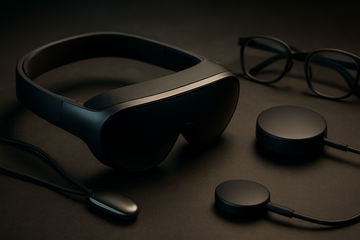
Meta Set the Ceiling — And the Floor at the Same Event
Meta Platforms used Connect 2026 to draw both ends of the AI agent hardware price range in a single keynote. The high end: $1,299 for the Meta VR Glasses — a 100-gram, tethered-puck headset built around micro-OLED displays, eye and hand tracking, and Qualcomm's new Snapdragon Reality Elite chipset, due in spring 2027. The low end: a $249 starting price on the new Ray-Ban Meta Gen 3 audio glasses, plus the December-bound Muse Charm pendant, which packs the full Muse personal-AI-agent stack into a palm-sized keychain.
Meta VR Glasses
$1,299
Spring 2027, 128GB, $1,059 starting at lower storage tiers per leak
Muse Charm pendant
December 2026
Price not disclosed at Connect; palm-sized, keychain form
OpenAI smart speaker
$300–$400
2027 launch, designed with LoveFrom, donut-shaped, moving parts
Sandbar Stream ring
$249
Preorder open; ships summer 2026; push-to-talk voice AI
Ray-Ban Meta Gen 3 (audio)
From $249
Announced Sept. 23, 2026; ships Oct. 13, 2026
Four Form Factors, One Interface Question
Every device above competes for the same role: an always-on, low-friction surface that sits closer to your face, hand, or wrist than the phone in your pocket. The form-factor choices are stark — and so are the unit economics each one implies.
| Device | Form factor | Price | Ship window | Chip / silicon | Companion AI |
|---|---|---|---|---|---|
| Meta VR Glasses | Tethered glasses (100 g) | $1,299 | Spring 2027 | Qualcomm Snapdragon Reality Elite + 12 GB RAM in puck | Meta Muse |
| Muse Charm (Meta) | Keychain / palm-sized | Not disclosed | December 2026 | Undisclosed | Meta Muse |
| OpenAI smart speaker | Donut-shaped, screenless | $300–$400 | 2027 | Undisclosed; designed with LoveFrom | ChatGPT |
| Sandbar Stream ring | Smart ring, push-to-talk | $249 | Summer 2026 | Undisclosed SoC | Sandbar Stream AI |
| Apple Watch (incumbent) | Wrist wearable | $399+ | On sale | Apple S-series SiP | Siri / Apple Intelligence |
The table makes the asymmetry visible. Meta Platforms is the only entrant paying for two displays, a tethered compute puck, and the production cost of micro-OLED panels at a $1,299 retail. The puck lets the glasses stay at 100 grams — roughly the weight of a pair of Ray-Ban Wayfarers — but adds a second bill-of-materials that the rival puck (OpenAI) and ring (Sandbar) do not need to absorb. Apple, the only incumbent, sells into an installed base of roughly 100 million active Watches with no new hardware capex.
What the $1,299 Actually Buys You
Per Mashable's hands-on and the CNBC report from the Sept. 23 keynote, the Meta VR Glasses run a Snapdragon Reality Elite chipset housed in a tethered puck containing the battery and storage; the glasses themselves weigh 100 g and carry micro-OLED displays with eye and hand tracking. The puck delivers up to roughly three hours of video playback per charge, runs the same operating system as Quest 3, and uses the Meta Neural Band gesture path when available. Work features include DisplayPort over USB-C, virtual keyboard projection onto flat surfaces, Dolby Atmos and Dolby Vision, IMAX Enhanced cinema mode, and full-body hologram calling.
The display sourcing is the most consequential supply-chain question. Per industry reporting in May 2026, Meta Platforms signed Chinese suppliers Seeya Technology and BOE's BMOT microdisplay division for the 2,560×2,560 micro-OLED panels on its next flagship headset — a deliberate move away from Sony Group, which still dominates OLED microdisplays in rival headsets including Apple Vision Pro. That sourcing decision sets the per-panel cost ceiling for the $1,299 retail and explains how Meta can price a tethered glass below the $3,500 Vision Pro.
Reality Labs Is Funding the Race at a $4.6B Quarterly Burn
Meta Platforms' Q2 FY2026 results — reported July 29, 2026 — frame how much the company is paying to compete. Reality Labs generated $431 million of revenue but posted a $4.619 billion operating loss in the quarter, with the broader Family of Apps generating $60.37B of revenue and $23.39B of operating income to absorb it. Cumulative Reality Labs losses since the2020 rebrand now exceed $88 billion, per multiple Q2 2026 reports.
Reality Labs: revenue vs. operating loss by quarter
Meta's Reality Labs segment: revenue scales in low hundreds of millions while operating losses run at multi-billion quarterly cadence
Unit: USD billions
Q1 2025
Op loss ~$4.2B
0.4
Q2 2025
Op loss $4.53B
0.4
Q3 2025
Op loss $4.4B
0.5
Q4 2025
Op loss $6.02B
1
Q1 2026
Op loss ~$4.5B est.
0.4
Q2 2026
Op loss $4.62B
0.4
The headline revenue figure understates consumer traction. EssilorLuxottica — Meta's Ray-Ban manufacturing and distribution partner — disclosed in February 2026 that Meta AI-glasses unit sales tripled to over 7 million pairs in 2025, more than every other smart-glasses maker combined. That puts Meta Platforms ahead of Apple on smart-glasses shipments by a wide margin, but the unit volume does not yet offset the segment's burn. The new $1,299 price point multiplies revenue per unit roughly 3–4x versus Ray-Ban Meta, but at a far smaller target market — the question for investors is how many buyers will pay glass-form pricing for a still-emerging use case.
Reality Labs vs. Apple Wearables — scale gap in one chart
Meta Reality Labs revenue (TTM)
~$2.3B
Q2 2026 trailing twelve months
Apple Wearables/Home/Accessories (TTM)
~$37B
FY2025 segment revenue per10-K
Meta Reality Labs operating loss (2025)
$19.19B
Full-year 2025 operating loss
Apple Wearables/Home/Accessories (Q3 FY26)
$7.9B
+6% YoY, June 27, 2026 quarter
Ray-Ban Meta cumulative (2025)
7M+ units
Per EssilorLuxottica FY2025 disclosure
Apple Watch installed base (analyst est.)
~100M+
Active devices, no formal disclosure
The Supply-Chain Winners Behind the Bidding War
Three suppliers sit across every credible AI-agent hardware form factor on the table — and one Chinese assembler has quietly become structurally hard to dislodge.
- Qualcomm ships the Snapdragon Reality Elite chipset that powers both the Meta VR Glasses puck and rival Xreal Aura's puck shipping this fall — the same part family already inside Quest 3 and the Ray-Ban Display Neural Band. Qualcomm's Q3 FY2026 (June 28, 2026) revenue of $9.95B and trailing-twelve-month revenue of $44.07B capture only a fraction of the XR opportunity, but Snapdragon AR1 Gen 1 is already inside Ray-Ban Meta and the Snapdragon XR2 Gen 2 inside Quest 3 — making Qualcomm the sole incumbent silicon supplier across Meta's full AI-glasses and VR lineup.
- Goertek — listed on Shenzhen as GoerTek Inc — is the primary assembler of Meta Quest and Ray-Ban Meta smart glasses and supplies the audio module for Quest 3 plus the optical engine for Ray-Ban Meta. Wellsenn XR teardowns put Goertek's share of total Quest 3 component value at roughly 6–7%, but its mastery of pancake-lens and surface-relief-grating waveguide production (alongside Sunny Optical) leaves Meta structurally dependent on it for any glasses-based headset at scale.
- Luxshare Precision — Shenzhen-listed Luxshare Precision Industry — played a role in the Quest 3 supply chain and is slated to assemble modules for Meta's next-generation AR glasses from Q4 2025 onward, giving it a second-sourced role that expands as Meta diversifies away from single-source Goertek risk.
- Sony Group remains the dominant OLED microdisplay maker for premium headsets — including Apple Vision Pro — but Meta deliberately moved next-generation sourcing to Seeya Technology and BOE's BMOT for the Meta VR Glasses launch. Sony keeps upside from any premium-tier Apple Vision Pro successor and the broader XR category, but the new Meta halo product will not be a Sony-display story.
- EssilorLuxottica — listed as EssilorLuxottica on US OTC markets — is the only supplier on the list with direct consumer distribution for the AI-glasses category: its Ray-Ban and Oakley brands carried Meta AI glasses to over 7 million units in 2025, and its stock hit an all-time high in October 2025 on the Meta AI revenue surge.
Apple's Wrist vs. Meta's Face — Different Bets on the Same Race
Apple is the only entrant that does not need to win new hardware — it needs to keep the wrist. The company's Wearables, Home and Accessories segment generated $7.9B in the quarter ended June 27, 2026 (+6% YoY) and $35.69B for fiscal2025, per Apple's 10-K filed October 31, 2025. That segment houses AirPods, Apple Watch, HomePod, and Apple TV — meaning Apple Watch alone is plausibly a high-single-digit-billion-dollar annual business with margins that the rest of the wearable-AI category cannot match.
The strategic mismatch: Apple is bidding for the next interface layer at the wrist, where it owns distribution, silicon (S-series SiP), and an installed base approaching 100 million active devices. Meta Platforms is bidding at $1,299 for the face — a market with no incumbent, but no installed base either. Both face the same question: can an AI agent generate more revenue per user than the marginal cost of running it?
Short-Term Catalysts vs. Long-Term Race
Days to quarters — the immediate movers: Meta reports Q3 FY2026 results on October 28, 2026, the first quarter to include any pre-orders for Ray-Ban Meta Gen 3 ($249) and the Audio variant ($349) that begin shipping October 13. The Muse Charm release lands in December, giving Reality Labs a second hardware revenue line in the holiday quarter. Apple's Q4 FY2026 print (October 30, 2026 baseline) will show whether the $399+ Watch tier can absorb the September iPhone 17 launch halo — Apple's biggest cross-sell window for Watch upgrades.
One to three years — the structural view: spring 2027 is when the Meta VR Glasses ship, which is also when OpenAI's puck is targeted. If Meta can move even 2–3 million VR Glasses units in2027, the segment's revenue mix shifts away from dependence on Ray-Ban Meta; if it cannot, Reality Labs' losses stay capped above $15B a year while Apple Watch continues compounding in a $35B+ segment. The structural risk for Meta is not product execution — it is that the $249 Sandbar / $300 OpenAI tier captures the always-on agent slot first, leaving $1,299 glasses as a niche media-consumption device rather than a primary interface. The structural risk for Apple is that the agent moves to a face- or finger-worn form factor while Siri/Apple Intelligence still anchors at the wrist.
Stocks positioned for the AI-agent hardware bid
- $1,299 VR Glasses price point lifts Reality Labs revenue per unit 3–4x over Ray-Ban Meta if it ships to even 2–3M units in 2027, narrowing — though not closing — the $4.62B-a-quarter burn disclosed in Q2 FY2026.
- December-bound Muse Charm and the $249 Ray-Ban Meta Gen 3 create two incremental hardware revenue lines before spring 2027, materially de-risking the holiday2026 quarter for Reality Labs.
- Diversifying display sourcing to Seeya Technology and BOE BMOT away from Sony Group protects per-panel cost at scale but caps Sony Group's near-term upside on Meta's halo product.
- Apple Watch anchors a $7.9B Q3 FY2026 Wearables/Home/Accessories segment (+6% YoY) and $35.69B FY2025 base — but the $399+ wrist tier faces the same always-on-agent question that $249 Sandbar / $300 OpenAI devices are attacking from below.
- Short-term: September iPhone 17 launch creates the strongest Watch upgrade window in two years — Q4 FY2026 print is the next catalyst.
- Long-term risk: if the AI agent migrates to glasses or ring form factors before Apple ships a face-worn device, the Watch could revert to a fitness band rather than an agent surface.
- Snapdragon Reality Elite powers both the Meta VR Glasses puck and Xreal Aura's competing puck shipping in fall2026 — making Qualcomm the de facto XR silicon layer across competing AI-agent form factors.
- Existing Snapdragon AR1 Gen 1 inside Ray-Ban Meta and Snapdragon XR2 Gen 2 inside Quest 3 mean Q3 FY2026 revenue of $9.95B already captures baseline Meta spend, with new puck programs upside.
- TTM revenue of $44.07B and TTM net income of $9.26B give plenty of cushion if Meta VR Glasses volume disappoints; the option value of being the sole incumbent is the upside case.
- Primary assembler of Meta Quest and Ray-Ban Meta smart glasses, supplying audio modules, pancake lenses, and the optical engine for Ray-Ban Meta — every Meta AI-glasses shipment routes through Goertek.
- Q2 2026 revenue of CNY 21.4B (~US$3.0B) and operating margin of ~4.8% show the model scales but margins are thin; Meta VR Glasses volume in 2027 would lift module revenue without proportional margin expansion.
- Waveguide and pancake-lens capacity is concentrated at Goertek and Sunny Optical, giving Goertek a structurally hard-to-displace position in any face-worn AI hardware — Meta's own diversification efforts notwithstanding.
- Slated to assemble modules for Meta's next-generation AR glasses from Q4 2025 onward, layering a second-sourced assembler role on top of existing Quest 3 participation.
- Diversifies Meta's China-assembly risk away from single-source Goertek dependency — a structural moat for Luxshare as Meta's AR glasses program scales beyond Quest.
- Not yet disclosed in Meta's primary documents as a VR Glasses (Phoenix) supplier, so the upside is contingent on Meta actually using the modules in2027 shipments.
- Meta deliberately shifted next-gen OLED microdisplay sourcing to Seeya Technology and BOE BMOT per May 2026 reports — capping Sony's upside on Meta's $1,299 VR Glasses halo product.
- Sony keeps dominant share in Apple Vision Pro-class OLED microdisplays, so any premium-tier Apple Vision Pro successor (or non-Meta flagship XR) re-anchors Sony as the display supplier.
- Watch catalyst: any Apple face-worn device announcement or Sony's own OLED microdisplay yield improvements would re-rate the segment — TTM revenue of $12.7T JPY shows scale, but a small negative net margin flags near-term cost pressure.
- Owns the only consumer distribution channel proven to move Meta AI glasses at scale — 7M+ units in 2025, more than every other smart-glasses maker combined per the company's own FY2025 disclosure.
- Stock hit an all-time high in October 2025 on Meta AI glasses momentum and would likely re-rate if the $1,299 VR Glasses launch drives a premium tier through the same Luxottica/ray-ban retail channel.
- Risk: a non-Ray-Ban smart-glasses brand (or Meta's own first-party retail) could erode Luxottica's channel rent over time.