
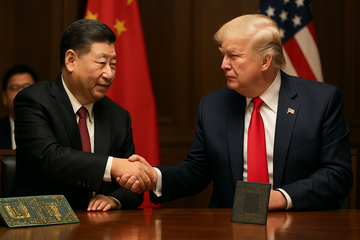
Verified event: who was seated at the state dinner and why it moves export-control expectations
CEOs who build the AI stack were treated as direct interlocutors at Xi’s state dinner—so the policy timeline gets shorter
Multiple outlets reported that the Trump–Xi state dinner guest list included top AI and technology CEOs—most notably NVIDIA, Microsoft, Apple, Google, and OpenAI. The practical implication for semiconductors is that the people who can change procurement terms, product roadmaps, and customer qualification processes are being pulled closer to the political center of gravity.
This is a leverage-map shift. Export controls affect (1) which SKUs get licensed or shipped, (2) what share of output is allocated to constrained geographies, and (3) how long firms wait for predictable decision paths. When chip and AI platform CEOs are explicitly included in the state-visit optics, markets tend to reprice the probability distribution of near-term policy moves—especially around the window where licensing guidance and eligibility interpretations get finalized.
Policy mechanics: what BIS already changed about China-bound AI chips
BIS policy is already written around case-by-case licensing for specific AI accelerators—so implementation details are the real catalyst
U.S. policy has a concrete “execution layer.” In a BIS press release, the U.S. Department of Commerce (BIS) stated it revised the license-review policy for semiconductor exports to China so that it would review license applications for NVIDIA H200 and AMD MI325X (and similar chips) on a case-by-case basis if security requirements are met.
BIS also described qualification requirements in the same announcement framework, including demonstrating the export would not reduce global semiconductor production capacity available to U.S. customers, and that the Chinese purchaser would adopt export-compliance procedures. Those are operational constraints that companies can plan around—meaning the market often responds not to the headline “export controls,” but to changes in licensing throughput, eligibility interpretation, and customer readiness.
Supply chain: where the policy lever actually transmits
The export-control lever transmits through lead times, not just chip sales
- Licenses change which accelerator SKUs get shipped into constrained China-bound configurations, which then determines platform-level workload capacity for enterprise/cloud customers.
- Qualification rules force customer onboarding and compliance screening, extending “time-to-ship” beyond formal licensing decisions.
- Geopolitical uncertainty affects wafer start scheduling and packaging/testing utilization; even when chip shipments resume, capacity rebalancing can take quarters.
The supply chain is therefore a multi-step translation device: BIS licensing decisions influence OEM/system integrator ordering, cloud workload commitments, and ultimately the downstream demand signal that feeds back into upstream equipment capacity. That creates a distinct market timing dynamic: the policy update can land politically first, but the financial line-item proof tends to surface via order timing, backlog visibility, and (later) revenue recognition.
Fundamentals anchor: what NVIDIA’s China exposure looks like in filings
China revenue exposure is large enough that even “partial throughput” scenarios can move expectations
Revenue from China (incl. Hong Kong), FY2026
$19,677M
NVIDIA fiscal year ended Jan 25, 2026 (geographic revenue exposure)
Revenue from China (incl. Hong Kong), FY2025
$25,048M
NVIDIA fiscal year ended Jan 26, 2025
Revenue from China (incl. Hong Kong), FY2024
$12,330M
NVIDIA fiscal year ended Jan 28, 2024
NVIDIA also disclosed that it changed how it presents geographic revenue exposure—moving to revenue based on the location of customers’ headquarters and recasting prior period information. That nuance matters for comparing year-over-year numbers cleanly, but it does not change the underlying investor takeaway: the China/Hong Kong revenue line is material, and export-control implementation is therefore not “small.”
Non-obvious causal chain: why symbolism can change near-term control outcomes
The symbolism is linked to implementation speed: CEOs can de-risk compliance execution faster than bureaucratic iteration
A state dinner is not a licensing memo—but it can accelerate what happens next. When chip and AI platform CEOs sit at the top table, they can commit resources to compliance processes, customer onboarding, and product qualification timelines that BIS-style requirements depend on. That reduces the probability that licensing is “technically allowed” but operationally stalled.
In other words, political access can compress the feedback loop between (a) policy eligibility and (b) enterprise execution. That is exactly what markets reprice when they move from “slow-burn reform” to “near-term catalyst.”
What to watch next (short- and long-term)
The next quarter’s guidance is where the policy story either becomes a trade or stays a headline
- Near term: watch for management language shifting from “uncertainty” to “predictability” in China-related demand and shipment schedules.
- Near term: look for evidence of faster customer qualification cycles (often reflected in backlog conversions rather than just new unit announcements).
- Long term (1–3 years): track whether case-by-case policy becomes a stable quota framework or reverts to tighter restrictions as new AI capabilities emerge.
The bear case remains real: export controls can still tighten, and case-by-case review can still slow. But the dinner’s key investor value is that it raises the odds that implementation moves in time to show up in quarterly numbers—rather than drifting into the background of geopolitical risk.
Investable read-throughs across the AI + semiconductor chain
- NVIDIA has material China/Hong Kong revenue exposure ($19,677M in FY2026) that can swing with licensing throughput.
- A faster case-by-case licensing cadence would convert policy permission into shipment-timing confidence that shows up in quarterly guidance.
- If compliance timelines stretch, the same policy framework can delay revenue recognition even when licenses are granted.
- BIS explicitly referenced AMD’s MI325X within the case-by-case policy framework, so MI325X eligibility interpretations can change demand timing for customers.
- Upside exists if licensing throughput rises; downside exists if eligibility is constrained by capacity and compliance requirements.
- The near-term tell is management commentary on China-related order cadence and backlog conversion around upcoming earnings.
- Even if AI-chip shipments into China change, memory/logic capex cycles determine tool orders with a lag that can be re-steered by policy expectations.
- The near-term catalyst is not immediate chip sales; it is any revision to long-horizon capex plans by major wafer tool customers.
- Watch for signs of front-loaded wafer capacity demand that would benefit advanced lithography spending.
- If licensing loosens, cloud and accelerator utilization can rise; that would support wafer demand and operating load through the next cycle.
- If licensing tightens, customers may pull forward or pause capacity; that can shift mix and utilization expectations with a timing lag.
- The watch item is whether policy-driven AI demand shows up in data-center-related wafer commitments rather than only in spot orders.