
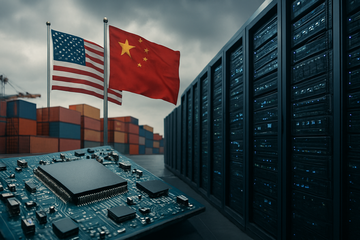
The Sep 26 announcement from Beijing — a $30B reciprocal tariff cut and a fresh US-China AI dialogue sealed during Xi Jinping's three-day state visit — looked, at first read, like compute sovereignty going bilateral. Read more carefully, the deal covers agricultural and energy goods, not the chips, optical transceivers, transformers and battery cells that the US AI buildout physically depends on. The opening is real, the dependency is older, and the capital is moving in both directions anyway.
What actually got agreed
Sep 26 Bought a Dialogue, Not a Component Pipeline
China and the US agreed to cut tariffs on $30B of reciprocal trade in 'noncritical' goods — agricultural and energy-related products — and to launch a bilateral AI dialogue, with the first substantive session scheduled for November. Treasury Secretary Scott Bessent called it the 'most favored nation' framework first floated at the May Beijing summit; the broader trade truce was extended by two months, from Nov 10 to Jan 10, to keep negotiations alive.
- AI dialogue: a November session on AI risks and benefits, plus an incident-response channel for national-security-level events.
- Trade truce: extended two months past Nov 10 to Jan 10, 2027, with $30B of reciprocal tariff reductions in 'noncritical' goods.
- Chip controls unchanged: Nvidia export restrictions, including the H200 carve-out, were not on the agenda; no broad deal emerged.
- Eight-point consensus: formal framework covering trade, AI dialogue, fentanyl cooperation, agriculture and energy — but not data-center hardware.
CNBC's summit takeaway was blunt: the visit produced 'bonhomie and pageantry' but 'few concrete agreements' on the technology that matters most to investors. Reuters noted the agreement was procedural — a 'mechanism' rather than a 'deliverable' — and the AI dialogue's value depends on whether the November talks produce anything enforceable. For markets, the asymmetric fact is this: the diplomatic opening is new, the technology decoupling is intact.
The dependency that didn't move
The US Buildout Is Still Wired Through Chinese Factories
US hyperscaler AI capex is now projected at roughly $700B-$745B for 2026 — Microsoft, Amazon, Alphabet and Meta combined — up about 60% YoY. JPMorgan CEO Jamie Dimon has said the industry could clear $1T next year. Yet even with that spend, the buildout is bottlenecked at the physical layer, and a meaningful share of that physical layer sits in Chinese factories.
Combined hyperscaler AI capex (2026)
$720–745B
Microsoft, Amazon, Alphabet, Meta combined 2026 guidance per TMT Finance analysis, August 2026
Q1 2026 hyperscaler capex (4 firms)
~$130B
Combined Q1 2026 capex reported through Q2 earnings, vs. ~$77B in Q1 2025
US data center power demand (2028E)
~74 GW
Morgan Stanley forecast; ~38 GW projected shortfall between demand and available capacity
US AI data centers in pipeline
~50% delayed/cut
Reuters/Yahoo Finance tally, April 2026; constrained by grid and Chinese component supply
Chinese optical transceiver share (global)
~2/3 of units
Including Zhongji Innolight and Eoptolink; per CNBC, Sep 3, 2026
Chinese share of US transformer/switchgear imports
~30% in select categories
Per CNBC, Sep 3, 2026, citing trade data
Chinese share of US battery imports
>40%
Including cells used in UPS and DC backup systems, per CNBC, Sep 3, 2026
On Aug 4, the Trump administration began drafting a ban on imports of new models of Chinese data center components — exactly the optical, transformer and battery categories above. The Sep 26 deal did not touch that workstream. CSIS estimates that semiconductors are 54 cents of every dollar of data center buildout, and the US currently fabricates only ~12% of the chips it uses; the upstream components needed to host those chips are even more import-dependent than the chips themselves.
The CSIS scenario analysis makes the cost stakes concrete: a broad semiconductor tariff with no carve-out could lift the US data center buildout cost from $1.44T to $4.14T by 2030 — a 53% increase. That is the implicit price tag of any move to fully decouple from Chinese supply. The Sep 26 deal does not pay that price. It doesn't change it either.
Where the Chinese capital is going
China Is Spending Anyway — Just Not Through the US
Chinese capital is responding to the US buildout on three tracks: providers raising capital for global (not US) buildout, Chinese-listed component makers opening offshore listings to fund US-aligned customers, and prefab builders pitching directly to US hyperscalers.
| Player | Move | Magnitude | US linkage |
|---|---|---|---|
| Alibaba | Q1 FY27 earnings: cloud rev +45% YoY; capex +75% YoY; Zhenwu V900 chip | Capex ~RMB 67.7B (~$10B) in one quarter | Funds 60% to global compute, 40% to hyperscale AI data centers |
| Tencent | Q2 2026 capex +176% YoY | RMB 52.8B (~$7.8B) in one quarter | Indonesia ($500M) and Saudi Arabia ($150M) regional DCs, not US |
| ByteDance (private) | 2026 Nvidia chip purchase plan | ~$14.29B (RMB 100B) for 2026 | Funds global training/inference; not US construction |
| Baidu | AI Cloud +50% YoY; GPU Cloud +283% in Q2 | $1.1B AI Cloud in Q2 | Domestic buildout, not US |
| Kingsoft Cloud | AI cloud gross billings +82% YoY | 56% of public cloud revenue from AI | Domestic buildout |
| Zhongji Innolight | Hong Kong listing July 30, 2026 | $6.81B raised (Asia's 2nd-largest 2026 listing) | Optical transceivers into US hyperscaler racks |
| Eoptolink | Optical transceiver capacity expansion | ~30% of global AI optical transceiver market | Sales to US hyperscalers — direct US-ban target |
| Brightray (private) / PrefabDC | US push for prefabricated data centers | Cuts 2–3-year US build cycle by at least half | Pitching directly to US hyperscalers and colos |
The pattern is clear: most Chinese capital is going into the Chinese buildout (Alibaba, Tencent, ByteDance, Baidu, Kingsoft Cloud), while the Chinese suppliers most exposed to the US market — optical transceivers, prefab construction — are either raising offshore capital (Zhongji Innolight's Hong Kong listing) or courting US customers directly (Brightray, Eoptolink). Both expose them to the Aug 4 component-ban track.
Where US investors should look
The Bigger Trade Is on the US Side: Power, Cooling, and Real Estate
The Sep 26 deal is, for now, a thinner headline than the capex numbers underneath it. The supply chain is bottlenecked at power and cooling, and the listed beneficiaries are almost entirely US-domiciled. Q2 2026 earnings released through July and August give the cleanest read.
| Company | Q2 2026 revenue | YoY change | Order/backlog signal |
|---|---|---|---|
| Eaton | $8.53B | +21.4% | Data center orders +85% YoY; Electrical backlog +$5B |
| Vertiv | $3.27B | +~20% adj. EPS +60% | Backlog >$15B; data center backlog +80% YoY |
| Digital Realty | $1.92B | +30% | Record backlog $1.9B annualized |
| Equinix | $2.63B | +16% | Annualized gross bookings $424M; raised FY26 to $10.21–$10.29B |
| NVIDIA (TTM) | $302.97B | +~56% YoY | Compute/networking backlog driven by US hyperscalers |
Eaton is the cleanest proxy for the constraint Sep 26 didn't fix: data center orders at its Electrical segment are up 85% YoY, and the company's Electrical backlog grew by $5B in a single year. Vertiv's $15B backlog now provides 'revenue visibility well into 2027,' per CEO Giordano Albertazzi. Digital Realty's record $1.9B backlog is multi-year. Equinix raised its FY26 outlook twice in four months — to $10.21–$10.29B — as AI-related bookings accelerated.
On the power-utility side, the demand pull is structural: data centers are projected to need ~74 GW by 2028, with a ~38 GW shortfall in delivered capacity. That shortfall is the load growth that names like NextEra Energy and NRG Energy are racing to serve. The Sep 26 deal does not change the load; it changes only whether the equipment to serve it can come from China.
US data-center buildout dependency on Chinese supply (selected categories)
Share of US imports or global supply originating from China, per CNBC, Sep 3, 2026
Unit: %
Optical transceivers (global unit share)
Zhongji Innolight, Eoptolink lead
66
US battery imports
Cells for UPS and DC backup
42
US transformer/switchgear imports
Select categories
30
Share of US 2026 AI DC pipeline delayed/cut
Reuters tally, April 2026
50
Catalysts and risks
Two Tracks, Two Timelines: What to Watch
Short-term (days to quarters): the November AI dialogue is the next hard date. Any deliverable there — a verification mechanism for distillation complaints, a tariff exclusion for legacy optical or transformer SKUs, or simply a confirmed second session — moves both sides of the trade. The Aug 4 component-ban draft remains in motion; if finalized in current form, optical transceivers and select electrical gear would face immediate disruption, lifting US-made or Mexican-made capacity to multi-year backorder status.
Long-term (1–3 years): the structural driver is unchanged. The US is still short ~38 GW of data-center power by 2028, and replacing Chinese components in optical and transformer categories on a multi-year timeline requires capacity that does not yet exist. The Trump administration's tariff posture, the Federal Communications Commission's optical-transceiver rule updates (Sept 11 narrowed but did not kill the proposed ban), and Chinese retaliation risk all layer on top of the same underlying capex wave.
Stocks to own against the bilateral track
- TTM revenue $303B and a 30x trailing P/E keep NVIDIA priced for sustained hyperscaler spend; US data center buildout underwrites the base case.
- Sep 26 dialogue didn't loosen China export controls; a near-term China-revenue upside remains capped, which is the 'mixed' drag on an otherwise bullish setup.
- Over 1–3 years, $1T-of-AI-capex scenarios (Dimon) make NVIDIA the convex upside — but component-supply friction caps the slope of acceleration.
- Backlog >$15B and a data-center backlog +80% YoY lock in revenue visibility well into 2027, the cleanest expression of the buildout constraint.
- Q2 2026 adjusted diluted EPS +60% YoY demonstrates that pricing power has caught up to demand.
- If Aug 4 component ban finalizes, Vertiv's US/North American power-and-cooling capacity becomes the substitute product for the same hyperscaler racks.
- Electrical Americas Q2 sales of $4.0B (+18% organic) and data-center orders +85% YoY show the constraint sitting at the upstream equipment layer.
- Electrical-sector backlog rose $5B in a year; management now treats its prior 2030 electrical revenue target as a floor, not a ceiling.
- Eaton is the most US-domiciled beneficiary of any move to onshore transformer and switchgear supply — Sep 26 didn't change the direction of that flow.
- Q2 revenue $1.92B (+30% YoY) and record $1.9B backlog provide multi-year visibility, supported by $410M of hyperscale lease signings in July.
- Backlog now equals over 30% of in-place data-center revenue, a structural cushion against any single-quarter churn.
- Sep 26 deal doesn't add or subtract US capacity; the secular capex tailwind does the work, and Digital Realty is levered to it.
- Q2 revenue $2.63B (+16% YoY) and FY26 guidance raised twice in four months to $10.21–$10.29B confirm accelerating AI-linked bookings.
- $424M of annualized gross bookings in one quarter and 52 data center projects underway across 33 markets point to backlog compounding into 2027.
- Equinix's interconnection revenue ($453M, +11% YoY) is the differentiator versus capacity-only peers and the reason to own it through any China-supply disruption.
- Q1 FY27 cloud revenue +45% YoY, capex RMB 67.7B (~+75% YoY), and 20+ GW global data-center capacity target by 2032 make Alibaba the largest single Chinese counter-party to the US buildout in capital terms.
- 60% of a recent $10B raise is earmarked for global compute infrastructure, with 40% for hyperscale AI data centers — but those dollars are largely going into non-US regions under current export-control rules.
- Q1 FY27 net income fell ~76% YoY as capex outran operating profit; investors must underwrite earnings compression now to capture the 1–3-year capacity option.
- $6.81B raised in its July 30, 2026 Hong Kong listing gives Zhongji Innolight the cash to keep building800G/1.6T optical transceivers while navigating US-side scrutiny.
- Roughly 2/3 of global data-center optical transceiver unit supply is Chinese — banning 'new models' could compress US-hyperscaler refresh cycles if the rule finalizes in current form.
- Mixed because the upside (US share retention via the Hong Kong listing, capacity scaling) is real and the downside (FCC ban risk, customer concentration) is also real.