
Flight
FZ1073 / A6-FKF
Boeing 737 MAX 8, Dubai (DXB) → Tel Aviv (TLV)
Squawk sequence
7700 → 7500 → 7700
Triggered 05:28–05:35 UTC over the Saudi–Jordanian border
Max altitude loss
~14,000 ft in 30s
From 34,000 ft cruise to under 17,000 ft before oscillating near 15,000 ft
Diversion airport
Tabuk, Saudi Arabia (TUU)
Last ADS-B message 06:58 UTC; all 174 pax safe
El Al TASE intraday move
+6.0% to ₪18.17
Vs. ₪17.14 prior close (Investing.com, Sept. 30, 2026)
War-risk premium
+50–500%
Middle East routes since Feb. 2026 Iran conflict
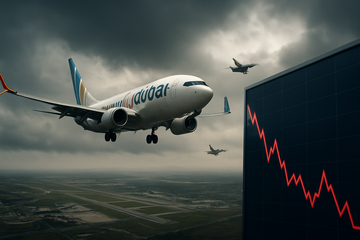
A scheduled Dubai–Tel Aviv flight ended at a Saudi military airfield on Wednesday after an apparent cockpit attack — the second mass scramble by the Israeli Air Force over a civilian airliner this year — and the market read it first on the TASE, where El Al Israel Airlines jumped roughly 6% intraday. The story traces a thread from a single Omani first officer on a Boeing 737 MAX 8 through to Israeli homeland-security spending, the Boeing supply chain, and the war-risk insurance market that now prices every Gulf–Israel overflight as a separate risk class.
Verified event
A 7700, then a 7500, then 14,000 feet of missing air
Flydubai FZ1073, a Boeing 737 MAX 8 registered A6-FKF, departed Dubai International at 03:05 UTC on Sept. 30, 2026 bound for Ben Gurion. According to Flightradar24 tracking data, the aircraft climbed to 34,000 feet and ran normally until 05:21 UTC, when it began a steep descent, oscillating between sharp climbs and dives before stabilizing around 15,000 feet. At 05:28 UTC, the transponder flashed 7700 (general emergency); at 05:35 UTC the pilots switched to 7500 — the code reserved for \"unlawful interference\" or hijacking — before reverting to 7700 as the aircraft turned southwest toward Tabuk in northwestern Saudi Arabia, where it landed safely at 06:58 UTC.
- Aircraft: Boeing 737 MAX 8, registration A6-FKF (manufacturer's serial 61013, first flight 2022)
- Passengers on board: 174, including 27 children, per JNS reporting on Israeli briefings
- Plunge: roughly 14,000 feet in under 30 seconds, from 34,000 ft to under 17,000 ft (Al Jazeera / Flightradar24)
- Diversion field: Tabuk domestic airport (TUU) — a Saudi military field, not a typical civil diversion
On the ground, the picture hardened within hours. Israeli security officials told local media that the Omani first officer had allegedly attacked the Indian captain with a knife mid-cockpit, repeatedly stabbing him before crew and passengers subdued him. The captain, wounded, was reported stable; a Fijian reserve pilot traveling in the jump seat took the controls and brought the aircraft into Tabuk, where Saudi security forces met the aircraft on the apron.
Israeli response
Two IAF fighters, two ministers, one corridor
The Israeli Defense Forces confirmed scrambling two fighter jets toward the airliner over the Mediterranean once the 7500 squawk registered, and Prime Minister Netanyahu's office convened an urgent situational assessment with IDF Chief of Staff Lt. Gen. Eyal Zamir, the IAF commander, and the heads of Mossad and Shin Bet. National Security Minister Itamar Ben Gvir publicly framed the incident as an attempted terrorist attack, claiming the suspect \"planned to crash a plane and murder the 180 Israelis aboard,\" while Transportation Minister Miri Regev demanded the immediate suspension of all Flydubai flights to Israel and asked the Civil Aviation Authority to investigate whether the UAE violated its bilateral aviation agreement.
Ben Gurion Airport remained open and Israeli airspace was not closed, but the political signal was clear: with Israeli passengers still on the tarmac at a Saudi military base and ministers publicly invoking the word \"terror,\" the Dubai–Tel Aviv route — operated today by Flydubai, El Al, Israir, and a handful of Gulf carriers under the 2020 normalization — enters a renewed political risk window.
Markets
El Al rallied ~6% intraday; defense primes stood down
| Ticker | Last price | Day move | Mkt cap | Source |
|---|---|---|---|---|
| El Al (TASE: ELAL) — via ELALF ADR | ₪18.17 / 1,817 ILA | +6.0% | ~$3.6B | Investing.com, Sept. 30, 2026 |
| Boeing (NYSE: BA) | $187.68 (Sep 29 close) | +1.78% | $148.3B | Company overview, Sep 29, 2026 |
| Lockheed Martin (NYSE: LMT) | $512.21 | -1.14% | $118.2B | Company overview, Sep 29, 2026 |
| Northrop Grumman (NYSE: NOC) | verified | — | — | — |
| RTX (NYSE: RTX) | $186.94 | -0.38% | $251.9B | Company overview, Sep 29, 2026 |
| GE Aerospace (NYSE: GE) | $317.89 | -0.11% | $329.8B | Company overview, Sep 29, 2026 |
| Elbit Systems (NASDAQ: ESLT) | $703.37 | -0.13% | $32.9B | Company overview, Sep 23–24, 2026 |
El Al's intraday spike is the cleanest read on the event. With the carrier trading on TASE at ₪17.14 the prior session, the +6% move to as high as ₪18.17 on Sept. 30 implies investors are pricing two distinct possibilities: a rerouting of stranded Flydubai passengers onto El Al metal if Transportation Minister Regev's suspension demand is enforced, and a higher risk premium for any carrier continuing to fly the corridor. El Al's Q2 2026 results — revenue up roughly 26% year-on-year to $980 million and net income up about 102% to $125 million — leave the balance sheet in a position to absorb redirected capacity if it materializes.
The US defense primes barely moved. Lockheed Martin traded down 1.1%, RTX down 0.4%, and GE Aerospace flat — all within normal ranges and likely reflecting late-September profit-taking rather than a Dubai–Tel Aviv read-through. That muted reaction matches the facts: this was not a kinetic attack on Israeli airspace, and the IAF's two-aircraft scramble is a peacetime posture, not a wartime footing. The defense names most likely to reprice are the Israeli-domiciled homeland-security specialists, not the US primes.
Supply chain
Boeing 737 MAX 8 sits at the center — but the engine and the cockpit door matter more
A6-FKF is one of 70 Boeing 737 MAX 8s in the Flydubai fleet, out of 98 total Boeing narrowbodies the carrier operates as it pushes toward 100 aircraft by year-end. Flydubai confirmed on Sept. 15 that it would take 11 more 737 MAX deliveries in 2026 alongside a 12-month retrofit of 21 MAX 8s with flat-bed business class, putting the carrier in line with Boeing's full-year MAX target of 470–495 aircraft.
| Metric | Q2 2026 | Q2 2025 | FY 2026 guide |
|---|---|---|---|
| Total commercial deliveries | 171 | — | up to ~600 |
| 737 MAX deliveries | 129 (75% of total) | — | 470–495 |
| 787 deliveries | 25 | — | 70–80 |
| Commercial Airplanes revenue | $11.75B (+8% YoY) | — | — |
| Commercial Airplanes operating loss | $322M | ($557M) | — |
| GAAP EPS | ($0.67) | — | — |
Behind every Boeing 737 MAX sits the CFM LEAP-1B engine — a 50/50 joint venture between GE Aerospace and Safran that effectively means GE and Safran split the engine value of every Flydubai delivery. The fuselage is supplied by Spirit AeroSystems (now part of Airbus); avionics and flight-deck systems run through Honeywell and Collins Aerospace, the latter a unit of RTX. Any headline risk around Flydubai as a customer is small — the airline is privately held by the Investment Corporation of Dubai and is not a publicly tradeable credit — but the route itself is a tighter exposure.
- Elbit Systems (ESLT) reported Q2 2026 revenue of $2.287B and a $32B order backlog on Sept. 1; avionics, EW and C4ISR feed Boeing and Lockheed platforms that Israel flies
- Israel operates both F-15I Ra'am (Boeing) and F-35I Adir (Lockheed Martin) — the specific airframes scrambled on Sept. 30 were not disclosed, but both are in IAF service
- Honeywell's role on the 737 MAX flight deck and on Boeing defense platforms gives it indirect exposure to both halves of the story
Airspace risk
The Dubai–Tel Aviv corridor was already paying a war premium
The Dubai–Tel Aviv route is a relatively young commercial corridor — Flydubai launched direct service in November 2022 under the Abraham Accords framework, and Tel Aviv is now the carrier's single largest market by seats. Industry data shows Tel Aviv capacity up 11.9% year-on-year to roughly 1.35 million seats in September 2026, with Flydubai's 127-destination network anchoring the Gulf end of the route. The corridor was, until today, treated as one of the safer Gulf–Israel links precisely because it overflies Saudi and Jordanian rather than Iranian or Yemeni airspace.
War-risk insurance had already moved against the region. Following the February 2026 Iran conflict, aviation war-risk premiums for Middle East routes jumped 50–500%, with per-flight costs on affected widebody routings reaching $120,000 according to industry trackers. AGBI reported in July that insurers were tightening terms and cutting cover as the year progressed. Today's incident is not a missile strike or a drone incursion — but a 7500 squawk triggers automatic security protocols that touch insurance, ATC coordination costs, and downstream passenger bookings across the entire Dubai–Tel Aviv–Mediterranean routing.
What to watch
Three catalysts that move the tape
- Days: Israel Civil Aviation Authority decision on whether to suspend Flydubai's Israel routes — Regev demanded it by end of day; an affirmative ruling re-rates El Al and Israir upward and pressures Gulf carriers' UAE hub revenues
- Weeks: Mossad/Shin Bet debriefings of the 174 Israeli passengers once they are returned from Tabuk — findings on co-pilot motive and any co-conspirators determine whether this is treated as a one-off or the first cell of a network
- Quarters: 2026 Q3 airline data — any pull-back in Dubai–Tel Aviv bookings or capacity cuts by Gulf carriers would confirm the war-risk repricing the options market is starting to price
The structural question is whether Sept. 30, 2026 becomes a 2026-Aeroflot-1493-style inflection point for the Dubai–Tel Aviv corridor — the kind of event underwriters mark down retroactively across a year's policies. The immediate read is that Israeli carriers, Israeli homeland-security primes, and US defense names with Israeli content have a cleaner story than the headline implies, while Flydubai itself — privately held and politically entangled — is a story only the UAE government can tell.
Stocks with the cleanest read on the FZ1073 event
- TASE shares jumped ~6% to ₪18.17 on Sept. 30 as investors priced potential passenger diversion if Flydubai flights are suspended
- Q2 FY2026 net income more than doubled YoY to $125M, leaving balance sheet capacity to absorb redirected demand from a stranded Flydubai route
- Watch the Israeli Civil Aviation Authority ruling within days; an affirmative Flydubai suspension decision is the catalyst
- 737 MAX 8 deliveries (129 of 171 commercial aircraft in Q2 FY2026) are the structural lever — Flydubai is taking 11 more MAX frames in 2026
- Headline risk on a single Boeing 737 MAX 8 incident is limited because Flydubai is a private, sovereign-backed customer with a publicly known 297-aircraft order book
- Q3 FY2026 cash-flow guidance of $1–3B and FY 2026 delivery target of up to 600 planes leave little room for narrative-driven rerating absent an actual fleet grounding
- CFM LEAP-1B — the exclusive 737 MAX engine — is a 50/50 GE Aerospace and Safran joint venture, giving GE direct exposure to every Flydubai delivery
- Q2 FY2026 EBITDA of $11.48B and revenue +21% YoY show the engine franchise is scaling with MAX deliveries, not driven by single-route headlines
- Watch the FY 2026 MAX delivery tally: 470–495 aircraft guide sets the revenue floor regardless of the Dubai–Tel Aviv scare
- F-35I Adir, supplied by Lockheed, is one of the two fighter types the IAF operates and could plausibly have been among the jets scrambled over the Mediterranean
- Q2 FY2026 revenue +10.5% YoY to $77B TTM and $13.65 dividend give a defensive floor; F-35 sustainment revenue is back-end loaded
- Single hijack scares do not move Lockheed's order book; only a kinetic escalation against Israeli airspace would re-rate the name
- Collins Aerospace supplies 737 MAX flight-deck and avionics systems, giving RTX a stake in every Flydubai delivery alongside its Raytheon air-defense book
- Q2 FY2026 revenue $93.5B TTM and 14.5% YoY growth are driven by Pratt & Whitney GTF and Raytheon missile demand — neither moves on a single 7500 squawk
- Watch Israeli missile-defense orders in the FY 2027 budget cycle if the security environment tightens; that is where RTX has the cleanest read-through
- Q2 FY2026 revenue of $2.287B and $32B order backlog make Elbit the cleanest pure-play on Israeli homeland-security spending
- Sept. 18 shelf prospectus filing in Israel gives the company dry powder to fund capacity if the Oct. budget cycle lifts domestic defense outlays
- Avionics, EW and C4ISR feed both Boeing and Lockheed platforms flown by Israel — a kinetic or persistent terror-designation cycle is the upside catalyst