
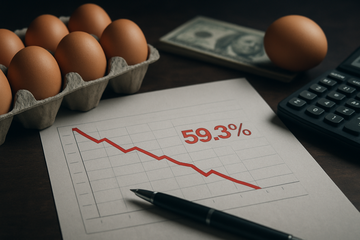
Conventional shell egg price change
-59.3%
Q1 FY27 vs Q1 FY26, dozen basis
Conventional egg segment operating result
-$71M
Q1 FY27, -35.2% segment operating margin
Net sales
$539.6M
Q1 FY27, down 41.5% YoY
Diluted EPS
-$1.26
Q1 FY27, vs +$4.12 in Q1 FY26
National wholesale egg price
$0.39/dozen
USDA AMS, week of Sept 25, 2026, graded loose Large white
BLS retail egg price
$2.27/dozen
August 2026 national city average
Specialty + Prepared Foods share of sales
54.1%
Q1 FY27, vs 37.1% a year earlier
The print
Conventional Eggs Did All the Damage
Cal-Maine Foods reported fiscal Q1 2027 results for the quarter ended August 29, 2026 on September 30, and the gap with the prior-year quarter is the entire story. Net sales fell 41.5% to $539.6 million, gross profit collapsed from $311.3 million to $403 thousand — essentially zero — and the company swung to a $58.6 million net loss against $199.3 million of net income a year ago. Diluted EPS went from $4.12 to -$1.26. The conventional shell egg segment alone recorded a $71.0 million operating loss at a -35.2% segment margin, on a 59.3% decline in average selling price per dozen against volume that was almost flat (-0.7%).
The other two segments were not enough to offset. Specialty shell eggs (cage-free, organic, free-range, pasture-raised) did $236.9 million of sales, down 14%, and produced $14.9 million of operating income at a 6.3% margin. Prepared foods — hard-cooked eggs, frozen egg products, refrigerated entrees — did $63.0 million of sales, down 13%, but held an operating margin of 12.4% on $7.8 million of operating income, even with management investing ahead of new capacity coming online. The net effect: specialty + prepared foods now contribute 54.1% of net sales, up from 37.1% a year ago, while conventional eggs dropped to roughly 38% of revenue from a majority position.
| Segment | Net sales ($M) | YoY change | Volume YoY | Avg price YoY | Op income ($M) | Op margin |
|---|---|---|---|---|---|---|
| Conventional shell eggs | 201.7 | -59.5% | -0.7% | -59.3% | -71.0 | -35.2% |
| Specialty shell eggs | 236.9 | -14.0% | -3.8% | -10.7% | +14.9 | +6.3% |
| Prepared foods | 63.0 | -13.0% | -19.3% | +7.9% | +7.8 | +12.4% |
| Total / consolidated | 539.6 | -41.5% | — | — | -82.2 (op loss) | -15.2% |
Supply
The Flock Rebuild Is Real — and Overshot Demand
The price collapse is not a mystery. It is the predictable second half of an HPAI cycle. The 2022-2024 HPAI outbreak culled roughly 17 million commercial laying hens in 2024 alone, with table-egg flocks accounting for about 75% of total domestic poultry losses across the multi-year outbreak, and farm-gate wholesale prices spiked above $8 per dozen in early 2025 — the all-time high. Producers responded by replacing flocks at scale, and by mid-2026 the U.S. table-egg flock stood at roughly 336 to 343 million hens, up materially from the 309 million reported at the start of the year.
Cal-Maine Foods management, on the September 30 call, framed the rebalancing window narrowly. August 2026 hatch numbers were down about 12% year-over-year — pullet placements that will not reach laying age for another five months — and cancellations had accelerated. The American Egg Board's recent monthly case production has run about 19.9 million cases over the prior three months, down modestly from peak. Yet layer-flock inventory at the start of last week was still up 1% sequentially, the Midwest alone held 9% more Large eggs than the prior week, and breaking-stock inventory was up 4% — all signs that supply has been running ahead of demand.
What management is watching is the seasonal HPAI risk. The 2022-2024 outbreak was historically amplified by fall wild-bird migration, and 7 states now have poultry affected in current surveillance, with Indiana — a major Cal-Maine operating region — added recently. The 2026 bird count is so far running about 11% below 2025's pace at the same date (20.6 million birds affected YTD versus 23.2 million), but the structural supply overhang is large enough that even a moderate fall outbreak is unlikely to lift prices back to the 2025 spike on its own.
U.S. wholesale egg prices have fallen off the 2025 spike
Wholesale price benchmarks by quarter. The 2026 trough reflects the largest flock in years.
Unit: $/dozen
Q1 CY25 peak
All-time high, TradingEconomics
8.2
Q4 CY25
USDA AMS national wholesale, Jan 30, 2026 reference
1.2
Q1 CY26 trough
Brief sub-$0.35 print, Jan 2026
0.4
Aug 2026
USDA AMS Midwest delivered, late August 2026
0.7
Late Sep 2026
USDA AMS national trading, Sept 25, 2026
0.4
Demand
Volumes Are Up, Prices Are Down — and That Is the Recipe for a CPI Reset
Demand has held up better than the price action implies — which is why the conventional-egg margin compression is a price story, not a volume story. Per NielsenIQ data cited on the call, retail egg volume was up roughly 4% year-to-date through August 2026; cage-free/organic/free-range/pasture-raised dozens grew about 6% versus the overall category at roughly 4%. Quick-service restaurant egg servings were up 2.4% YTD through July — roughly 69 million incremental servings — and U.S. egg export volume rose approximately 29% YTD through July, the strongest monthly print since May 2023.
Translated into the consumer's basket, BLS average retail prices for Grade A large eggs stood at $2.272 per dozen in August 2026, up only marginally from $2.189 in July and $2.141 in June — after bottoming near $2.14 — and USDA's Economic Research Service reported that eggs rose 3.5% from July to August, the first meaningful sequential uptick since the deflation began. Eggs remain a heavy year-over-year deflationary print in food-at-home CPI: USDA's 2026 full-year forecast is for egg prices to fall 29.4%, with a forecast interval of -32.9% to -25.2%. That is the largest single-commodity drag in the food CPI for 2026.
Retail egg dozens, YoY change
+~4%
YTD through Aug 2026, NielsenIQ data via Cal-Maine call
QSR egg servings, YoY
+2.4%
YTD through July 2026, +69M incremental servings
U.S. egg export volume
+29%
YTD through July 2026, strongest since May 2023
USDA 2026 egg price forecast
-29.4%
Full-year 2026, interval -32.9% to -25.2%
Strategy
Specialty and Prepared Foods Are Cal-Maine's Hedge — and the Mix Has Now Flipped
Cal-Maine has spent the past three years tilting its mix toward businesses where the conventional commodity cycle matters less. Specialty shell eggs (Eggland's Best, Land O'Lakes, Farmhouse, and 4-Grain) sell under differentiated brands at lower price elasticity; prepared foods — liquid, frozen, hard-cooked, and refrigerated egg products — sell under multi-year contracts to foodservice and packaged-food customers. Q1 FY27 is the first quarter in which specialty + prepared foods (54.1% of revenue) overtook conventional shell eggs as the majority of the top line.
The prepared foods build-out is the bigger story for the next 18 to 24 months. Management has guided to a more-than-60% increase in prepared foods production capacity by the first half of fiscal 2028 versus the end of fiscal 2026, with three named bolt-ons of capacity: roughly 12 million pounds of annual capacity from a new high-speed pancake line coming online in early FY27, 17 million pounds of scrambled-egg capacity through FY27, and 18 million pounds progressively through FY28 from the Crepini acquisition (egg wraps). Capex in Q1 FY27 was $26.6 million, cash and temporary investments ended the quarter at $767.6 million, and management holds $315.7 million of remaining share-buyback authorization. The company is funding the build with cash on hand — virtually debt-free — and signaled it is evaluating additional tuck-in acquisitions.
Specialty eggs are the more cyclical piece. Pricing declined 10.7% YoY in Q1 — far less than conventional's 59.3% — but the volume comparison was tough because the prior-year quarter benefited from retailers and consumers trading down to specialty when conventional supply was constrained. Management framed the current specialty pricing as \"not sustainable\" relative to the conventional cycle and said specialty volumes should re-converge with overall market growth as the conventional pricing normalizes. The $25 million spent during the quarter to acquire additional Eggland's Best franchise territory in the Northeast — bringing the total franchise footprint higher — is consistent with management's bet that branded, contracted shell eggs carry less cycle risk than undifferentiated commodity eggs.
Meanwhile, the cash dividend is suspended. Cal-Maine will not pay a cash dividend until it recovers a $94.5 million cumulative loss deficit at quarter-end, a sharp contrast from the company's standing as a dividend aristocrat for most of the last decade. Cash used in operating activities was $101.4 million in Q1 FY27, against $278.6 million of cash provided a year ago — the operating-cash-flow reversal is the single cleanest summary of how fast the conventional cycle has turned.
Spillover
Downstream Food Names Get an Egg-Cost Tailwind — and That Is the CPI Story
Eggs ran as a top contributor to food-at-home CPI through the first three quarters of 2025. With wholesale prices now near $0.39 per dozen — roughly 5% of the 2025 peak — the egg contribution to the food CPI is mathematically large in the opposite direction. USDA's full-year 2026 forecast of -29.4% for retail egg prices would shave roughly 30 to 40 basis points off food-at-home CPI if delivered in full; the August 2026 print of food at home up only 2.2% YoY — versus 2.7% for all food — confirms eggs are now a deflationary force rather than an inflationary one.
That arithmetic flows straight into packaged-food cost lines. Conagra Brands, Kraft Heinz, General Mills, and Campbell's use eggs as a meaningful input in frozen meals, refrigerated dough, dressings, sauces, and prepared soups. Lower egg costs flow through to gross margin with a one- to two-quarter lag as contracts repricing — Cal-Maine explicitly noted \"long-standing customer pricing structures including cost-plus and hybrid structures\" remain intact, which means the cost reset is contractually embedded for buyers.
| Company | Egg exposure | Direction of impact |
|---|---|---|
| Conagra Brands | Frozen meals (Marie Callender's, Healthy Choice), egg-based sides | Egg-input cost relief; cited eggs as a top FY26 inflation driver |
| Kraft Heinz | Mayonnaise, sauces, refrigerated dressings, refrigerated meals | Egg-input cost relief; discontinued Heinz Real Mayo in 2023 due to egg cost |
| General Mills | Pillsbury refrigerated dough, baking mixes, Annie's, Old El Paso | Egg-input cost relief; large baking-mix category is egg-intensive |
| Campbell's | Soup, refrigerated dressings, prepared foods | Modest egg-input cost relief; less direct than Conagra |
| Tyson Foods | Prepared foods (Jimmy Dean), egg products; chicken (related) | Mixed — egg input relief offset by chicken cycle weakness |
| Pilgrim's Pride | Chicken; no direct egg exposure | Indirect — feed (corn, soy meal) cost correlation with egg cycle |
| McDonald's | Eggs in breakfast menu; major QSR egg buyer | Egg-input cost relief; QSR egg servings +2.4% YTD |
| Post Holdings | Owns Michael Foods — value-added egg products (largest U.S. processor) | Mixed — competes with Cal-Maine prepared foods; benefits from lower shell egg input |
Legal overhang
The DOJ Settlement Is Now Part of the Cal-Maine Story
On June 29, 2026, Cal-Maine Foods reached a resolution with the U.S. Department of Justice Antitrust Division and 17 state attorneys general over an investigation into egg-industry pricing-benchmark conduct. Under the agreement, Cal-Maine agreed to donate 30 million eggs to food banks and to pay $1.5 million to the settling states, while implementing antitrust compliance and reporting measures. The company denied wrongdoing. The action targeted coordinated behavior around the Urner Barry benchmark — the same index Cal-Maine management referenced on the Q1 FY27 call when disclosing that external price realization was 99% of the Urner Barry Southeast average in Q1 FY27 versus 101% in the prior quarter.
The settlement does not impose a monetary penalty of material size relative to Cal-Maine's balance sheet ($767.6 million of cash, no dividend), and the 30 million eggs (roughly 2.5 million dozen) is small against the company's annual production scale. But the compliance overlay is a real operating cost, and the underlying conduct produced the worst optics during the 2025 price spike. Investors should price in continued antitrust risk around the egg benchmark — even as the conventional price collapse makes the conduct economically less relevant.
Outlook
What Moves First — and What Cal-Maine's Stock Has to Clear
The stock has already done a lot of the work. Cal-Maine Foods closed at $68.55 on September 29, 2026, down roughly 28% over the trailing twelve months against the S&P 500 at +19.9% — meaning the egg-cycle reset is largely priced in at the headline P&L level. But the print establishes that the conventional egg cycle is closer to its trough than its peak: the conventional segment booked a $71 million operating loss on near-flat volume, the operating-cash-flow reversal is $380 million worse YoY, and management explicitly said the market turn is \"not confirmed.\"
Near-term (days to quarters), the catalysts that move the stock are concrete and data-driven. First, fall HPAI surveillance data — already seven states with affected poultry, Indiana added, and the fall wild-bird migration historically amplifies the outbreak. A meaningful resurgence could pull the layer flock down toward the 320 million range that the industry was modeling pre-2026. Second, the August hatch data (-12% YoY) and pullet cancellations: if cancellations accelerate, 5-month-out laying flock is lower. Third, Q2 FY27 (quarter ending November 2026) will be the next read on prepared foods commissioning costs and any seasonal lift in egg demand for baking — management explicitly warned that Q2 will include upfront commissioning costs for capacity coming online.
Longer-term (one to three years), the structural argument has two parts. The conventional egg segment will recover when the flock rebalances, but management is no longer promising to return to the FY25 earnings power — instead it is committing to a structural tilt toward specialty and prepared foods. With $767.6 million of cash, no debt, a paused dividend, and a named 60%+ capacity expansion in prepared foods by 1H FY28, the equity story is increasingly about the prepared-foods platform versus the conventional commodity. The question is whether that platform can earn an earnings multiple closer to branded packaged food than commodity eggs — which is the only scenario in which the stock rebuilds from here.
Where the egg cycle reset actually shows up
- Conventional eggs booked a $71M Q1 operating loss at -35.2% margin on -59.3% pricing, and management concedes supply still outruns demand.
- Specialty + prepared foods climbed to 54.1% of mix; prepared foods guides to >60% capacity increase by 1H FY28.
- Dividend suspended until the $94.5M cumulative loss deficit is recovered; share buyback has $315.7M remaining authorization.
- Eggs were a top FY26 inflation driver per Conagra's own commentary; the cycle reset is a direct gross-margin tailwind for frozen meals and sides.
- FY27 guidance still reflects elevated COGS inflation; a sustained egg drop feeds the FY28 margin recovery.
- Risk: tariff and meat inflation (per recent Conagra CFO commentary) can offset the egg tailwind.
- Kraft Heinz discontinued Heinz Real Mayo in 2023 explicitly due to egg costs — a reset in egg prices reverses that input pressure.
- Gross margin expanded 230 bps to 36.7% in Q1 FY26; an egg tailwind over the next two to three quarters extends that trajectory.
- Watch: the egg relief is one of several moving parts in Kraft Heinz's margin path, not the dominant one.
- Pillsbury refrigerated dough and baking mixes are egg-intensive categories; lower wholesale eggs directly lowers COGS.
- Specialty egg growth (+6% YTD dozens per NielsenIQ) is structurally favorable to General Mills' premium baking brands.
- Near-term: General Mills hedges a meaningful share of input costs, so the tailwind realizes with a one- to two-quarter lag.
- Michael Foods (Post subsidiary) is the largest U.S. processor of value-added eggs — direct competitor to Cal-Maine's prepared-foods build.
- Lower shell egg input costs benefit Michael Foods' margins in the same way they benefit Cal-Maine's prepared-foods segment.
- Watch: Michael Foods' contract structures and customer overlap with Cal-Maine's prepared-foods build determine the share-shift.
- Tyson has direct egg exposure in Jimmy Dean and prepared foods plus feed-cost exposure on the chicken side.
- Egg-input relief is a tailwind, but chicken-cycle weakness (per Pilgrim's Pride Q2 CY26) caps the upside.
- Catalyst pending: Q4 FY26 results expected late October; egg-input commentary will confirm or deny the margin trajectory.
- McDonald's is the single largest QSR egg buyer in the U.S.; QSR egg servings +2.4% YTD per Cal-Maine's NielsenIQ cite.
- Eggs are a stated inflation watch-item for U.S. foodservice operators; the cycle reset directly eases a known cost pressure.
- Watch: McDonald's contracts are typically multi-quarter and cost-plus/hybrid per Cal-Maine, so relief arrives on a lag.
- Soup, refrigerated dressings, and select prepared foods use eggs as a meaningful ingredient.
- Lower wholesale egg prices flow through with a one- to two-quarter lag, supporting Campbell's gross-margin recovery in FY27.
- Smaller direct egg exposure than Conagra or Kraft Heinz — the tailwind is real but secondary in Campbell's mix.