
AI equipment cargo losses tracked
$150M+
Overhaul H2 2026 AI Infrastructure Intel, Oct 2026 — to-date figure since tracking began
Q2 2026 industry-wide cargo losses
$304.6M
Verisk CargoNet, Aug 6, 2026 — vs. $135.7M in Q2 2025, more than doubled
AI-related cargo theft growth since 2024
+34%
Overhaul H2 2026 report
Total stolen-goods value growth since 2024
+110%
Overhaul H2 2026 report
High-value tech thefts using deception
92%
Overhaul H2 2026 — spoofed carriers, double brokering, falsified paperwork
Average cargo-theft shipment value, Q2 2026
$564,009
Verisk CargoNet Q2 2026, up sharply from Q2 2025
What happened in Fremont: thieves came for Nvidia and got silica
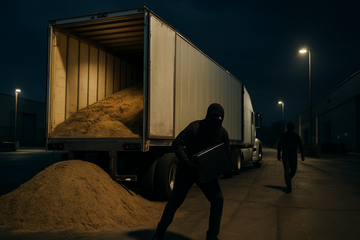
Overnight between Sep. 23 and Sep. 24, 2026, two trailers carrying Nvidia co-branding were pulled from the yard of PlusAI, a Santa Clara-based autonomous-trucking developer, at its Fremont testing site. Workers arrived at 9:30 a.m. on Thursday morning to find the glad-hand couplings forced open and 40,000 pounds of sand gone — sand PlusAI uses as weight ballast to simulate real freight while testing driverless trucks running on Nvidia's Alpamayo foundation model. The same afternoon, a friend of PlusAI's vice president of legal texted a photo showing both trailers parked outside a Newark, California office; Newark police recovered them within hours. No arrests. Per the company, it was the first theft in PlusAI's ten-year history.
The $150 million problem hiding behind the sand joke
The Fremont sand heist is funny only until you stack it against the broader trend. Supply-chain risk manager Overhaul had tracked more than $150 million in AI equipment cargo losses by the second half of 2026, with individual events now regularly exceeding $30 million and the largest single incident topping $100 million. Cargo theft incidents targeting AI hardware are up 34% since 2024, and the total dollar value of goods stolen is up more than 110%. The whole theft economy is shifting upmarket: thieves no longer need volume when one truckload of Nvidia-powered servers can finance a criminal network for a year.
U.S. and Canada cargo-theft losses are decoupling from incident counts
Industry-wide theft losses have more than doubled even as incident counts have fallen — a textbook sign that thieves are selecting higher-value targets.
Unit: Incidents / $M
Q2 2025 incidents
916
Q2 2026 incidents
677
Q2 2025 losses ($M)
135.7
Q2 2026 losses ($M)
304.6
| Date | Event | Cargo / value | Source |
|---|---|---|---|
| Aug 14, 2026 | Two armed escorts rammed on California highways; trucks not recovered | AI hardware shipments, values undisclosed | Tom's Hardware / WIRED |
| Jul 2026 | DOJ charges Super Micro co-founder and two associates | ~$2.5B of Supermicro servers with restricted Nvidia GPUs diverted to China | DOJ / CNBC |
| Aug 27, 2026 | Apex Logistics (Kuehne+Nagel) under BIS probe for 47 shipments | Nvidia-powered servers via Southeast Asia to Hong Kong | Bloomberg / Reuters |
| Sep 3, 2026 | Tom's Hardware reports $1.3M data-center supplies stolen from trailers in Alabama and Florida | $1.3M data-center supplies | Tom's Hardware (via Facebook) |
| Sep 23–24, 2026 | Two Nvidia-branded PlusAI trailers stolen from Fremont, recovered in Newark | 40,000 lbs of sand (no chips); thieves appeared to expect AI hardware | WIRED / Fortune |
| Dec 2024 | Tractor-trailer load of Nvidia chips stolen from California warehouse | >$7M of Nvidia chips | Fortune (July 3, 2026) |
Cargo insurance was priced for the wrong century
Standard cargo insurance was built for shipments worth tens of thousands of dollars, not $5 million to $30 million AI rack loads. Industry rates for general cargo insurance run 0.1% to 0.6% of insured value; high-value electronics and semiconductor freight is already being quoted at 0.6% to 2% in 2026, and the Lloyd's market has not finished repricing. A Lloyd's-of-London and Overhaul partnership launched a $75 million dedicated AI hardware insurance pool tied to live shipment telemetry in June 2026 — an explicit market signal that legacy paper policies no longer cover the loss distribution.
- Declared-value caps are stuck at parcel scale. FedEx defaults to $100 of declared value per package, and UPS Enhanced Maximum Declared Value tops out in the $50,000-$100,000 range per shipment — a fraction of a single DGX rack's worth of Nvidia kit.
- Fraudulent carrier IDs are the new ram-raid. CargoNet's Q2 2026 analysis names business-email compromise as the primary access point, with criminals impersonating trusted parties and altering pickup details while appearing legitimate.
- Stolen loads mostly leave the country. Overhaul estimates 60% to 70% of AI-related loads stolen in the U.S. now move abroad — primarily to China, Russia and Iran — where export-controlled Nvidia hardware sells at a 2x premium (the Nvidia DGX B300 reportedly clears $1.1 million in China versus roughly $550,000 at U.S. retail).
Transmission to listed equities: who actually pays for the next sand trailer
Four transmission channels matter. First, declared-value and insurance surcharges at the integrators. Second, cargo loss-ratio pressure on the underwriters. Third, telemetry-and-data subscription tailwinds at the cargo-intelligence vendors. Fourth, brand and supply-chain risk for the chip makers whose logos are now theft magnets. The freight revenue base is large enough that even meaningful repricing lands as margin, not revenue, for the carriers.
| Company (ticker) | Latest fiscal-year revenue | Direct exposure to AI-cargo theft story | Direction |
|---|---|---|---|
| United Parcel Service (UPS) | $88.66B (FY2025) | Standard parcel declared value $100; EMDV caps in $50K-$100K range; AI truckloads dwarf coverage | Mixed |
| FedEx (FDX) | $94.72B (FY2026, ended May 31, 2026) | Already repositioning into AI-data-center precision logistics via FedEx Surround and SenseAware ID; absorbs declared-value gap if priced in | Mixed |
| FedEx Freight (FDXF) | $8.795B (FY2026, spun off Jun 1, 2026) | Newly public LTL pure-play; less direct AI exposure but most exposed to general freight insurance repricing | Watch |
| J.B. Hunt (JBHT) | $12.00B (FY2025) | Intermodal/truckload carrier; ~1% revenue decline in 2025 reflects soft freight — limited direct AI exposure | Watch |
| Verisk (VRSK) | $3.07B (FY2025) | Owns CargoNet, the de-facto data monopoly on cargo-theft intelligence; AI-cargo risk makes its subscription product a board-level purchase | Bullish |
| Travelers (TRV) | $48.83B (FY2025); Business Insurance NWP $22.65B | Largest U.S. commercial P&C insurer; cargo underwriting is sub-scale but repricing here is margin-accretive in a hard market | Bullish |
| Nvidia (NVDA) | $215.94B (FY2026); Data Center $89.0B Q2 FY2027 | Brand is now a theft magnet; doesn't ship itself, but every partner's loss event is a brand and customer-trust event | Mixed |
Short-term: four catalysts, four quarters
- Cargo insurance hardens by year-end 2026. The Lloyd's/Overhaul $75M pool sets a template; expect a second and third pool by Q1 2027 with stricter telemetry requirements — a direct margin tailwind for Verisk CargoNet subscriptions and a direct loss-ratio reset for Travelers.
- Integrators reprice declared value. Watch UPS and FedEx Q4 2026 / Q1 2027 customer guidance for AI-data-center surcharges; the FedEx Surround premium tier is already telegraphing this.
- Hyperscaler procurement gets clauses. Nvidia's largest customers will start writing armor-and-escort requirements into master service agreements — the second-order effect that turns a brand liability into a FedEx services line.
- A high-profile unrecovered theft lands. Tom's Hardware already documented two 2026 California escort-ramming cases where trucks vanished. The next such loss above $50M will be the legislative trigger.
Long-term: structural shift over 1–3 years
Three structural changes look likely if the trend holds. First, mandatory live-telemetry becomes the price of admission — carriers without second-by-second tracking will be uninsurable on AI freight by 2028. Second, dedicated AI-cargo insurance products consolidate the Lloyd's-of-London-style pools into a single specialty market, with capital flowing toward Verisk-style data platforms. Third, the high-value / low-volume bulk market bifurcates: AI hardware moves under armed escort and dedicated security lanes, while general cargo continues to flow through standard declared-value channels. The PlusAI trailer in Fremont is the early signal that the bifurcation has already started — thieves are reading the trailer decals, and the freight industry has not yet learned to read back.
Listed names with a verifiable transmission from the AI-cargo theft story
- CargoNet Q2 2026 already documented 677 incidents with $304.6M in losses — a board-level subscription sale for AI-shippers.
- Owns the only national cargo-theft dataset as AI hardware becomes the dominant high-value target category.
- 2025 revenue of $3.07B and net income of $908M give operating leverage if AI-cargo telemetry mandates spread industry-wide by 2028.
- $48.83B 2025 revenue and $6.29B net income make it the largest U.S. commercial P&C balance sheet exposed to cargo underwriters.
- Loss ratios on AI cargo rising from sub-50% to 60%+ allow non-catastrophe premium increases without customer churn.
- Repricing is margin-accretive: cargo is a fraction of total premium but the rate cycle compounds into other inland-marine and property lines.
- $88.66B 2025 revenue sets the carrier base, but net income of $5.57B is down from $5.78B in 2024 — the company needs premium service lines.
- Standard parcel declared value of $100 caps liability on AI truckloads worth $5M-$30M; pricing leverage exists but customer pushback is real.
- Q4 2025 holiday quarter is the next test of whether UPS can launch a high-value AI freight service tier without ceding share to FedEx Surround.
- FY2026 revenue of $94.72B (ended May 31, 2026) was reported just before the May 15 spin-off of FedEx Freight.
- FedEx Surround and SenseAware ID (every-two-second tracking) are already positioned as the precision-logistics product for AI data centers — per FedEx's own July 29, 2026 business-insights page.
- Already a step ahead on telemetry, but the company has yet to convert that into a measurable surcharge line in reported revenue.
- Spun off June 1, 2026 at $109-$200/share range with FY2026 revenue of $8.795B.
- Pure-play LTL carrier; less direct AI exposure than FDX but most exposed to broader freight insurance market repricing.
- Watch Q1 FY2027 (Aug 2026) earnings — first standalone quarter is the cleanest read on whether LTL insurance costs have moved.
- FY2025 revenue of $12.00B was down 1% YoY in a soft freight market — limited direct AI exposure.
- Intermodal and dedicated truckload segments sit one layer removed from hyperscaler AI freight.
- Catalyst pending: any hyperscaler announcement routing AI hardware through intermodal (versus air) directly changes JBHT's exposure profile.
- Data Center segment revenue of $89.0B in Q2 FY2027 (reported Aug 26, 2026) — nearly all of it moving down the same freight corridors that just lost an Nvidia-branded trailer.
- Brand is now an inadvertent theft target; every co-marketed partner (PlusAI, etc.) becomes a potential ingress point.
- Hyperscaler procurement contracts will start demanding telemetry-backed SLAs, indirectly redirecting freight spend toward carriers and insurers that meet them.