
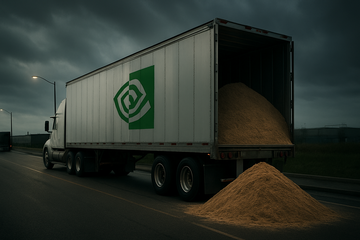
On Thursday morning, Sep 24, 2026, two trailers were pulled out of an autonomous-trucking startup's warehouse in Fremont, California. The criminals had done their homework on the signage: one trailer carried Nvidia branding, the other PlusAI branding, both bearing the livery of a partnership announced between the two companies and International Motors in November 2025. The thieves had every reason to expect a load of high-end AI GPUs bound for a hyperscale data center. They got 40,000 pounds of construction sand — about 20,000 lbs per trailer — and abandoned the trucks outside a Newark office after a PlusAI vice president of legal spotted them on a routine drive-by.
The story reads like a punchline. The supply-chain reality underneath it is not funny. Per the Overhaul AI Infrastructure Intel H2 2026 report and Verisk CargoNet's Q2 2026 cargo theft analysis, the Fremont sand job is one symptom of an industrialised theft market that is targeting AI logistics specifically — and it is on a different curve than general cargo crime.
The Sand Heist Reads as a Theft-Market Bellwether, Not a Curiosity
Nvidia didn't immediately comment on the Fremont trailer theft, and PlusAI's tech-enabled truck cabs — parked inside the warehouse — were not taken. Per Wired's Sep 25, 2026 reconstruction, the thieves broke open the backs of the trailers, found nothing of value, and left them within hours; the case remains under investigation with no arrests. The mistake here was amateur — sand had been mistakenly loaded onto the branded trailers during a routine shipment mix-up for an autonomous-truck construction project. The mistake tells you exactly what criminals expect to find inside an Nvidia-branded trailer in 2026: something worth stealing at gunpoint.
Trailers stolen (Fremont, CA)
2
Sep 24, 2026, from a PlusAI warehouse; one Nvidia-branded, one PlusAI-branded
Sand recovered per trailer
20,000 lbs
40,000 lbs total; recovered same day outside a Newark office
Overhaul-tracked AI cargo losses to date
$150M+
Per Overhaul AI Infrastructure Intel, H2 2026
Q2 2026 US/Canada cargo loss total
$304.6M
More than doubled YoY; Verisk CargoNet, Aug 6, 2026
Avg theft value (Q2 2026)
$564,009
Per Verisk CargoNet, despite 26% drop in incident count
Single-event scale (2026)
$100M+
Top theft to date; losses of $30M now recurring weekly — Overhaul
AI Theft Has Doubled in a Year While General Cargo Theft Went the Other Way
AI-Focused Cargo Theft Losses Have Doubled YoY
Cargo theft losses (US + Canada), with Overhaul's AI-equipment loss line tracked separately. General cargo theft is fragmenting into more, smaller heists while AI shipments concentrate losses into fewer, much larger events.
Unit: $M
US/Canada total losses (Q2 2025)
Verisk CargoNet
135.7
US/Canada total losses (Q2 2026)
Verisk CargoNet
304.6
AI-only losses (cumulative, 2024–Q2 2026)
Overhaul AI Infrastructure Intel H2 2026
150
Data-center freight lost since Jun 3, 2026
FreightWaves, Aug 14, 2026
110.6
The most counterintuitive data point is that Verisk CargoNet's incident count actually fell 26% year over year in Q2 2026 — 677 events versus a higher 2025 base — yet estimated losses more than doubled to $304.6M. Average value per reported theft crossed $564,009, up from roughly $200,000 in 2024 and $275,000 in 2025. Electronics moved from 22% of all 2025 thefts to 23% in Q2 2026, per Overhaul; separately, Overhaul tracks chip-and-data-center theft up 34% and total AI cargo value up 110%+ since 2024. The pattern is unambiguous: thieves aren't getting greedier, they're getting more selective — they have shifted from scattered opportunistic grabs to concentrated, planned jobs against the freight that holds the highest resale value per pound.
| Metric | 2024–2025 baseline | Q2 2026 / 2026 latest | Source |
|---|---|---|---|
| US/Canada cargo loss total | $135.7M (Q2 2025) | $304.6M (Q2 2026) | Verisk CargoNet, Aug 6, 2026 |
| Incident count | 3,854 (FY2024) | 677 Q2 2026 (–26% YoY) | Verisk CargoNet |
| Avg theft value (reported) | ~$200K (2024) | $564,009 (Q2 2026) | Verisk CargoNet |
| AI-related theft count | 2024 baseline | +34% vs. 2024 | Overhaul H2 2026 |
| AI cargo total value stolen | 2024 baseline | +110% vs. 2024 | Overhaul H2 2026 |
| Single largest event | Multi-million | $100M+ (recurring weekly) | Overhaul H2 2026 |
| Share of stolen loads leaving US | n/d | 60–70% | Overhaul H2 2026 |
The Method Has Shifted From Force to Fraud, and the Insurance Model Hasn't Caught Up
Overhaul's H2 2026 report attributes 92% of affected tech-shipment thefts to deception rather than physical break-in: fraudulent carrier identities, double brokering, spoofed communications, and falsified paperwork. The Q2 2026 California highway attacks — where organised crews deliberately rear-ended and PIT-manoeuvred the private security escorts guarding two high-value AI shipments from Silicon Valley to Southern California, leaving both trucks unrecovered — are the violent exception, not the norm. The faster, quieter fraud channel is what's now moving the needle.
- Puts 92% of tech-shipment losses through deceptive-pickup and carrier-identity fraud rather than physical theft, per Overhaul's H2 2026 report — meaning standard 'the trailer got broken into' cargo policies miss the dominant claim channel entirely.
- Runs a 3-to-1 hidden-to-visible loss ratio across the AI freight base, per Overhaul — schedule slippage, liquidated damages, lost contract eligibility and remediation costs triple the visible dollar loss, none of which is captured by an insurance deductible.
- Holds incident geography in warehouses (37%) and the midnight–6 a.m. window (28%) per Q2 2026 data — meaning the right control is real-time GPS + geofence + driver-identity verification, not a heavier padlock on the trailer.
- Pushes standard motor-truck cargo premiums of 0.1%–2.0% of declared value sharply under-priced for AI freight, where a single pallet of Nvidia Blackwell systems clears seven figures and a single event has topped $100M.
The Hidden Inventory Risk Sits With Distributors and Integrators, Not the Chipmakers
The instinct is to look at Nvidia and Super Micro — the brand on the trailer, the company whose chips were actually stolen in the December 2024 $7M California warehouse heist that was bound for a Super Micro facility in San Jose. Both companies, however, ship from high-security, bonded supply chains, carry direct relationships with hyperscale buyers, and have balance sheets that can absorb an occasional loss. The freight that gets hit at the warehouse door and on Interstate 880 is the freight that has been warehoused by a third party waiting to be configured for an enterprise customer. That is CDW, Arrow Electronics, Insight Enterprises (NSIT) and the long tail of system integrators.
| Layer | Listed name (ticker) | TTM revenue | Inventory risk vs. theft |
|---|---|---|---|
| Chip designer / foundry-bound GPU | Nvidia | $302.97B (TTM) | Direct loss rare; brand exposure on trailers is the target marker |
| Server OEM (named in Dec 2024 theft) | Super Micro | $39.06B (TTM) | Direct theft already occurred; negative TTM operating cash flow limits loss-absorption |
| Enterprise IT distributor (US/UK) | CDW | $23.50B (TTM) | Large GPU/config warehousing for enterprise rollouts |
| Global electronics distributor (enterprise) | Arrow Electronics | $35.92B (TTM) | Global Enterprise Computing Solutions segment = largest exposure |
| Truckload + intermodal carrier | J.B. Hunt | $12.70B (TTM) | Intermodal trailers are a primary attack surface |
| Asset-heavy truckload carrier | Knight-Swift | $7.73B (TTM) | Carries high-value electronics freight under standard policies |
| Cargo intelligence / analytics | Verisk (owns CargoNet) | $3.14B (TTM) | Rising demand for theft analytics and insurance data |
Super Micro's exposure is already documented — the December 2024 California warehouse heist that netted more than $7M in Nvidia chips was destined for its San Jose facility, and its own co-founder and a senior vice president were indicted in March 2026 by the DOJ on charges of diverting $2.5B in AI servers, including at least $510M in a single three-week window. The DOJ press release puts the export-diversion problem on the same page as the cargo-theft problem: the same high-value freight is leaving US supply chains through both legitimate-looking paperwork fraud and outright theft, and 60–70% of those stolen loads are leaving the country entirely per Overhaul.
- Pins freight loss onto CDW and Arrow Electronics's inventory lines first, because both warehouse large GPU/configured-server pools for enterprise rollouts, and a single loss event can wipe the margin on an entire quarter's data-center revenue.
- Hands Super Micro a permanent compliance and insurance-premium tailwind, given its DOJ indictment and the DOJ's reference to a U.S. 'Manufacturer' in the March 19, 2026 unsealed case — every server it now ships carries higher export-control audit cost.
- Makes Verisk's CargoNet franchise a structural winner, as insurers and shippers pay for the theft intelligence that did not exist in volume before 2025 — premium growth follows the loss curve, not the incident-count curve.
- Adds a 'physical-AI risk premium' to J.B. Hunt and Knight-Swift freight contracts — the carriers that handle AI pallet-loads will need to fund escorts, GPS, and identity verification, and those costs get billed back to the shipper.
What Changes in 12 Months — and What Compounds Over Three
The short-term setup is mechanical. Over the next two to four quarters, freight insurance premiums on declared AI shipments get repriced sharply upward as the 2025–Q2 2026 loss curve feeds through underwriting cycles. Distributors' freight surcharges to enterprise customers rise in lockstep, and at least one major US distributor is likely to take a publicly disclosed inventory write-down tied to a theft event — the kind of disclosure that re-rates a multiple. The proposed FY2027 BIS budget increase of 91.5% and addition of 290 export-enforcement agents, per Overhaul, is a structural signal that Washington expects the export-diversion tail of this market to keep growing, not fade.
- Moves AI-cargo insurance premiums up multiples within 4 quarters as the $564K average theft value and $100M+ single events feed underwriting repricing — distributors' freight surcharges rise in tandem.
- Forces a publicly disclosed distributor inventory write-down within 12 months, given the 110% YoY value jump and 60–70% cross-border diversion rate — a clean catalyst to re-rate CDW or Arrow Electronics multiples.
- Accelerates secure-logistics demand for Loomis and similar carriers that offer GPS + geofence + driver-identity as a service rather than commodity truckload, creating a new revenue line within 18 months.
- Compounds into a 1–3 year moat for Verisk CargoNet and the analytics layer — the longer the theft curve stays steep, the more insurers, shippers, and BIS enforcement pay for the underlying data feed, independent of how many incidents occur in any given quarter.
Investable read-through
- Q2 FY2027 revenue of $96.22B (10-Q filed Aug 26, 2026) makes any single theft event financially immaterial, but its branding on trailers is now a target marker for organised crews.
- Trailer liveries function as advertising for thieves: every Nvidia-branded container now requires escort-level logistics that Nvidia does not directly pay for.
- Indirect exposure through its $150M+ documented AI cargo theft footprint lifts demand for secure-freight services Nvidia's downstream supply chain partners will have to fund.
- TTM operating cash flow turned negative and gross margin sits near 10.8%, leaving little buffer for the $7M December 2024 theft that targeted a San Jose-bound shipment.
- DOJ unsealed a March 19, 2026 indictment naming a co-founder and SVP for $2.5B in server diversion, with $510M in a three-week window — every shipment now carries higher export-control audit cost.
- Negative TTM operating cash flow limits the company's ability to absorb future theft or compliance penalties without a margin or balance-sheet hit within 12 months.
- $23.5B in TTM revenue (Q2 FY2026 10-Q filed Aug 5, 2026) makes a single large GPU-pallet loss small in dollars but large in margin — CDW earns single-digit net margin, so one theft event wipes out a quarter's earnings.
- Distributor-led freight insurance is being repriced for AI shipments; CDW's freight surcharge line is the lever that absorbs or passes through the new physical-security premium.
- Watch Q3 2026 commentary for any disclosure of a freight-related inventory reserve — that is the first signal the physical-AI risk has hit reported numbers.
- Global Enterprise Computing Solutions (GECS) — Arrow's server/config business — is the segment most aligned with the AI freight theft footprint, given Q2 FY2026 revenue of $9.99B filed Aug 6, 2026.
- Arrow's receivable-to-payable cycle of roughly 285 days of sales outstanding means inventory in transit sits on the balance sheet longer than peers — a longer window for theft exposure.
- Watch for any disclosed inventory write-down in Q3/Q4 2026 — that disclosure is the cleanest catalyst to differentiate GECS valuation from peers.
- Owns CargoNet, which already publishes the Q2 2026 cargo loss dataset ($304.6M) that underpins every insurance repricing in this article.
- TTM revenue of $3.14B and 67.7% gross margin position Verisk to monetise the structural rise in cargo-theft analytics demand regardless of which carrier or distributor is hit.
- The longer the AI theft curve stays steep, the more insurers and shippers pay Verisk for the underlying data — a multi-year compounding tailwind independent of incident count.
- Intermodal segment is a primary attack surface given the bump-and-run tactic documented on California highways in August 2026.
- Q2 2026 revenue of $12.7B TTM means J.B. Hunt absorbs AI-freight insurance premium increases — a margin headwind unless passed through to shippers.
- Opportunity: differentiated secure-intermodal service is a new revenue line the company can monetise against enterprise AI shippers within 12–18 months.
- Carries high-value electronics freight under standard truckload cargo policies that are now mispriced for AI shipments.
- Truckload segment revenue mix exposes KNX to freight-surcharge repricing from enterprise shippers that have to fund new escorts and GPS verification.
- Watch the LTL and Logistics segments for any disclosed AI-specific freight contract — that is the first signal the company is capturing the new physical-security premium rather than absorbing it.
- Cash-in-transit and secure-logistics specialist positioned to extend its secure-transport offering into high-value AI freight as the theft wave compounds.
- OTC ADR (LOIMY) liquidity is thin — the clean way to play the secure-AI-freight thesis is via a logistics platform already scaling, but Loomis is the only listed pure-play adjacent to the demand.
- Watch for any 2026/2027 disclosure of a North American AI-cargo contract — that is the catalyst that converts the thematic read-through into reported revenue.