
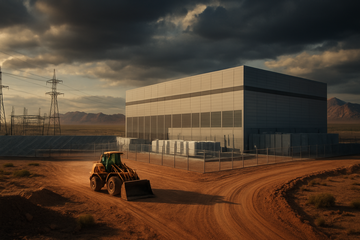
The choke point just moved. For the last18 months the AI data-center fight has run through statehouses — New York's moratorium push, Georgia's data-center-ballot backlash, Virginia's transmission siting battles. On Sept. 1, 2026 a single administrative ruling from the Department of the Interior's appeals arm paused the only AI data center ever approved on federal public land, and with it reset where the next permitting wall will rise. The relevant docket is no longer Albany or Richmond; it is Washington, BLM's Las Vegas Field Office, and the Interior Board of Land Appeals.
How88.5 Acres in Nevada Became the Test Case
One right-of-way, two very different projects. On June 26, 2026 the Bureau of Land Management's Las Vegas Field Office amended a right-of-way originally issued for a 19-MW solar plant with 35 MW of battery storage — held by Townsite Solar 2 LLC, a vehicle tied to Skylar Capital Management — and used the same paperwork to authorize a 167-MW hyperscale data center four buildings wide and roughly 300,000 square feet of floor space, backed by 70 MW of on-site battery storage and 167 MW of backup generation tied to 230-kV transmission.
The legal theory is narrow and replicable. Rather than prepare a new Environmental Assessment for a 24/7 compute load with materially different water, air-emission, lighting and wildlife profiles, BLM issued a Determination of NEPA Adequacy — a DNA — finding the solar review \"essentially like\" the data center because they shared an88.5-acre footprint, the same utility corridor, and similar industrial character. Administrative Judge David Gunter rejected the analogy on Sept. 1, ruling no cited case upholds a DNA for projects \"as different as a data center and a solar plant,\" and noting that BLM's own construction-duration handling \"masks the potential for a 50% increase in the duration of construction impacts.\"
Project scale
167 MW / 88.5 acres
BLM decision record, June 26, 2026
On-site battery
70 MW BESS
ENR, Sept. 3, 2026
Power equivalent
>75,000 homes
E&E News, July 21, 2026
Stay issued
Sept. 1, 2026
IBLA appeal 2026-0213, City of Boulder City
The Pipeline Behind the Pause: 17,600 Acres, 12 Proposals, Six States
The pause is bigger than one project. A Washington Sun review of BLM right-of-way records found the bureau is currently weighing at least 12 data-center or related-infrastructure proposals on 17,600 acres of public land across Arizona, Idaho, Nevada, Oregon, Utah and Wyoming. The single largest is a 10,200-acre site in Utah — more than 30× the footprint of Townsite — with Nevada, Arizona and Idaho proposals each running into the low thousands of acres. Arizona's congressional delegation has already demanded a freeze.
BLM data-center and related proposals on public lands (acres by state)
Public records reviewed by Washington Sun, Sept. 18, 2026; Utah dominates the pipeline.
Unit: acres
Utah
10,200
Nevada
2,600
Arizona
2,000
Idaho
1,200
Wyoming
900
Oregon
700
The legal theory travels. Every one of those 12 proposals, if approved, will rely on either an amended right-of-way, a new right-of-way, or a plan amendment — each of which is a NEPA trigger. The IBLA's Sept. 1 ruling establishes a working precedent that the DNA shortcut Townsite used will not survive appeal. That single Nevada decision now raises the cost and timeline of every other federal-land application in the queue, including the largest.
Why the Federal Layer Now Dominates
State zoning is not the bottleneck. Most of the Western public-land proposals cross sparsely populated counties with no municipal zoning — Boulder City was a rare exception because its planning commission could still deny a city-leased parcel. Once a developer pivots to a BLM right-of-way, the gatekeepers are federal: BLM for the land action, the Department of the Interior for appeals, the DOE for grid interconnection on federal transmission corridors, and Congress for any blanket prohibition. State legislatures can slow projects; they cannot authorize one on BLM land.
- H.R. 9939 — No AI Data Centers on Federal Lands Act (Rep. Tlaib, introduced July 23, 2026): would permanently ban qualifying AI data centers on any land owned or managed by the U.S. government and require removal of existing ones. 9 cosponsors as of Sept. 21, 2026; Skopos prognosis 2%.
- S. 4214 — AI Data Center Moratorium Act (introduced March 25, 2026 in the Senate): would impose a moratorium on new data-center construction nationwide until Congress passes guardrails — broader in geography, narrower in scope than H.R. 9939.
- Executive Order 14363 — Launching the Genesis Mission (signed Nov. 24, 2025): directs the Department of Energy and its 17 national laboratories to stand up a federal AI platform; pairs with a $293 million Genesis Mission funding opportunity (FOA issued March 17, 2026) and the Lux AI cluster deployment at ORNL with AMD in 2026.
- Executive Order (July 23, 2025) — Accelerating Federal Permitting of Data Center Infrastructure: directs EPA and other agencies to expedite permitting across both federal and non-federal land — the policy the Townsite appeal challenged.
The conflict is structural. The Trump administration is using the same federal levers — BLM right-of-way amendments, NEPA shortcuts, DOE interconnection — to accelerate AI buildout. Conservation plaintiffs are using the same federal levers — NEPA, the Administrative Procedure Act, the IBLA appeal process — to slow it. State moratoriums cannot reach this fight; they only ever covered non-federal land.
Transmission Up the Stack: Who Carries the Risk
The deal that already cracked. Oracle and OpenAI scrapped the planned 600-MW expansion of the flagship Stargate data center in Abilene, Texas on March 6, 2026 — financing talks collapsed and OpenAI's shifting demand forecasts killed the buildout. Meta Platforms is now in talks to lease the abandoned expansion capacity, with Nvidia paying a $150 million deposit to Crusoe to secure it — a defensive move to keep an alternative AI-cloud buyer from locking down finite U.S. data-center capacity.
Power, cooling, and the developers behind the queue. The 17,600 acres in the BLM pipeline will need hundreds of megawatts of firm power each — the kind of load that drives long-dated power purchase agreements with independent power producers. Vistra (38.7 GW of generation across gas, nuclear, coal, solar and storage) and Constellation Energy (32.4 GW, weighted toward nuclear) sit closest to that load growth. The 70 MW of on-site battery on Townsite and the 167 MW of backup generation also explain why fuel-cell plays like Bloom Energy have moved into hyperscaler discussions, and why Vertiv's power-and-thermal franchise is being repriced as a capex proxy. None of these names get direct federal-land exposure — but all of them ride the same multi-year load curve that the federal-estate pipeline is meant to feed.
| Company | Ticker | FY end | Revenue (TTM) | Market cap | Exposure angle |
|---|---|---|---|---|---|
| Oracle Corp | ORCL | May | $71.8B | $409.9B | Stargate build partner; 600-MW Abilene expansion dropped |
| NVIDIA | NVDA | Jan | $303.0B | $5.74T | AI chip leader; $150M deposit to Crusoe for Stargate spare capacity |
| Advanced Micro Devices | AMD | Dec | $371B (note: rev field shows LTM) | $1.03T | DOE Lux AI cluster partner for Genesis Mission; Meta MI450 deal |
| Vistra Corp | VST | Dec | $19.2B (latest Q) | $47.2B | 38.7 GW IPP capacity; gas/nuclear/storage blend |
| Constellation Energy | CEG | Dec | $31.3B (latest Q) | $96.8B | 32.4 GW generation; nuclear-led hyperscaler PPAs |
| Vertiv Holdings | VRT | Dec | $11.5B (latest Q) | $97.1B | Power and thermal infrastructure for hyperscale builds |
| Equinix | EQIX | Dec | $9.9B (latest Q) | $101.2B | Global colocation REIT; comp for private-public split |
| Digital Realty Trust | DLR | Dec | $6.8B (latest Q) | $66.1B | 3 GW operating + 6.3 GW buildable IT capacity |
Short-Term: What Moves First
- IBLA final ruling on Townsite — the board's final decision was due Sept. 21, 2026. If it affirms the Sept. 1 stay on the merits, every DNA-based amendment in the federal-land queue becomes legally fragile.
- Congressional markups — H.R. 9939 sits in the House Natural Resources Committee; a markup date will set the ceiling on the federal-prohibition trade. cosponsors now at 9 (per GovTrack, Sept. 21, 2026).
- DOE Lux AI cluster commissioning — first AMD-powered nodes land at Oak Ridge in 2026 under the Genesis Mission; expect DOE to use the cluster as proof of concept for siting AI compute on federal lab land (a federal-lands-by-default path).
- State-level coordination — at least 14 states are advancing data-center moratorium bills in 2026 (per NCSL tracker); federal rulings will give state legislators a template.
- BLM response — Interior may reissue Townsite with a fresh Environmental Assessment rather than retry the DNA. Either path costs Skylar Capital and any successor developer 12–18 months.
Long-Term: Structural Implications
The thesis splits in two. In the structural-bull case, federal land becomes the relief valve that lets the U.S. AI buildout proceed while state moratoriums close off alternatives — and DOE, through the Genesis Mission, becomes the de facto site selector. In the structural-bear case, the IBLA ruling propagates through every pending BLM right-of-way, forcing every 17,600 acres of pipeline back through a full NEPA review, pushing first-power dates by 18–36 months, and rerouting capital toward private-land sites where municipal zoning becomes the next political flashpoint.
Either way, the bottleneck moves. State-level permits cannot unlock federal acreage, and federal acreage cannot bypass NEPA. The hyperscalers most exposed to this fight are the ones whose capacity roadmaps assume large, single-site federal builds — Oracle's Stargate commitments and any developer — public or private — sitting on 17,600 acres of BLM right-of-way applications. Capital-light buyers (Meta, Microsoft, Google's Anthropic-adjacent workloads) can absorb a delay by switching clouds; capital-heavy build-and-lease operators carry it on the balance sheet.
Investable Read-Through
- Stargate 600-MW Abilene expansion was scrapped on March 6, 2026; remaining Stargate sites shift toward DOE-anchored federal builds — long-tail bullish for Oracle's $71.8B TTM cloud infrastructure franchise if the federal pathway opens, bearish if every BLM application gets stuck in NEPA.
- Oracle trades at 22.3× trailing earnings on $71.8B TTM revenue (Q1 FY2027, ended Aug. 31, 2026), with 26.4% net margins — the multiple leaves room for either a federal-estate upside or a permitting discount depending on how the IBLA final ruling lands.
- Over 1–3 years, the read depends on whether the federal Genesis Mission cluster becomes the default U.S. AI compute platform; if so, Oracle's existing cloud and database stack stays inside the perimeter.
- NVIDIA's $150M deposit to Crusoe to secure abandoned Stargate expansion capacity is a defensive bid on U.S. data-center footprint — and the company's Q2 FY2027 quarter (ended Jul. 31, 2026) shows 105.9% year-over-year revenue growth, $303.0B TTM revenue and 63.7% net margins.
- Permitting friction at the site level reinforces NVIDIA's pricing power: every federal-estate project that slips by 12–18 months tightens the supply of installed AI compute, supporting a higher multiple on NVIDIA's 29.6× trailing earnings.
- Over 1–3 years the chip vendor captures upside from both the federal cluster (Genesis Mission) and the private hyperscaler build-out — the most insulated name in this list.
- AMD is the named partner on the DOE Lux AI cluster at ORNL under the Genesis Mission — a direct federal-customer win that bypasses the BLM permitting queue because it sits on existing DOE lab land.
- AMD's $41.3B TTM revenue (Q2 FY2026) is growing 50.1% year-over-year with 15.6% net margins; the MI450 custom-GPU deal with Meta (Feb. 2026) and the DOE cluster together reset the AMD federal-share narrative.
- Over 1–3 years, AMD becomes the second-source for federal AI compute under Genesis Mission — a slower but more durable revenue stream than chasing hyperscaler GPU share against NVIDIA.
- Vistra carries 38.7 GW of generation across gas, nuclear, coal, solar and storage — the diversified mix that makes it the default counterparty for the kind of 167-MW single-site loads that the BLM pipeline is meant to deliver.
- Vistra trades at 23.6× trailing earnings on $19.2B TTM revenue (latest reported Q2 2026), with 11.6% net margins and a $47.2B market cap — the multiple compresses quickly if federal-estate buildout speeds up.
- Over 1–3 years, the federal-estate acceleration expands the long-dated PPA market that supports Vistra's nuclear and gas revaluation; permits going sideways is a known risk already in the stock.
- Constellation holds 32.4 GW of generation skewed to nuclear; the Microsoft Three Mile Island restart and prior hyperscaler PPAs set the template the federal-estate pipeline will demand.
- Constellation trades at 25.2× trailing earnings, $927 (52-week range $228–$410); the stock has already priced a meaningful data-center premium, so a federal-lands permitting win is mostly upside vs. an unchanged bear case.
- Watch the September 2026 wholesale-power auction and the IBLA final ruling — together they will determine whether nuclear PPAs extend to federal-land sites, which is the marginal swing factor for Constellation over the next 6–12 months.
- Vertiv sells the power-and-thermal kit every federal-estate data center needs, including the 70 MW battery and 167 MW backup generation visible in the Townsite spec — the order book tracks site build-out, not site ownership.
- Vertiv's $11.5B TTM revenue grew 24.1% year-over-year in Q2 2026 with 15.1% net margins; the $97.1B market cap implies38.7× EV/EBITDA — pricing in continued data-center capex regardless of who holds the land.
- Over 1–3 years, federal-estate delays are a short-term headwind but a long-term tailwind: every 12–18-month slip simply pushes the same Vertiv shipment into the next fiscal year.
- Equinix is the global colocation REIT with no direct federal-land exposure — but its65.8× trailing earnings multiple and 2.0% dividend yield make it the cleanest read on whether private colocation absorbs demand displaced from public-land buildout.
- If the IBLA ruling pushes hyperscalers back to private interconnect hubs, Equinix' $9.9B TTM revenue base (latest Q2 2026) and13.7% book-value-per-share growth capture the redirected load.
- Over 1–3 years the spread between public-land private-REIT performance and federal-estate build-out speed is the dominant variable for Equinix — and right now the REIT is the cheaper side of that trade.