
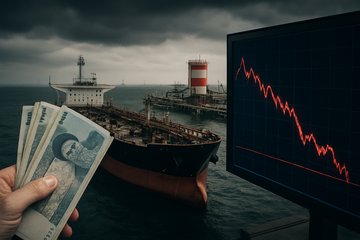
Rial per USD (free market)
2,693,000
Bonbast live quote, Oct. 5, 2026; ~170% depreciation YoY
Iran crude tanker loadings, Sept.
0 bpd
Treasury Secretary Bessent on X, Oct. 1, 2026; vs. ~250,000 bpd in August per Kpler
Inflation rate (CPI YoY)
~90%
Iran International, Sept. 2026 SCI print of 89.8%; food and drink +127.5%
Iran central-bank USD intervention
$2.0B
Failed to support rial, Reuters/Investing.com, Oct. 3, 2026
A7 Network transaction volume
$91.5B
FinCEN investigation; ~13% of Russia's 2025 foreign trade; flagged Oct. 1, 2026
Brent crude (front-month)
$101.44
TradingEconomics, Oct. 5, 2026; +55.6% YoY
The currency story crossed a threshold in the first week of October. The open-market rial trades past 2.69 million per US dollar, having set a record around 2.5 million earlier the same week — itself a fresh record above the 2.2 million breach on Sept. 2. A year ago the rial stood near 920,000 per dollar. Going back further, it traded at 35,000 per dollar at the start of 2018. The slope is the story: a currency that lost roughly half its value in twelve months and is on track for a regime-style reset.
Crucially, the rial collapse is not the cause of the oil collapse — it is the consequence. Iran's central bank tried to defend the currency with up to $2 billion of dollar sales on Oct. 3 (Reuters/Investing.com) and watched it fail. With oil revenue at zero and inflation running near 90% YoY (food and drink prices +127.5% per Iran International's Sept. 2026 SCI print), defending a peg without foreign-currency inflows is arithmetic, not policy.
Treasury's Operation Economic Outcast, expanded on Oct. 1, 2026, is built around a different premise than prior Iran pressure campaigns. Read the designations closely and the target is not barrels — it is the financial wiring that moves barrel money. The press release (Treasury sb-0643) authorizes OFAC to sanction any entity operating in Iran's automotive and rail sectors under E.O. 13902, and names Iran Khodro, SAIPA, the Islamic Republic of Iran Railway, and a constellation of Hong Kong, UAE, Turkish and Indonesian facilitators.
- IKCO and SAIPA, which control over 90% of Iran's auto market and produce nearly 1.5 million vehicles a year, are now sanctioned as IRGC-linked nodes.
- The Islamic Republic of Iran Railway and its passenger and freight arms are designated for their role in transporting oil and sustaining sanctions evasion.
- Iran's steel and copper export pipeline — operated through Hong Kong-based Ramin Keshvardoust and shell companies like KGT Trading and Dominion Trading — is named as a money-laundering channel that moves 'tens of millions' in euros and dollars for a domestic bank client.
- OFAC's corresponding-account power is the real lever: foreign banks that knowingly clear for designated persons can be cut off from the US dollar system entirely.
The same day, FinCEN designated the A7 Network — a Russia-linked shadow-banking operation OFAC calls a 'significant transnational criminal organization.' FinCEN's investigation (Alert FIN-2026-Alert007) says A7's sub-agents processed more than $17 billion between January 2025 and June 2026 globally, and that A7 itself claimed to move more than $91.5 billion across 2,000-plus daily transactions — roughly 13% of Russia's 2025 foreign trade. Iran-specific examples named in the alert include ~$140 million routed through a sub-agent tied to Iran's 'shadow fleet' and roughly $1.6 million routed to an entity linked to Iranian sanctions evasion and weapons procurement.
Existing market coverage has centered on three things: the Strait of Hormuz war risk premium (Brent peaked at $118.35 on March 31, 2026, per Wikipedia's economic-impact page, and sat at $101.44 on Oct. 5 per TradingEconomics), Hormuz tanker disruption (about 20% of seaborne crude and LNG normally transits the strait), and Iran's collapsing headline export number. All three are supply-side stories. The Oct. 3 Fortune piece and the Treasury actions frame something different: even a buyer willing to take Iranian crude now faces a payment-rail problem on the back end.
| Channel | Mechanism | Status as of Oct. 5, 2026 |
|---|---|---|
| Iran–China SPV (ChuXin) | Barter: oil credited against Chinese goods; managed by China MOFCOM and Iran's central bank | Reuters estimates $2B–$2.5B moved in past year; Pezeshkian says funds are 'blocked' and unusable |
| Shandong teapot refiners | Independent Chinese refiners buy discounted Iranian crude, mostly via Malaysian blends | Per OFAC Apr 2026 alert, teapots handle majority of Iran's exports; five+ plants halted purchases after US sanctions |
| Zhuhai Zhenrong (China state trader) | Direct liftings and pre-payments to NIOC | Long-sanctioned (2012, 2019); Reuters reports it stopped buying 'until this year' |
| A7 Network (Russia-linked) | Ruble-denominated shadow banking, ~$91.5B cumulative volume | Designated as transnational criminal org by OFAC on Oct. 1, 2026 |
| Bilateral rial/ruble settlement | Iran and Russia claim 60–95% of bilateral trade in local currency | Kremlin plan: 71% target by 2026; IranWire: 'public bookkeeping differs from actual currency received' |
| Hong Kong / UAE / Turkey front companies | Trade-based money laundering; shell-firm invoicing | Treasury sb-0643 names Hessenberg, Tanex, Traco International, Silver Line Metal as designated |
Iran's own state inspection organization has confirmed the breakdown. Per Iran International's July 27, 2026 report, the head of the State Inspection Organization said one intermediary alone failed to return $200 million before fleeing; prosecutors have opened 59 criminal cases and sought Interpol Red Notices for 15 fugitives. The head of the Iran-China Chamber of Commerce publicly alleged 'billions of dollars' of national wealth had walked out the door. Even allowing for rhetorical inflation, this is the regime admitting its shadow oil-payment system has been looted from the inside.
Iran's pre-war crude exports ran near 1.4 million bpd, almost all of which headed to China (per Kpler, ~80%+ of Iran's shipped oil went to China in 2025). With September loadings at zero per Kpler/Bloomberg and Bessent projecting Iran will have 'no oil on the water' this week, the question for the oil market is no longer whether Iranian barrels disappear but who absorbs them on a sustained basis. The candidates and the math are very different.
Iran's crude exports by month, 2026
Pre-war baseline (Jan–Feb) set the ceiling; the July blockade restart collapsed loadings to zero by September.
Unit: million bpd
Jan–Feb 2026 (baseline)
million bpd; ~80% to China per Kpler
1.4
Apr–May (first blockade)
approx, US blockade mid-Apr to late-May
0.5
June 2026
UANI tanker tracker; recovery on shadow fleet
0.9
July 2026
approx; pre-restart of blockade
1
Aug 2026
Kpler; post July 14 blockade restart
0.3
Sept 2026
Kpler/Bloomberg; Treasury confirmation
0
Upstream of Iran, the substitution chain is OPEC+ and US shale. Reuters reported Aug. 27 that OPEC+'s global market share has dropped to about 40% as China-leaning supply chains reroute; Semafor's Sept. 3 coverage noted Saudi Aramco's price-cut move signaled Riyadh is unwilling to surrender Asian share. Downstream, China's largest listed refiner Sinopec has already started replacing Middle East barrels with discounted Russian Far East crude — a one-for-one switch that shows the substitution mechanism works in the short run but leaves China structurally short if Hormuz risk re-escalates.
| Source | Realistic incremental bpd | Constraint |
|---|---|---|
| Saudi Arabia / OPEC+ spare capacity | ~1.0–1.5M (theoretical) | Saudi spare capacity is itself trapped behind Hormuz risk and Saudi has cut OSPs rather than raised output |
| Russia (Urals / ESPO) | ~0.4–0.6M | Discounts of $1–$2 vs Brent now vs $10 before war; Sinopec substituting |
| US shale | ~0.3–0.5M over 6–12 months | Capex discipline; rig counts lag prices by ~6 months |
| Iran shadow fleet | Currently zero | USS blockade, A7 designation, Keshvardoust network sanctioned |
| Iran offshore storage drawdown | ~0.9–1.2M (one-time) | 90M barrels in tankers in mid-July; Kpler says runs out mid-October; final China-bound cargoes stretch to December |
Horizons
Near-Term Catalysts vs. the 1–3 Year Structural Read
In the days-to-quarters frame, three dates dominate. First, the offshore-storage window closes by mid-October (Kpler's 90-million-barrel estimate from mid-July); any unsold cargoes either head to China at steeper discounts or sit unsold. Second, Treasury's Oct. 1 designation of the A7 Network carries a 30-day wind-down for transactions already in flight — meaning late-October compliance pain at smaller Iranian counterparties is the next operational shoe to drop. Third, Bessent's projection of 'no oil on the water' this week will be tested against the October-loading data due in early November; a non-zero print would be the first sign sanctions evasion is rebuilding capacity.
On the 1–3 year horizon the argument flips from tanker math to system math. If Iran's payment rails stay broken — and Treasury's October designations explicitly target the rail, auto, steel and shadow-banking nodes that route the dollars — then the missing ~1.4 million bpd has to be replaced by someone else. The substitution runs through Russian ESPO and Urals (capacity-limited and already 30% below pre-war pricing power per IER), Saudi spare capacity (politically constrained), and US shale (capex-lagged). None of those clears 1.4 million bpd overnight. The structural read: $90–$110 Brent is the new floor, not $70.
- Watch the final December-loading print for Iranian crude — if cargoes to China clear, the discount channel survived; if not, the system is more broken than the rial suggests.
- Watch whether A7 sub-agents outside Russia (UAE, Turkey, Hong Kong) become the next OFAC tranche — that's where Iran's remaining payment plumbing lives.
- Watch Saudi Aramco's November OSP decision; another cut means Riyadh is competing for share, not defending price, which caps the upside on integrated oils.
- Watch Chinese teapot refiner credit lines — China's regulator already told the largest banks to pause new lending to five recently sanctioned refiners, per May 2026 reporting; a wider lending freeze would force demand-side destruction.
How the Iran payment-rails collapse lands on listed names
- Brent at $101.44 with Iran at zero loadings puts integrated cash margins near cycle highs; XOM trades at 9.3x EV/EBITDA TTM with $33B FCF generation capacity.
- If the ~1.4M bpd Iran used to ship stays structurally absent, XOM's upstream portfolio captures a durable $15–$20/Bbl wedge versus pre-war assumptions.
- Watch: Saudi OSP cuts into Q4 would cap the upside by signaling OPEC+ is competing for Iran's lost share.
- Higher Brent flows straight to CVX's upstream book; current quote $206.77 vs. analyst target $224.62 leaves room on a sustained $100+ regime.
- Lower Iranian heavy crude actually helps CVX's Gulf of Mexico and Permian barrels compete for Gulf Coast and Asian refiners — a near-term share gain.
- Risk: capex cycle re-acceleration if Brent stays >$100 for two quarters would compress FCF yield from the current 6.6%.
- Pure-play E&P with the lowest capex/op-cash ratio in the peer set (10.6%) means COP converts the Iran-supply premium to shareholder returns fastest.
- Trailing FCF yield of 12.7% TTM versus sector mid-single-digits is the highest in the US majors; structurally sustained $90+ Brent supports buybacks.
- Risk: leverage to LNG spot prices in 2027 if Hormuz reopens would dilute the oil-only thesis.
- Iranian oil going to zero removes a chunk of Middle East haulage demand, a near-term negative for VLCC tonne-miles; FRO is up 250%+ YoY but those gains now face a structural ceiling.
- Counterbalancing positive: Hormuz closure forces longer routes around the Cape of Good Hope, supporting global tonne-mile demand even if barrels are fewer.
- Watch: Kpler/Bloomberg October-loading data on Iran; any non-zero restart would compress VLCC rates within weeks.
- Loss of discounted Iranian heavy crude widens the heavy-light differential in VLO's favor on the Gulf Coast; refining cracks have already expanded to mid-cycle.
- VLO's 12 US refineries are configured for heavy/sour slates; sustained absence of Iranian and Venezuelan heavy is a structural margin tailwind through 2027.
- Risk: a sharp crack-spread normalization if US gasoline demand softens into Q4 would mute the upside.
- Sinopec is the largest Chinese refiner and was a primary buyer of Iranian crude at $10–$14/Bbl discounts before the war; those barrels are now gone, raising feedstock cost.
- Per Reuters Aug 2026, Sinopec is substituting Russian Far East ESPO at $1–$2/Bbl discounts — the swap works in volume but at much narrower economics.
- Watch: any new OFAC designation of Sinopec-linked Shandong terminals would tighten sanctions risk premium and push the stock toward the lower end of its 2026 range.