
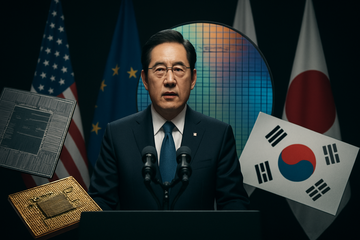
President Lai Ching-te used his October 10, 2026 National Day address — delivered exactly 16 days after the Trump-Xi Washington summit on September 24 — to frame Taiwan not just as the world's chipmaker but as the convening power of a 'democratic chip alliance.' The political ask, anchored in his pre-existing global semiconductor supply-chain partnerships for democracies initiative, lands as the underlying silicon is hitting record prints. TSMC's September monthly revenue was NT$511.86 billion, up 54.6% year on year, capping a January–September total of NT$3,898.73 billion (+41.1% YoY) — a tape that, read against Beijing's silence on export controls after the summit, has just acquired a geopolitical bid.
The political event
Lai's October 10 speech reframes Taiwan's chip supremacy as a coalition asset
Standing outside the Presidential Office on Taiwan's National Day, Lai told citizens that the island 'cherishes peace, but will not give up its freedom' and warned that 'peace cannot rely solely on wishes.' Beijing denounced the speech within hours. The chip subtext, however, is the durable one: Lai earlier this year unveiled the global semiconductor supply-chain partnerships for democracies initiative, and his National Day framing built on the Five Trusted Industry Sectors — semiconductors, next-generation communications, AI, defense, and security/surveillance — explicitly positioning Taiwan as the node that connects US, EU and Japanese capacity into a 'non-red' ecosystem.
- Democracies framing is operational, not rhetorical. Lai's plan targets a 'ring of trust' among democratic partners to protect industrial continuity — meaning TSMC's overseas fabs in Arizona, Dresden and Kumamoto are assets of that ring, not substitutes for it.
- Defense spending pulled into the same speech. Taiwan is moving to 3.32% of GDP on defense next year, targeting 5% by 2030 — a parallel commitment that underwrites political support for allied fab buildouts at home.
- Beijing's response hardened the tape. Within hours, China's Taiwan Affairs Office called the speech 'distortion' with 'ulterior motives,' raising the chance that any future US/EU/Japan coordination will be read in Taipei as protective.
The summit backdrop
The Trump-Xi summit left chips off the table — by design
The September 24 Trump-Xi meeting ended with tea at the US National Archives, a tour, and no joint statement. Read-outs from both sides omitted any direct mention of semiconductor export controls. CSIS called the result 'stability, not a breakthrough'; the South China Morning Post concluded that US chip controls were 'not a major sticking point' because both leaders preferred to keep the October 2025 truce on tariffs alive ahead of the November APEC and G20 follow-on summits. The truce is good for NVIDIA's H20 restoration talks and Micron's access in the medium term, but it expressly did not roll back any chip or equipment restrictions.
Trump-Xi summit date
Sep 24, 2026
Washington, D.C.; no joint statement; chip controls excluded
Lai's National Day address
Oct 10, 2026
Speech titled 'Taiwan's Future: A City upon a Hill, the Salt and Light of the World'
Gap between the two events
16 days
Same week as TSMC's Q3 monthly revenue reports
APEC follow-on summit
Nov 2026, Shenzhen
Next pre-scheduled Trump-Xi touchpoint
The numbers underneath
The underlying tape is already running: TSMC, HBM, and CoWoS capacity at record highs
Lai's pitch lands on a chip industry already straining against demand. TSMC's consolidated September net revenue of NT$511.86 billion took the year-to-date total to NT$3.89873 trillion, up 41.1% from the first nine months of 2025, with the September print alone up 54.6% YoY. Q2 2026 reported revenue of NT$1,270.38 billion (≈ US$40.2B at the company's then-applied FX of 31.60) with gross profit of NT$860.31 billion — a gross margin in the high-60s region that the company itself framed as consistent with its 65–67% Q3 guidance.
| Company | Latest period | Revenue | Gross margin | Source |
|---|---|---|---|---|
| TSMC | Q2 FY2026 (Jun 30) | NT$1,270.4B (~$40.2B) | ~67.7% | TSMC 10-Q, Q2 FY2026 |
| TSMC | Sep 2026 monthly | NT$511.86B (+54.6% YoY) | n/d | TSMC Sept 2026 Revenue Report |
| NVIDIA | Q2 FY2027 (Jul 26, 2026) | n/d (Q1 FY27 revenue $44.06B) | ~75% range TTM | NVIDIA 10-Q, Q1 FY2027 |
| ASML | Q2 CY2026 (Jun 30) | n/d (TTM $35.3B) | ~52.7% TTM | ASML 10-Q, Q2 CY2026 |
| SK Hynix | Q2 CY2026 (Jun 30) | KRW 79.32T (~$60B eq.) | ~83% quarterly | SK Hynix Q22026 results |
| Micron | Q3 FY2026 (Aug 31) | $9.3B (revenue $133.2B TTM) | ~80.7% TTM | Micron 10-Q, Q3 FY2026 |
| Samsung Electronics | Q2 CY2026 (Jun 30) | KRW ~485T (TTM) | ~56.9% TTM | Samsung Q2 2026 earnings |
Downstream, NVIDIA qualified Samsung Electronics, SK Hynix and Micron for HBM4 alongside the Vera Rubin platform in mid-2026, and the July 25 SK Group–NVIDIA partnership extended that to a '$500B plus' AI factory / next-gen memory initiative anchored on a 2-gigawatt DSX AI Cloud in Korea. CoWoS advanced-packaging capacity at TSMC — the third chokepoint that bonds GPU silicon to HBM stacks — is sold out across 2026, with [NVIDIA](nvda] holding an estimated 60% of allocation. Every percentage point of US/EU/Japanese fab capex flows back to these three bottlenecks.
Why this is a coordinated-buying story
Allied export controls are already moving in Congress — Lai's call slots in
Lai's 'democracies must unite' pitch is not a stand-alone slogan. On April 8, 2026, Senators Risch, Ricketts and Kim introduced the MATCH Act (Multilateral Alignment of Technology Controls on Hardware) with Schumer as co-sponsor; House companion legislation is led by Rep. Baumgartner. The bill would compel allied partners — the Netherlands, Japan, South Korea, Taiwan — to align semiconductor-equipment export controls with Washington's, closing entity-list and servicing loopholes. The parallel STRIDE Act (H.R. 6058), introduced November 17, 2025, sets up the formal multilateral coordination mechanism.
- ASML is the only producer of EUV lithography and the binding constraint on every advanced-node plan — its 2026 China share (≈20% of sales) is what MATCH aims to recapture for allied fabs.
- Tokyo Electron TOELY is the dominant Japanese back-end tool maker; matching Washington's rules onto its DUV/coater/developer business is the wedge that converts Lai's speech into capex orders.
- Renesas Electronics on automotive and industrial MCUs is the quiet third leg of Japan's contribution to a democratic stack, alongside TSMC's Kumamoto fabs.
The supply chain, mapped
From Dutch lithography to Korean memory, the chip-alloy has five transmission lines
Lai's call transmits into equity values through five distinct links. First, equipment: ASML and TOELY absorb every dollar of allied fab capex. Second, foundry: TSMC is the only producer at 3nm/2nm with credible US, EU and Japan footprints ($265B Arizona, $3.5B Dresden, Kumamoto). Third, advanced packaging: CoWoS is a TSMC-only franchise. Fourth, HBM: SK Hynix holds the HBM4 yield lead, Micron is qualified second-source, and Samsung Electronics is still working through 12-layer stack qualification. Fifth, the demand sink: [NVIDIA](nvda]'s Vera Rubin platform ties all four together.
TSMC's monthly revenue keeps re-accelerating into Lai's speech
Trailing-twelve-month revenue in NT$ billions at the end of each month; August 2026 figure derived from TSMC's +0.6% MoM disclosure.
Unit: NT$ billions
Sep 2025
baseline
331
Dec 2025
Q4 2025 quarterly filing
412.5
Mar 2026
Q1 2026 reported
460.1
Jun 2026
Q2 2026 implied
506.8
Sep 2026
Sept 2026 monthly print
511.9
Short-term vs long-term
Days–quarters: the tape moves first on equipment and HBM; 1–3 years: the foundry re-rates
The immediate market read is on the front-end of the chain. ASML trades at a 57.4 trailing P/E with a 28.9 forward P/E — the gap is the multiple that closes if MATCH passes and 2027 China revenue is rerouted to TSMC Arizona, Micron's Idaho/New York fabs and South Korean DRAM expansion. SK Hynix trades on 7.3 trailing earnings against 50%+ Q2 gross margins and the locked-in NVIDIA HBM4 contract; that is the lowest-multiple expression of the chip-alloy tape. Micron at a 13.8 trailing P/E with a 7.0 forward P/E is the US-domiciled beneficiary, and the TSMC Sept 15, 2026 earnings call (scheduled for October 15) is the near-term catalyst that will frame the foundry multi-year capex narrative.
- Days–quarters: MATCH/STRIDE committee markups in the House Foreign Affairs and Senate Banking committees; TSMC October 15 Q3 earnings; October-end Micron FY2026 close.
- 1–3 years: TSMC Arizona Fab 3 (2nm) production in 2028; TSMC Dresden first-output milestones; SK Hynix M16 DRAM/HBM ramp; ASML EXE:5200 high-NA EUV qualification across TSMC and Intel
- Key risk: any Trump-Xi concession on chip controls at the November APEC summit in Shenzhen — particularly H200-class shipments — would compress the premium for non-red supply.
Synthesis
Lai turned a tariff truce into an industrial coalition — the chip-alloy price is the spread
Three independent threads converged on October 10, 2026. The political thread: Lai reframed Taiwan's 'over 90%' leading-edge share as a coordinating duty, not just an inheritance, in front of an audience that included Japan's Furuya Keiji and a dozen diplomatic delegations. The trade-policy thread: the Trump-Xi summit's silence on chips preserved allied policy space, which MATCH and STRIDE are now actively filling. The industrial thread: TSMC's +54.6% YoY September revenue, SK Hynix's 70%-plus HBM4 share with NVIDIA and the still-sold-out CoWoS line confirm that democratic-side capacity is the binding constraint, not slack to be reallocated.
The investable conclusion is asymmetric. The equipment chokepoint (ASML, TOELY), the foundry (TSMC), the qualified HBM suppliers (SK Hynix, Micron) and the demand sink (NVIDIA) are a single re-rating bet, dressed up as five tickers. The laggard — Samsung Electronics, whose HBM3E qualification friction has been public since2025 — is the chip-alloy short on the political side and the structural laggard on the engineering side. If the November APEC meeting in Shenzhen surprises with chip-control concessions, the premium compresses; absent that, the coalition Lai is calling for is already being built by capex announcements, not press releases.
Where the chip-alloy tape lands — investable reads across five links of the chain
- Lai's coalition pitch hardwires demand for TSMC's $265B Arizona, $3.5B Dresden and Kumamoto fabs as political assets, not just commercial ones.
- September revenue at NT$511.86B (+54.6% YoY) and the October 15 Q3 call will quantify the 2027 capex envelope that matches the speech.
- Over 1–3 years, the 2nm Arizona Fab 3 ramp in 2028 and Dresden first-output re-rate the foundry beyond the China-decoupling bear case.
- MATCH/STRIDE legislation would legally bind Dutch, Japanese and Korean allies to Washington's EUV/DUV controls, converting the ~20% China revenue drag into allied fab upside.
- ASML trades at a 57.4 trailing P/E but 28.9 forward — the multiple closes as 2027 China revenue is rerouted onto TSMC, Micron and SK Hynix capex.
- Within 1–3 years, EXE:5200 high-NA EUV qualification on TSMC and Intel 18A nodes locks in an installed-base annuity that grows with the coalition.
- SK Hynix's HBM4 yield edge and the $500B-plus SK Group–NVIDIA partnership give it a ~70% share of Vera Rubin HBM, anchoring the democratic chip-alloy's memory leg.
- Q2 2026 gross margin in the low-80s against a 7.3 trailing P/E leaves the multiple behind the operating reality of the HBM4 ramp.
- Within 1–3 years, M16 fab capex pulls HBM4 supply into 2027–2028 just as TSMC CoWoS capacity and Lai's 'chain of guardian mountains' speech frame it as a strategic asset.
- Micron's June 2026 NVIDIA HBM4 qualification makes it the only US-domiciled HBM supplier — the cleanest direct read on Lai's call for democratic alignment.
- A 13.8 trailing P/E compressing to 7.0 forward on FY2026 ends in October; every Idaho/New York fab dollar is now politicized capex, not just commercial capex.
- Within 1–3 years, HBM share gains versus Samsung and TSMC's CoWoS pulls mean Micron revenue accelerates faster than the consensus 3-year plan.
- NVIDIA's Vera Rubin platform and the DSX AI Cloud in Korea are the demand sink that makes the democratic chip-alloy self-financing — every SK Hynix HBM4 die and every TSMC CoWoS slot exists to feed it.
- A 28.8 trailing P/E is the cleanest expression of the HBM-and-CoWoS bottleneck rents that the Lai coalition preserves.
- Over 1–3 years, the Vera Rubin ramp into 2027–2028 keeps NVIDIA's pull on allied memory and packaging capacity firm, but watch for any APEC H200-class concession in November 2026.
- Samsung's HBM3E 12-layer qualification friction and lower HBM4 yield keep it outside the NVIDIA primary flow that the democratic chip-alloy relies on.
- A 11.6 trailing P/E and broader memory/display franchise cushion the equity if HBM catches up, but the tape underweights that optionality until qualification proves out.
- Within 1–3 years, Samsung's foundry and HBM re-acceleration would close the gap to SK Hynix; absent that, the structural lag continues.