
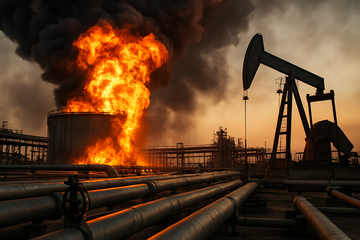
Saudi Aramco confirmed on Oct 13 that a Houthi missile strike on an administrative building at its Dhahran headquarters caused only a \"limited fire,\" with no production impact. The statement was almost an afterthought — what matters is the October 15 Reuters feature showing how, one month earlier, attack drones had already burnt out a pumping station on Saudi Aramco's biggest oil pipeline and the company kept exporting. Brent settled at $104.72 that day, up 14% from the $92 floor set in August when the US announced fresh Iran sanctions. The price action says the market believes the resilience. The data behind it says the resilience is structural, not tactical.
Aramco's playbook is now documented in the company's own words
At the Q2 2026 media call, CEO Amin Nasser framed the crisis directly: \"the ongoing geopolitical crisis continues to aggravate the biggest supply shock in history, removing an average of 11 million barrels of liquids supply each day.\" That 11 mmbpd figure is the denominator every other analyst is arguing around — and Nasser volunteered the numerator too. The world has lost \"over 2.6 billion barrels\" of oil destined for agriculture, semiconductors, automotive, chemicals and manufacturing. The release of strategic reserves, commercial inventory drawdowns and demand rationing offset some of that loss — and then he named Aramco's own infrastructure as the next line of defense. \"Aramco's East-West Pipeline and global inventories have also helped to alleviate the supply shock, lowering the net loss to around 1.8 billion barrels.\"
That gap is not theoretical. The East-West Pipeline is a 1,200-kilometer, 5-million-bpd system that Aramco pushed to a record 7M bpd in March 2026 when Strait of Hormuz transit was disrupted, restored to full capacity after subsequent attacks, and is now operating as the redundant bypass every time Houthi drones find a new target in the Eastern Province. The spare capacity sitting behind it is equally well-documented: Aramco can sustain a maximum sustainable capacity of 12 million bpd for a full year without additional capex, and — per CEO Nasser in May 2026 — can reach that ceiling within three weeks if required.
Iran's vanishing barrels are why the playbook matters
The structural pressure on Brent isn't the Houthi drones. It is the Iran war that started with US and Israeli strikes in February 2026 and continues to disrupt crude exports through the Strait of Hormuz. OPEC+ left its October output policy unchanged on September 6 because, in Reuters' words, \"the Iran war continues to disrupt oil exports through the Strait of Hormuz, limiting OPEC+'s influence over prices.\" ANZ Research has estimated that 1M to 2M bpd of Iranian capacity could be permanently lost or limited even after the war ends — close to the 1.5 mmbpd the brief flags as the structural hole in Middle Eastern supply.
- Aramco H1 2026 hydrocarbon production hit 11 mmboed, with liquids at 9.1 mmbpd — the company is producing near its MSC, not drawing on the cushion
- Aramco's instant spare capacity of 2.43 mmbpd equals more than half of OPEC+'s entire reported spare capacity, a buffer no other producer can replicate at this scale
- OPEC+ crude production rose to its highest since the Iran war began in September, but the lift came from rerouting around Hormuz, not from new barrels — supply-side response is structural, not incremental
- The EIA raised its Q4 2026 Brent forecast to $105/bbl in October, a $14 jump in a single monthly STEO, the largest revision of the cycle
Brent crude —60-day path (Aug–Oct 2026)
Daily settle, US$/bbl. Spot price re-rated higher as pipeline attack, Iran sanctions and Houthi escalation compressed Middle East supply.
Unit: USD/bbl
Aug 24
Post-sanctions drop
92.2
Sep 22
East-West restart
96.4
Oct 8
Pipeline-attack risk premium
105.3
Oct 9
Settle, hurricane + Iran talks
104.7
The shale response that used to follow $100 oil isn't coming
Brent at $105 should historically unlock Permian growth within two quarters. In 2026 it has not. RBN Energy tracks2026 US E&P capital investment at $59.1 billion — down 5% from $62.5 billion in 2025 — even as crude has rallied. Through H1 2026, Chevron and ConocoPhillips cut Lower 48 capital expenditure by 10%, and Occidental Petroleum trimmed alongside them. The Dallas Fed Energy Survey's respondent consensus still forecasts only $74/bbl WTI at year-end 2026. Capital discipline is the operating thesis; $100-plus oil is being banked as free cash flow, not converted into new DUC completions.
| Company | TTM revenue | TTM rev growth YoY | Trailing P/E | Forward P/E | Capex / OCF |
|---|---|---|---|---|---|
| ExxonMobil | $361.1B | +44.1% | 22.4x | 14.8x | 48.8% |
| Chevron | $209.4B | +53.5% | 21.4x | 15.2x | 40.4% |
| EOG Resources | n/a | n/a | n/a | n/a | n/a |
| Occidental Petroleum | n/a | n/a | n/a | n/a | n/a |
| Devon Energy | n/a | n/a | n/a | n/a | n/a |
The implication runs through the equity stack. Integrated majors with Permian exposure capture the high-margin barrel today and return capital; pure-play E&Ps are even more disciplined because investor mandates punish growth-at-any-cost. That means the marginal price-setter for the next 12 months is not a Houston completion crew — it is the spare-capacity holder in Dhahran. The forward P/E spread between the integrateds and pure E&Ps is the cleanest way to play the divergence.
The services complex gets paid twice
Oilfield service companies are the structural pick-and-shovel beneficiary on both sides of the disruption. Aramco's hardening of the Eastern Province — pipeline redundancy, Khurais-to-Yanbu rerouting, idle-well restarts that lifted the East-West Pipeline to its 7 mmbpd ceiling — requires fracturing fleets, coiled tubing, cementing and production chemicals. Saudi Aramco's Q3 2026 earnings call on November 3 is expected to quantify the rig count supporting that effort; through H1 2026, total hydrocarbon production of 11 mmboed was already running near maximum, meaning any incremental capacity response is incremental work for service companies.
| Company | TTM revenue | TTM margin | Trailing P/E | Forward P/E | Capex / OCF |
|---|---|---|---|---|---|
| Halliburton | $22.4B | 7.2% | 17.3x | 11.4x | 37.3% |
| SLB | $36.4B | 8.5% | 23.6x | 16.0x | 30.3% |
| Baker Hughes | n/a | n/a | n/a | n/a | n/a |
SLB and Halliburton are leveraged to Saudi-Khurais completions and to US refrac work for E&Ps using the higher price deck to optimize existing wells. The forward P/E compression at Halliburton (11.4x) versus SLB (16.0x) understates the call on Saudi work that hasn't been booked yet. Baker Hughes sits between the two — turbomachinery exposure to LNG and gas processing is a parallel beneficiary of the structural premium Nasser's call described.
Downstream cracks widen while OPEC+ watches
Nasser's Q2 remarks flagged the second-order effect explicitly: \"the global refining system is stretched heavily as refineries are operating at near maximum utilization rates.\" Crack spreads have widened accordingly. US independent refiners with complex configurations convert the structural crude premium into a disproportionate gasoline and distillate margin. Marathon Petroleum, Valero, Phillips 66 and HF Sinclair operate Gulf Coast and Mid-Con assets positioned to capture that spread, particularly as the EIA notes China is resuming refined fuel exports at the same time hurricane Isaias shut in more than 70% of US Gulf production on October 9.
The geopolitical-premium trade is no longer a directional bet on the front of the Brent curve. It is a structural claim that every oil-importing economy pays a tax to the producer-and-refiner complex — and that the equities most exposed to that tax (downstream and OFS) outperform the upstream equities that nominally benefit. OPEC+ has been sidelined by the Iran-war disruption to Hormuz transit; its October6 decision to leave quotas unchanged is the second month running that the group's deliberations are described in trade press as a non-event. Cohesion is no longer the variable. Supply optionality is.
What to watch next
Three catalysts re-rate the trade: Aramco's Q3 2026 earnings on November 3 will quantify production volumes, capex into spare capacity and the year-to-date impact of the September pipeline attack on the East-West Pipeline. The next EIA Short-Term Energy Outlook (early November) will reset the Q12027 forecast off the October print of $105/bbl — a continued revision higher extends the premium. And the next OPEC+ meeting will confirm whether the group adds any new barrels in 2027, or whether the Hormuz disruption has effectively removed its policy levers. The Reuters feature drops October 15 and is the cleanest primary read on Aramco's tactical playbook in this cycle.
- Aramco Q3 2026 earnings — November 3, 2026; watch liquids production vs 9.1 mmbpd H1 baseline and capex guidance toward12M bpd MSC
- EIA STEO November update — Brent forecast for Q1 2027; continuation of $105-plus keeps backwardation intact
- Next OPEC+ meeting — quota signal; with Iran disruption sidelining the group, a status-quo print confirms the structural-margin thesis
- Brent term structure — watch the prompt-month backwardation; sustained backwardation is the trade signal, contango would be the unwind
Equities with verified linkage to the Aramco-resilience trade
- Saudi Eastern Province hardening and East-West Pipeline work flow through Halliburton's completion and production segment, lifting Middle East revenue mix versus the 7.2% TTM net margin base case
- Halliburton's 11.4x forward P/E leaves the most operating leverage among the OFS peers if Aramco books incremental rig count toward the 12 mmbpd MSC ceiling
- US refrac activity from disciplined E&Ps monetizing existing DUC inventory adds a second demand leg through2027
- SLB's digital and reservoir performance segment captures Aramco's Eastern Province reservoir optimization, while integrated projects work scales with each new pipeline redundancy
- The Middle East rig count has historically tracked Saudi spare-capacity utilization; Q3 2026 results on Nov 3 will quantify the pipeline-driven demand pull
- Forward P/E of 16.0x is below the integrated-major average, leaving room for re-rating if Aramco books the 12M bpd ceiling trajectory
- Turbomachinery and LNG compressor exposure to Gulf-of-Chainfield gas processing benefits from the same 'refining system stretched' dynamic CEO Nasser flagged in Q2
- Saudi-Khurais gas-handling work and Aramco's gas production of 10.2 bscfd in H1 2026 frame the medium-term order book
- Gas-processing equipment backlog tracks spare-capacity announcements; Q3 2026 earnings will be the next read
- ExxonMobil's 44.1% TTM revenue growth and 14.8x forward P/E capture the integrated play: Permian barrels at $100-plus crude plus Guyana offshore growth
- Captures the structural-premium trade with capital-return discipline; capex/OCF of 48.8% leaves room for incremental buybacks
- Q4 production guidance off Permian tight oil is the key 2027 earnings driver; Gulf Coast refining captures crack-spread upside
- Chevron's 53.5% TTM revenue growth is the highest among the integrateds, and Lower 48 capex cuts at 10% in H1 2026 lock in free-cash conversion
- Forward P/E of 15.2x leaves room for re-rating as Permian and Tengiz volumes meet the higher crude deck
- The Permian discipline trade is best expressed here because capex cuts were the steepest, signalling the discipline regime is durable
- Captures the refining-margin spread CEO Nasser's Q2 2026 call described as 'stretched heavily' — Gulf Coast and Mid-Con assets are positioned for widening cracks
- Hurricane-driven Gulf shut-ins of 70%+ in early October and refined-product tightness are direct margin tailwinds into Q4
- Higher crude prices typically compress pure downstream multiples, but margin expansion offsets when utilization rates are at record levels
- Valero's Gulf Coast and Caribbean refining footprint is structurally short refined products at the current tightness, capturing the same dynamic as Marathon Petroleum
- Renewable diesel capacity hedges margin against any crude-price spike reversal and captures carbon-policy tailwinds
- Best-in-class refining utilization at the top of the cycle makes Valero a leveraged play on the refining-tightness call
- Higher Brent lifts global gas prices through the oil-indexed LNG contract structure, benefiting Cheniere Energy's Henry Hub–linked but globally priced offtake book
- Risk: a Hormuz-disruption resolution removes the gas-price premium that oil-linked LNG contracts currently enjoy, creating downside if the Iran war ends abruptly
- Long-term US LNG capacity additions still earn a structural margin advantage over regional gas; near-term is a function of geopolitical resolution