
Nikkei 225 close
64,334.68
Down 4.9% / 3,318 points, Oct 15, 2026 close
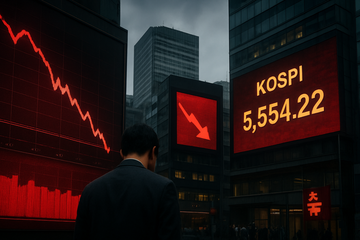
KOSPI close
5,554.22
Down 7.57% — six-month low, intraday -9.29%
Taiex close
-3.4%
Largest drop in three sessions, Oct 15, 2026
Kioxia Holdings
-11.2%
¥13,050 close; -11.2% on Oct 15, 2026
SoftBank Group
-9.6%
¥4,852 close; largest one-day drop since Apr 2025
SK Hynix
-11.1%
₩1,262,000 close; second sharp drop in three sessions
Samsung Electronics
-9.5%
₩210,000 close; foreign selling of ₩3.6T in KOSPI
US 10Y Treasury yield
5.32%
Intraday peak Oct 14 — highest since July 2007
The Trigger Was in New York, Not Tokyo
The Asian session on October 15 opened into a US tape that had already broken. The Bureau of Labor Statistics reported September CPI at 3.7% year-over-year, with energy pushing the monthly print up 0.6%. Within hours, the 10-year Treasury yield spiked to 5.32% — its highest intraday level since July 2007 — before settling at 5.189%, per WSJ's October 14 live coverage. That single yield move repriced the discount rate applied to every far-future cash flow on the AI infrastructure stack, and Asia's most rate-sensitive proxies absorbed the hit first.
The credit leg of the story had been building for weeks. CoreWeave — the AI cloud provider that is essentially a leveraged Nvidia financing vehicle — saw its unsecured junk-bond yields push toward 15% on October 14, while its equity fell 15.46% to $65.78 in a single session, per BigGo Finance. The company carries net debt of roughly $46 billion against an enterprise value near $84 billion and an interest expense that has already outpaced gross profit on a TTM basis, according to its latest 10-Q. Per Goldman Sachs Research, roughly one-third of the ~$600 billion in 2026 hyperscaler AI capex will be debt-financed — a ~$250 billion wall of refinancing that markets are only now starting to price.
Three Exchanges, Three Failure Modes
The selling in Asia wasn't uniform — it reflected three different exposures to the same credit shock. Japan's Nikkei 225 closed at 64,334.68, down 4.9% (a 3,318-point drop), per the Associated Press dispatch. The Taiex fell 3.4% as chip foundries sold off into the night before TSMC's Q3 release. Korea's KOSPI closed down 7.57% at 5,554.22 — a six-month low — and tripped circuit breakers for the tenth time this year when it hit an intraday 9.29% decline, per Reuters via Central Oregon Daily. Foreign investors pulled a net ₩3.6 trillion ($2.68 billion) out of Seoul.
- Japan's pain was concentrated in OpenAI-leveraged and NAND-leveraged names: Kioxia fell 11.2% to ¥13,050, SoftBank dropped 9.6% to ¥4,852, and Tokyo Electron lost 7.5%.
- Korea's pain was structural: SK Hynix collapsed 11.1% to ₩1,262,000 and Samsung Electronics fell 9.5% to ₩210,000 — both now trading well below their 200-day moving averages.
- Taiwan's pain was pre-earnings: TSMC gave back 2% in the cash session ahead of its Q3 release, before recovering to close +0.8% after results showed another record quarter.
- The won and the yen both weakened, with USD/KRW at 1,344.6 — amplifying the USD-denominated AI capex risk for cross-border investors.
Memory Carries the Loser's Side of the Trade
The damage inside Japan's and Korea's tape was concentrated in NAND flash and HBM — the two product categories most exposed to AI accelerator buildouts, and most exposed to a capex pause. Kioxia, which listed on the Tokyo Stock Exchange Prime Market in December 2024 with an offer price of ¥1,455 and trades at roughly 13x earnings on a TTM basis, saw 11.2% of its market cap evaporate in a single session. SK Hynix, the HBM leader whose 76% gross margin and 1.0x ROE have driven its 2026 valuation higher, fell 11.1%. Samsung — the only conglomerate on the list with material non-memory earnings buffer — still dropped 9.5%.
Equipment and Foundry Held Up — Visibility Still Wins
The contrast inside Japan's tape told the story. Advantest, the dominant HBM/SoC test equipment supplier, opened lower but closed up 1.66% at ¥41,610. Tokyo Electron — the deposition and etch leader whose tools run inside every leading-edge fab — also closed up 1.98% at ¥10,570. The reason: order books for advanced-node equipment are already booked into 2027, with 2nm ramps and CoWoS packaging expansion keeping WFE (wafer fab equipment) spending above the $140 billion level per SEMI's Q2 2026 data. A rate spike hurts; a cancelled order book does not.
TSMC's own Q3 results, released October 16, reinforced the foundry divergence. Net profit hit NT$763.1 billion ($23.59 billion), up 69% year-over-year; revenue reached NT$1.494 trillion with gross margin at 66.4%. CEO C.C. Wei struck a more cautious tone on 2027 — \"prudent in our business planning\" — but the company raised its full-year 2026 revenue growth forecast to ~44% (from >40%) and guided Q4 revenue to $52.3-54.3 billion, per Reuters. Capex was maintained at $60-64 billion for the year. Foundry earnings are now the structural counter-anchor to the AI credit story.
SoftBank: The Circular-Finance Link in the Chain
SoftBank Group is the cleanest single read on the AI credit cycle in Asia — and the October 15 drop of 9.6% to ¥4,852 (the lowest close since April 2025) reflected exactly that. The company's FY2025 annual report, filed in July 2026, shows cumulative OpenAI investment at $34.6 billion against a fair value of $79.6 billion — a $45 billion unrealized gain that already partially reversed when AI equities sold off in October. S&P revised SoftBank's outlook to Negative in March 2026 following additional OpenAI commitments, per S&P Global Ratings, and SoftBank has been issuing ¥1.12 trillion in domestic bonds plus $2.2 billion and €1.7 billion in foreign bonds over fiscal 2025 to fund its position.
Per The Kobeissi Letter, SoftBank is in the process of pricing what would rank among the largest junk-bond deals ever to fund a follow-on OpenAI investment. A widening of high-yield credit spreads — even by 100 basis points — flows directly into SoftBank's funding cost and, by extension, into the mark-to-market value of its OpenAI stake.
Supply Chain: Where the Transmission Hits Next
The October 15 sell-off did not hit every name equally because the AI supply chain has clear bottlenecks where demand cannot easily be cancelled. The transmission map runs in two directions:
- Upstream pain runs through HBM and NAND: SK Hynix and Samsung supply HBM to Nvidia and AMD; Kioxia supplies enterprise NAND to AI server OEMs. A capex pause translates into a HBM/NAND inventory build first.
- Upstream resilience runs through equipment: Tokyo Electron and Advantest tools are already committed inside TSMC's 2nm ramps and CoWoS packaging lines, where cancellation penalties and 18-month lead times give near-term revenue protection.
- Downstream pain runs through the funding layer: AI cloud providers like CoreWeave sit at the bottom of the stack — their $46 billion debt load, 11.5x net debt/EBITDA, and 15% bond yields are now the canary for upstream order revisions.
- Capital-flow spillover: a ₩3.6 trillion KOSPI outflow in one session, a stronger USD/KRW, and 10-year yields near 5.3% create a tightening cycle for Asian corporates trying to roll debt — including SoftBank's planned $11 billion issuance.
Fundamentals Still Diverge — The Rout Doesn't Equal the Boom Ending
Memory and AI-proxy companies entered this sell-off with very different balance sheets. Kioxia carries net debt/EBITDA of 0.02x and trades at 15.5x TTM earnings — its sell-off is pure multiple compression. SK Hynix has negative net debt and trades at 5.5x earnings, but its 76% gross margin and 100% return on equity are the most exposed to a capex pause. SoftBank, by contrast, carries net debt/EBITDA of 3.55x and a debt/equity ratio of 1.54x, with interest coverage at -0.5x — meaning operating cash flow alone cannot cover interest expense, which is why a credit-spread widening hits the equity first.
| Company | Net debt/EBITDA | Gross margin | EV/Sales | 1-day move |
|---|---|---|---|---|
| Kioxia | 0.02x | 61.7% | 5.7x | -11.2% |
| SK Hynix | -0.04x | 76.2% | 4.7x | -11.1% |
| Samsung | -0.31x | 56.9% | 2.6x | -9.5% |
| SoftBank | 3.55x | 51.5% | 7.6x | -9.6% |
| CoreWeave (US) | 11.47x | 67.4% | 11.0x | +3.6% (rebound) |
The rebound in CoreWeave — up 3.6% on October 15 to $68.12 — came only after Nvidia CEO Jensen Huang told Bloomberg in Stockholm that the company's \"strength is improving every day\" and its \"cost of capital is actually decreasing.\" That single sentence from the largest shareholder — Nvidia holds a substantial economic interest in CoreWeave — was enough to drive a $1.5 billion intraday rebound in a stock that had lost 15.5% the prior session. The episode exposed the entire AI complex to a new fragility: it now trades on the verbal backstops of a handful of large players, not on operating fundamentals alone.
Short-Term: What Moves in Days and Quarters
Three near-term catalysts will determine whether October 15 is a one-session shakeout or the start of a deeper Asian deleveraging cycle.
- US September PCE on October 31: the Fed's preferred inflation gauge will either confirm or reject the CPI print's signal. A cooler PCE (below 0.3% monthly) would compress yields and stabilize memory; a repeat hot print would extend the rout.
- SoftBank's planned $11 billion junk-bond deal pricing: a successful deal at coupon below 8% revalidates the funding model; a pulled deal or coupon above 9% directly hits SoftBank's equity and, by contagion, Kioxia.
- TSMC's revised 2027 capex commentary: any guidance below the maintained $60-64 billion 2026 range — particularly in advanced packaging — would reset HBM/NAND volume expectations for SK Hynix, Samsung, and Kioxia within one quarter.
Long-Term: The Structural Question for Asian AI
The IMF warned this week — per The Guardian's October 15 reporting — that an AI share-price shock would ripple globally and put financial stability at risk, with Asian markets most exposed. October 15 was a small test of that thesis: a US credit event translated into a -7.57% KOSPI close and a -4.9% Nikkei within 12 hours, with foreign outflows in Seoul alone at $2.68 billion.
The structural question over the next 12-36 months is whether the AI buildout decouples from the credit cycle. If the roughly one-third debt-financed share of the ~$600 billion 2026 hyperscaler capex cannot be refinanced at acceptable spreads, the upstream Asian order book compresses — hitting Tokyo Electron, Advantest, TSMC, and the memory complex in sequence. If it can, the same names re-rate back toward the order-book visibility they had entering October. Either way, Asia is now structurally a beta-2 trade to the US high-yield credit market — and that is a linkage investors will price into every session from here.
Related stocks
- 11.2% one-day drop on Oct 15 is the largest single-session move in its post-IPO history (listed Dec 18, 2024) — multiple compression hit first because Kioxia carries zero HBM exposure and pure NAND AI-proxy exposure
- Net debt/EBITDA of 0.02x and 61.7% gross margin mean the sell-off is rating-driven, not fundamentals-driven — but any further leg down in AI capex sentiment re-prices the entire 15.5x P/E
- Short-term: SoftBank's planned $11B junk-bond pricing is the next binary catalyst; long-term: 2027 NAND capacity ramps vs. AI server demand reset the order book
- 11.1% one-day drop extends a losing streak and pushes the stock below its 200-day moving average — HBM leadership cuts both ways when AI capex is repriced
- 76.2% gross margin and 100% ROE remain best-in-class, but the 5.5x TTM P/E only holds if 2027 HBM volumes stay near current utilization
- Short-term: KOSPI circuit breakers (10th this year) raise trading-halt risk; long-term: HBM4 ramp timing vs. Nvidia's Blackwell/Blackwell Ultra cycle is the decisive variable
- 9.5% one-day drop wipes ₩130 trillion+ in market cap and exposes the conglomerate's AI-memory correlation — even the diversified non-memory earnings buffer didn't cushion the AI-credit transmission
- Net debt/EBITDA of -0.31x and 56.9% gross margin mean the company can absorb the shock, but HBM3E qualification timing remains the unresolved overhang
- Short-term: foreign-outflow risk at KOSPI's open remains elevated; long-term: capturing the HBM #2 slot from Micron determines 2027-28 revenue trajectory
- 9.6% one-day drop to ¥4,852 — the lowest close since April 2025 — directly reflects credit-spread widening on the planned $11 billion OpenAI follow-on junk-bond deal
- FY2025 ended with $79.6B fair value vs. $34.6B cumulative cost on OpenAI; a 20% OpenAI markdown would erase the bulk of the unrealized gain
- Short-term: bond-deal pricing is the binary catalyst; long-term: S&P's Negative outlook (March 2026) implies a one-notch downgrade if metrics worsen — pushing bond coupons higher
- Q3 revenue of US$46.7B (+16.2% QoQ) and 66.4% gross margin confirmed Oct 16 — foundry fundamentals are the structural counter-anchor to the AI credit rout
- CEO C.C. Wei's 'prudent 2027' tone is the first capex guidance risk signal, but 2026 capex of $60-64B is maintained
- Short-term: any 2027 capex revision below $60B triggers memory/NAND order cuts; long-term: CoWoS packaging scarcity keeps foundry margins above 60% regardless of credit cycle
- Opened lower on Oct 15 but closed up 1.98% at ¥10,570 — the equipment layer's visibility kept it from being repriced alongside memory
- Forward order book into 2027 is locked in by 2nm ramps and CoWoS expansion; WFE spending held above $140B per SEMI's Q2 2026 data
- Short-term: TSMC's 2027 capex guidance (October 31 earnings call) is the binary catalyst; long-term: etch/deposition share gains at 2nm sustain the 45.6% gross margin
- The US trigger that started the Asian sell-off: -15.46% on Oct 14, +3.6% rebound on Oct 15 after Nvidia's Jensen Huang comments — the entire AI complex now trades on verbal backstops from a handful of large shareholders
- Net debt/EBITDA of 11.47x and bond yields near 15% define the credit-stress layer that any further AI capex pullback will amplify
- Short-term: next earnings call (early November) is the binary catalyst — any operating cash flow improvement vs. interest expense determines whether the bond market reopens; long-term: a single-customer concentration on Nvidia makes CoreWeave a pure equity proxy for AI capex confidence