
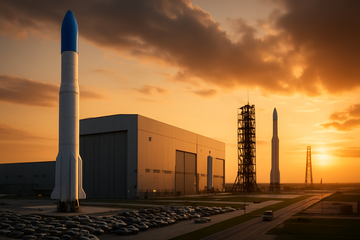
The Oct 16 announcement reads like a real estate filing, but the strategic message is a launch-rate one. A 1.37-million-square-foot Rocket Park addition in Cape Canaveral, targeted to be complete by summer 2027, gives Blue Origin the throughput to support up to 150 New Glenn 9x4 upper stages a year — the bottleneck for moving from a four-flight-in-15-month track record to multiple flights per week by 2030. The capex piggybacks on a year of compounding commitments: a $600M \"Project Horizon\" upper-stage plant in May, a $160M payload processing facility in August, a $78.2M Space Force satellite-processing win in late 2025, and an FAA filing to lift the LC-36A annual cadence from 12 to 50. Together they rewire the US heavy-lift market from a SpaceX solo into a duopoly with credible second sourcing.
Expansion capex
$330M
Rocket Park campus, Cape Canaveral; announced Oct 16, 2026
Facility footprint
1.37M sq ft
Targets 150 New Glenn 9x4 upper stages/year; completion summer 2027
Target flight rate
50/year → weekly
FAA filing raises LC-36A cap from 12; goal is multiple New Glenn launches/week by end of decade
Florida footprint (total)
$3B+ invested
5,000+ employees across 20+ sites in Brevard and Orange counties
Latest funding round
$10B raised
Valued at $140B; CEO Dave Limp described round as \"oversubscribed,\" Sept 30, 2026
What $330M Actually Buys
Blue Origin's campus footprint has more than doubled in 12 months. The Rocket Park build adds the manufacturing depth the company has been missing since New Glenn's debut: an in-house upper-stage production line scaled for the 9x4 variant, which carries nine BE-4 engines on the first stage and four BE-3U engines on the upper stage versus the seven-and-two configuration currently flying. Senior Vice President of Operations Ian Richardson tied the spend directly to cadence: the campus is \"designed to support multiple flights per week by the end of the decade.\"
- Two additional launch and landing pads — modeled on Launch Complex 36A (for New Glenn 7-2) and LC-36B (for New Glenn 9x4, still under construction) — push the company toward its FAA target of 50 flights/year at LC-36A alone.
- Two new landing vessels join the marine fleet to recover boosters for the vertical integration facility also rising at Cape Canaveral.
- A new customer integration facility, co-built with the US Space Force, lets Blue Origin run multiple missions in parallel — the binding constraint that today keeps cadence low.
- Cumulative Florida capex now exceeds $3B across 20+ sites, with 5,000+ employees; the latest round of grants from Florida's Spaceport Improvement Program underwrites part of the build.
The Duopoly Math Just Reset
The timing matters because SpaceX is openly walking away from the bus that built its launch empire. Per reporting in August 2026, SpaceX plans to retire Falcon 9 once Starship is flying \"reliably several times per week,\" with commercial Falcon 9 sales widely expected to wind down beginning in 2028. Falcon 9 still lifts ~25 tons to LEO; Starship V3 is sized for more than 100 tons. The gap that opens for everyone else — commercial constellations, NSSL Lane 1, NASA payloads, international customers — is exactly the 12–70-ton class New Glenn and the future New Glenn 9x4 are built to fill.
US Heavy-Lift Capacity (tons to LEO)
Heavy-lift payloads per launch, by vehicle. New Glenn 9x4 clears the entire Falcon Heavy-to-Falcon 9 gap and sits a tier below Starship.
Unit: tons to LEO
Falcon 9
25
New Glenn 7-2
45
Falcon Heavy
63
New Glenn 9x4
70
Starship V3
100
Rocket Lab's Neutron, the only other credible US medium-lift debut this decade, slipped into 2027 in mid-October — its carbon-fiber stage issue has pushed the inaugural flight beyond the original 2026 window. That leaves Blue Origin as the only scaled second source for US commercial and government heavy-lift between 2027 and 2030, which is precisely the window in which Falcon 9 commercial availability is supposed to fade. The supply tightening shows up in two customer queues: Amazon's Project Kuiper constellation, which paid Blue Origin roughly $585M through April 2025 against a $7.4B total launch-services spend across providers, and AST SpaceMobile's Block 2 BlueBird deployment, which needs reliable New Glenn capacity through 2027–28.
The 9x4 Design Choice Is the Pricing Lever
The new Rocket Park line is purpose-built for the 9x4 variant — nine BE-4 engines on the booster and four BE-3U engines on an enlarged upper stage. The variant more than triples New Glenn's trans-lunar injection capability to >20 tons versus 7 tons for the 7-2 baseline, and lifts LEO capacity to >70 tons versus 45 tons. That re-rates the rocket's competitive position relative to Falcon Heavy (~63 tons to LEO, expendable) and creates genuine optionality on crewed lunar logistics, where NASA's Mars Telecommunications Orbiter task order — a $700M-class award announced in October — gives Blue Moon a near-term anchor customer.
| Spec | New Glenn 7-2 (current) | New Glenn 9x4 (upcoming) |
|---|---|---|
| First-stage engines | 7 × BE-4 | 9 × BE-4 |
| Upper-stage engines | 2 × BE-3U | 4 × BE-3U |
| Payload to LEO | ~45 t | >70 t |
| Payload to TLI | ~7 t | >20 t |
| Manufacturing line | Existing | New Rocket Park facility (summer 2027) |
Supply Chain: Who Feeds the Build
Blue Origin builds its BE-4 engines in-house, but the airframe, structures and avionics flow from a publicly identifiable supplier base. Constellium supplies Airware aluminum-lithium plate and sheet for New Glenn from its Ravenswood, West Virginia plant — a contract Blue Origin has extended as cadence scales. Smaller Kansas machine shops — Harlow Aerostructures among them — handle complex machined components and electromechanical subassemblies for the engine and vehicle programs. For the campus build itself, Florida's Spaceport Improvement Program is the public coffer; construction subcontractors handle the 830,000-square-foot Project Horizon plant and the new 1.37M-square-foot Rocket Park addition.
BE-4 production is itself a hidden second-source stream: each Vulcan launch by United Launch Alliance consumes two BE-4 engines, and Vulcan has steadily pulled ahead of New Glenn on launch count. That means every Blue Origin engine-factory throughput hour is shared with ULA's Vulcan manifest — and Vulcan's commercial backlog (most visibly the 38-launch Amazon Kuiper commitment) effectively subsidizes the same line that builds New Glenn's first stage. Investors watching Lockheed Martin and Boeing, the ULA partners, are watching a sister supply chain rather than a competing one.
- Constellium — Airware aluminum-lithium plate/sheet for New Glenn from Ravenswood, WV; the higher 9x4 cadence directly increases Constellium pull-through on aerospace plates.
- KBR — engineering, program management and construction services across multiple Florida spaceport builds; the $330M campus is the kind of program KBR's Government Solutions segment is structured to support.
- Redwire — Florida-headquartered (Jacksonville) space components, sensors and avionics; rising launch cadence at Cape Canaveral pulls through more Redwire flight hardware per quarter.
- Harlow Aerostructures and other Kansas machine shops — complex machined components and subassemblies for New Glenn and BE-4, public under Blue Origin's Kansas supplier agreements.
The Customer Line — Who Pays for the Cadence
Three contracts carry the demand math. First, the US Space Force's National Security Space Launch (NSSL) Phase 3 Lane 1 award: $13.7B split across SpaceX, United Launch Alliance and Blue Origin in April 2025, with the first firm NRO task order going to Blue Origin on May 28, 2026 — the same day the static-fire explosion occurred at LC-36A. The fact that the Space Force did not pause the task order underscores how dependent the NSSL Lane 1 architecture is on having two viable heavy-lift providers.
Second, Amazon's Project Kuiper: 12 New Glenn launches under contract with options for 15 more, against a wider 83-launch portfolio across ULA, Arianespace and Blue Origin. Amazon had paid roughly $1.7B across all launch agreements by April 2025, of which approximately $585M went to Blue Origin; its $7.4B cumulative launch spend through 2028 makes Amazon the largest single customer any second-source heavy-lift provider has ever had. Third, AST SpaceMobile's Block 2 BlueBird deployment, which has been the public stress test of New Glenn reliability: BlueBird 7 was lost when NG-3's upper stage placed it in too low an orbit on April 19, 2026, with AST SpaceMobile filing a roughly $30M insurance claim.
| Program | Customer | Status / value |
|---|---|---|
| NSSL Phase 3 Lane 1 | US Space Force / NRO | $13.7B pool; first NRO firm task order to Blue Origin, May 28, 2026 |
| Project Kuiper | Amazon (Project Kuiper) | 12 firm New Glenn launches + 15 options; ~$585M already paid to Blue Origin |
| BlueBird Block 2 | AST SpaceMobile | Multi-launch agreement; BlueBird 7 lost Apr 2026, $30M insurance claim filed |
| Mars Telecommunications Orbiter | NASA | $700M-class task order for Blue Moon–delivered orbiter, announced Oct 2026 |
Short-Term and Long-Term Horizons
Short term (days to quarters), the market re-prices the second-source option. The FAA's 30-day public comment period on the 12-to-50 launch rate at LC-36A closes Oct 30, 2026 — approval is the binary near-term catalyst for the cadence math to clear. Any sign that the NG-3 upper-stage failure has been root-caused and the May static-fire anomaly is contained tightens the same catalyst. Investors in the listed supply chain — Constellium, KBR, Redwire — get a multiple lever on Blue Origin's order book before Blue Origin itself is investable; AST SpaceMobile is the cleanest single-name read on New Glenn reliability.
Long term (one to three years), the structural call is whether the $330M build actually delivers multi-weekly flights by 2030. The summer 2027 facility completion is the binding constraint on 9x4 throughput; until then, Blue Origin is still effectively running on a single-variant (7-2) production system while recovering from a year of two high-profile anomalies. The launch rate that matters for the NSSL, Kuiper and AST backlogs is the rate after summer 2027 — and the rate that matters for the duopoly math is the rate after 2028, when SpaceX is widely expected to stop selling new Falcon 9 commercial slots. The honest risk to the thesis is execution: a second consecutive year of flight anomalies would push the cadence ramp into 2029 and erode the second-source premium before it is fully priced in.
Investable names tied to the Blue Origin build
- Multi-launch New Glenn agreement is the primary 2026–2028 deployment path for Block 2 BlueBirds; BlueBird 7 loss on NG-3 cost a $30M insurance claim and pushed schedule right.
- Higher New Glenn cadence directly accelerates AST's constellation build-out and revenue per launched satellite; reliability recovery is the binary catalyst.
- Stock trades at ~150x EV/Sales (TTM through Jun 30, 2026) on $115M LTM revenue — execution risk cuts both ways; a successful cadence ramp pulls the multiple toward revenue.
- Project Kuiper has paid Blue Origin ~$585M to date against a $7.4B launch spend through 2028 — Blue Origin is structurally tied to Kuiper's deployment deadline.
- Higher New Glenn cadence de-risks Kuiper's FCC half-orbit-by-July-2026 milestone and pulls forward the AWS/connectivity revenue mix tied to the constellation.
- Indirect Bezos ownership link makes Blue Origin an extension of Amazon's space strategy; capex confidence at $140B private valuation signals no near-term capital ask from Amazon.
- Neutron's slip from 2026 into 2027 (announced mid-October 2026) hands the medium-lift second-source slot to Blue Origin for at least another 18 months.
- Electron continues to compete in the small-launch class untouched by New Glenn, but the heavy/mid-lift convergence is the strategic prize Rocket Lab is now chasing from a delayed start.
- Stock trades near $50.84 vs $151 52-week high; binary catalyst is Neutron's first launch in 2027 — every quarter of slip widens the Blue Origin launch-rate advantage.
- Florida-headquartered space-components supplier (Jacksonville); rising Cape Canaveral launch cadence pulls through more sensors, avionics and spacecraft platforms per quarter.
- LTM revenue $426M against ~$2.1B market cap (price ~$8.39, P/S ~5x); operational leverage to a multi-year US launch-rate doubling is the structural call.
- Direct exposure to both Blue Origin and broader Space Force/NSSL demand from the same Florida industrial base.
- Named supplier of Airware aluminum-lithium plate/sheet for New Glenn; higher 9x4 upper-stage cadence directly increases Ravenswood, WV pull-through.
- Aerospace & Transportation segment is the wedge into a multi-year Blue Origin supply extension; trading at ~6.7x P/E (TTM through Jun 30, 2026) leaves room for re-rating.
- Cumulative Florida program scale (Blue Origin + Vulcan via ULA's BE-4 airframes) supports a sustained aerospace-mix shift, not a one-off order.
- Government Solutions segment covers spaceport engineering, construction management and program support — the $330M Rocket Park build is the type of work KBR's space portfolio is built for.
- LTM revenue $7.7B, operating margin ~7.6%, EV/EBITDA ~8x — space is a growth wedge inside a mature engineering services book, not the dominant thesis.
- Material upside requires multiple parallel Cape Canaveral wins (Blue Origin, Space Force, ULA); one anchor contract alone moves the needle less than peers with concentrated space exposure.
- Owns half of ULA alongside Lockheed Martin; a stronger Blue Origin indirectly tightens ULA pricing power on NSSL Lane 1, which cuts both ways for the partners.
- Mission Extension Vehicle and sat-servicing lines compete in adjacent orbit-services markets but do not rely on New Glenn cadence.
- Catalyst to watch: any Blue Origin move into GEO satellite servicing or ESPAStar-class bus work would compete directly with NOC's space-logistics franchise.
- ULA partner sharing Vulcan margin with Boeing; Vulcan's Kuiper backlog (38 launches) is the indirect read-through on Blue Origin engine production health.
- National security space franchise benefits from a credible second-source heavy-lift option — pricing discipline on NSSL Lane 1 task orders holds if Blue Origin stays operational.
- Lockheed is not directly exposed to New Glenn airframe work but is structurally long on US launch-rate durability, which is what the $330M build extends.