
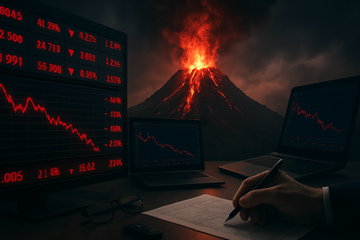
The metaphor is deliberate. On Saturday, October 17, 2026, Michael Burry posted on X that for 'each of the ten market tops over the last 40 years, one will find a caldera of lava underneath the placid S. Park-like valley floor. Akin to Super Volcano Caldera under Yellowstone Park in real life. The lava, actually magma, has settled into levels.' The 'S. Park' reference is to a placid surface, not to South Park — and the post landed one day after the worst week for the Nasdaq since June, one day after a -2.14% Friday that dragged the index down 4.5% on the week, and on the same morning that CoreWeave bonds were still trading at distress-level yields above 15%.
This article traces that convergence: what Burry actually said, what the tape actually did on October 16, and why the combination — AI debt stress, a 5.10% 10-year, a hedge-fund blowout rumor spike in the VIX, and a deregistered fund manager running a Substack — is the kind of inflection that turns a quiet October into something else.
The Caldera Post, Word for Word
Burry's supervolcano post on Saturday, October 17, 2026 was not a price prediction. It was a chart argument: each of the past ten S&P 500 peaks sat above a layer of latent stress that didn't show up in the index itself. He backed it with real examples — the real S&P 500 fell roughly 53% between 1966 and 1982, was down 58% in real price from 1929 to 1949, and lost about 40% in real terms from the 2000 peak to the 2011 trough. With dividends reinvested those drawdowns shrink to roughly 10% and 25%, but the unreinvested magnitude is what stays with a reader.
- Burry's post drew on the breadth warning he has run for months: 182 straight trading days without a session where 80%+ of NYSE volume came from falling stocks — the longest streak in 30 years, per BTIG's Jonathan Krinsky.
- It landed less than two weeks after a separate Burry note on September 28, 2026, when he told investors the 'AI bubble may burst sooner than later,' sharpening his earlier 'less than 270 days' timeline from earlier in October.
- His Q3 2025 13F — filed November 3, 2025 — had already disclosed put options on roughly 5 million Palantir shares and 1 million NVIDIA shares, with a notional of about $1.1 billion at the time of disclosure.
The Day the Surface Cracked: October 16, 2026
Nasdaq Composite close
26,140.03
-2.14% on Friday Oct 16, 2026; -4.5% for the week, worst since June
S&P 500 close
7,659.44
-1.09% on Oct 16; -1.9% on the week; still +15.5% YTD per S&P DJI
Dow Jones close
52,002.41
-0.34% on Oct 16; +0.7% on the week (only major index up)
VIX close
19.99
+21.45% on the session; intraday spiked roughly 30% above 21 on hedge-fund blowout rumors
10-year Treasury yield
5.085%
Hovering near 5.10% Oct 15; within a basis point of a 17-year high
The numbers are tidy, and they cluster. A 2.14% drop in the Nasdaq is not panic — it is one bad day. A -4.5% week after a record-high stretch is the kind of pullback that the buy-the-dip crowd usually shrugs off. But the VIX told a different story: it spiked roughly 30% intraday on October 16 to above 21 — a four-month high — on circulating rumors of a major hedge fund collapse, before settling at a still-elevated 19.99 close.
Reuters reported the Nasdaq was on track for its sharpest weekly fall since June, while the S&P 500 was set for its steepest weekly loss since January. Within the tape, Palantir dropped 7.22% to $186.03, NVIDIA shed another 1.43% to $214.13 on a seven-session losing streak that has erased more than $850 billion of market capitalization since late October 2025, and Broadcom fell 3.6%. The PHLX Semiconductor Index closed down 3.83% at 11,137.29 — its eighth straight day of declines and the longest such streak in sixteen years.
The Lava Underneath: AI Debt Is Where the Surface First Cracks
If October 16 was the day the index showed the cracks, the AI-infrastructure complex has been showing them for a week. CoreWeave — the Nvidia-backed GPU cloud provider that went public in March 2025 — saw its stock fall roughly 15.5% on Wednesday, October 14, closing at $65.78, with its 9.75% bonds due 2031 yielding15.78% and credit-default swaps pricing distress. The Reuters reading: bonds issued in June at a 9.675% yield have since plunged in price, pushing their yield to 15%. NVIDIA CEO Jensen Huang's optimistic comments Thursday helped CoreWeave recover about5%, but the underlying message — that debt-funded AI compute is being repriced in real time — did not go away.
AI-Debt Stress Signals Concentrate in CoreWeave
CoreWeave's two bond issues were both trading at yield levels associated with distress by mid-October 2026, while its stock closed the week well below its March2025 IPO price of $40 plus subsequent run.
Unit: percent
CRWV 9.75% bond due 2031 yield (Oct 14, 2026)
per CNBC, distress territory
15.8
CRWV June bond yield (Oct 15, 2026)
per Reuters, originally issued at 9.675%
15
CRWV stock decline Oct 14, 2026 (%)
close $65.78, per Admiral Markets
-15.5
PHLX Semiconductor Index weekly move (%)
5-day loss per Reuters, 8-day streak per index data
-8
Burry's specific worry is the math of the buildout. Hyperscaler AI capex is on track for roughly $600–700 billion in 2026, with J.P. Morgan estimating $697 billion. That spend is funded by an estimated $250 billion in investment-grade debt issuance from the largest hyperscalers alone. CoreWeave is a smaller but more leveraged version of the same story: take on debt to buy GPUs, lease them back to AI labs, and hope the resulting revenue outruns the cost of capital. When 10-year yields sit at 5.10% and bond spreads widen, the hope gets repriced.
The $1.1 Billion Short That Built Into a Stalk
Burry's AI thesis isn't a Substack opinion, it's a portfolio. In his Q3 2025 13F filing — disclosed November 3, 2025 — Scion Asset Management reported put options on 5 million Palantir shares (about $912 million at the time) and 1 million NVIDIA shares (about $186.5 million). Total notional: roughly $1.1 billion. On September 10, 2026, he told investors he was trimming all positions and shedding the December 2026 NVIDIA and Palantir puts. Two weeks later, on September 28, he told CNBC the 'AI bubble may burst sooner than later.'
- The dollar size of Burry's 13F is modest relative to a multibillion-dollar hedge fund — Scion held about $155 million in discretionary assets when it deregistered — but the notional of the puts is what shows up in headlines.
- Burry deregistered Scion Asset Management on November 13, 2025, telling investors he 'no longer understands how today's markets work' and returning capital. He now publishes 'Cassandra Unchained' on Substack, which crossed 300,000 subscribers in 231 days.
- That positioning matters: the supervolcano post isn't a fund manager adjusting a book in real time. It is someone who has already returned capital, talking to retail readers — and the timing (peak complacency in AI, peak AI debt stress, peak10-year yield) is the message.
The Macro Pinch: 5.10% Yields, a Hot CPI, and a 50-50 Fed
Burry's caldera is not built from AI debt alone. It also contains the macro layer. The Federal Reserve raised rates 25 bps on September 16, 2026, taking the target range to 3.75–4.00%. September core CPI came in at 2.6% year-over-year versus a 2.5% Reuters poll forecast, with September headline CPI at 3.7%. Reuters reported that market pricing for an October Fed rate hike rose sharply to roughly 50-50 on the data. Software prices, which Burry has flagged repeatedly, were up 28% year-over-year — the largest increase ever recorded in that component.
The 10-year yield responded by sticking near 5.085% on October 16 and 5.10% on October 15, after the 30-year had touched 17-year highs earlier in the month. The 10-year had posted its biggest two-day high-to-low move of the year on October 15, closing at 5.08%, in a partial relief bounce — but the level itself is the story. At 5.10%, the long end of the curve is forcing a discount-rate reset on the entire AI capex stack.
Fed funds target range
3.75%–4.00%
After 25 bps hike on Sept 16, 2026; next FOMC Oct 27–28
September core CPI YoY
+2.6%
Above 2.5% Reuters poll forecast; headline +3.7%
Hyperscaler AI capex 2026E
$697B
J.P. Morgan estimate; ~$250B funded via investment-grade debt
S&P 500 stocks above 200-day MA
55.6%
As of Oct 11, 2026, per MacroMicro — narrow rally confirmed
If the Fed hikes again on October 28 — currently priced at roughly 17% probability per Morningstar — the curve pushes higher and the CoreWeave-style debt stress migrates from a single name into the broader hyperscaler stack. If it holds, the relief may not last: a 50-50 market implies a coin-flip, and a hawkish surprise six days before a U.S. election is a setup the Nasdaq does not need.
The Anthropic Variable: A $2 Trillion Test on the Calendar
Anthropic is private, but its IPO is the cleanest single test of the AI bubble thesis on the calendar. Reuters reported on October 16, 2026, that prospective investors are tempering valuation expectations for the listing, even as bankers discuss a target near $2 trillion. Anthropic told prospective IPO investors on Wednesday, October 15 that its Q3 revenue jumped 45% to $16.8 billion — strong absolute growth, but a deceleration from earlier quarters. The IPO prospectus reportedly shows a near-$42 billion net loss against that $965 billion May valuation.
For Burry, this is the second-order transmission. A markdown of the IPO would weaken the equity case for the hyperscalers and the GPU cloud providers in one move, which feeds back into NVIDIA order book assumptions. The same feedback loop runs through Palantir, whose revenue is partly a function of government and large-enterprise AI budgets — and which dropped7.22% on October 16 as that transmission was repriced in real time.
Horizons: Days vs. Quarters vs. Years
The short-term catalyst calendar is dense. The October 28 FOMC sits six days before the U.S. election. The Anthropic IPO is reportedly targeting a mid-to-late October marketing window. NVIDIA and Palantir earnings will reset expectations for AI capex conversion into revenue. And CoreWeave has $2.75 billion of 9.75% bonds due 2031 trading at 81 cents on the dollar — the kind of price action that, in past cycles, has preceded both forced equity issuance and covenant resets within ninety days.
Over one to three years, the structural question is whether the AI capex stack can generate cash flow fast enough to amortize the debt that built it. The 2026 hyperscaler spend of roughly $697 billion is a 36% increase over 2025, and roughly $250 billion of that is debt-funded. If the underlying AI revenue compounds at even half the rate analysts are pricing, the math closes. If it doesn't — and Burry's caldera argument is that crowding, leverage, and stretched multiples make it harder to generate alpha from AI exposure at current valuations — then the surface cracks again, and the S&P 500's +15.5% YTD run reverses in the same way that the unreinvested 1966–1982 real return of -53% played out in Burry's examples.
Stocks the Supervolcano Post Touches Directly
- Burry's Q3 2025 13F put roughly 1 million NVDA shares — about $186.5M at disclosure — and his September 28, 2026 'AI bubble may burst sooner than later' note explicitly named the AI capex stack.
- The stock is on a seven-session losing streak through October 16, 2026, closing at $214.13 (-1.43% on the day), with more than $850B of market cap erased since late October 2025.
- Near-term: Q3 earnings will reset the data-center order book; an October 28 Fed hike adds a discount-rate headwind that pulls forward the caldera thesis into days and weeks, not quarters.
- Burry's Q3 2025 13F put roughly 5 million PLTR shares — about $912M at disclosure — the larger leg of his $1.1B AI short.
- The stock dropped 7.22% on October 16, 2026 to $186.03, the biggest single-day AI-software casualty of the selloff week.
- Over 1–3 years, an Anthropic IPO markdown directly pressures PLTR's enterprise and government AI valuation premium, the same transmission Burry flagged in his 'less than 270 days' note earlier in October.
- Stock fell 15.5% on October 14, 2026 to $65.78; the 9.75% bonds due 2031 traded at a15.78% yield, with CDS at distress — the single most concentrated AI-debt stress signal in the public market.
- Bonds issued in June 2025 at 9.675% have since repriced to 15%+, meaning the cost-of-capital math that underwrote CoreWeave's GPU buildout no longer works at current rates.
- Near-term risk: covenant resets or forced equity issuance within the next 90 days if 10-year yields stay above 5.10% and the Fed adds a hike on October 28.
- Fell 3.6% on October 16, 2026 — a direct read-through from the AI-debt stress that hit CoreWeave and the broader chip complex.
- AVGO's AI ASIC and networking exposure is a longer-duration beneficiary of hyperscaler capex, but the same capex math that pressures CoreWeave pulls forward valuation risk for AVGO at +20x peak sales multiples.
- Over 1–3 years, AVGO is leveraged to the AI buildout continuing; the caldera thesis says that exposure cuts both ways, with custom-silicon wins offsetting multiple compression.
- HBM demand is tied to the same AI capex stack Burry is calling a bubble — MU is the most concentrated US-listed beneficiary of that spend, and the most concentrated risk if hyperscalers pull capex.
- Micron trades as a long-duration AI proxy and will reprice with the rest of the chip complex; the PHLX Semiconductor Index's eighth straight losing day through October 16 captured that flow.
- Binary near-term catalyst: the next two quarters of HBM contract pricing will determine whether MU is a beneficiary or a victim of the same buildout that is pressuring CoreWeave.
- TSMC is the foundry chokepoint for every AI chip named above; a capex pullback at hyperscalers transmits directly into TSM wafer demand with a one- to two-quarter lag.
- The stock has tracked the PHLX Semiconductor Index's eight-day slide, but is structurally insulated by its process-node lead and pricing power.
- Watch Q4 2026 earnings for hyperscaler capex commentary — a downward revision is the cleanest confirmation that the AI capex stack is starting to crack from the foundry end.
- QQQ closed the week of October 13–16, 2026 down 4.5% — its worst week since June — and the index's largest components, NVIDIA and Palantir, are the same names Burry is short.
- The October 28 FOMC and a mid-to-late October Anthropic IPO window are the two largest near-term catalysts; both cut in the direction of the caldera thesis on a hawkish surprise or a markdown.
- Over 1–3 years, QQQ is the cleanest single-vehicle expression of the AI capex trade — and the cleanest expression of the trade unwinding if Burry's caldera argument is right.