
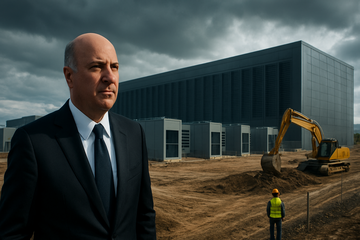
O'Leary: share of announced projects that will never get built
60–65%
MarketBeat, Oct 14, 2026
Tenants in 2026 want per-site capacity up from 250–500 MW to
1.4 GW
MarketBeat interview, Oct 16, 2026
Hyperscaler AI capex, 2026 (Amazon + Microsoft + Alphabet + Meta)
~$740B
Company guidance, 2026
US data center power demand added in 2026 (Goldman revised Oct 5)
+12 GW
Goldman Sachs Research, Oct 5, 2026
Data center projects blocked or delayed in 2026 H1 (Data Center Watch)
$170B+
Data Center Watch, Q2 2026 report
Large projects Sightline Climate expects delayed or cancelled in 2026
30–50%
Sightline Climate, Feb 2026
The warning
Mr. Wonderful, the man building the world's largest data center, just shorted the thesis
On the MarketBeat YouTube channel on October 16, 2026, host Bridget Bennett aired an interview titled \"Mr. Wonderful Warns Most AI Data Centers Will Shut Down (Here's Who Wins).\" The guest was not an enterprise-AI startup founder — it was Kevin O'Leary, the Shark Tank investor who chairs O'Leary Digital and is personally trying to build what he calls \"Wonder Valley,\" a planned 40,000-acre AI campus in Box Elder County, Utah with 9 gigawatts of on-site gas generation. He has skin in the game at unprecedented scale, and he used the interview to say something that contradicts his own commercial interest: 60-65% of announced North American data center projects will never get built.
A clarification is necessary because the assignment that surfaced this story conflated two unrelated \"Wonderful\" entities. Wonderful AI — the Amsterdam-headquartered enterprise-AI-agent startup that closed a $550M Series C at a $5B valuation on September 2, 2026 with Salesforce as a new investor — has not, as far as the public record shows, issued any bear thesis on data center shutdowns. The speaker here is the unrelated Mr. Wonderful, Kevin O'Leary, and that distinction actually strengthens the call: the warning comes from a developer who is mid-bid on the biggest project in the country, not from a pundit with no exposure.
His math is hard to dismiss as outsider noise. He frames the test as three filters: do you have power, do you have a permit, do you have an anchor tenant? Most announced projects fail at least one. A single hyperscale project now runs ~$16B from planning to operations, with planning alone costing $20-30M per gigawatt, and tenants that used to ask for 250-500 MW are now asking for at least 1.4 GW — a jump that can only be served by sites that already have utility-scale power agreements.
The paradox
The bear case comes from the bull, and the bull case still has $740B behind it
On paper, the bull case has gotten stronger since the summer, not weaker. The four largest hyperscalers — Amazon, Microsoft, Alphabet and Meta — are guiding to roughly $720-745B of capital expenditure in 2026, up about 77% from a year earlier. Amazon raised its 2026 capex estimate to roughly $220B in its Q2 release; Microsoft spent $41B in fiscal Q4 alone (July 29, 2026) and brought 88 new data centers online across FY2026; Meta bumped its 2026 capex range to $125-145B; and Oracle, a fifth hyperscaler, told investors its FY2026 capex reached $55.7B and guided to $70B of net capex in FY2027 after signing $67B of new AI infrastructure contracts in Q4 alone. Goldman Sachs Research raised its US data center power demand forecast on October 5, 2026, now expecting +12 GW in 2026 and +17 GW in 2027.
Where the 2026 AI buildout dollars are going
Hyperscaler 2026 capital expenditure by company. Oracle is now a fifth player on a similar trajectory.
Unit: USD billions
Amazon (raised to $220B in Q2)
220
Microsoft (FY26 capex)
190
Alphabet (2026 guidance)
185
Meta (raised range)
135
Oracle (FY26, FY27 guide $70B)
55.7
That is a one-sided way to look at the same number. The other side is Kevin O'Leary's 60-65%, applied to the much larger universe of speculative projects that hyperscaler announcements have spawned — REITs, developers, and shell companies that announced campuses but have neither power agreements nor anchor tenants. Multiplied through the pipeline, the practical implication is that even a $740B capex year from the four biggest hyperscalers will result in less physical capacity than the headline announcements implied.
Where the body count falls
Real-estate exposure sits at the wrong end of the funnel
Listed data center REITs are the cleanest way to play the bear thesis because their assets are long-duration, debt-heavy, and dependent on contractually locked power — and most of their announcements over the last 18 months have been speculative. Equinix trades at 12.6x EV/sales and 27.7x EV/EBITDA on its TTM through June 2026, with $95.9B of market cap and $9.83B of revenue. The company raised its full-year 2026 revenue growth guidance to 11-12% and AFFO/share to 10-12% on July 29, 2026 — strong, but the multiple assumes the buildout completes. Digital Realty Trust, the more levered of the two at 4.8x net debt/EBITDA and 85x trailing P/E, has 3.0 GW of IT capacity in service and 6.3 GW buildable. Both stocks gave back gains on September 15, 2026 after a weaker outlook from Digital Realty spooked the sector, and the pair has underperformed since.
| Company | Ticker | TTM revenue | EV / EBITDA | Exposure to O'Leary's bear case |
|---|---|---|---|---|
| Equinix | EQIX | $9.83B | 27.7x | Backlog protected; new project announcements exposed |
| Digital Realty Trust | DLR | $6.76B | 26.4x | Most levered (4.8x ND/EBITDA); speculative pipeline at risk |
| Vistra | VST | $19.2B | 10.4x | Sells into demand regardless of which projects break ground |
| Constellation Energy | CEG | $31.3B | 15.2x | Nuclear baseload; hyperscaler PPAs locked in |
| NVIDIA | NVDA | $303.0B | 23.2x | Compute sold to survivors; near-zero exposure to real-estate cancellations |
The contrast with the power sellers is the point. Vistra, the Texas-based independent power producer with 38,700 MW of generation capacity, sold 5-10x more reliably than the REITs throughout the October selloff — its customer is whichever data center actually energizes, not whichever one gets announced. Constellation Energy, which runs the largest US nuclear fleet at 32,400 MW, has already locked in 20-year power contracts with Microsoft to restart Three Mile Island's Unit 1 and operates behind a regulated moat that doesn't depend on any one project breaking ground. These two utilities trade at 10-15x EV/EBITDA, roughly half the multiple on the data center REITs, and that gap is the entire market mispricing the \"useful vs. provisioned\" divergence.
Supply chain
The survivors will look a lot like NVIDIA, not a lot like a REIT
NVIDIA is the clearest beneficiary of the divergence and the easiest case to underwrite. Q2 FY2027 (reported August 26, 2026) delivered $96.2B of revenue, up 106% year-over-year, with data center revenue of $89.0B, up 117%. The customer base is the four hyperscalers that are spending the $740B, and NVIDIA does not care which announced campus gets canceled — its chips go into the surviving 35-40% of the pipeline, not the announced 100%. Oracle sits in a more interesting middle: it is signing $67B of new AI infrastructure contracts in a single quarter and committing $70B of FY2027 capex to back them, but its stock sold off after its June 10, 2026 release because the contracts require it to fund data centers before customers pay, putting pressure on free cash flow. Oracle is the hyperscaler most exposed to the \"useful vs. provisioned\" gap if its anchor tenants scale slower than the buildout.
- Power: Vistra and Constellation Energy sell into whichever projects survive; their earnings are insulated from project cancellations because contracted capacity, not announcements, sets revenue.
- Compute: NVIDIA sells to hyperscalers that have the power, the permits, and the capital to finish — three filters that filter out 60-65% of announced demand.
- Hyperscalers: Amazon, Microsoft, Alphabet and Meta still build aggressively but increasingly use their own custom silicon, which compresses NVIDIA's unit economics over time.
- Real estate: Equinix and Digital Realty Trust carry the speculative project risk; the higher the multiple today, the more the cancellation rate is being assumed away.
- Adjacent: steelmakers like Cleveland-Cliffs and Nucor have ridden the AI infrastructure narrative, but data centers use far less steel per dollar of capex than factories or transmission, so the demand-side exposure is thinner than the market has priced.
Horizons
What moves first, what takes 1-3 years, and the main risk to the thesis
Days to quarters: the test of Kevin O'Leary's call comes from the next two earnings cycles of Equinix (October 29 guidance) and Digital Realty Trust (October 29, 2026), and from Q4 hyperscaler capex updates. Any guided slowdown in new project signings, or any meaningful reduction in \"backlog conversion\" to operating capacity, will be the first confirmation. The current setup — REITs at 26-28x EV/EBITDA, utilities at 10-15x — is what the gap looks like before the market accepts the divergence.
One to three years: the survivors of the 60-65% cull will be the listed projects with permits, power, and anchor tenants today. Power infrastructure (gas turbines, nuclear restarts, grid interconnection) takes 18-36 months to deliver and is the binding constraint on which 35-40% survives. Any company whose revenue model depends on the announced 100% — speculative REITs, certain private developers, Crusoe competitors, and any merchant data center without a hyperscaler anchor — is in line for the cull. The risk to Kevin O'Leary's thesis is the opposite: if power bottlenecks ease faster than expected — through grid reform, behind-the-meter gas, or siting reform — the cancellation rate falls and the REITs catch a bid. Meta's October 21, 2026 earnings will be a leading indicator of how aggressively the hyperscalers expect to self-supply power going forward.
Stocks that move on the useful-vs-provisioned divergence
- At 27.7x EV/EBITDA the multiple assumes the announced buildout completes; O'Leary's 60-65% cancellation rate would force a re-rate if backlog conversion slows in the October 29 earnings.
- Even with management's 11-12% revenue growth guide for 2026, the gap between announced campuses and operating ones means future capex commitments carry the highest speculative risk in the REIT complex.
- Most balance-sheet-exposed of the data center REITs at 4.8x net debt/EBITDA, 85x trailing P/E, and 6.3 GW of buildable capacity that depends on which speculative projects break ground.
- Already absorbed a 16% one-day selloff in September2026 on weaker outlook — a 60-65% cancellation backdrop extends that drawdown.
- Sells 38,700 MW of generation to whichever data center actually energizes; earnings insulated from project cancellations because contracted power, not announcements, sets revenue.
- Trades at 10.4x EV/EBITDA versus 26-28x for the data center REITs — the gap is the market mispricing the divergence, and closes as the bear case plays out.
- Largest US nuclear fleet at 32,400 MW with20-year hyperscaler PPAs already locked in (Three Mile Island restart with Microsoft) — revenue does not move with project cancellations.
- Power is the bottleneck Kevin O'Leary names; baseload nuclear wins as 60-65% of speculative projects fail the power filter.
- Q2 FY2027 data center revenue of $89.0B (+117% YoY) sells to the hyperscalers that pass Kevin O'Leary's three-filter test — near-zero exposure to real-estate cancellations.
- Custom silicon from Amazon, Microsoft, Alphabet and Meta compresses NVIDIA's unit economics over a 1-3 year horizon, but the 2026 cycle is locked in.
- Q4 FY2026 backlog hit $638B driven by $67B of new AI infrastructure contracts — the binary catalyst is October's quarterly release and the speed of contract conversion to revenue.
- FY2027 capex guide of $70B requires Oracle to fund data centers before customers pay — the most direct hyperscaler exposure to O'Leary's 'useful vs. provisioned' gap.