
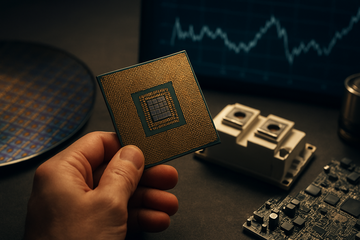
Washington has finally written its first big check for the part of the AI buildout that runs on electricity rather than on transistors. On October 22, 2026, the Commerce Department's CHIPS Research and Development Office signed four letters of intent worth up to $389 million for power semiconductor devices and critical materials. The four awardees — Helion, Commonwealth Fusion Systems, Vertical Semiconductor and Sibelco — are all private companies. The money is aimed at the conversion layer inside and beside the AI rack, and at the two materials that layer is physically made of.
Total federal R&D committed
$389M
Four letters of intent signed Oct 22, 2026, CHIPS R&D Office
Share of Commerce's spent chip R&D
77%
$389M against $506.8M expended as of the Aug 2026 GAO review
Appropriated, then canceled
$7.8B
Of the $11B appropriated for advanced microelectronics R&D
Going to fusion, not AI racks
67%
$260M of $389M to Helion and Commonwealth Fusion Systems
China's share of primary gallium
~99%
2025 supply; ex-China capacity seen near 20 tons vs a ~678-ton gap
Power transformer lead times
24–48 mo.
Against 6–12 months before 2020; large units run more than 36 months
The Announcement
Four Private Companies, $389 Million, and a Bill for Equity
Commerce disclosed the awards as letters of intent, not definitive grants, and every recipient gives up equity to get the money. Each of the four companies will issue the government a minority, non-controlling, non-voting stake as a condition of the award. Helion's is sized at $175 million, struck against its most recent Series G preferred valuation, and it converts only when a definitive agreement is signed. Cost share is disclosed for exactly one award: Helion paired its $175 million with $50 million of private investment over a three-year award period.
| Awardee | Federal award (up to) | What the money buys | Ownership and disclosure |
|---|---|---|---|
| Helion | $175M | High-voltage power semiconductors and advanced power modules for high-peak-current pulsed-power fusion | Private. Washington receives a $175M non-voting interest at the Series G valuation, on signature of a definitive agreement |
| Commonwealth Fusion Systems | $85M | Semiconductors for radio-frequency plasma heating, power electronics, fusion-diagnostics electronics and radiation-hardened parts | Private. Stake size and matching private funds not disclosed |
| Vertical Semiconductor | $73M | Vertical gallium nitride power transistors, demonstrated in a 2.5-MW AI rack | Private MIT spin-out, $11M seed round in Oct 2025. Manufacturing partners not named |
| Sibelco North America | $56M | Purification and finishing of ultra-high-purity quartz for crucibles, ingots and process glassware | Private unit of Belgium-based Sibelco. Leaching pilot plant to be built in North Carolina |
Where the $389 million goes
Federal R&D awards signed Oct 22, 2026, in $ millions
Unit: $ millions
Helion
Pulsed-power semiconductors for fusion
175
Commonwealth Fusion Systems
RF heating, diagnostics and rad-hard electronics
85
Vertical Semiconductor
Vertical GaN for a 2.5-MW AI rack
73
Sibelco North America
Ultra-high-purity quartz purification
56
Program Context
This Check Is 77% of Everything Washington Has Actually Spent on Chip R&D
The August 2026 audit of the program is the context every investor needs. Of the $11 billion appropriated for advanced microelectronics R&D in the 2022 CHIPS Act, Commerce canceled awards worth $7.8 billion: the National Semiconductor Technology Center award was terminated in 2025, advanced packaging awards were canceled or paused, and the industrial advisory committee charter was allowed to lapse. After those cancellations the department had spent $506.8 million — about 5% of the appropriation. The October 22 award of $389 million therefore equals roughly 77% of the program's entire spending to date, and only 3.5% of what Congress actually gave it.
| Program line | Amount | Status as of late 2026 |
|---|---|---|
| Appropriated for advanced microelectronics R&D (CHIPS Act 2022) | $11.0B | Appropriation |
| Awards canceled during 2025–26 | $7.8B | Technology center award terminated; packaging awards canceled or paused; advisory committee charter lapsed |
| Expended through the August 2026 audit | $506.8M | About 5% of the appropriation |
| New energy-semiconductor awards, Oct 22, 2026 | $389M | Letters of intent only; equity stakes vest on definitive agreements |
| Earlier grants in the same fund | 19 awards | Compute, memory, packaging and fabs — $450M to SK hynix, $400M each to GlobalWafers and Amkor Technology, $1.6B to Texas Instruments |
The Bottleneck
Why Power Semiconductors and Not GPUs: the Constraint Moved Down the Stack
The diagnosis is measurable. Power transformer lead times that ran 6 to 12 months before 2020 now run 24 to 48 months, with prices up 50% to 80%, and large units take more than 36 months; generators carry two-year lead times and high-voltage transformers 12 to 18 months. Substation transformer lead times stretched from roughly 140 weeks in 2023 to more than 160 weeks in 2026, and annual transformer demand is projected to pass 9,000 units by 2030 against roughly 1,500 today. This is the layer of the AI buildout with no spare capacity.
The industry has already rewritten the architecture around that constraint. NVIDIA is moving data centers to 800-volt direct current from 2027 to support racks of 1 MW and above, with named semiconductor suppliers including Texas Instruments, STMicroelectronics, ROHM, Monolithic Power Systems and Navitas, and named power-system suppliers including Eaton and Vertiv. The Open Compute Project's solid-state transformer specification reached release 0.3 in July 2026, and more than 80 equipment makers and infrastructure providers are already building to it. The megawatt rack gets decided in the conversion layer, not in the chip.
| Company | Reported quarter | Power and AI signal |
|---|---|---|
| onsemi | Q2 2026 revenue $1.604B, gross margin 38.4% | Power Solutions Group revenue $829M, +19% YoY; AI data-center business guided to more than double in 2026; GaNEXUS portfolio spans 40V to 650V |
| Vertiv | Q2 2026 revenue $3.274B, operating income $638M | Named 800 VDC power-system partner; revenue up 23.6% on the prior quarter |
| Eaton | Q2 2026 revenue $8.531B, operating income $1.392B | Named 800 VDC power-system partner; building DC-distribution semiconductor transformer capability |
| Navitas | Q2 2026 revenue $10.5M, operating loss $27.2M | Named 800 VDC chip supplier; the GaN pure-play still runs on $36.5M of trailing revenue |
If we can cut that loss in half, that's actually twice the power output of the fusion system.
Who Actually Gets Paid
The Only Listed Company in the Payoff Chain Is a Specialty Foundry
None of the four awardees is listed. But roughly $80 million of Helion's award is earmarked for semiconductor tooling, design and process development in Burlington, Vermont, in collaboration with GlobalFoundries — which directs roughly $80 million of Helion's award into GlobalFoundries' Vermont tooling program and makes the foundry the only listed company whose income statement this announcement directly funds. Helion's chief executive frames the prize in efficiency terms: the power electronics in the fusion path lose roughly 5% to 10% of the electricity flowing through them, and halving that loss is equivalent to doubling the output of the system.
GlobalFoundries has also bought its way into the same conversion layer from the commercial side. Its acquisition of Photeon Technologies' integrated voltage regulator business gives it power-delivery products aimed at AI data centers, and it reported second-quarter 2026 revenue of $1.786 billion at a 28.3% gross margin, with growth led by optical networking inside AI data centers. For a company whose economics turn on utilization, federal R&D contracts that fill tooling and process-development capacity are a better use of a fab than another logic wafer.
- Helion's Everett, Washington program — more than $100 million for semiconductor and advanced packaging R&D and over 100 jobs — is domestic capacity that does not exist today.
- The award will not reach Orion. Helion's own disclosure says the R&D targets subsequent power plants, not the first one.
- GlobalFoundries' second-quarter revenue of $1.786 billion was 4.6 times the entire federal award: a rounding error to the fab, a real one to the R&D calendar.
- Vertical Semiconductor names no manufacturing partners and discloses no cost share, so the commercial path from a $73M research award to shipped power transistors is not yet visible.
Upstream
Quartz Gets a Subsidy, Gallium Does Not
The materials layer is where the award is most revealing. Sibelco's $56 million targets next-generation purification and finishing of ultra-high-purity quartz — the material for the crucibles and process glassware used to grow silicon ingots and compound-semiconductor crystals. Spruce Pine in North Carolina has historically supplied more than 90% of the world's high-purity quartz sand, and Sibelco has spent $200 million there with another $500 million planned. The new leaching process is to be piloted in North Carolina.
- Jiangsu Pacific Quartz won international semiconductor supply-chain qualification in September 2026, breaking a market dominated by Spruce Pine material for more than a decade — federal money is underwriting process depth for an incumbent whose monopoly is already being contested.
- Shin-Etsu Chemical already sits on both sides of this award: it invested in Vertical Semiconductor's $11 million seed round in October 2025, and its group includes a semiconductor quartz business making tubes, rings, boats and substrates.
- Shin-Etsu's Electronics Materials segment — silicon wafers, photoresists, mask blanks and quartz — generated record segment operating profit of ¥101.9 billion on ¥279.2 billion of revenue in the April–June 2026 quarter, up 23% and 16% year on year.
- Coherent is the merchant silicon carbide substrate supplier: fiscal 2026 fourth-quarter revenue of $2.046 billion at a 38.5% gross margin, with a Pennsylvania expansion targeting 1 million 150mm-equivalent substrates a year by 2027.
- Entegris, the US materials supplier, reported second-quarter 2026 revenue of $883.2 million, up 11.5% year on year, at a 47.6% gross margin — the AI fab-materials cycle is already running hot before any of this federal money lands.
| Measure | Latest reading | Why it matters |
|---|---|---|
| China's share of primary gallium supply, 2025 | ~98.9% | Vertical GaN is a gallium device; the metal sits outside the award |
| Gallium price, early March 2026 | ~$2,100 per kg | Up 123% since the start of 2025; prices outside China run 9–10x 2023 levels |
| Ex-China gallium capacity, end-2026 | ~20 tons | Against an estimated supply gap of roughly 678 tons |
| US imported gallium unit value, 2025 | $580 per kg | Up 30% on 2024, per USGS trade data |
| Listed non-Chinese response | 8-inch GaN substrates from FY2026 | Sumitomo Metal Mining starts selling 8-inch substrates and develops iron-gallium alloy |
Read the two materials awards together and the pattern is clear. Washington is funding purification of the quartz that silicon is grown from, and the power transistor that gallium nitride is made into — but not the gallium, and not the gallium-nitride substrates. A research program that pays for the device while leaving the metal and the substrate untouched relocates the bottleneck rather than removing it.
Downstream
Downstream, the Megawatt Rack Pays the Bills
The downstream names are the ones already collecting revenue from the transition. Vertiv converted the demand most visibly: second-quarter 2026 revenue of $3.274 billion was 23.6% above the prior quarter, with gross profit of $1.235 billion and operating income of $638 million, a 37.7% gross margin. Eaton reported $8.531 billion of quarterly revenue, $2.855 billion of gross profit and $1.392 billion of operating income, and has been developing DC-distribution semiconductor transformers for the same architecture.
- Vertiv is the cleanest expression of the megawatt rack: $3.274 billion of quarterly revenue at a 37.7% gross margin, with a published seat in the 800 VDC reference design.
- Eaton carries $8.531 billion of quarterly revenue into the same transition and has the balance sheet to fund it without a capital cycle.
- Navitas shows how early the commercial GaN power market still is: $10.5 million of revenue in the June 2026 quarter against a $27.2 million operating loss.
- The federal award's AI-relevant slice, $73 million for vertical GaN, is twice Navitas' entire trailing revenue — the check is larger than the market it is meant to create.
Horizons
What Moves in Quarters, and What Only Moves in Years
- Next 2–4 quarters — definitive agreements rather than letters of intent: each equity stake vests only on signature, and Helion's $175 million converts at its Series G preferred valuation.
- Next 2–4 quarters — third-quarter results in early November 2026 are the first hard read on whether AI power demand is still accelerating: onsemi guided to $1.65–1.75 billion of revenue and a 40–42% gross margin.
- Next 2–4 quarters — Wolfspeed's government financing is tranche-based and conditional: a $600 million first tranche to refinance 2030 notes, then three more of $200–400 million inside a 36-month commitment period.
- Next 2–4 quarters — Sibelco's North Carolina leaching demonstration plant is the near-term proof point for the quartz award.
- Next 1–3 years — whether vertical GaN wins a socket: the 800 VDC reference design and the Open Compute Project transformer specification decide it, not the subsidy.
- Next 1–3 years — whether gallium is ever addressed: with ex-China capacity near 20 tons against a roughly 678-ton gap, the metal remains the wall.
- Next 1–3 years — whether the program survives its own politics: the GAO found Commerce's plan to re-establish the national semiconductor technology center insufficiently detailed, and $7.8 billion has already been canceled.
The Thesis
What This Actually Means for Investors
Washington's bottleneck diagnosis is right, and its portfolio is narrow. The AI power constraint is measurable in transformer lead times and in the gross-margin expansion at the power-chip vendors, and the money is landing on the least-substituted nodes in that chain: high-voltage pulsed-power devices, vertical power transistors, and the purification step for the hardest-to-make quartz. What the portfolio omits is as informative as what it contains.
- Fact: four letters of intent worth up to $389 million, signed Oct 22, 2026, all to private companies, all carrying minority non-voting government equity stakes.
- Fact: $73 million targets vertical gallium nitride for a 2.5-MW AI rack; $56 million targets ultra-high-purity quartz purification; $260 million targets fusion pulsed-power electronics.
- Inference: the award is a supply-side bet on the grid, so the vendors already selling power into AI racks capture the demand while the awardees chase qualification.
- Inference: the gallium metal and the gallium-nitride substrate are untouched, while China holds roughly 99% of primary supply — the bottleneck is being funded, not removed.
- Speculation, flagged: if the definitive agreements convert, a company that has raised $11 million in total becomes a credible second source in vertical power transistors, but sockets will be decided by hyperscaler and NVIDIA architectures in 2027, not by Commerce.
The investable read-through
- Roughly $80 million of Helion's award funds GlobalFoundries' Burlington, Vermont tooling work — the only listed company this announcement directly pays.
- Second-quarter 2026 revenue of $1.786 billion at a 28.3% gross margin means federal R&D contracts fill tooling capacity without new capital.
- The Photeon integrated voltage regulator deal puts the foundry in AI power delivery, the same conversion layer the $73 million vertical GaN award targets.
- Near-term catalyst: definitive award agreements and third-quarter results in November 2026; over 1–3 years, a federal R&D seat as a specialty foundry.
- more than doubles AI data-center revenue in 2026 on top of $829 million of Power Solutions Group revenue in the second quarter alone.
- Gross margin of 38.4% in Q2 2026, guided to 40–42% for Q3, shows pricing power in AI power silicon.
- Risk over 1–3 years: a federally funded vertical-GaN entrant and Chinese silicon carbide competition attack the same sockets.
- Horizon: the November 2026 third-quarter print is the first read on whether the AI power ramp is still accelerating.
- grew revenue 23.6% sequentially to $3.274 billion in Q2 2026, with operating income of $638 million.
- A 37.7% gross margin means the megawatt rack is a profit story, not just a revenue story.
- Named 800 VDC power-system partner, with the Open Compute Project transformer specification at 0.3 pulling more than 80 builders to the same architecture.
- Risk: transformer lead times of 24–48 months cap how fast backlog converts into shipments.
- carries $8.531 billion of quarterly revenue into the 800 VDC transition, with $1.392 billion of operating income.
- Named 800 VDC power-system partner and developer of DC-distribution semiconductor transformers for the same architecture.
- Horizon: 1–3 years, the semiconductor transformer line is where grid-side silicon meets rack-side demand.
- Risk: a 33.5% gross margin still leaves the electrical-equipment backlog exposed to the same transformer shortage the whole sector is selling into.
- supplies the silicon carbide substrates that gate every power device, with Pennsylvania capacity targeting 1 million 150mm-equivalent substrates a year by 2027.
- Fiscal 2026 fourth-quarter revenue of $2.046 billion at a 38.5% gross margin funds that substrate buildout.
- Near-term driver remains AI datacom optics; power-substrate upside is 2027-plus optionality.
- Risk: subsidized and Chinese substrate capacity is expanding faster than 2026 power-device demand.
- secured a conditional $1.5 billion government loan for domestic silicon carbide wafers, power devices, gallium nitride epitaxy and radiation hardening.
- First tranche of $600 million refinances 2030 notes; three more of $200–400 million follow inside a 36-month commitment period.
- Fiscal 2026 shows why the loan matters: $665 million of revenue, a $539 million operating loss and $354 million of negative free cash flow.
- Catalyst to watch: definitive documentation and the first tranche draw; if it lapses, US silicon carbide capacity stalls.
- owns a stake in Vertical Semiconductor and runs a semiconductor quartz business in the same chain the award is funding.
- Bull case: record ¥101.9 billion quarterly segment operating profit in the April–June 2026 quarter, up 23% year on year.
- Bear case: Sibelco's federally funded purification capacity and a newly qualified Chinese supplier erode the scarcity premium in high-purity quartz.
- Horizon: pressure builds over 1–3 years as Sibelco's North Carolina demonstration plant scales.
- starts selling 8-inch gallium nitride substrates in FY2026, the listed non-Chinese answer to the metal constraint Washington ignored.
- Gallium at roughly $2,100 per kilogram in March 2026 with ex-China capacity near 20 tons against a roughly 678-ton gap.
- Caveat: gallium is small against a copper-dominated base — first-quarter FY2027 operating income was ¥89.9 billion.
- Horizon: 1–3 years, an option on gallium scarcity rather than a driver of group earnings.