
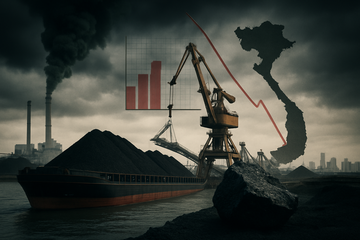
Coal imports needed for power generation
17-19 Mt
Vietnam's industry ministry estimate for 2026, published Jun 16, 2026
Coal's share of the generation mix
54.5%
First half of 2026, against 46.2% ten months earlier
National power deficit projected for 2027
4,256 MW
About 2.9 billion kWh on the government's own adjusted plan
Vinacomin's planned coal imports for 2027
17 Mt
Up from about 10 Mt in 2025, reported March 2026
US coal shipped to Vietnam
1 Panamax cargo
Wyoming coal via Guaymas, Mexico, announced Sep 10, 2026
Newcastle thermal coal, Mar 9, 2026
$150/t
Highest print since November 2024
The gap
Vietnam's Power Shortfall Is Being Filled With Coal, Not Gas
Vietnam is not short of clean-power ambition; it is short of electricity. Coal supplied 54.5% of national output in the first half of 2026, up from 46.2% ten months earlier, while the country's 22.5 GW LNG target for 2030 is only 7.3% achieved. The result is that seaborne thermal coal becomes the marginal energy source for the next three years of industrial load. Every additional megawatt of Vietnamese demand is now, in practice, a coal procurement decision.
| Metric | Figure | Period or basis |
|---|---|---|
| Coal demand for power generation | >80 Mt | 2026 plan |
| Domestic mining capacity | 40-45 Mt | Annual average |
| Import requirement | 17-19 Mt, or 20-22% of demand | 2026 estimate |
| Coal supply schedule | 85.28 Mt | 2026 plan |
| Coal burned in five months | 35.53 Mt, or 41.7% of schedule | Jan-May 2026 |
| Coal imports in two months | 11.16 Mt for $1.21B | Customs data, avg $108.4/t |
| Coal's share of the generation mix | 54.5% | First half of 2026 |
| Coal capacity under the adjusted plan | 31.1 GW by 2030 | Adjusted Power Development Plan VIII |
| New coal capacity proposed | 5,300 MW by 2030 | Ministry proposal, Oct 2026 |
| Quang Ninh's additional proposal | 5,940 MW | Provincial submission, Aug 2026 |
- Hydro output fell 10.5% year on year in the first quarter of 2026 as heat and drought pulled down the northern reservoirs.
- LNG cannot fill the gap, with the 22.5 GW 2030 target only 7.3% achieved and the Iran war undermining security of supply.
- Grid build-out lags generation: between 2016 and 2020 northern load grew 6,000 MW while new capacity added only 4,600 MW, and the network has barely been rebuilt since.
- Extreme heat does the rest. National consumption reached 138.9 billion kWh in five months, up 8.8%, which is already 39.7% of the utility's full-year target of 350.2 billion kWh.
Vietnam's 2030 power plan, on two different bases
Total installed capacity target
183-236 GW
Master power development plan
Coal share of installed capacity in the plan
13.1-16.9%
Compare coal's 54.5% of actual output today
LNG share of installed capacity in the plan
9.5-12.3%
22.5 GW target, 7.3% achieved
Coal projects the ministry asked to drop
14.12 GW
Requested of government in July 2026
Offshore wind target
7 GW by 2030
Alongside a carbon-neutral-by-2050 pledge
The fuel
The Fuel Is Contracted for Two Decades; The Volume Is Still A Forecast
Vietnam's utilities have started buying coal on terms that outlast the politics which created the demand. State utility EVN signed an agreement with state coal group Vinacomin to supply Indonesian coal to plants running on imported coal until 2047, part of a centralisation of fuel procurement that also lifts Vinacomin's own import book from about 10 Mt in 2025 to 13 Mt in 2026 and 17 Mt in 2027. At plant level the contracts run longer still: Vung Ang 2 is being supplied 3.6-4.0 Mt a year from Indonesia and Australia on 25-year terms.
Vinacomin's imported coal purchases
The import book roughly doubles in two years as fuel procurement is centralised; 2026 and 2027 are company forecasts reported in March 2026.
Unit: million tonnes
2025 actual
about 10 Mt
10
2026 forecast
13
2027 forecast
17
| Commitment | Scale | Counterparty or term |
|---|---|---|
| EVN and Vinacomin Indonesian coal supply | Until 2047 | Centralised procurement for imported-coal plants |
| Vung Ang 2 fuel supply | 3.6-4.0 Mt a year | Indonesia and Australia, 25-year contracts |
| Vung Ang 2 plant | 1,200 MW | Full commercial operation from April 2026 |
| Quang Trach 1 | 1,403 MW, two units of 701.5 MW | VND 42 trillion; both units on the grid in 2026 |
| Ministry's proposed coal additions | 5,300 MW by 2030 | Near load centres in Quang Ninh, Hung Yen and Quang Tri |
| Quang Ninh provincial proposal | 5,940 MW | Would lift provincial coal demand to about 37 Mt a year |
| Vinacomin import tenders, April 2026 | $132.14/t CFR Cam Pha | 5,000 kcal/kg ARB basis |
Economics
Coal Costs About Three Times What Gas Costs Here, So This Is A Security Decision
Vietnam is not building coal plants because coal is cheap. In July 2026 Newcastle thermal coal traded around $115-122 a tonne, roughly $19-20 per MMBtu, while imported LNG for Vietnamese power generation sat at $14.05 per MMBtu. At a typical 38% coal plant efficiency that is roughly $45-53 of fuel per megawatt hour from coal against about $14 from a combined-cycle gas plant. The build-out is an energy-security and permitting decision, and it is being financed with contracts that lock those economics for two decades.
Newcastle thermal coal, US$ per tonne
Point readings through 2026. The March spike followed the Strait of Hormuz disruption and the highest global coal price since November 2024.
Unit: US$/tonne
Mar 9, 2026
150
Mid-May 2026
129
Jul 9, 2026
131.7
- Vietnam's seaborne buying weakens as international coal prices rise, and strengthens when they fall, which makes the 17-19 Mt import plan self-defeating in exactly the conditions that make coal strategically necessary.
- Indonesia's approved 2026 output has fallen to about 580 Mt from roughly 790 Mt in 2025, and seaborne cargoes from Indonesia remain tight, so the largest supplier to Vietnam is supply-capped.
- The 17 Mt of imports pencilled in for 2027 cost materially more than the 10 Mt bought in 2025, when Indonesian 4,200 kcal cargoes averaged $45.17 a tonne, down 15.6% year on year.
- Vietnam's own 4,000 kcal imports averaged $83.12 a tonne in February 2026 against an all-origin average of $108.4, so origin choice is now a bigger lever than headline benchmark prices.
Policy
The Tariff Moat That Built The Load Was Rebuilt In 2026
The premise that Vietnam is the tariff-free workshop is out of date. On February 20, 2026 the US Supreme Court held that the International Emergency Economic Powers Act does not authorise tariffs, and US Customs stopped collecting the IEEPA duties on February 24, taking with them the 20% reciprocal rate Vietnam had negotiated and the 40% transshipment surcharge that policed the China+1 assembly model. What replaced them is narrower and more origin-focused: on July 24, 2026 USTR finalised Section 301 duties of 10% and 12.5% on 60 economies, with Vietnam among the 38 economies facing 12.5% on roughly 37% of its exports to the US, and Vietnam's own forced-labour import ban effective from July 22.
| Element | Status | Effective |
|---|---|---|
| 20% reciprocal rate under IEEPA | Struck down; collection ended | Feb 20-24, 2026 |
| 40% transshipment surcharge | Lost its IEEPA legal basis | Feb 2026 |
| Section 301 forced-labour duty | 12.5% on Vietnam, 10% for others | Jul 24, 2026 |
| Scope of the 12.5% duty | About 37% of Vietnam's US exports | Jul 24, 2026 |
| Vietnam's forced-labour import ban | Decree 292/2026/ND-CP | Jul 22, 2026 |
| Vietnam's origin rule for US-bound goods | Requires about 40% local content | Reported Oct 2026 |
| Textile and transshipment rates cited in industry | About 46% textiles, 40% transshipment | Reported Oct 23, 2026 |
- China's share of Vietnam's newly approved foreign investment fell to 5.6% in the first half of 2026, dropping China to fourth place behind Singapore, South Korea and Japan, from second place in 2025.
- Vietnam's electronics component localisation runs at only 5% to 10%, so a 40% local-content rule disqualifies much of the Chinese-component assembly that defined the relocation.
- Orders are moving home: Jasan Holding, whose Vietnam plant once carried about 70% of its capacity, is among the Chinese knitwear makers reclaiming US work, with suppliers returning to Dongguan.
- Factories that already moved are funding their own power, because on-grid supply is unreliable and self-generated diesel runs at roughly three times grid power costs, which is exactly the cost that makes tariff-driven relocation unviable.
For the coal chain this matters more than for the tariff headlines. The 17-19 Mt of imports and the 5,300 MW of proposed coal capacity are justified by manufacturing load that came to Vietnam to dodge tariffs, and the tariff architecture that made that relocation rational was dismantled in February and replaced with rules that penalise precisely the Chinese-component assembly Vietnam's export base depends on. The fuel is contracted for 21 years; the load that justifies it is a policy variable.
Upstream
The US Coal Optionality Is Real, And It Pays The Exporter Rather Than The Biggest Mine
American coal reached Vietnam in June 2026, but only as a pilot. Union Pacific, Ferromex and Peabody Energy moved Powder River Basin coal from the North Antelope Rochelle mine in Wyoming to the Mexican port of Guaymas and loaded it onto a Panamax vessel bound for Vietnam, opening a Pacific export lane with no volume behind it yet. Core Natural Resources, the country's largest coal exporter, has been taking orders from what its chief executive calls surprise markets, Indonesia and Vietnam, with exports expected to rise 10% this year. The tonnage is trivial next to domestic US burn, so the earnings effect lands on the exporter, not on the largest mine.
| Metric | Peabody Energy | Core Natural Resources |
|---|---|---|
| Q2 2026 revenue | $1,003.2M | $1,141.0M |
| Q2 2026 gross profit | -$72.0M | $85.3M |
| Q2 2026 net income | -$90.6M | $126.5M |
| Q2 2026 earnings per share | -$0.74 | $2.51 |
| Trailing 12-month revenue | $4,010.9M | $4,270.3M |
| Trailing 12-month net income | -$182.7M | $100.1M |
| FY2025 EBITDA | $401.2M | $427.5M |
| Trailing 12-month EBITDA | $284.4M | $721.0M |
Peabody Energy: quarterly gross profit, US$ million
Gross profit turned negative in the June quarter as coal-market costs outran realizations, even with Newcastle trading above $130 a tonne.
Unit: US$ million
Q3 2025
1.3
Q4 2025
49.7
Q1 2026
108.6
Q2 2026
-72
Core Natural Resources: quarterly net income, US$ million
The export pivot shows up as an earnings inflection, not as a press release: four consecutive quarters of losses turned into $126.5 million in the June quarter.
Unit: US$ million
Q1 2025
-69.3
Q2 2025
-36.6
Q3 2025
31.6
Q4 2025
-79
Q1 2026
21
Q2 2026
126.5
Downstream
Who Gets Paid: The Contractor, The Trading House And The Factory That Cannot Switch Off
Two groups cash the build-out without carrying the fuel risk. Doosan Enerbility signed a KRW 837.97 billion EPC contract with PVN for the 1,155 MW O Mon III plant, equal to 4.91% of its KRW 17.06 trillion in sales and running to October 2030, and booked about KRW 3.87 trillion of Vietnamese combined-cycle awards in 2026 across five projects. Mitsubishi Corp supplies the fuel instead, holding a 40% stake in the Vung Ang 2 vehicle that now imports coal from Indonesia and Australia on 25-year terms, having walked away from Vietnam's Vinh Tan 3 coal project in 2021 on decarbonisation grounds. The factory floor, meanwhile, is paying for the strategy in outages.
- The industry ministry's tightest power-rationing directive of the year pulled power from about 11,000 companies, including Samsung, Foxconn and Canon, with rotating cuts across the northern industrial parks.
- Hydro output fell 10.5% year on year in the first quarter of 2026, and the transmission network that must carry replacement load has not been meaningfully rebuilt in a decade.
- Vietnam restarted cross-border electricity purchases from China on May 23, 2026, planning 30 million kWh a month with a first phase of nearly 68 million kWh and a further 1.8 billion kWh in mind.
- Self-generation is the fallback, and factory diesel runs at roughly three times grid power costs, which is precisely the cost that turns a tariff-driven relocation into a margin problem.
For the companies at the top of the chain this is a volume story; for the ones at the bottom it is a cost story that no amount of factory relocation can hedge. Samsung Electronics shows the gap between the two: second-quarter operating profit of KRW 89.5 trillion against KRW 4.7 trillion a year earlier means a fortnight of rationed power in northern Vietnam is a rounding error at group level, but it is a permanent tax on the China+1 assembly model that the tariff regime was built to reward.
Horizons
What Moves First, And What Would Break The Thesis
| Horizon | Trigger to watch | Read-through |
|---|---|---|
| Next two quarters | A second Powder River Basin cargo to Vietnam | Whether US coal reaches Vietnam at commercial rather than pilot volumes |
| Next two quarters | Decision on the 5,300 MW coal proposal and the Quang Ninh 5,940 MW submission | Whether the build-out is approved, and where it lands |
| Next two quarters | Third-quarter results for the EPC contractors and the trading house | Order-book conversion on the 2026 Vietnam awards |
| 2027 | The 4,256 MW and 2.9 billion kWh national deficit | Whether coal closes it or rationing returns |
| 2027 | Vinacomin's 17 Mt import target | Whether price-elastic demand holds with Newcastle above $130 |
| 2027 to 2030 | US-Vietnam negotiations and the 40% local-content rule | Whether the load that justifies 2047 fuel contracts still exists |
| 2027 to 2030 | A carbon-neutral 2050 pledge against 31.1 GW of coal capacity | Whether the fuel book outruns the climate commitment |
Here is the trade in one paragraph. Vietnam needs 17-19 Mt of imported coal in 2026 and has contracted the fuel through 2047 because coal is the only thing that can be built and dispatched at the speed its factories require, and because gas, hydro and the grid cannot close the gap on the same timetable. The same supply chain that guarantees the fuel is pricing it at levels where Vietnamese buying is weakest, and the tariff regime that created the factory load has been narrowed twice in 2026. Own the contracted fuel and the contracted engineering; do not own the coal price and do not own the relocation premium. The demand case behind 21 years of fuel is the least certain part of it.
Where the trade actually shows up
- The Guaymas pilot reached Vietnam in June 2026; a second Panamax cargo is the near-term binary catalyst.
- Peabody sold coal below cost in the second quarter of 2026, booking a negative $72.0 million gross profit on $1,003.2 million of revenue.
- A trailing net loss of $182.7 million makes the Vietnam lane a volume option rather than an earnings story over the next one to three years.
- Exports are expected to rise 10% in 2026, with orders from what management calls surprise markets, Indonesia and Vietnam.
- Core Natural swung from a $153.2 million FY2025 net loss to $100.1 million of trailing net income.
- Second-quarter earnings per share of $2.51 against a $0.70 loss a year earlier, with trailing EV/EBITDA at 6.1 times.
- The KRW 837.97 billion O Mon III award equals 4.91% of KRW 17.06 trillion in FY2025 sales and runs to October 2030.
- Doosan booked about KRW 3.87 trillion of Vietnamese combined-cycle awards in 2026, roughly 23% of FY2025 revenue.
- At 45.7 times trailing EV/EBITDA and 5.0 times net debt to EBITDA, the equity case waits on conversion through 2027 to 2030.
- Vung Ang 2 takes 3.6-4.0 million tonnes a year from Indonesia and Australia on 25-year contracts.
- Mitsubishi re-entered Vietnamese coal after exiting Vinh Tan 3 in 2021, now supplying fuel for about 3% of national demand.
- Earnings accrue over a quarter-century, and the coal book sits against the group's own decarbonisation commitments.
- Rotating power cuts in the northern industrial parks hit Vietnamese assembly alongside about 11,000 other rationed companies.
- Second-quarter operating profit of KRW 89.5 trillion against KRW 4.7 trillion a year earlier makes the outage immaterial to group earnings.
- Over one to three years the risk is to the China+1 assembly footprint rather than the memory franchise, as local-content rules bite Chinese-component sourcing.
- Vietnam once carried about 70% of its capacity, and a 40% local-content rule makes much of that output non-compliant for the US.
- Jasan recovers US order flow in its home plants at a 16.7% trailing net margin.
- At 7.0 times trailing EV/EBITDA with an 18.3% return on equity, the relocation unwinding looks unpriced.