
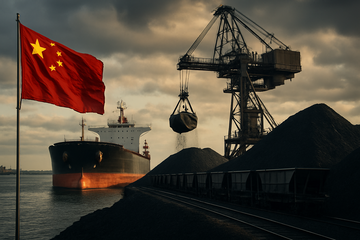
China coal pledge
≥20 Mt
≥10 Mt in 2027 + ≥10 Mt in 2028, per White House fact sheet, Sept 25, 2026
China's current tariff on US coal
28–31%
Retained after Nov 2025 truce; $30B Sept 2026 carve-out covers 'non-sensitive' goods
CNR 2026 thermal sales guidance
30.0–32.0 Mt
Q4 FY2025 release, Feb 12, 2026; ~23.4 Mt already committed and priced at $57.27/ton
CNR Q2 2026 thermal cash margin
$19.53/ton
Q2 FY2026 release, Aug 6, 2026 — realized $58.11/ton vs. cash cost $38.58/ton
US thermal coal exports 2025
52 Mt
EIA, Apr 1, 2026 — averaged $86/short ton
10 Mt vs. US thermal exports
~19%
10 Mt/yr is ~19% of 52 Mt 2025 thermal baseline — material, not transformational
What the White House Actually Committed, in Tonnes
The Sept 25, 2026 fact sheet (whitehouse.gov) puts the coal commitment in two crisp sentences: China will import at least 10 million metric tons of US coal in 2027 and another 10 million in 2028. The pledge sits inside a broader package — a $30 billion reciprocal tariff carve-out on \"non-sensitive\" goods, an AI dialogue, a one-year extension of the rare-earth truce, and the launch of the U.S.-China Board of Trade that will police compliance. None of that touches coal tariffs directly.
The headline reads \"China to buy US coal.\" The constraint is that the same summit left in place the 15% retaliatory tariff Beijing imposed in February 2025, layered on top of its 3-6% baseline MFN duty, producing the28-31% combined rate that has choked US met and thermal flows into China for 20 months. Reuters reported the November 2025 truce suspended only tariffs announced after March 4, 2025 — the February measures on coal and LNG stayed (Reuters factbox, May 12, 2026). For US producers, the marginal economics depend on whether the new Board of Trade process takes the coal tariff off the table in 2026 — and that is an open question, not a fact.
CNR Owns the Only Thermal-Export System Anyone Else Has to Lease
Core Natural Resources is the highest-beta read on the deal because it is the only US producer that owns the entire thermal-export chain from mine to vessel. CNR runs the Pennsylvania Mining Complex (Bailey, Enlow Fork, Harvey), holds 100% of the Baltimore Marine Terminal (formerly CONSOL Marine Terminal), and is the controlling owner of Dominion Terminal Associates in Newport News — a 20 Mt/year facility that ships Hampton Roads' coal to seaborne markets. CNR's self-stated owned export capacity is ~30 Mt/year (corenaturalresources.com), of which the high-CV thermal segment alone is guided to 30.0-32.0 Mt for2026 (Q4 FY2025 release, Feb 12, 2026).
CNR Q2 2026 high-CV thermal tons sold
8.4 Mt
+9% QoQ; Q2 FY2026 release, Aug 6, 2026
CNR Q2 2026 realized thermal price
$58.11/ton
vs. $57.27/ton committed-and-priced book for 2026
CNR Q2 2026 thermal cash cost
$38.58/ton
Q2 FY2026 release; guidance was $38.00–$39.50/ton for FY2026
CNR Q2 2026 adjusted EBITDA
$324M
+80% QoQ (Q1 $179M); TTM $721M; Q2 FY2026 release, Aug 6, 2026
The arithmetic matters. China's 10 Mt/yr pledge is roughly a third of CNR's full-year 2026 high-CV thermal sales guidance. If CNR captures even half of that volume at current realized prices, the thermal segment alone adds $290M of revenue at a ~$20/ton cash margin — about $200M of incremental EBITDA versus the Q2 2026 run-rate of $324M. That is meaningful upside on a TTM EBITDA base of $721M. The risk is that the cargo flows to Hampton Roads competitors rather than CNR's terminals, because most US thermal is fungible coal — the port where it ships is a competitive moat, not the molecule.
- CNR controls ~30 Mt/yr of owned thermal export capacity, more than any single US peer
- 2026 high-CV thermal sales guidance of 30.0-32.0 Mt = China deal could consume one-third of annual volume
- Q2 2026 thermal cash margin of $19.53/ton is the lowest-margin segment but most export-eligible
- Metallurgical (coking) at $121.43/ton and $28.48/ton cash margin is the higher-margin, lower-tonnage (2.6 Mt Q2) segment
- CNR returned $292M of capital since the merger; Q2 2026 buyback was $63M at avg $87.54 — implying buybacks accelerate above ~$90/ton realized
Peabody Has the Seaborne Book but Australian Mines Set the Ceiling
Peabody Energy is the second-most-direct beneficiary, but with a meaningful asterisk: its 2026 seaborne thermal guidance of 12.0-13.0 Mt (Q1 FY2026 8-K, Feb 23, 2026) is anchored in Australian mines, not Appalachia. Peabody's US thermal book is concentrated in the Powder River Basin (82-88 Mt FY2026 guidance) — a low-Btu product that does not fit Chinese power plants without blending. The seaborne thermal platform is the lever, but Peabody has been guiding to slower Centurion ramp-up and reporting weak near-term numbers: Q2 FY2026 EBITDA of just $26M against $74.8M a year earlier, with a $90.6M net loss (Q2 FY2026 release, Aug 6, 2026).
| Company | Symbol | Mkt Cap | Q2 Revenue | Q2 EBITDA | Thermal Vol Q2 | Realized $/ton (thermal) |
|---|---|---|---|---|---|---|
| Core Natural Resources | CNR | $4.49B | $1.14B | $324M | 8.4 Mt (High-CV) | $58.11 |
| Peabody Energy | BTU | $3.10B | $1.00B | $26M | ~3 Mt (Seaborne) | n/d (blended) |
| Alliance Resource Partners | ARLP | $3.24B | n/d | n/d | n/d (IL Basin/Appalachia) | n/d |
The Domestic Side: Court Killed the Lifeline, ARLP Lives on Dividends
The China deal arrives into a US coal market that is being repriced in two directions at once. On the export side, CNR and BTU gain a Chinese off-take window. On the domestic side, the lifeline that the Trump administration tried to throw aging coal plants is being cut. On Sept 11, 2026, the D.C. Circuit Court of Appeals struck down the Department of Energy's emergency order that had forced Consumers Energy's J.H. Campbell plant in West Olive, Michigan to keep operating past its planned retirement, ruling that DOE's use of the Federal Power Act emergency provision reflected a \"misconception of the nature and scope of its emergency authority\" (EDF summary, Sept 11, 2026).
Alliance Resource Partners is the pure domestic play in this story. ARLP runs seven underground mining complexes in the Illinois Basin and Appalachia, sells almost entirely into US utilities and industrials, and ships through its Mt. Vernon, Indiana Ohio River terminal — no deep-water export access. Its9.4% distribution yield (TTM distribution $2.40/share on a $25.15 stock price as of Sept 25, 2026) reflects the market's view that ARLP is a yield instrument, not a growth story. The China deal is mildly positive for ARLP because it tightens the US thermal market — every ton diverted to China is a ton that does not depress domestic thermal prices — but ARLP does not directly capture export volume.
The Second-Order Read: AI Data Centers Are Pulling on the Same Coal Stack
The export story and the AI-grid story are pulling on the same finite US thermal coal supply — and that is the long-term bid that turns a 20 Mt two-year pledge into something more durable. The IEA forecasts natural gas plus coal together meeting more than 40% of incremental data-center electricity demand through 2030 (IEA Energy and AI report), and EIA's September 2026 Short-Term Energy Outlook raised US power demand to a record 4,270 billion kWh in 2026 and 4,349 billion kWh in 2027 (Reuters, Sept 9, 2026). Behind that power growth sits a generation mix that the IEA expects to keep coal capacity roughly flat through 2030 in absolute terms — so coal is being defended in the US generation stack precisely as AI capacity is being added.
That is the non-obvious causal chain: AI data centers create round-the-clock baseload demand → the marginal supplier of round-the-clock power in many Eastern Interconnection zones is existing coal capacity → domestic utilities outbid export customers for available coal → US producers allocate scarce tons to the higher-net-back US utility market → Chinese cargoes come from the marginal Appalachian or Baltimore-served tonnage that is not absorbed domestically. The China deal does not necessarily raise CNR's realized price — it raises the floor on volume by giving CNR an alternative buyer if US utilities pull back.
The Rails Move the Coal: Norfolk Southern and CSX Get the Volume
The two eastern Class I railroads carry the export side of this story whether or not the China deal is a marginal-volume story for the producers. Norfolk Southern hauled ~33 Mt of export coal in 2024, slightly more than its domestic coal volume, and the split has tilted further toward exports in 2026 — domestic coal down 8% YoY, export coal up 25% in Q2 (LPM, Aug 3, 2026). CSX saw overall coal volumes up 5% in Q2 2026, with export flows doing the lifting. Hampton Roads — the largest US coal export district — moved 33.8 Mt in 2025 (85% metallurgical), and Baltimore thermal exports jumped to 1.81 million short tons in July 2026, nearly double the 1.04 Mt shipped a year earlier (uscoalexports.org, Sept 8, 2026).
- Norfolk Southern export coal volumes +25% YoY in Q2 2026; domestic coal -8%
- Baltimore thermal exports 1.81 Mt in July 2026 vs. 1.04 Mt year earlier — ~74% YoY
- Hampton Roads 2025: 33.8 Mt total, 85% metallurgical — the met-thermal split favors CNR's existing mine mix on the met side and the seaborne thermal world on the thermal side
- Rail economics matter: every Mt of incremental export coal moves ~2,200 rail carloads through Hampton Roads
Horizons: What Moves First, What Holds the Thesis
Short-term (days to quarters), the trade is about whether the new US-China Board of Trade mechanism pulls the 28-31% coal tariff into the negotiating set. That is not promised — the $30B carve-out explicitly covers \"non-sensitive\" goods, and energy security coal is the textbook definition of sensitive. If the tariff stays, the deal is a high-water-mark signal that supports CNR's export franchise without unlocking the underlying P&L; if the tariff moves, the deal becomes a P&L event. The Oct 2026 round of Board of Trade working-group meetings is the first real test.
Long-term (1-3 years), the thesis rests on two structural facts. First, China seaborne thermal coal imports are growing again — June 2026 was forecast at 27.8 Mt, +27.6% YoY (Discovery Alert via LinkedIn) — so a 10 Mt/yr US carve-out is a real share gain against Indonesia, Australia and Russia. Second, US domestic thermal demand is being defended by AI-driven baseload growth, which raises the floor on US thermal pricing even as export volumes fluctuate. The synthesis: CNR is the structural winner because it owns both the export terminals and the High-CV thermal mines that fit Chinese power plants, and the two-sided US demand story means its realized price has a floor whether or not the China deal delivers.
How to play the China coal pledge
- Owns 100% of Baltimore Marine Terminal and the controlling stake in Dominion Terminal Associates — the only integrated thermal-export system from mine to vessel
- 10 Mt/yr China pledge equals ~a third of CNR's 30.0-32.0 Mt 2026 high-CV thermal sales guidance; even partial capture adds material EBITDA
- Q2 FY2026 thermal cash margin of $19.53/ton is the segment most exposed to incremental Chinese volumes — every ton at $58/ton is incremental EBITDA at a low marginal cost
- Short-term catalyst: Oct 2026 Board of Trade working-group talks determine whether the 28-31% Chinese coal tariff enters the negotiating set
- Cheapest multiple in US coal at 0.95x P/B and 0.77x P/S as of Sept 25, 2026, but Q2 FY2026 EBITDA collapsed to $26M from $74.8M a year earlier
- Seaborne thermal book of 12.0-13.0 Mt for FY2026 sits in Australian mines — Chinese volumes flow through Australian supply, not PRB
- Long-term: a successful China deal validates Peabody's seaborne thermal thesis and supports Centurion mine expansion, even if near-term earnings stay weak
- Risk: BTU is down 21% YTD 2026, and the China pledge does not directly monetize the PRB thermal book — most of Peabody's US thermal cannot reach Chinese power plants economically
- Pure domestic Illinois Basin and Appalachia thermal;9.4% distribution yield reflects its status as a yield instrument, not a growth play
- Indirect beneficiary: China deal tightens US thermal supply, supporting domestic realized prices — but ARLP does not capture export volumes directly
- The Sept 11, 2026 D.C. Circuit ruling that killed DOE's emergency authority to keep J.H. Campbell open is a long-term domestic headwind for ARLP's utility customers
- Short-term: ARLP is a \"yield with optionality\" — the China deal supports the price floor on US thermal without changing ARLP's distribution coverage
- Moved ~33 Mt of export coal in 2024 — more than its domestic coal volume — and Q2 2026 export volumes are +25% YoY
- Direct beneficiary of any incremental Hampton Roads / Baltimore thermal volume flowing to China; every Mt moves roughly 2,200 rail carloads
- TTM revenue of $12.5B and EBITDA of $5.66B gives NSC the operating leverage to convert coal volume gains into margin
- Long-term: if the US-China Board of Trade sustains the coal commitment, NSC's coal carload franchise is structurally defended against intermodal competition
- Q2 2026 coal volumes +5% YoY led by export flows; Baltimore thermal exports nearly doubled in July 2026 (1.81 Mt vs. 1.04 Mt year earlier)
- 19,500 route miles give CSX direct access to the Baltimore and Hampton Roads export complexes via its Curtis Bay terminal
- TTM revenue of $14.5B and EBITDA of $6.83B make CSX the larger of the two eastern rails in coal dollar terms — though coal is a smaller share of total carloads than at NSC
- Short-term catalyst: Oct 2026 export data will reveal whether the China pledge is already pulling incremental CSX carload volumes ahead of tariff resolution