
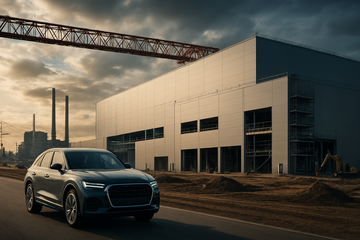
The announcement
What Was Actually Announced: 200,000 SUVs, 4,500 Jobs and a 2031 Start Date
Volkswagen's Audi will build 200,000 premium SUVs a year at the Middle Georgia Megasite in Peach County, Georgia, for about $4 billion — the brand's first US plant, announced at a Trump campaign rally on October 24, 2026. Georgia's own schedule is slower than the headline: grading begins in 2027, construction in 2028, full production in 2031. A US official told Reuters the line will assemble the Q7, Q8 and Q9, and Sen. Bernie Moreno says Audi will now build all of its SUVs in the US. The electric programme was left undisclosed — and with the battery-electric Q8 e-tron discontinued and Brussels closed in February 2025, this is not an EV plant.
Committed investment
$4B
Audi announcement, Oct 24, 2026
Annual capacity
200,000 units
Plant design capacity; full production expected 2031
Jobs
~4,500
New roles, with Georgia Quick Start training programmes
Audi's 2025 duty bill
€1.2B
About $1.4 billion, on US-bound imports from Europe and Mexico
US duty on imported cars
25%
Section 232; EU rate cut to 15% on Aug 1, 2025, then raised to 25% in May 2026
| Project fact | Audi plant — Peach County, Georgia | Scout plant — Blythewood, South Carolina |
|---|---|---|
| Investment | About $4 billion | $2 billion, under construction |
| Capacity | 200,000 vehicles a year | 25,000 Audi vehicles a year |
| Models | Q7, Q8 and Q9, per a US official | Not disclosed |
| Employment | About 4,500 jobs | Not disclosed |
| Production start | 2031 | Not disclosed |
Every element of the deal is a tariff calculation. Section 232 duties of 25% on imported vehicles and parts remain in force; the EU rate for cars was cut to 15% on August 1, 2025, then raised back to 25% in May 2026 when the administration said the deal was not being honoured. Audi's exposure was concrete — roughly €1.2 billion of duties in 2025 on vehicles shipped from Europe and Mexico, where the Q7 has been built in Bratislava since 2005 and the Q8 since 2018. The relief is explicitly conditional on local production, which ties the plant's economics to a rate that has already moved twice.
If EU partners produce cars and trucks in U.S. plants, there will be NO TARIFF.
The economics
The Plant Is a Tariff Hedge, Not a Growth Bet
Volkswagen is funding this from weakness, not strength. Group operating profit fell to about €8.9 billion in 2025, roughly half the prior year, and the company now guides to 2026 sales revenue between -3% and 0% with an operating margin of just 4.0% to 5.5%. First-half 2026 revenue was flat at €158.1 billion while operating profit dropped 12% to about €5.9 billion, a 3.8% margin, with deliveries in China down 20%. North American deliveries fell 2.3% in the third quarter even as nine-month volume edged up 1.7%. Volkswagen is buying tariff relief rather than buying growth.
| Metric | Latest reading | Comparison or guidance |
|---|---|---|
| Sales revenue | €158.1B, H1 2026 | Flat year on year |
| Operating result | €5.9B, H1 2026 | Down about 12% |
| Operating margin | 3.8%, H1 2026 | Guidance 4.0% to 5.5% for 2026 |
| Full-year operating profit | €8.9B, 2025 | Roughly halved |
| 2026 revenue guidance | -3% to 0% | Revised down |
| North America deliveries | -2.3%, Q3 2026 | +1.7% over nine months |
| Automotive investment ratio | 11.8% for 2026 | Guidance 11% to 12% |
| Next results date | Oct 29, 2026 | First nine-month figures |
- The prize is a duty bill, not market share: Audi absorbed roughly €1.2 billion of US import duties in 2025 on vehicles shipped from Europe and Mexico.
- The cost is fixed and dated: about $4 billion spread from grading in 2027 to a 2031 start, against a group whose 2025 operating profit roughly halved to €8.9 billion.
- The plant replaces imports rather than adding volume, so its return depends on the duty rate, not on a US market that grew 1.7% over nine months.
The grid
Georgia's Grid Is Already Full — an Assembly Plant Is a Rounding Error
Georgia Power, the Southern Company operating subsidiary, already projects about 8,500 megawatts of load growth over the next six years, has an approved plan for more than 1,000 miles of new transmission, and is funding an $81 billion capital programme for 2026-2030, 95% of it inside state-regulated utilities. Southern has 17 gigawatts of contracted large load across 31 projects, more than 1.2 gigawatts already drawing power, with data-centre usage up 55% in the second quarter alone. An assembly plant of this scale barely registers inside a data-centre queue.
Southern Company's contracted large load by customer type, Q2 2026
17 gigawatts across 31 signed projects, on contracts averaging 16 years for hyperscalers and 20 years for other large load.
Unit: GW
Self-owned data centres and hyperscalers
Six signed projects above 1 GW
12.5
Industrial or small data-centre developers
Weighted-average contract of 20 years
4
Large data-centre developers above 300 MW
0.5
| Item | Figure | Period |
|---|---|---|
| Southern capital plan | $81B | 2026-2030 |
| State-regulated share | 95% | 2026-2030 |
| State-regulated electric capital | $68B | 2026-2030 |
| Contracted large load | 17 GW across 31 projects | Q2 2026 |
| Data-centre load online | Above 1.2 GW | Q2 2026 |
| Data-centre usage growth | +55% in Q2, +49% year to date | Q2 2026 |
| Projected load growth | About 8,500 MW over six years | 2026-2031 |
| New transmission | More than 1,000 miles | Approved plan |
| Projected rate base growth | 9% | 2026-2030 |
| Georgia Power base rates | Frozen through 2028 | PSC approval, Jul 2025 |
| Typical residential bill | About $50 lower a year | From June 2026 |
| Large-load tariff threshold | 100 MW | PSC rule, Jan 2025 |
Funding is the part that keeps utilities honest. Southern's trailing capital spending of $7.7 billion ran against $10.2 billion of operating cash flow, and the gap was covered with $5.8 billion of net new debt and $1.7 billion of stock issuance. An industrial anchor helps that arithmetic in a way a speculative data-centre pipeline does not: it is a firm, contracted load with real jobs behind it, and it lands in a state where base rates are frozen through 2028 and a typical residential bill is falling by about $50 a year.
- Southern Company sells the power and the wires: Georgia Power is a named project partner, and the 2026-2030 plan is 95% state-regulated capital that grows with contracted load rather than with announcements.
- Norfolk Southern handles the inbound steel and the finished vehicles: Georgia cites direct access to the Class I rail network and to the ports of Savannah and Brunswick, both within five hours by rail — the export valve that made the site sellable.
- The state supplies the other input: Georgia Quick Start will build training curricula and a dedicated training facility with the Technical College System of Georgia, which matters more than power on a 4,500-job plant.
The competition
The Reset Arrives in 2031, Not at the Groundbreaking
| Company | Latest reported figures | Exposure |
|---|---|---|
| General Motors | Q3 2026 revenue $50.0B; operating income $3.60B, a 7.2% margin, after $3.65B of other charges; trailing operating margin 2.3% | Imported premium and large SUVs already carry the duty; a US-built German alternative caps pricing power from 2031 |
| Hyundai Motor and Kia | Georgia EV complex: more than $7.5B committed, production from October 2024, 8,500 on-site and 6,900 supplier jobs, Sportage Hybrid built there since June 2026 | Already the state's EV champion; now shares its supplier base, labor pool and state attention with a German combustion plant |
| Tesla | Q3 2026 revenue $28.0B; operating income $718M, a 2.6% margin; trailing operating margin 3.3% | Sits outside the segment Audi is defending, and confirms US OEM capital is choosing combustion capacity over EV capacity |
| Volkswagen and Audi | Group operating result €5.9B in H1 2026, a 3.8% margin, down about 12% | Owns the duty saving and spends $4 billion and 4,500 jobs to capture it |
Georgia's committed automotive capital
More than $7.5 billion for Hyundai's EV complex, $4 billion for Audi's SUV plant and $2 billion for Scout — Georgia is funding both sides of the powertrain split at once.
Unit: $ billion
Hyundai EV complex, Bryan County
More than $7.5 billion committed
7.5
Audi plant, Peach County
Announced Oct 24, 2026
4
Scout plant, South Carolina
Under construction; 25,000 Audi units a year
2
The reset is about price, not volume. Audi's 2025 problem was arithmetic: a 25% duty on every imported unit, paid on cars built in Bratislava and shipped across an Atlantic, in the most price-transparent large-SUV market in the world. Moving assembly to Georgia adds no customers and no capacity for the market — it removes the duty, which lets Audi hold price and margin in a segment where General Motors has imported rather than built. The irony is that Georgia's incumbent champion is Hyundai Motor: its Metaplant America campus in Bryan County, more than $7.5 billion and 8,500 on-site jobs, was built to make electric vehicles in the US, and it gets no battery demand at all from Audi's combustion SUVs.
The horizons
The Next 90 Days Decide Little; 2031 Decides Everything
- Oct 29, 2026 — Volkswagen publishes its first nine-month figures; the automotive investment ratio and any Georgia capital line are the first hard read on cost.
- Nov 5, 2026 — Southern Company reports third-quarter earnings; watch contracted large-load gigawatts, the $81 billion plan and the path to about 17% FFO to debt by 2029.
- 2027 — grading starts and supplier selection begins; the first verifiable supply-chain winners will be named, along with the terms of the plant's power contract.
- 2028 — construction year, and the point at which grid commitments harden; any Georgia Power contract above 100 MW goes to the PSC for review.
- 2031 — the first Georgia-built Q7, Q8 and Q9 reach US showrooms with the duty rate far from settled.
From announcement to first sale
Announcement
Oct 24, 2026
$4 billion, 200,000 units a year, about 4,500 jobs
Grading
2027
Site preparation begins
Construction
2028
Plant build year
Full production
2031
200,000 units a year
Duty on imported cars
25%
EU rate15% from Aug 2025, back to 25% in May 2026
The hedge has three failure modes, and none of them is demand. First, the rate: the EU duty was 25% in early 2025, 15% from August 2025, and 25% again from May 2026, so a plant sized against the high end of that range can be stranded by a rate move. Second, the contract: Georgia's large-load terms allow commitments of up to 15 years with minimum billing, so if Audi under-runs 200,000 units it still pays for the generation and transmission built for it. Third, the balance sheet: a group guiding to a 4.0% to 5.5% margin while spending $4 billion in the US is converting a cyclical margin problem into a five-year fixed obligation.
Where the tariff-for-factory trade actually lands
- Converts a €1.2B annual duty bill into $4B of capital, with cash out from 2027 and no volume until 2031.
- H1 2026 operating result of €5.9B, down 12% on a 3.8% margin, leaves little room for a plant that cannot contribute inside most forecast horizons.
- Nine-month results on Oct 29, 2026 are the first test of whether Georgia capital fits inside an 11% to 12% automotive investment ratio.
- Horizon: near term, guidance and capex disclosure; one to three years, the 2027 construction start and the 2031 ramp.
- Georgia Power projects about 8,500 MW of load growth over six years and is spending $68B on state-regulated electric capital through 2030.
- Any customer above 100 MW pays its own site and upstream costs, so an assembly plant adds contracted load without loading residential bills.
- 17 GW of contracted large load across 31 projects, with data-centre usage up 55% in Q2 2026, is what actually drives the $81B plan.
- Horizon: Q3 results on Nov 5, 2026 for load additions and the path to roughly 17% FFO to debt by 2029.
- Georgia cites direct Class I access for the Megasite, so 200,000 SUVs a year becomes a freight book, if a distant one.
- Q3 2026 operating income of $1.15B on $3.53B of revenue, a 32.6% margin, means incremental density is worth real money.
- Catalyst: named rail volume or service commitments as construction begins in 2028; the first cars roll in 2031.
- Bear case: one plant's volume is immaterial to near-term numbers, and the same site can serve competing tenants.
- Loses its import-price umbrella in premium SUVs once a US-built German SUV arrives, while its trailing operating margin is only 2.3%.
- Q3 2026 revenue of $50.0B produced $3.60B of operating income after $3.65B of other charges — little cushion for a pricing reset.
- Georgia's plant is the first US-built premium German alternative to GM's imported large SUVs.
- Horizon: near term, tariff-cost pricing holds; one to three years, Georgia capacity decisions set up the 2031 contest.
- Georgia's Metaplant America is more than $7.5B, producing since October 2024 with 8,500 on-site and 6,900 supplier jobs — an EV complex the German plant cannot dilute.
- No battery demand comes from Audi's combustion SUVs, so Hyundai keeps the state's EV identity while sharing its labor pool.
- Horizon: near term, Georgia's supplier depth improves for both; one to three years, a US-built premium German SUV pressures premium pricing.
- The Sportage Hybrid has been built in Georgia since June 2026, giving Kia a tariff-free made-in-Georgia halo that its German rival now contests.
- Audi's 200,000-unit programme and Kia's Georgia hybrid volume are the same fight for the same state and the same supplier base.
- Horizon: near term, no change; one to three years, Georgia becomes a two-plant contest for premium and hybrid SUV buyers.