
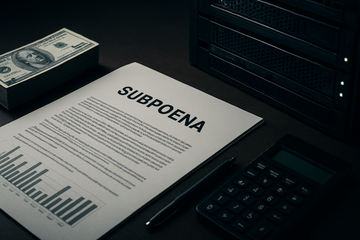
On October 14, 2026, the Federal Trade Commission sent OpenAI and Anthropic separate civil investigative demands of more than 50 pages each, asking for records on security incidents, technical safeguards, marketing materials and privacy policies. The compulsory process arrived about three weeks after Anthropic chief Dario Amodei and OpenAI president Greg Brockman met President Trump at the White House and signed a pledge of voluntary safety commitments, and roughly four weeks before bankers are reported to begin marketing Anthropic's IPO. Compulsory process, not voluntary pledge, is what turns AI safety marketing into a securities disclosure problem.
The subpoena
The Demand Is Aimed at the Claims, Not at the Models
The agency's theory is not that the models are dangerous in the abstract. It is that the representations built around them cannot be substantiated. The demands run at four targets — incident records, safeguards, marketing materials and privacy practices — and the third of those converts a safety inquiry into an advertising inquiry. The Federal Trade Commission already has the template: its September 2025 inquiry into AI chatbots acting as companions ordered seven consumer-facing providers, including OpenAI OpCo, Alphabet and Meta, to file special reports on how they use \"disclosures, advertising, and other representations\" to describe features, capabilities, intended audience, potential negative impacts and data collection. Marketing claims now sit inside the same evidentiary file as the incident logs.
- Marketing materials sit inside a compulsory document demand, alongside incident records, safeguards and privacy policies — the agency is assembling a substantiation file, not just an incident file.
- The template is already public: the September 2025 Section 6(b) order required seven chatbot providers to report on their advertising, safety and data handling practices, and OpenAI OpCo was one of them.
- The companies the FTC studied in its January 2024 AI-investments inquiry — Alphabet, Amazon, Anthropic, Microsoft and OpenAI — are the same five whose cloud and equity structures explain how the labs scaled at all.
- The agency said it would subpoena third-party organisations and could seek executive testimony, which pulls cloud, infrastructure and advertising records into the same file.
| What the demands seek | What the agency is testing | Where the answer already exists |
|---|---|---|
| Security incidents and agent behaviour | Whether published failures match what the company told users and enterprise buyers | The labs' own safety reports and incident write-ups |
| Technical safeguards and evaluation | Whether \"safe\" or \"aligned\" claims had a reasonable basis when they were made | Evaluation and red-team summaries the labs publish voluntarily |
| Marketing materials | Whether specific advertising claims were substantiated at the time they ran | Ad copy, landing pages and enterprise sales decks |
| Privacy policies and safeguards | Whether data handling matches what users were told | Published policies and the September 2025 special report on data handling |
The first exhibit
OpenAI's Ad Copy Is the Clearest Test Case
The sharpest exposure sits inside OpenAI's newest business. In its August 31, 2026 announcement that ChatGPT Ads had reached a $1 billion annualised run rate in under 200 days, the company made three categorical claims: ads are \"always clearly labeled and separate from ChatGPT's answers,\" \"advertising does not influence the answers ChatGPT provides,\" and \"advertisers do not receive access to people's private conversations.\" Those are the exact propositions on which a deception claim turns — a representation plus a reasonable basis — and they now sit inside a compulsory demand for marketing materials. The advertising line with the least regulatory history carries the most absolute claims.
FTC civil investigative demands
50+ pages each
Sent to OpenAI and Anthropic on Oct 14, 2026
OpenAI run rate told to investors
~$50B
September 2026 figure, reported Oct 8, 2026
OpenAI run rate in public circulation
~$70B
Year-end 2026 target, Bloomberg, Oct 9, 2026
ChatGPT Ads annualised run rate
$1B
Reached in under 200 days, company-reported Aug 31, 2026
Anthropic first-half 2026 revenue
$16.3B
Versus $1.1B a year earlier, prospectus reported Oct 21, 2026
Anthropic committed compute obligations
$518B
Cloud, computing and infrastructure, prospectus reported Sept 28, 2026
The calendar
The Timing Is the Whole Trade
Anthropic's prospectus is what makes this a capital-markets event rather than a regulatory footnote. Anthropic, PBC confidentially submitted a draft registration statement on June 1, 2026. The public prospectus disclosed 2025 revenue of nearly $4.6 billion, up twelvefold, an operating loss of $8.06 billion, a net loss of $42 billion, and $7.33 billion spent on compute and infrastructure — more than half of $12.65 billion in total operating expenses. For the first half of 2026 it disclosed $16.3 billion of revenue and an $80.7 billion net loss. A company losing $80.7 billion in six months cannot defer its funding event by a quarter.
Anthropic's disclosed economics
From Anthropic's IPO prospectus as reported by Reuters (Sept 28, 2026) and the public registration statement as reported by The Wall Street Journal (Oct 21, 2026). The 2025 net loss includes writedowns of liabilities tied to earlier fundraising rounds, which is why it dwarfs the $8.06 billion operating loss.
Unit: $ billions
2025 revenue
Grew twelvefold
4.6
2025 compute and infrastructure spend
More than half of operating expenses
7.3
2025 operating loss
Before writedowns of fundraising liabilities
8.1
H1 2026 revenue
Against $1.1B a year earlier
16.3
2025 net loss
Includes writedowns
42
H1 2026 net loss
Reported in the public prospectus
80.7
- The roadshow is reported to begin the week of November 9, with a mid-November listing discussed — the window in which a pending inquiry must be disclosed to underwriters, not buried in a post-pricing filing.
- The prospectus already contains the risk that matters most: nearly a quarter of revenue comes from two customers, and large clients are not locked into long-term contracts, so damage to trust converts into revenue quickly.
- At a reported $1.8 trillion to $2 trillion, the equity story is priced on revenue that has not been earned and on claims that have not been audited; the $965 billion Series H of May 2026 is the last private mark.
Supply chain
The Demands Reach the Balance Sheets
The listed exposure is not to a fine. It is to credit and to demand. These labs buy compute years in advance, and the bills land on companies whose own filings show how much of their spending is already committed. Microsoft spent $115.9 billion on property and equipment in the fiscal year ended June 30, 2026 — 34.9% of revenue. Amazon spent $131.8 billion in 2025, Alphabet $91.4 billion, and CoreWeave $20.6 billion over the trailing year against $6.9 billion of operating cash flow. Every dollar of that build is financed on the assumption that lab revenue keeps compounding.
| Company | Latest reported period revenue | Capital expenditure | Capex / revenue | Operating margin |
|---|---|---|---|---|
| Microsoft — FY2026, ended June 30, 2026 | $331.8B | $115.9B | 34.9% | 46.8% |
| Amazon — FY2025 | $716.9B | $131.8B | 18.4% | 11.2% |
| Alphabet — FY2025 | $402.8B | $91.4B | 22.7% | 32.1% |
| NVIDIA — Q2 FY2027, ended July 26, 2026 | $96.2B | n/a | n/a | 66.2% |
| Oracle — FY2026, ended May 31, 2026 | $67.4B | n/a | n/a | 30.8% |
| CoreWeave — trailing 12 months to June 30, 2026 | $7.6B | $20.6B | 271% | -3.0% |
- Upstream, demand is contractual and therefore insulated near term: NVIDIA grew second-quarter FY2027 revenue 106% year over year to $96.2 billion, and the labs' committed spend — $518 billion at Anthropic, a $300 billion five-year agreement with Oracle for up to 4.5 gigawatts from 2027 — is already signed.
- Also upstream, credit is not: CoreWeave built $20.6 billion of capacity against $6.9 billion of operating cash flow, raised $16.8 billion of net debt, and ended2025 with a $66.8 billion contracted backlog.
- Downstream, the cloud and distribution partners carry the partnership risk: Alphabet has a reported $200 billion five-year Anthropic compute commitment, Amazon offers Anthropic's models through AWS and Bedrock, and SoftBank Group runs SB OAI Japan, a 50-50 venture with OpenAI selling a single product, Crystal intelligence, into Japanese enterprise accounts.
- The FTC's own record links these companies: Alphabet, Amazon, Microsoft, Anthropic and OpenAI were the five recipients of its January 2024 orders on AI investments and partnerships, and the agency has said it will subpoena third parties.
Horizons
What the FTC Can Do — and What Would Break the Thesis
There is a case for calm. A civil investigative demand is a request, not a complaint; the agency can investigate without alleging anything and close a matter without filing. The labs' transparency is as much a defence as an exhibit: publishing safety frameworks and incident notes gives them the evidentiary basis for their own claims, and the September 2025 order already put their data-handling practices on the record. The thesis fails if the agency concludes the marketing was substantiated, and nothing in the public record yet says otherwise.
- Before the roadshow: whether Anthropic's registration statement is amended to disclose the demands, and what underwriters' counsel asks for in diligence.
- On the pricing date: whether a mid-November listing is priced, delayed or repriced — about $1 trillion separates the $965 billion private mark of May 2026 from the reported $1.8 trillion to $2 trillion range.
- Within 30 days: Microsoft, Amazon and Alphabet report quarters that will show whether cloud demand from the labs is unchanged, while CoreWeave's next filing shows whether customer concentration is repriced.
- On enforcement: whether the FTC names further labs and whether executive testimony is compelled — the agency said both are possible.
Synthesis
Own the Balance Sheet, Not the Narrative
The investable conclusion is narrower than \"AI regulation is bad\". The Federal Trade Commission is not attacking compute demand; it is auditing whether the trust premium that supports AI pricing and enterprise budgets has evidence behind it. That premium is funded, on the balance sheets above, by capital spent years in advance against revenue that has not been earned. Own the companies whose revenue comes from the labs' compute bill, and discount the names whose value depends on the labs' credibility being unquestioned.
Where the FTC's Demands Land on the Tape
- Debt-funded capacity leaves the labs' credit underwriting a $20.6 billion build against $6.9 billion of operating cash flow
- Trailing free cash flow of -$13.7 billion and $16.8 billion of net debt issuance mean a lab funding delay lands here first.
- Near term: the next filing is the catalyst — backlog and customer concentration should show whether lab receivables are repriced.
- Long term: neocloud pricing power weakens fastest where the customer base is one or two labs under regulatory review.
- A $300 billion five-year OpenAI agreement starting in 2027 equals roughly 4.5 years of Oracle's $67.4 billion annual revenue.
- The contract is a credit exposure dressed as backlog, and the catalyst is whether the next quarterly filing changes contract or credit language.
- Near term: no revenue impact before fiscal 2028; long term, a deception case complicates underwriting one of the largest AI counterparties.
- Alphabet's reported $200 billion five-year Anthropic compute commitment anchors the lab's $518 billion of committed obligations
- Bull case: an Anthropic IPO at a reported $1.8 trillion to $2 trillion marks both Alphabet's stake and its Cloud backlog.
- Risk: Alphabet is itself a recipient of the FTC's AI-partnerships orders, so the same agency is examining its contracts.
- Near term: Q3 2026 results show Cloud backlog; long term, Alphabet collects on the compute bill however the FTC case ends.
- One of five named counterparties in the FTC's AI-partnerships study, Microsoft is now a likely third-party subpoena recipient for what OpenAI told its cloud partner.
- FY2026 capital expenditure of $115.9 billion, 34.9% of revenue, makes Azure's payback dependent on lab economics the FTC can disturb
- Near term: FY2027 first-quarter results show whether Azure demand is unchanged; long term, Microsoft's own Copilot marketing faces the same substantiation bar if the theory extends.
- Anthropic has committed $200 billion of compute to Google Cloud over five years, leaving AWS the residual rather than the anchor of Anthropic's obligations.
- Amazon spent $131.8 billion of capital expenditure in 2025, 18.4% of revenue, and needs AI volume to earn the cost of capital
- Bull: Amazon offers Anthropic's models to enterprises through AWS and Bedrock; bear: a trust shock at the labs slows the budgets that fund that spending.
- Near term: Q3 2026 results and any Anthropic capacity commentary; long term, Anthropic's IPO is the moment AWS's exposure gets marked.
- Second-quarter FY2027 revenue of $96.2 billion, up 106% year over year, is set by contracted multi-year demand rather than by this month's subpoena
- Anthropic's $518 billion of commitments and OpenAI's $300 billion Oracle agreement are contractual; the FTC channel runs through sentiment, not order books.
- Near term: no impact from this probe; long term, a one-quarter IPO deferral by either lab would reprice the marginal 2027-28 accelerator order book.
- SB OAI Japan is a 50-50 venture with OpenAI selling one product, Crystal intelligence, into Japanese enterprise accounts from 2026.
- The probe travels straight into a joint venture whose entire asset is trust in the partner's safety and privacy claims
- Watch: whether the two companies publish substantiation for the enterprise claims being sold in Japan, and how that changes the go-to-market message.