
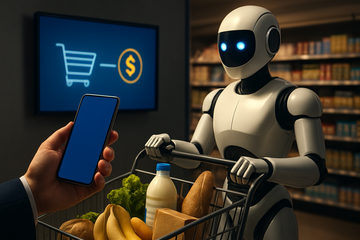
On October 21, 2026, Walmart said third-party AI assistants could shop Walmart and Sam's Club on a customer's behalf — inside a spending limit the customer sets, with approval required by default, and with no card data ever handed to the agent. The three pieces are an Agent Gateway built on the Model Context Protocol, per-agent profiles linked to the customer's account, and a set of AI agent terms that suspend agents that break the rules. Read as infrastructure rather than a feature, the announcement moves transaction authority out of model labs and into the retailer that owns the ad slot, and it lands three weeks after Amazon cut Meta's Muse agent off its own store.
Customer-set agent spending limit
$50-$200
Examples Walmart cited on Oct 21, 2026; approval can still be required inside the cap
Agent checkout conversion
1/3
Walmart pilot data: agent checkouts convert at roughly one-third of click-outs
Order value of Walmart's own agent users
+35%
Average order value of Sparky users vs. non-users, per Walmart's Q1 FY2027 earnings call, May 21, 2026
Walmart advertising growth
+38%
Q2 FY2027, reported Aug 20, 2026; Walmart Connect +43% excluding VIZIO
Meta advertising revenue
$63.1B
Q3 2026, filed Oct 22, 2026 — up 26%, with online commerce the largest growth contributor
The announcement
What Walmart Actually Announced on October 21
Three objects, one staged rollout. The agent terms and the rules of engagement are live now; the per-agent profiles arrive within a month of the announcement; the gateway itself opens only as a limited beta for companies and developers, with no date and no partner list named. Reuters reported that the gateway is designed to connect assistants including OpenAI's ChatGPT, Google's Gemini and Meta's Muse to Walmart and Sam's Club systems. What Walmart has not disclosed is the commercial half of the deal — no fee schedule, no partner list, no volume target, and no statement of how agent-placed orders will be attributed in its ad products.
| Control | Who sets it | What it lets the agent do | Status at announcement |
|---|---|---|---|
| Purchase approval | The customer | Approve every order, or delegate within a cap | Default is approval on every order |
| Spending limit | The customer — examples cited at $50, $100 and $200 | Buy without asking, up to the cap | Agent profiles, within a month |
| Payment credentials | Walmart | Never sees the card; charges the linked account | Agent terms, effective Oct 21 |
| Agent identity | The customer links each agent | Each agent gets its own profile, visible and revocable | Created on first use |
| Returns | Walmart policy | Standard returns process applies even when the agent errs | Agent terms, effective Oct 21 |
| Catalog access | Walmart | Approved agents search inventory and buy through the gateway | Limited beta; no date or partners named |
| Compliance | Walmart | Agents that break the terms are blocked from the site | Agent terms, effective Oct 21 |
Mechanism
A Spending Cap Is a Delegation of Purchasing Power, Not a Safety Feature
Amazon's objections to AI shopping agents were specific: nobody consented, the agent did not identify itself, and the agent appeared to capture customer credentials. Walmart's design answers each one with a control rather than an argument — a customer-created profile for consent and identification, and a payment instrument the agent never sees. What remains is the one thing no platform could previously offer a customer: a bounded mandate to spend.
- Amazon said no one had agreed to agents acting for customers. Walmart's answer: each agent gets its own revocable profile inside the customer's account.
- Amazon said agents do not identify themselves. Walmart's answer: every agent-placed order becomes traceable to a named agent.
- Amazon said agents capture customer credentials. Walmart's answer: the agent never sees the card and the customer stays the merchant of record.
- Amazon said agents could act beyond the shopper's intent. Walmart's answer: the cap plus approval-by-default puts a hard ceiling on how far intent can be stretched.
Attribution
Whoever Authorizes the Money Owns the Receipt, the Data and the Ad Slot
This is the layer that decides who wins. Meta's advertising revenue reached $63.1 billion in Q3 2026, up 26%, with the online commerce vertical the largest contributor to the increase — commerce ad money is being earned inside conversations no retailer owns. Walmart's advertising business grew 38% in the June quarter, with Walmart Connect up 43% excluding VIZIO, and it attaches to transactions Walmart can see from search to doorstep. Agent-mediated shopping only pays a retailer if the retailer keeps the receipt, because the receipt is what the ad gets priced against.
| Layer of the agent stack | Who held it before | What Walmart's gateway changes |
|---|---|---|
| Discovery and the shortlist | Meta's Muse, Google's Gemini, OpenAI's ChatGPT | Stays with the assistant |
| Catalog, local inventory and price | The retailer | Stays with the retailer, now served as structured data instead of a web page |
| Purchasing authority | Model labs, until OpenAI handed checkout back in March 2026 | Moves to the retailer through the customer's spending cap |
| Payment instrument and token | Networks, wallets and Stripe's Link | Walmart keeps the instrument; the network still authorizes |
| Transaction record and attribution | The retailer's ad server | A per-agent order record inside Walmart Connect |
| Ad impression | Platform feeds — Meta advertising alone was $63.1B in Q3 2026 | Retail media inventory inside the agent session |
| Brand's first-party relationship | The brand's own site and app | Moves to the retailer and the agent |
Brands sit on the wrong side of that trade. A paid placement inside an assistant that is meant to represent the customer is hard to disclose and harder to defend, which means the retailer's ad inventory, not the platform's feed, is the only place a sponsored result can survive. Walmart has not said whether agent sessions will carry sponsored inventory at all, and has not told brands what an agent-placed order is worth inside a media plan.
The economics
The Conversion Math Decides Whether Any of This Matters
The number that matters is not the cap; it is the conversion gap. Walmart's own pilot data, cited in October, puts direct agent checkouts at roughly one-third the conversion rate of click-outs — and because the agent is capped at $50 to $200, the basket it places is smaller still. That is why the retailer, not the model, has to hold the transaction: a third of the value per session is not worth handing the customer relationship to a platform that will bill for the impression.
Walmart's June quarter: where the growth is
Year-over-year growth in the quarter ended July 31, 2026. Walmart reports advertising growth rather than advertising revenue in dollars.
Unit: % growth vs. a year earlier
Total net sales
$187.9B in net sales
5.9%
Global eCommerce
an $8.2B increase
23%
Store-fulfilled delivery
earnings release: up 40% in the quarter
40%
Marketplace net sales
more than 50%; presentation shows +52%
50%
Advertising
Walmart advertising, global
38%
Walmart Connect (ex-VIZIO)
US retail media
43%
Walmart's own numbers show where agent demand would land. In the June quarter, Walmart U.S. operating income rose 20.6% to $8.12 billion, Sam's Club U.S. operating income rose to $678 million from $470 million, consolidated operating income rose 28.8% to $9.38 billion, and gross margin widened to 26.1% from 25.2%. Membership and other income reached $1.84 billion against $1.65 billion. The mix that is compounding is small-basket replenishment, store-fulfilled delivery and advertising, and the basket a $50-to-$200 cap produces lands in the highest-margin part of that mix.
| Segment | Q2 FY2027 | Q2 FY2026 | Change |
|---|---|---|---|
| Walmart U.S. | $8,120M | $6,732M | +20.6% |
| Walmart International | $1,439M | $1,234M | +16.6% |
| Sam's Club U.S. | $678M | $470M | +44.3% |
| Corporate and support | $(854)M | $(1,150)M | $296M smaller loss |
| Consolidated | $9,383M | $7,286M | +28.8% |
- Walmart's in-app agent is the benchmark: management said Sparky users post an average order value about 35% above non-users, so a third-party agent running at one-third conversion under a hard cap is a far weaker basket builder than the retailer's own assistant.
- Agent orders are immaterial to revenue today: June-quarter net sales were $187.9 billion, so agent rails move sentiment long before they move the P&L.
- Returns are the margin risk Walmart just accepted — its standard returns process applies even when an agent does not act as intended, and agent error and agent-order return rates are not disclosed.
- Capacity is not the constraint: FY2026 operating cash flow of $41.6 billion covered $26.6 billion of capital spending, so a gateway is affordable at any plausible scale.
The competitive split
Amazon's Wall and Walmart's Gateway Answer the Same Three Objections
Amazon cut Meta's Muse agent off Amazon.com in September, telling shoppers that continued access by an unauthorized AI agent violates the conditions they had accepted. Amazon's stated reasons were precise: it never agreed to the access, the agent did not identify itself, and the agent appeared to capture and store customer credentials. Walmart's design answers each objection with a control. Amazon keeps the ad funnel and cedes the agentic surface, while Walmart trades a slice of catalog control for the chance to own the transaction.
- October 2025: Walmart and OpenAI put shopping inside ChatGPT, with the model lab holding the checkout.
- March 2026: OpenAI pulled back from handling purchases — merchants keep their own checkout, the model focuses on discovery — and Walmart moved account linking, loyalty and payment onto its own rails.
- September 2026: Amazon blocked Meta's Muse; the agent had launched on September 8.
- October 2026: Walmart opened a budget-bearing gateway, and Meta then listed Walmart among roughly 20 large retailers in its Muse partnerships.
Supply chain — upstream
Authorization and Identity Are Where the Fee Pool Moves
Retailers can approve agents, but they cannot authenticate them alone. That work is migrating to the card networks and to the checkout layers that already hold tokenized credentials, which makes it the one part of the stack that does not require either side to trust the other.
- Mastercard's Agent Pay framework authorized South Korea's first live agentic transaction on March 17, 2026, with CardInfoLink facilitating a ride booked and paid through the hoppa platform, and more markets flagged for 2026. Networks collect a toll on every delegated purchase.
- Visa's Intelligent Commerce programme, and Mastercard's follow-on trust and intelligence services announced on September 30, 2026, push agent authentication and tokenization toward the merchant.
- Shopify is wiring Shop Pay's agentic checkout into Meta's Muse and runs agentic storefronts, which gives brands a checkout layer that requires no retailer's spending cap.
- Stripe, privately held, supplies the Link wallet Meta's Muse uses to pay — evidence that the credential layer sits with payment specialists, not with retailers or model labs.
- Protocols are fragmenting: Walmart's gateway speaks MCP, Google's open standard is the Universal Commerce Protocol launched with Walmart in January 2026, and OpenAI runs the Agentic Commerce Protocol. Every extra handshake taxes a conversion rate already running at one-third.
Supply chain — downstream
Brands Carry the Data Build and Lose the Click They Used to Own
The retailer has made a decision brands cannot ignore: an agent that finds a product may never visit the brand's site, and the order will sit in the retailer's file, priced against the retailer's ad inventory. Walmart has already told sellers that listings need stronger product information, competitive pricing, availability and reliable delivery promises before agents will recommend them.
- Agents need machine-readable local facts — which store can fulfil, the local price, the live promotion, the delivery window — so the catalog upgrade lands on brand and seller data teams.
- The first-party relationship migrates to the retailer and the agent, leaving the brand with the media bill and not the data.
- Paid placement inside a customer-facing assistant is a trust problem: sponsored products have to appear in a recommendation without undermining the assistant's neutrality, and Walmart has not said how agent sessions will be sold.
- The tests that matter are returns and repeat rate on agent-placed orders; neither is disclosed, and both decide whether the cap stays a cap or becomes a ceiling.
Outside the US
The Global Tell: Alibaba and Rakuten Keep the Agent In-House
Walmart is not the only retailer building agent rails, but it is building a different one. Alibaba connected its Qwen assistant to Taobao's entire product catalog and launched a Qwen-powered shopping assistant inside the Taobao app. Rakuten launched Rakuten AI inside the Rakuten Ichiba mobile app on January 5, 2026. Both keep the agent on the retailer's own property and inside the retailer's own data; Walmart is the first large retailer to invite outside agents and hand them buying power inside the customer's account.
Agentic retail: who has opened what
United States — Walmart
Third-party agents with customer spending caps
Agent Gateway in limited beta, announced Oct 21, 2026
United States — Amazon
Blocks third-party agents from buying
Meta's Muse cut off, September 2026
China — Alibaba
Qwen assistant inside Taobao, full catalog connected
Platform-owned agent, announced 2026
Japan — Rakuten
Rakuten AI inside the Rakuten Ichiba app
Launched January 5, 2026
South Korea — payments
First live agentic transaction authorized
Mastercard Agent Pay, March 17, 2026
That contrast is the investment signal. If the open model works, the platforms that kept the agent in-house eventually face a choice between opening a budget-bearing gateway to outside assistants and watching agent traffic settle on whichever retailer did it first. If it does not — and a one-third conversion rate is not encouraging — they have avoided an expensive rollout that brands would have fought, while Walmart has spent a quarter of management attention on a rail with no revenue attached to it yet.
Horizons
What Moves in Quarters, and What the Thesis Needs Over Years
- Agent profiles land within a month of October 21; the gateway's beta partner list and any fee schedule are the first real datapoints, and neither has been disclosed.
- Watch whether Meta's Muse actually routes through Walmart's gateway, and whether caps stay per-order. The beta partner list is the first thing to check, before any revenue claim.
- Watch agent order volumes, return rates and repeat rates at Walmart's next quarterly report; none of the three is disclosed today.
- Watch whether Amazon ever accepts an identified, permissioned agent; that would validate the governed-rail model and blunt Walmart's first-mover claim.
- If budget delegation scales, the retailer's media business becomes the toll booth for agent traffic and Walmart Connect monetizes baskets that platforms cannot claim.
- Brand first-party data keeps migrating to retailers and agents; the brands that win are the ones with the best machine-readable catalog, not the best click-through rate.
- Standards consolidate around agent identity and tokenization, with networks arbitrating trust and retailers paying per delegated transaction.
- The main risks: agent error and returns, brands refusing to supply structured data, a platform assistant scaling faster than third-party agents, and regulators examining delegated purchasing.
Who the agent rail actually touches
- Owning the spending cap means owning the attribution: Walmart advertising grew 38% in Q2 FY2027, with Connect up 43% excluding VIZIO.
- Agent traffic converts at roughly one-third of click-outs and stays capped at $50-$200, so watch returns and repeat rate, not headline volume.
- Near term, agent profiles arrive within a month of Oct 21 and the gateway beta names no partners — no agent revenue yet in the $187.9B quarterly base.
- Over one to three years, Walmart Connect monetizes baskets that platforms cannot claim, and membership and other income of $1.84 billion shows the recurring-income model already works.
- Blocking agents protects the ad funnel it already owns but cedes agent-driven demand, leaving Walmart's gateway as the default US alternative.
- Q2 FY2026 net sales of $200.6B and $27.5B of operating income mean Amazon can wait: agent volume is immaterial to revenue today.
- Mixed over one to three years — the own assistant keeps the walled garden, but every agent that shops elsewhere starts with Walmart's catalog.
- Catalyst: if Amazon ever accepts an identified, permissioned agent, the governed-rail model wins and Walmart loses exclusivity.
- Alphabet launched the open agentic commerce protocol with Walmart in January 2026, keeping its checkout standard inside the retailer's rails.
- Q2 FY2026 revenue was $119.8B; if assistants absorb discovery, Google Ads loses the click-out impression that agents no longer produce.
- Mixed over one to three years: protocol ownership keeps Alphabet in the flow while agent-mediated discovery compresses sponsored results.
- Watch whether Google Checkout inside AI Mode converts, given agent checkouts run at roughly one-third of click-out rates.
- Muse reaches roughly 20 large retail partnerships including Walmart, so Meta's agent can transact wherever a retailer grants a budget.
- Advertising revenue hit $63.1B in Q3 2026, up 26%, with online commerce the largest growth contributor — the exact vertical agents attack.
- Operating income fell 37% to $13.0B as Meta funds the agent push, so the commerce payoff has to arrive before margins recover.
- Over one to three years, if agents own discovery, feed impressions shrink even as agent bookings grow.
- Shop Pay's agentic checkout inside Meta's Muse gives brands a fee-bearing checkout layer that needs no retailer's spending cap.
- Q2 FY2026 revenue of $3.58B and $488M of operating income put the rails business ahead of the agentic volume.
- Bullish over one to three years: brands can route agent traffic through their own storefront instead of granting budget to Walmart.
- Catalyst: the first disclosed agent-placed order completed on a Shopify-powered storefront.
- Agent Pay authorized South Korea's first live agentic transaction on March 17, 2026, with more markets flagged for 2026.
- Q2 FY2026 net revenue was $9.28B with $5.59B of operating income; every delegated purchase still needs a network authorization.
- Bullish over one to three years: agent identity and tokenization, not checkout screens, is the toll booth retailers cannot build.
- Watch whether Walmart's gateway can authorize spend without adding a network fee the retailer cannot pass on.
- Alibaba connected Qwen to Taobao's entire catalog and put a Qwen shopping assistant inside the Taobao app — an in-house agent, not an open rail.
- Watch catalyst: whether Taobao ever grants third-party agents spending caps, which would validate the open-gateway design outside the US.
- Downside read-across: if in-house agents win, Walmart's move concedes discovery without a proven conversion payoff.
- Near term, China's agentic rail is a platform-owned storefront, so nothing changes for Taobao's transaction flow.
- Rakuten AI has run inside the Rakuten Ichiba app since January 5, 2026, keeping the agent on Rakuten's own property.
- Watch catalyst: whether Rakuten opens Ichiba to third-party agents with spending caps, the way Walmart did.
- Mixed over one to three years: Rakuten keeps first-party data but forgoes third-party agent traffic that Walmart is absorbing.
- Japan's agentic rail still runs through platform-owned surfaces, with no budget delegation to outside agents.