
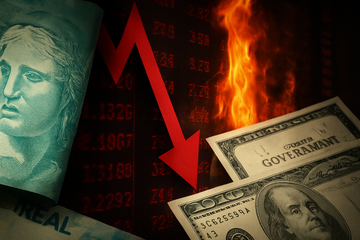
Real's one-session fall
8.36%
Oct 26, 2026, to 5.406 per dollar; largest one-day move since 1999
Brazil 10-year government bond
+246bp
12.99% to 15.45% on Oct 26, 2026; a decade high, peaking at 15.6%
A year's carry erased in one session
73%
erased 8.36 points of an 11.45-point spread over the Fed's 4.00% ceiling on Oct 26, 2026
U.S. 10-year Treasury
4.93%
Oct 30, 2026; Fed funds held at 3.75–4.00% on Oct 28
Brent crude
$113.43
Oct 30, 2026, up 75% over twelve months
EM portfolio outflow
$26.3bn
September 2026, the first monthly outflow since June
October 25–26, 2026
The Trigger Was an Election; the Vulnerability Was a Position
Luiz Inácio Lula da Silva won Brazil's Oct 25, 2026 runoff with 51.8% of the valid vote against Flávio Bolsonaro's 48.2%, a margin of more than four million votes that defied the polls published in the final weeks. Markets had gone into the runoff positioned for the opposite: J.P. Morgan upgraded Brazilian equities to overweight after the first round and projected 12% to 20% upside.
On Monday, Oct 26, that position turned: the market moved from pricing a policy reset to pricing a fiscal reckoning in a single session, and the damage was recorded across every Brazilian asset at once.
| Asset | Before | After | Move |
|---|---|---|---|
| Brazilian real (USD/BRL) | 4.98 | 5.406 | -8.36% |
| Ibovespa index | — | — | -13.9% at the close, -17% intraday |
| Brazil 10-year government bond | 12.99% | 15.45% | +246bp, peaking at 15.6% |
| Brazil 5-year sovereign CDS | 120.2bp | 151.7bp | +26% |
| iShares MSCI Brazil ETF | — | $34.15 | -19.8% on 244.9m shares, 5.6x the 30-day average |
| National Treasury bond auctions | Two planned | Both canceled | Demand doubts at soaring yields |
The carry arithmetic
The Cushion Is the Currency, Not the Yield
A dollar-funded investor in Brazilian local government bonds was being paid 15.45% to take currency risk on top of a Fed funds rate capped at 4.00% — a spread of 11.45 points. Monday's 8.36% depreciation of the real consumed 8.36 of those points in one session. Korean estimates put the price loss on the January 2035 bond at roughly 11%, so a position bought earlier in October lost about a fifth of its value in a day.
One Session Against a Year of Carry
Brazil's carry arithmetic after the Oct 25, 2026 runoff: the currency leg erased 73% of the spread in a single session
Unit: %
Brazil 10-year local yield
Oct 26, 2026 close
15.4%
Spread over the Fed's 4.00% ceiling
What dollar-funded investors were paid
11.4%
Real's depreciation in the Oct 26 session
What one session cost them
8.4%
The yield was never the cushion: the currency is the leg that gaps, and it gaps in a session, while the funding leg is repriced only when central banks move. The Fed held at 3.75–4.00% on Oct 28 with two of twelve voters dissenting in favour of a hike, so the dollar cost of carry is fixed and high while the position leg is marked continuously.
- Currency, not yield, is the buffer: Brazil's 15.45% local 10-year still paid 11.45 points over the Fed's 4.00% ceiling, and one session gave back 8.36 of them.
- The funding leg has no relief while the currency leg keeps its gap risk, because the Fed's next move is a hike or a pause, not a cut.
- Hard-currency credit never repriced the politics: Brazil's 5-year CDS rose 26% to 151.7bp and eased back to 141bp, against 246bp on the local 10-year.
- Positioning multiplied both sides of the trade: local currency EM bond funds absorbed $4.1bn in the third quarter, and money that arrived quickly cannot always leave quickly.
Brazil's Five-Year Sovereign CDS
Hard-currency credit barely repriced the political shock — the damage was priced in local rates and the currency
Unit: basis points
Pre-election level
Before the Oct 25 runoff
120.2
Oct 26 close
+26% on the day
151.7
Oct 29 close
Partially retraced
141
Why Brazil
The Most Crowded Corner of the Carry Trade Was Where It Broke
Brazil was not the largest emerging market, but the flows show it was the most crowded corner of the carry trade. Local currency EM bond funds absorbed $4.1bn in the third quarter of 2026 and hard currency funds $1.4bn, while J.P. Morgan Asset Management's Oct 29 bond bulletin recorded that global investors had been drawn to Brazil for its relatively high carry right up to the weekend before the election — and that it was now more cautious on the real and local rates than on credit.
| Benchmark | Brazil's weight |
|---|---|
| EM local-currency government bond index | 8.0% |
| MSCI EM equity index | 4.2% |
| iShares MSCI Emerging Markets ETF | 3.90% |
| EM hard-currency (USD) sovereign debt | 3.2% |
| EM hard-currency (USD) corporate debt | 4.9% |
Read that table as a map of where damage can land. Brazil is 8.0% of the local-currency government bond index — where the shock actually landed — but only 3.2% of hard-currency sovereign debt, which is why its 5-year CDS rose 26% while the local 10-year rose 246 basis points. A large local-rates position and a small hard-currency position is exactly the profile that converts a political shock into a funding problem.
| Evidence | Number | What it shows |
|---|---|---|
| Local currency EM bond fund flows, 3Q26 | +$4.1bn | Fresh money into the crowded leg |
| Hard currency EM bond fund flows, 3Q26 | +$1.4bn | The safer half of the trade |
| EM portfolio flows, September 2026 | -$26.3bn | First monthly outflow since June |
| EM equity outflow caused by Korean selling | -$19.2bn | The unwind had already started in Korea |
| Foreign purchases of Korean shares, August 2026 | +7.2tn won | Where the recycled carry went |
| Korean net purchases of Brazilian bonds, September 2026 | $5.53m vs $1.39m in August | Retail money chasing a tax-free 10% yield |
The macro overlay
Oil and the Fed Closed Both Exits
Two shocks outside Brazil turned an election result into a repricing. Brent closed at $113.43 a barrel on Oct 30, up 75% over twelve months, which is why the Federal Reserve held at 3.75–4.00% on Oct 28 with two votes for a hike and warned that inflation remains elevated. The same crude price is why Brazil's government had spent about R$40bn ($7.8bn) on fuel relief between March and the end of September and was still paying R$1.40 a litre to cushion imported diesel in late October.
Inflation remains elevated; accumulation of more information will help determine the policy stance appropriate to ensure a timely return of inflation to the Committee's 2 percent goal.
This is the compound effect that matters. Oil lifts the inflation bill, inflation keeps central banks tight, tight money keeps the dollar funding cost high, and a high funding cost is what makes emerging-market carry positions crowded and one-sided. Add a fiscal expansion that has to be funded somewhere, and Copom's easing cycle — which cut the Selic to 14.00% from a near-two-decade peak of 15% — becomes the third casualty: keeps the dollar funding cost high and the carry positions one-sided.
The fiscal arithmetic
The Fiscal Gap Is Now the Whole Trade
Brazil's fiscal position entering the election looked respectable: the IMF's 2026 Article IV put the federal primary deficit at 0.4% of GDP, inside the 0.25% target band, and Fitch saw the same 0.4% for 2026 against 0.5% in 2025, with the consolidated public sector's August primary deficit of R$10.0bn narrowing from R$17.3bn a year earlier. The International Finance Institute's October monitoring report, published Oct 29, then put the election pledges on a different footing.
Brazil's fiscal arithmetic
2026 federal primary deficit (IMF)
0.4% of GDP
2027 primary surplus needed to stabilise debt (IFI)
2.1% of GDP
2027 primary surplus the government projects
0.13% of GDP
Unbudgeted cost of election pledges (IFI)
R$40bn
Fiscal adjustment the IFI says is needed
~3pp of GDP
2027 fiscal target announced by the finance ministry
0.5% primary surplus
The IFI estimates that the campaign commitments — a larger Bolsa Família benefit, lost online-betting revenue and relief for microentrepreneurs — could push the 2027 primary deficit to 1% of GDP, against a government projection of a 0.13% primary surplus. That is the distance between a market that expects consolidation and one that expects drift, and it is priced in a 1,049 basis point spread over the 10-year Treasury.
- A finance minister the market can price: J.P. Morgan names the choice of finance minister and a credible consolidation path as the two things to watch.
- A constitutional spending freeze, possibly widened before the new legislature convenes in February 2027 — the fastest credible route to a smaller 2028 primary deficit.
- A fuel-price decision that stops consuming budget, because R$1.6bn every 30 days for imported diesel is small next to R$40bn but is the quickest way for the fiscal story to break.
- A central bank that can keep easing: Brazil's 2026 inflation expectations sit at 4.9% against a 3% target with a 1.5-point tolerance, so the Selic path now depends on the fiscal path.
Who owns the loss
Korea Bought the Carry, and Korea Is Where It Broke
The most revealing ownership data of the week came from Seoul. Korean retail investors net-bought $5.53m of Brazilian government bonds in September, four times the $1.39m bought in August, and kept buying into October with $1.78m net through Tuesday, according to the Korea Securities Depository. The attraction was arithmetic rather than romantic — about 10% annual yields taxed at zero under the bilateral treaty between the two countries — and one Monday erased the reason they bought.
Those buyers were not reckless, only early. A January 2035 Brazilian government bond yielded12.5% at a 52-week low earlier in October before surging to 15.4% on Monday, which Korean analysts estimated cut bond prices about 11%; add the 8.36% currency loss and roughly a fifth of the position disappeared in a session. On the equity side, foreign investors had bought 7.2tn won of Korean shares in August, then drove $19.2bn of the $26.3bn September outflow from emerging-market equities, and the KOSPI fell 1.46% to a seven-month low on Oct 26 as foreigners sold about 700bn won.
- Korea broke first: the September EM equity outflow was Korea-driven, and the KOSPI was already at a seven-month low on the day of the Brazilian runoff.
- Peer currencies were soft before the vote — the Mexican peso closed at an October low near 18.67 on Oct 21 — so the unwind was already running before Brazil accelerated it.
- The yen is the mirror image: the yen surged to a seven-month high in September as carry trades buckled, and the Bank of Japan held at 1.25% on Oct 30 while signalling further hikes.
Balance sheets
Where the Damage Lands: Brazilian Banks and Brazilian Oil
Two Brazilian balance sheets decide whether this stays a market event or becomes an economy event. Itaú Unibanco is the cleanest case of a two-sided trade: a 14.00% Selic pushed 2Q26 net interest income to R$21.2bn from R$14.7bn in 1Q26, but the same rate move that pays the margin marks down the bond portfolio, and the June 30 balance sheet carried R$919bn of long-term investments plus R$117bn of short-term investments against R$218bn of shareholders' equity.
| Company | Key figures | The tension |
|---|---|---|
| Itaú Unibanco | 2Q26 net interest income R$21.2bn (1Q26: R$14.7bn); R$1.04tn of investments vs R$218bn of equity | 14% Selic pays the margin; a 246bp rise in local rates marks down the bond book — at an illustrative four-year duration, roughly half of book equity |
| Petrobras | 3Q26 production 3,512 mboed; 2Q26 net income R$52.4bn, up 97% year on year | Cash flow and dividends at the top of the oil cycle, but a stretched budget raises the odds of more intervention in fuel pricing |
Petrobras sits on the other side of the chain. Third-quarter production reached 3,512 mboed with 2,454 mbpd from pre-salt fields, refining utilisation hit 99%, and exports of crude and products set a record 1,251 mbpd — so the company converts $113 oil into cash and dividends while the fiscal channel becomes the swing factor. The risk is not geological but political-economic: with the government already absorbing imported-diesel costs, a budget squeeze raises the odds of more fuel-price intervention, which lands on the domestic seller.
| Vehicle | Level (Nov 1, 2026) | 52-week range | Read |
|---|---|---|---|
| iShares MSCI Brazil ETF | $32.46 | $30.72–$43.90 | 26% below the high after a 19.8% day; its 3.94% trailing 12-month yield was consumed five times over |
| iShares MSCI South Korea ETF | $161.83 | $86.90–$220.89 | 27% below the high as foreign flows reverse |
| iShares J.P. Morgan USD Emerging Markets Bond ETF | $92.25 | $89.69–$97.80 | The hard-currency carry leg barely marked down |
Horizons
What Moves First, and What Would Break the Thesis
Over days to quarters, the calendar is the catalyst. The next Copom decision, the December Federal Reserve and Bank of Japan meetings, and the fiscal signals that precede the new legislature convening in February 2027 set the price of the dollar and the risk premium on local rates. None of it is a Brazilian secret; all of it is priced.
- Copom: with 2026 inflation expectations at 4.9% against a 3% target, a fiscal-driven inflation surprise ends the easing cycle and removes the last support for the real.
- The December FOMC: two dissents in October were already voting for a hike, and a higher-for-longer Fed keeps the 4.93% 10-year — and the carry funding cost — exactly where it is.
- The December Bank of Japan meeting: a second hike after October's hold at 1.25% tightens the other funding leg of the same trade.
- Brazil's fiscal signals, because the 10-year at 15.42% on Oct 30 is where the verdict gets read and the finance minister is the variable.
Over one to three years, the question is whether Brazil can close a gap running from a 0.13% projected primary surplus to the 2.1% the IFI says stabilises the debt ratio — roughly three points of GDP of adjustment, with R$40bn of pledges already unfunded. If it closes, a 1,049 basis point spread over the 10-year Treasury is the widest risk premium in the local-bond complex and the carry rebuilds around it. If it does not, Brazil stops being a crowded carry trade and becomes a fiscal-dominance story, which is a more durable discount.
- Oil back to $80 restores the cushion: a lower crude price shrinks Brazil's fuel-relief bill, cools inflation and gives Copom room to ease, and the carry rebuilds without any fiscal improvement.
- A credible consolidation deflates the warning faster than any flow: a market-friendly finance minister and a constitutional spending cap could compress the spread quickly.
- A hawkish Fed surprise is the asymmetric risk: a dollar that strengthens from here hits every EM currency at once, turning a Brazil-specific positioning event into a systemic one.
Conclusion
The Warning Is About the Trade, Not the Country
Brazil's October rout was the cheapest available stress test of a global position, and it failed in the harshest way: a 15.45% local yield, a 4.93% dollar and a single session of 8.36% currency weakness were enough to erase three-quarters of a year's carry while hard-currency credit barely blinked. That tells investors where to look — not at Brazilian solvency, but at the price of funding and at how one-sided the positions are.
The portfolio conclusion is uncomfortable but simple. In a cycle where the Federal Reserve is on hold with two votes for a hike, oil is 75% above a year ago and the 10-year Treasury sits just under 5%, emerging-market carry is a short volatility position in the currency dressed as a bond investment. Brazil proved it can be closed by one election result, one Monday and one number — and the same arithmetic applies to every other market where that money went.
The investable map
- Sits 26% below its 52-week high after a 19.8% single-day loss on 5.6 times normal volume, the second-worst session in 26 years.
- Catalyst: the finance minister pick and any credible consolidation path; until then a 1,049bp spread over the 10-year Treasury keeps local-rate risk dominant.
- Days to quarters: fiscal signals and the next Copom decision set direction; one to three years: a 1% primary deficit would make the discount structural.
- Keeps earning a 14% Selic on R$21.2bn of quarterly net interest income while a 246bp rise in local yields marks down its bond book.
- R$1.04tn of investments against R$218bn of equity means a four-year-duration illustration of the yield shock is worth roughly half of book equity.
- Days to quarters: Copom and the curve decide margin versus marks; one to three years: fiscal credibility decides which side of that trade the bank wins.
- Turns a $113 barrel into record cash flow on 3,512 mboed of 3Q26 production, 99% refining utilisation and record 1,251 mbpd of exports.
- The risk is fiscal, not geological: R$40bn of fuel relief has already been authorised through September, so a stretched budget raises the odds of more price intervention.
- Days to quarters: quarterly results and the monthly diesel-subsidy decisions; one to three years: the 2027 budget decides whether dividends or the fiscal account absorb the oil windfall.
- Absorbs the shock that broke the local market: Brazil's 5-year CDS rose 26% to 151.7bp and eased to 141bp, against 246bp on the local 10-year.
- Hard-currency credit is where the carry survives, and J.P. Morgan now prefers credit to local rates while staying focused on carry.
- Catalyst: the December Federal Reserve and Bank of Japan meetings; one to three years: Brazil is only 3.2% of EM dollar sovereign debt, so losses stay contained.
- Carries the most crowded EM equity positioning, with the KOSPI at a seven-month low on Oct 26 as foreigners sold about 700bn won.
- Korea broke first: foreign selling drove $19.2bn of the $26.3bn September EM equity outflow, so Brazil was the accelerant, not the origin.
- Days to quarters: the ETF sits 27% below its 52-week high and stays exposed to the next dollar-funding shock; one to three years: a weaker won supports exporters' translated revenue.
- Already absorbed a 40% drawdown from its 52-week high at 7.0x earnings and 4.0x EV/EBITDA with net cash, making the de-rating a flow event rather than an earnings event.
- The flow driver is documented: Korean selling drove $19.2bn of the September EM equity outflow and the KOSPI hit a seven-month low on Oct 26.
- Days to quarters: foreign flow direction and the won decide the multiple; one to three years: memory-cycle earnings and a weaker won support translated revenue.