
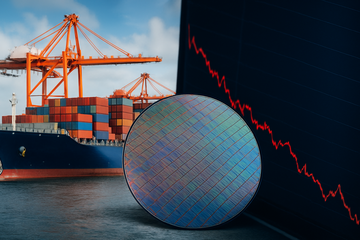
Two facts landed two days apart and point in opposite directions. On Friday, October 30, the Nasdaq Composite fell 2.86%, Intel fell 28.6% and Nvidia fell 4.2% as investors marked down the financing of AI spending. On Sunday, November 1, Korea's Ministry of Trade, Industry and Resources published customs data showing October exports up 93.7% to $115.28 billion — the strongest month since January 1974 — with semiconductor exports up 259.4% to $56.44 billion and a $42.50 billion trade surplus. The tape priced a demand collapse; the print settled one. Both numbers are true because they measure different things — one prices what buyers will pay in 2027, the other records what was already paid for in 2026.
October 2026 exports
$115.28B
+93.7% year on year; strongest month since January 1974
Semiconductor exports
$56.44B
+259.4% year on year; 49% of everything Korea shipped
Trade surplus
$42.50B
Second straight month above $40 billion
January–October exports
$930.0B
+60.6% year on year; $1 trillion expected within November
Exports to the United States
$24.9B
+185.8% year on year, led by chips and AI servers
KOSPI close, Oct 30
5,730.74
Down 3.48%, before the export data was published
The Contradiction
The Tape and the Print Are Pricing Different Variables
The selloff was about money, not about orders. Amazon reported a sharp cash outflow and signalled another leg up in capital spending; rate expectations shifted toward more than 50 basis points of Fed increases by mid-2027, which makes debt-funded AI spending harder to defend; and Alphabet sold off on record cash outflows. None of that changes what physically shipped in October. Customs recorded $56.44 billion of semiconductors leaving Korean ports and $42.50 billion of net exports. Funding a boom and recording it are two different questions with two different answers.
| Signal | What it actually measures | The hard number | Date |
|---|---|---|---|
| AI cash-burn selloff | The price of funding AI capital spending | Nasdaq -2.86%; Intel -28.6%; Nvidia -4.2% | Oct 30, 2026 |
| Korean customs data | Goods shipped, invoiced and paid for | Exports $115.28B, +93.7% | Nov 1, 2026 |
| KOSPI close | What Korean equities did that day | 5,730.74, -3.48% | Oct 30, 2026 |
| Won | The price of the export receipts | About ₩1,339 per dollar, off a two-year high | Oct 29, 2026 |
| DRAM contract prices | The price of a bit of memory | About +20% QoQ expected in 4Q26 | Oct 20, 2026 |
- The selloff repriced future cash flow: Amazon fell 1.4% and Intel 28.6% on October 30, and together were set to erase close to $200 billion of market value.
- The print recorded present cash: Korea's cumulative surplus reached $294.9 billion over ten months, and the won stood near ₩1,339 per dollar after touching a two-year high.
- Both readings describe the same boom; only one of them describes a buyer that has already paid.
Stripping the Noise
The Growth Rate Is Flattered; the Level Is Not
Two things inflate the headline: last October was depressed by the Chuseok holiday falling differently, which gave Korea more working days this year, and the base itself was low. Implied October 2025 exports were $59.51 billion against $115.28 billion now. But a low base does not create a level: at $115.28 billion in a single month and $930.0 billion across ten months, Korea has already crossed a $1 trillion annual run-rate before the fourth quarter is out, and the ministry expects the milestone within November.
Korea's export level has stepped up, not merely grown
Monthly Korean exports, $ billion. October 2025 is implied from the reported 93.7% increase; May, August and September 2026 come from trade ministry releases.
Unit: $ billion
Oct 2025
Implied base
59.5
May 2026
87.8
Aug 2026
98.3
Sep 2026
Record month
120.9
Oct 2026
115.3
| Item | October 2026 | YoY | Implied October 2025 | Share of the increase |
|---|---|---|---|---|
| Total exports | $115.28B | +93.7% | $59.51B | 100% |
| Semiconductors | $56.44B | +259.4% | $15.70B | 73% |
| Computers | $5.85B | +496.6% | $0.98B | 9% |
| Automobiles | $6.55B | +18.1% | $5.55B | 2% |
| Semiconductors plus computers | $62.29B | — | $16.68B | 82% |
Price Versus Volume
This Was a Price Shock, and That Decides What Can Break It
The export line is denominated in dollars, and dollars per bit exploded. DRAM contract prices rose about 80% quarter-on-quarter in the second quarter of 2026 and about 40% in the third, and TrendForce expects another 20% in the fourth — roughly a tripling of the price of memory inside a year. Volume did not have to triple for Korea's export value to triple, and it did not: DRAM industry bit shipments are growing only in the mid-20% range this year.
Memory prices are still rising, just more slowly
Quarter-on-quarter change in DRAM contract prices. The fourth-quarter figure is a TrendForce forecast published Oct 20, 2026.
Unit: % QoQ
2Q26
80%
3Q26
40%
4Q26 forecast
20%
That distinction sets the falsification test. If AI demand were collapsing, contract prices would fall first and export value would follow with a lag. Prices have not fallen: Micron closed its fiscal fourth quarter with $54.23 billion of revenue at an 86.8% gross margin and guided the next quarter to $61.5 billion at about an 86% gross margin.
- The honest weakness is timing: order cuts reach guidance first, prices second and customs records third, so the export line lags the tape by a quarter or two rather than leading it.
- That makes the print a coincident indicator. It can confirm a collapse long after the tape called it, which is precisely what happened to energy and telecom hardware in prior cycles.
- The print is wrong only after memory prices turn, because price is what a dollar-denominated export line actually measures.
The Import Line
The Best Evidence Against a Demand Collapse Sits on the Wrong Side of the Ledger
Korea's exports are the half of the ledger investors read. The other half says something the tape finds inconvenient: imports rose 36.0% to $72.78 billion, the largest annual increase since January 2022, and Reuters attributed the rise in part to demand for semiconductor manufacturing equipment. A memory industry facing a collapsing end market does not order more tools. It cancels them.
| Company | Commitment | Period | Announced |
|---|---|---|---|
| Samsung Electronics | ₩27.2T in Device Solutions in Q3; about ₩84.4T planned for the year | Q3 2026 / FY2026 | Oct 2026 |
| Micron | About $11.5B in the first quarter, about $25B in the first half, more in the second | FY2027 | Sep 30, 2026 |
| SK hynix | Next year's investment to increase significantly as Yongin Phase 1 starts up | 2027 | Oct 28, 2026 |
| Hanmi Semiconductor | ₩44.2B thermo-compression bonder order from SK hynix, roughly 15 units | Jun 2026 | Jun 8, 2026 |
| Tokyo Electron | FY2026 capex raised 48% to a record on DRAM etch demand | FY2026 | Jan 9, 2026 |
And the money funding that ramp is not coming from the debt markets the tape is worried about. Over the trailing twelve months SK hynix generated ₩86.7 trillion of free cash flow against roughly ₩36.1 trillion of capital spending, and Samsung Electronics generated ₩147.6 trillion against roughly ₩54.8 trillion. The buyers, not the sellers, are the ones with a funding problem.
Funding Versus Settlement
The Panic Is Real — It Just Is Not About Orders
Rating agencies have already drawn the map. S&P Global Ratings expects combined hyperscaler capital expenditure to exceed $1.3 trillion by 2027 and negative free operating cash flow at the six largest hyperscalers in both 2026 and 2027, with no recovery projected until 2029, funded through debt, equity issuance, leases, joint ventures, special purpose vehicles and residual value guarantees. That is a genuine problem, and it is a problem about the price and structure of AI capital. It is not about whether the chips ordered in 2026 were real.
- The funding stress is documented: Amazon carries negative trailing free cash flow, capital spending at 27% of revenue and net debt at 0.8 times EBITDA after a 1.4% fall on October 30.
- The settlement is documented: $42.50 billion of net exports in October, $294.9 billion across ten months, and a won off its two-year high.
- The timing difference is the whole argument: a capital spending reset would reach memory orders in two to three quarters and would appear in the March 2027 customs print, not the October one.
- The memory sellers are pre-funded: Micron holds $32 billion of customer financial commitments, mostly cash deposits, under 26 supply agreements covering over 35% of its revenue through 2030. That is cash, not a forecast.
Much tighter in calendar 2027 and 2028 than they were in 2026.
Fundamentals
The Print Is Already in the P&L. The Multiple Is Not.
| Company | Latest reported quarter | Revenue | Operating profit | Operating margin |
|---|---|---|---|---|
| SK hynix | 3Q26, ended Sep 30, 2026 | ₩104.6T | ₩83.3T | 80% |
| Samsung Electronics | 3Q26, ended Sep 30, 2026 | ₩195.3T | ₩107.4T | 55% |
| Micron | FQ4 FY2026, ended Sep 3, 2026 | $54.23B | $43.75B | 81% |
| Company | Close, Oct 30, 2026 | That day | From 52-week high | EV/EBITDA, trailing | Free cash flow yield, trailing |
|---|---|---|---|---|---|
| SK hynix | ₩1,418,000 | -7.1% | -52.5% | 4.4x | 9.1% |
| Samsung Electronics | ₩225,000 | -3.0% | -39.9% | 4.0x | 10.9% |
| Micron | $884.74 | -5.3% | -29.5% | 8.9x | 5.9% |
| Nvidia | $204.64 | -4.2% | -15.9% | 21.2x | 2.6% |
| Amazon | $240.35 | -1.4% | -16.3% | 10.9x | -1.8% |
| Tokyo Electron | ¥9,514 | -5.2% | -41.5% | 24.5x | 1.8% |
| Hanmi Semiconductor | ₩182,700 | -7.2% | -57.1% | 64.7x | 0.6% |
The capital return is the tell. SK hynix put a shareholder-return package of about $75 billion, roughly ₩100 trillion, on the table alongside its third-quarter results and raised its 2025–27 target to over 50% of cumulative free cash flow, on top of a ₩40 trillion treasury cancellation that began in August against a ₩1,662,000 reference price. The stock now trades at ₩1,418,000.Cancelling shares15% below the price used to size the cancellation, while committing to a two-year capex ramp is a bet against the tape rather than a hedge against it.
The concentration is the bear case and it is not subtle. Semiconductors were 49% of everything Korea exported in October and 54% including computers. If AI memory pricing normalises, Korea loses more than half its export output at once, and the won, which reached a two-year high on exactly this earnings stream, has no cushion left.
Horizons
What Moves First, and What Would Prove the Tape Right
- Monday, November 2 is the first session that can price a $42.5 billion surplus, and the KOSPI enters it after a 3.48% fall on October 30 and a seven-month-low close of 5,469.47 on October 26.
- Micron reports its fiscal first quarter against guidance of $61.5 billion and about an 86% gross margin, the cleanest near-term test of whether October's price signal held.
- SK hynix says HBM4 shipments began in earnest in the third quarter and should pass HBM3E on both volume and revenue in the fourth, with the M15X line at maximum capacity by year-end.
- Korea's next customs release in late November should confirm the $1 trillion milestone the ministry expects within November.
- The binding constraint is supply, not demand: DRAM industry bit shipments are forecast to grow in the low-20s% in 2027 and 2028, and both Micron and Samsung Electronics describe those years as tighter than 2026.
- SK hynix has more than 50% of 2027 and 2028 capacity committed under long-term agreements with 14 customers, including leading cloud providers — visibility nobody signs if orders are collapsing.
- Cash is being returned rather than hoarded: the shareholder-return target is over 50% of cumulative free cash flow for 2025–27, which only makes sense if the cash keeps arriving.
- The export line measures dollars, not bits, so a price cap inside long-term agreements, or a cut in HBM stack height, can flatten export value even if unit shipments hold.
Supply Chain
Who Gets Paid, and Where the Money Enters the System
| Layer | Company | Evidence | Read |
|---|---|---|---|
| Upstream | Hanmi Semiconductor | ₩44.2B thermo-compression bonder order from SK hynix; 42.5% trailing operating margin | Bullish |
| Upstream | Tokyo Electron | FY2026 capex raised 48% to a record on DRAM etch demand | Mixed |
| Upstream | Korean tool imports | October imports up 36.0%, partly on semiconductor manufacturing equipment | Bullish |
| Memory | SK hynix | ₩83.3T 3Q26 operating profit; over 50% of 2027–28 capacity committed | Bullish |
| Memory | Samsung Electronics | Device Solutions operating profit ₩106.5T; about ₩84.4T of 2026 capex planned | Bullish |
| Memory | Micron | FQ4 revenue $54.23B; 26 supply agreements covering over 35% of revenue through 2030 | Bullish |
| Downstream | Nvidia | Named HBM4 supplier for the Rubin platform; stack-height trade-off cuts content per GPU | Mixed |
| Downstream | Amazon | Third-quarter cash outflow with another capital spending step-up guided | Bearish |
| Downstream | US hyperscalers | Capex above $1.3 trillion by 2027; Korean exports to the US up 185.8% to $24.9B | Bullish |
The settlement geography is the clearest summary of what is happening. Exports to China rose 133.6% to $26.98 billion and have cleared $20 billion for five straight months. Exports to the United States rose 185.8% to $24.9 billion, the fastest growth of any major destination, led by semiconductors, computers and AI-infrastructure electrical equipment. Southeast Asia rose 128.0% to $21.3 billion and the European Union 56.4% to $8.1 billion. Money is being spent on AI hardware in every region that buys servers, which is not the signature of a demand collapse.
What the October print does not tell you
HBM versus commodity DRAM
Not disclosed
Korea reports semiconductors as a single customs line; no monthly HBM split is published
Bit volumes versus price
Not disclosed
Customs values are in dollars; memory unit volumes are not published monthly
Shipbuilding and petroleum
Not broken out
The ministry's October summary itemised semiconductors, computers, autos and wireless gear
November and December
Not yet reported
The ministry expects the $1 trillion annual milestone within November
The investable chain behind October's print
- Third-quarter operating profit of ₩83.3T on an 80% margin is what October's export line looks like after it reaches the income statement.
- Trailing EV/EBITDA of 4.4x and a 9.1% free cash flow yield price in a collapse the customs data does not show.
- More than 50% of 2027–28 capacity is already committed under long-term agreements with 14 customers, so the risk is price, not volume.
- Horizon: at ₩1,418,000 the shares are 52% below the 52-week high, and the first session to price the export print is November 2.
- Device Solutions posted ₩106.5T of operating profit on ₩147.1T of revenue, the largest semiconductor profit pool in Korea's history.
- A 10.9% trailing free cash flow yield and 4.0x EV/EBITDA make it the cheapest way to own the memory upcycle.
- Capex of about ₩84.4T is planned for 2026, with management expecting AI demand to far exceed industry supply in 2027.
- Horizon: chips are 99% of group operating profit, so the same cycle that lifted 2026 earnings now sets 2027 risk.
- Fiscal fourth-quarter revenue of $54.23B at an 86.8% gross margin, with $61.5B guided next quarter, matches Korea's $56.44B chip line.
- Twenty-six supply agreements covering over 35% of revenue through 2030, backed by $32B of customer deposits, make the order book cash-backed rather than forecast.
- Trailing EV/EBITDA of 8.9x and a $1.0 trillion market cap mean the 2027 story is already partly in the price.
- Horizon: management expects supply to be much tighter in 2027–28 than 2026, extending the cycle beyond the tape's fear.
- Supplies the thermo-compression bonders that stack HBM dies; the ₩44.2B order from SK hynix for roughly 15 units is a disclosed HBM4 capacity order.
- A 42.5% trailing operating margin shows how profitable the HBM tool cycle has become upstream.
- Horizon: at ₩182,700 the stock is 57% below its 52-week high of ₩426,000 while HBM4 output ramps at SK hynix and Samsung Electronics.
- Risk: at 64.7x EV/EBITDA, any deferral of HBM4 tool orders or a cut in stack height hits the multiple first.
- The broadest read on memory capex: it lifted FY2026 capex 48% to a record on DRAM etch demand, matching the spend plans at Samsung Electronics, Micron and SK hynix.
- EV/EBITDA has expanded from 3.6x at the March 2026 year-end to 24.5x trailing, so the equipment cycle is already in the price.
- Horizon: a 2027 capital spending reset would hit tool orders first, and the current multiple assumes tightness persists into 2028.
- Mixed because confirmed demand and a market capitalisation that went from ¥3.4 trillion to ¥22.3 trillion point in opposite directions.
- All three memory makers were named HBM4 suppliers for the Rubin platform, so this buyer sets the price that Korea's export line records.
- Cutting Rubin Ultra from 12-Hi to 8-Hi would remove about a third of the HBM content per GPU, the one channel where memory tightness becomes this company's problem.
- Trailing EV/EBITDA of 21.2x and a 2.6% free cash flow yield leave it the most exposed to the funding narrative behind the October 30 selloff.
- Horizon: more HBM supply from three certified vendors is what lets it ship more GPUs in 2027, the offsetting force.
- It triggered the October 30 selloff by reporting a sharp third-quarter cash outflow while signalling another increase in capital spending.
- Trailing free cash flow is negative, with capex at 27% of revenue and net debt at 0.8 times EBITDA, making it the most funding-dependent buyer in the chain.
- Horizon: any capital spending reset reaches memory orders in two to three quarters, hitting SK hynix and Micron before the tape recovers.
- But October's customs data shows the servers shipped and were paid for, so the cut has not started.