
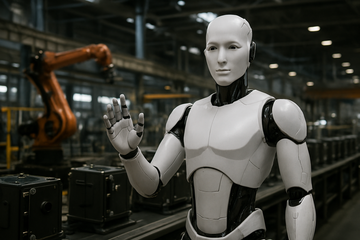
Meta's prototype is a supply-chain disclosure, not a partnership announcement. Reuters reported on Oct 31, 2026, citing The Information, that the company built a working humanoid with Shanghai-based Fourier Intelligence in roughly three months: about 106 pounds, roughly 1.5 metres tall, five-fingered hands, a display that mimics facial expressions, and Nvidia's Jetson Thor for compute. Reporting adds that Meta's team spent about two months inside Fourier's Shanghai factory working with Fourier's vice president of product for robotics, Li-Chen Miller, and that a second version with a redesigned torso, better hands and stair sensors is already under way. Neither company has announced the collaboration. The prototype reveals a physical-AI program running on a Chinese bill of materials.
Prototype build time
~3 months
Reported by Reuters on Oct 31, 2026; neither company has confirmed the collaboration
Prototype weight
106 lb
About 1.5 m tall, Jetson Thor compute, per the same report
Meta capital expenditure, Q3 2026
$33.9B
Quarter ended Sept 30, 2026; 2026 guidance $135–145B
Reality Labs operating loss, Q3 2026
$4.13B
On $443M of segment revenue; FY2026 guidance $18–19B
Chinese reducer price gap
40–60%
Of Japanese equivalent prices, per industry supply-chain data, Sept 2026
Humanoid build cost with Chinese parts
¥46,000
Versus ¥131,000 without Chinese suppliers; Tesla target ¥20,000
Unitree humanoids shipped, 2025
5,500+
Of 13,318 shipped worldwide that year, roughly 41% share
Harmonic Drive operating margin
4.3%
Fiscal year ended March 31, 2026, versus near zero the prior year
Policy
Washington Built the Firewall on the Wrong Layer
The July 28, 2026 Covered List addition reads as a nationality test and works as a geography test. The FCC's entry covers \"foreign-produced advanced robotic devices,\" and the public notice states the newly covered equipment is identified \"by place of production, not by entity.\" A robot assembled in Shanghai is covered whether it belongs to Meta, Fourier or a Chinese state-linked manufacturer; a robot assembled in Ohio is not covered even if every joint inside it shipped from Suzhou. The firewall taxes the assembly step, not the bill of materials.
| Instrument | Date | Scope | Practical effect | Remaining gap |
|---|---|---|---|---|
| FCC Covered List addition: \"Foreign-produced advanced robotic devices, except advanced robotic devices which have been granted a Conditional Approval by DoW\" | July 28, 2026 | New foreign-made humanoids and quadrupeds; identified by place of production | No new FCC equipment authorization, so no new model can be imported, marketed or sold in the US | Components are not covered equipment; previously authorized models keep market access |
| FCC conditional-approval route | July 28, 2026 | Foreign producers seeking exemption | Producers can apply to the Department of War after disclosing ownership, investors, supply chains, manufacturing arrangements and firmware architecture | Decision-by-decision; no approvals confirmed in the sources reviewed |
| American Security Robotics Act | Announced March 26, 2026 | Federal purchase and use of Chinese humanoids and unmanned ground vehicles | Would bar federal agencies from buying or using them; military and law-enforcement research exempt if no data reaches China | FCC's own fact sheet says its action does not affect sales to, or use by, the federal government |
- New models of foreign-produced humanoids and quadrupeds can no longer obtain FCC equipment authorization
- Devices authorized before the cutoff keep their market access, and firmware updates remain permitted
- Fixed industrial arms stay outside the rule, so factory robots from China and Germany keep selling into America
- Federal purchasing remains open under the FCC action, leaving the door the Senate bill was written to close
The gap between instruments is where the money moves. The FCC's fact sheet states the action \"does not affect sales to, or use by, the federal government,\" so Washington's own determination leaves federal purchasing wide open. The American Security Robotics Act, announced by Senators Tom Cotton and Chuck Schumer on March 26, 2026 with a House companion from Representative Elise Stefanik, would close that door by barring federal agencies from buying or using Chinese humanoids and unmanned ground vehicles, with a narrow carve-out for military and law-enforcement research that cannot exchange data with China. Beyond introduction, the bill's status is not established by the sources reviewed here, so treat it as pipeline rather than law.
Supply chain
The Bill of Materials Runs Through Shanghai
Actuators are where the economics live. Schaeffler puts actuators at roughly half the value of a humanoid's bill of materials, and Hyundai Mobis puts them near 60% of material cost. Chinese harmonic reducers sell at 40% to 60% of Japanese equivalent prices, and analysts cited in Chinese media put the resulting gap starkly: building an Optimus without Chinese suppliers would cost about ¥131,000 against ¥46,000 with them, against Tesla's ¥20,000 target. Clean sourcing roughly triples the bill
What a clean US humanoid would cost per robot
Analyst estimates cited in Chinese media and compiled in industry supply-chain data, Sept 2026. Yuan per robot, not company guidance.
Unit: yuan per robot
With Chinese suppliers
Industry estimate for an Optimus-class bill of materials
46,000
Without Chinese suppliers
Same estimate with non-Chinese sourcing
131,000
Tesla's stated cost target
Target cited in the same estimates
20,000
| Component | Named suppliers | Reported position | Cost position |
|---|---|---|---|
| Harmonic reducers | Leader Harmonious Drive Systems (688017), Harmonic Drive Systems (6324), Green Harmonic | Leaderdrive named as a reducer source for AgiBot and UBTECH; Green Harmonic reported as a second Optimus source | Chinese makers at 40–60% of Japanese equivalent prices |
| Rotary actuators and joint modules | Tuopu Group (601689), Schaeffler/Ewellix, Hyundai Mobis (012330), Harmonic Drive Systems (6324) | Tuopu reported for Optimus rotary joints and hand motors; Hyundai Mobis reported for Boston Dynamics Atlas actuators | Actuators near 50% of BOM, per Schaeffler |
| Linear actuators | Sanhua Intelligent Controls (002050), Schaeffler | Sanhua reported for Optimus linear actuator assembly, roughly 500,000 sets a year of capacity | Cheap at scale; US onshoring keeps the order book in China |
| Planetary roller screws | GSA/Rollvis, with Chinese challengers | GSA reported as the initial Optimus source; Chinese challengers at roughly half that price | Localisation is the cheapest cost lever in the bill |
| Six-axis torque sensors | Keli Sensing, with Bota Systems and ATI also cited | Keli Sensing described as the only Chinese producer at scale | Sensor slot is Chinese-held |
| Motors and compute | maxon, Kollmorgen within Regal Rexnord (rrx), TQ RoboDrive, and Nvidia (nvda) Jetson Thor | Jetson Thor is the compute inside Meta's prototype; a Western motor bench is already named in humanoid platforms | Compute travels; motors compete on price |
- Leaderdrive's reducers reach the same customer set: industry reporting names AgiBot and UBTECH as humanoid customers, alongside reported Optimus work at Sanhua and Tuopu
- The non-Chinese pipeline is real but thin: Hyundai Mobis is the reported actuator supplier to Boston Dynamics' Atlas, and Schaeffler claims roughly half of humanoid actuator content
- Even the Chinese integrator is not purely domestic: maxon's precision drives go into Fourier's rehabilitation robots, so Max's bill of materials mixes Swiss, American and Chinese content
Max: the reported prototype, as described
Height and weight
~1.5 m, ~106 lb
Reported Oct 31, 2026
Build time
~3 months
By the two companies together
Compute
Nvidia Jetson Thor
Per the same report
Hands and display
Five-fingered hands; facial-expression display, speakers
Designed for small-object handling and home interaction
Where it was built
Fourier's Shanghai factory
Meta team on site ~2 months with Li-Chen Miller, Fourier VP of product for robotics
Next version
Max 2: redesigned torso, improved hands, stair sensors
Reported in development
Margins
Where the Margin Went
The margin evidence is where the price war shows up. Leader Harmonious Drive Systems lifted 2025 revenue 47% to about ¥569 million and more than doubled net profit to roughly ¥124 million, a net margin near 22%, on 425,158 reducers sold, with capacity targeted at 1.44 million units a year by end-2026 and a 30% to 40% share of China's harmonic reducer market. Harmonic Drive Systems went the other way: operating profit of about ¥7 million on ¥55.6 billion of sales in the year to March 2025, recovering to a 4.3% operating margin in the year to March 2026, with guidance of ¥68.0 billion of sales and ¥6.2 billion of operating profit for the year to March 2027. Chinese reducer economics run at roughly eight times the incumbent's net margin
Harmonic Drive Systems: operating margin by fiscal year
Fiscal years ended March 31. Final year is company guidance. Source: Harmonic Drive Systems consolidated results and IR forecast.
Unit: operating margin, %
FY ended Mar 2025
Operating profit of about ¥7M on ¥55.6B of sales
0
FY ended Mar 2026
Operating profit of about ¥2.57B on ¥59.56B of sales
4.3
FY ending Mar 2027 (guidance)
Guidance of ¥6.2B operating profit on ¥68.0B of sales
9.1
Components shipped versus robots shipped, 2025
Units. Reducer and actuator volumes are dominated by industrial robotics, so humanoid demand is the option, not the base. Sources: Omdia shipment data and company disclosures, 2025–26.
Unit: units
Humanoid robots shipped worldwide
Global humanoid shipments in 2025, per Omdia data
13,318
Of which Unitree
Company-disclosed humanoid shipments in 2025
5,500
Leaderdrive reducers sold
Company-disclosed harmonic reducers sold in 2025
425,158
Leaderdrive capacity target
Annualised capacity targeted by end-2026
1,440,000
Sanhua linear actuator sets
Reported annual capacity
500,000
That gap is what makes the humanoid option expensive on the wrong side of the ledger. Leaderdrive trades on roughly 377 times trailing earnings on the twelve months to June 2026, and Unitree on about 430 times trailing earnings on trailing revenue of ¥2.35 billion, while Harmonic Drive Systems changes hands at about 7.8 times enterprise value to sales. The market pays a premium for cost leadership it already expects to erode
The buyer
Meta's Robot Is an Option, Not a Line Item
Meta's own accounts show how far the humanoid programme is from being a business. Third-quarter 2026 revenue was $64.60 billion with $12.99 billion of operating income, while Reality Labs — the unit housing the robotics effort — turned $443 million of revenue into a $4.13 billion operating loss, with full-year 2026 Reality Labs losses guided to $18–19 billion. Capital expenditure of $33.94 billion in the quarter now exceeds the $32.79 billion of operating cash flow, and 2026 spending is guided to $135–145 billion. No robot line appears anywhere in it
| Metric | Q3 2026 | FY2026 guidance or comparison |
|---|---|---|
| Revenue | $64.60B | Quarter ended Sept 30, 2026 |
| Operating income | $12.99B | 20.1% operating margin |
| Reality Labs revenue | $443M | 0.7% of group revenue |
| Reality Labs operating loss | $(4.13)B | Guidance: $18–19B of losses |
| Capital expenditure | $33.94B | Guidance: $135–145B |
| Operating cash flow | $32.79B | Below quarterly capital spending |
| Free cash flow | $(2.12)B | Negative in the quarter |
What would turn the prototype into something financial: a formal agreement with Fourier, an FCC or Department of War conditional approval for a US-bound product, and a second prototype that reports measurable task performance. Until then this is an engineering milestone with a strategic cost attached — Meta's software stack and Nvidia's compute travel to Shanghai, while the finished robot cannot travel back without clearance. Prototype speed is the product; the commercial path is the risk
Comparables
The Cross-Market Scoreboard Is Lopsided on Purpose
Read the chain end to end and the economics separate cleanly by layer. Compute and the model layer earn extraordinary margins and carry extraordinary multiples. The mechanical layer is where the Chinese cost curve bites: a Chinese reducer maker earned a net margin near 22% in 2025 while the Japanese incumbent earned a 2.7% net margin on far larger sales. The platform layer is loss-making and capital-hungry, with UBTECH still showing a trailing net loss of ¥597 million and Unitree's IPO leaving it on roughly 430 times trailing earnings after a 460% debut. Hardware margins are real; hardware multiples are borrowed from the option value of the robot
| Company | Latest reported base | Growth | Margin | Where it sits |
|---|---|---|---|---|
| Meta Platforms | Q3 2026 revenue $64.60B; Reality Labs revenue $443M | Revenue up 26% year on year | Group operating margin 20.1% | Demand side: the buyer, and the only US hyperscaler prototyping a home humanoid |
| Nvidia | Q2 FY2027 revenue $96.22B, quarter ended July 26, 2026 | Quarterly revenue up sharply on prior-year base | Gross margin 75.0% | Compute and models; Jetson Thor sits inside the Chinese-built prototype |
| Novanta | FY2025 revenue $980.6M; TTM revenue $1.03B | TTM revenue up 5% | Gross margin 41.6%; operating margin 11.9% | US precision motion: encoders, servo drives, robotic end-effectors |
| Hyundai Mobis | FY2025 revenue KRW61.1T; operating profit KRW3.36T | Revenue up 6.8% | Operating margin 5.5% | Reported Atlas actuator supplier; the non-Chinese actuator bench |
| UBTECH Robotics | H1 2026 revenue ¥1,269.1M; 921 full-size humanoids delivered | Revenue up 104.2%; humanoid revenue up 1,445% | Gross margin 44.7%, up 9.7 points | Domestic platform; TTM net loss ¥597M; one customer at 24% of revenue |
| Unitree Robotics | FY2025 revenue ¥1,699.3M; 5,500+ humanoids shipped | Revenue up 333% | Gross margin 60.1%; net income ¥278.2M | Volume leader; ~41% of 2025 global humanoid shipments |
| Leader Harmonious Drive Systems | FY2025 revenue ¥569.0M; 425,158 reducers sold | Revenue up 46.9% | Net margin near 22%; TTM revenue ¥666.1M | Reducer supplier to AgiBot and UBTECH; capacity to 1.44M units |
| Harmonic Drive Systems | FY ended Mar 2026 sales ¥59,557.9M | Sales up 7.0% | Operating margin 4.3% | Japanese incumbent losing the humanoid price point |
- Hardware gross margins of 41% to 60% sit beside earnings multiples of 92 times to 430 times, so the market is capitalising optionality the hardware layer is already commoditising
- The two Western names closest to the demand, Novanta's precision motion and Mobis's actuators, earn 11.9% and 5.5% operating margins on the same programs
- Loss-making platforms are the other side of that funding, with UBTECH's trailing net loss of ¥597 million sitting against a 46.5% humanoid revenue mix
Horizons
Two Horizons, One Falsification Test
Over the next two quarters, the evidence arrives in a specific order: hardware milestones first, regulatory decisions second, order books third.
- Max 2 milestones, namely the redesigned torso, better hands and stair sensors, decide whether a prototype becomes a product
- The first conditional-approval decisions under the July guidance, which set the real price of entry for Chinese-made humanoids
- Unitree's first full quarters as a listed company, testing whether roughly 41% of 2025 global humanoid shipments is durable
- UBTECH's next interim print, testing whether 921 full-size humanoid deliveries in H1 2026 repeat at a 44.7% gross margin
- IPO supply risk, which no lock-up or expiry data in the sources reviewed here resolves
Over one to three years, three structural forces decide the outcome: whether the actuator cost curve can be rebuilt outside China, whether US onshoring actually lifts Chinese component volumes, and whether the compute layer keeps selling to both coalitions at once.
- Cost curve, where Chinese reducers at 40–60% of Japanese prices make a fully non-Chinese humanoid a 2.8-times cost proposition
- Onshoring, where the FCC rule should push final assembly onto US soil while leaving joints in Suzhou
- The AI layer, where Nvidia's physical-AI roster now spans AgiBot, Figure, Boston Dynamics, Fanuc, Yaskawa and ABB
- Fourier's balance sheet, with roughly $230–240 million raised in total across nine rounds including a near-¥800 million Series E announced in January 2025
Fact, inference and speculation should be kept apart. Fact: Meta built a prototype humanoid with a Shanghai supplier in about three months, and on July 28, 2026 the FCC closed the US authorization door on foreign-produced humanoids while leaving components untouched. Inference: the rule relocates assembly rather than supply, so Chinese component makers gain demand while Chinese finished-robot brands lose US market access — which places the actuator trade upstream of the robot trade. Speculation: the gap between Meta's software and its Chinese hardware is a negotiating position rather than a hard dependency, and it breaks the moment either side signs something American. Own the joints and the compute, not the robot
Where the trade sits in the chain
- Reality Labs' $4.13 billion quarterly loss shows the robot program carries no P&L line yet
- Q3 capital spending of $33.94 billion against $32.79 billion of operating cash flow means physical AI is funded from the balance sheet, not earnings
- Over 1–3 years a Chinese bill of materials is the fastest route to a home robot; over days–quarters Washington decides whether that robot can be sold in America
- Jetson Thor is the compute inside Meta's Chinese-built prototype, and Nvidia's physical-AI roster spans AgiBot, Figure, Boston Dynamics and Fanuc
- Q2 FY2027 revenue of $96.22 billion at a 75.0% gross margin prices physical AI as a compute cycle, not a hardware cycle
- Over 1–3 years compute demand compounds with humanoid unit volume regardless of which country assembles the body
- Precision Motion supplies encoders, servo drives and robotic end-effectors — the content a US-assembled robot still has to buy
- FY2025 revenue of $980.6 million, a 41.6% gross margin and net cash, but no disclosed humanoid design win
- Catalyst to watch: an FY2026 10-K, due on the company's late-February filing cadence, disclosing a humanoid or collaborative-robot design win
- FY2025 revenue of KRW61.1 trillion and operating profit of KRW3.36 trillion, both records, at about 8 times earnings with net cash
- Reported actuator supplier to Boston Dynamics' Atlas, and the source of the estimate that actuators are near 60% of humanoid material cost
- Over 1–3 years, US onshore assembly needs non-China actuator capacity, and Mobis is one of the few scaled suppliers with it
- H1 2026 humanoid revenue grew 1,445% to ¥590.3 million on 921 units delivered, with gross margin up 9.7 points to 44.7%
- One customer was ¥308.5 million, 24% of group revenue, so the order book scaleswhile concentrating
- Over 1–3 years, factory deployment in China carries the revenue, because the FCC rule covers mobile robots and not factory arms
- FY2025 revenue of ¥1,699.3 million, up 333%, at a 60.1% gross margin, with humanoid revenue 51.8% of the total
- New foreign-made humanoids cannot obtain FCC authorization, closing the US channel for new models
- At roughly 430 times trailing earnings after a 460% debut, the China-IPO story is already in the price while the US door shuts
- FY2025 revenue rose 47% to ¥569 million with net profit more than doubling to about ¥124 million, a net margin near 22%
- 425,158 reducers sold in 2025, up 72%, with capacity targeted at 1.44 million units a year by end-2026
- Over 1–3 years, the onshoring the FCC forces is good news for reducer volume even as the Chinese price war compresses unit pricing
- Operating margin compressed to 4.3% even on record ¥59.56 billion of sales, after near-zero operating profit the year before
- Chinese reducers sell at 40–60% of Japanese equivalent prices, and FY2027 guidance needs margin recovery to 9.1%
- Over 1–3 years the humanoid segment is where the price competition bites hardest, so the incumbent must lean on non-humanoid automation demand