
Asian spot LNG, December delivery
$30.50/MMBtu
Oct 23, 2026 — the highest since December 2022
Hormuz daily transits
4.3 ships
Sep 1–13, 2026, against 85.5 a day in 2025
War-risk premium, one Hormuz transit
7.5–12.5% of hull value
Against roughly 0.25% before the conflict — 30 to 50 times the peacetime cost
Qatari LNG exports
18 cargoes
March–June 2026, down 96% year over year
Qatar liquefaction capacity impaired
12.8 Mtpa (17%)
Repairs estimated at three to five years
Cheniere FY2026 adjusted EBITDA guidance
$8.75–9.25B
Raised Oct 29, 2026 from $7.90–8.40B
The October 30 incident
Cleared for Four Hours, Then Hit
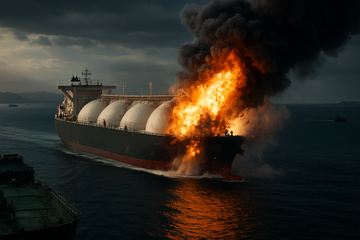
On the evening of Friday, October 30, 2026, the LNG carrier Al Mayeda was hit by unidentified objects in the Arabian Gulf near the Strait of Hormuz. The vessel belongs to Qatar Gas Transport Company, Nakilat, and was Marshall Islands-flagged and loaded with Qatari LNG bound for Pakistan. Nakilat said in a statement to the Qatar Stock Exchange that no crew were injured, there was no spill, and the ship remained operational with the impact being assessed. Qatar condemned the attack as reckless and irresponsible and said it was investigating who was responsible. The detail that matters for risk pricing came from people with direct knowledge: Iranian authorities had cleared the vessel to transit only hours before it was struck, and after the hit the ship turned back into the Persian Gulf.
| Date | Vessel | Cargo | What happened |
|---|---|---|---|
| Jul 7, 2026 | Al Rekayyat | Qatari LNG | Struck by a projectile while transiting; engine-room fire; Qatar held Iran legally responsible |
| Aug 1, 2026 | GASLOG SHANGHAI | Qatari LNG | Struck about 11 nautical miles northeast of Limah; the IRGC said it disabled two tankers and turned back four |
| Sep 23, 2026 | Shandong Redwood | Qatari LNG for Pakistan | Cleared by Tehran, crossed the strait and headed for Port Qasim, Karachi |
| Oct 5, 2026 | Unidentified tanker | Not disclosed | Struck by an unidentified projectile in the strait |
| Oct 30, 2026 | Al Mayeda | Qatari LNG for Pakistan | Cleared hours earlier, then struck; turned back into the Persian Gulf; no casualties |
The mechanism
Clearance Is Permission, Not Protection
Iran's transit regime operates as a toll, not a treaty. Vessels that pay the political price get a green light; vessels that do not face the warning that any ship attempting to pass without permission will face destruction. Pakistan, which borders Iran and buys more than 90% of its imported gas from Qatar, has proved the most successful negotiator. On September 21 it secured passage for another Qatari cargo, and the Shandong Redwood crossed days later on its way to Karachi. On October 30 the same paperwork did not hold. The market implication is not that permission is worthless — it is that the buyer cannot verify what happens after clearance is issued, so that gap has to be priced into the molecule rather than into the voyage.
- Clearance has worked twice for Pakistan: a Qatari cargo loaded at Ras Laffan on June 28 was cleared in September and sailed for Karachi.
- Clearance has not scaled: QatarEnergy exported 18 cargoes between March and June 2026, against 509 in the same four months of 2025.
- Clearance does not bind the force that struck the ship: Qatar is still investigating, and Iran has not been held publicly responsible for the October 30 attack.
- The cost of failure is already visible in the replacement market: Pakistan bought spot cargoes at $17.00 per MMBtu in early July and $21.88 in mid-July.
The structural difference
Crude Reroutes. LNG Molecules Cannot.
Oil can be carried the long way; molecules cannot. When the strait closed, crude simply took the long route: Cape of Good Hope transits rose from 49.1 a day in 2023 to 91.0 in the first thirteen months of 2026, Suezmax voyages stretched from 22–23 days to 51–52, and the Atlantic–Pacific share of loaded VLCC cargoes rose from 22% to 35%. The tanker market was paid for the detour, with west-east tonne-mile demand up 9%. LNG has no equivalent escape. Ras Laffan lost 12.8 million tonnes a year of liquefaction capacity, 17% of the national fleet, and the repair bill is estimated at three to five years. A barrel can be carried twice as far; a liquefaction train cannot be moved.
Hormuz traffic has not recovered
Average daily transits of the Strait of Hormuz. Tanker-only transits fell from 48.2 a day in 2025 to 1.2 in the first thirteen days of September 2026.
Unit: ships per day
2025 average
85.5
Jan–13 Sep 2026
20.9
Since March 2026
6.8
Sep 1–13, 2026
4.3
Tanker transits, Sep 1–13
1.2
- Crude adapted by travelling further: VLCC cargoes fell to 14.4 million barrels a day from 22.5 million, while the tonne-mile index rose to 109 from 100.
- LNG adapted by disappearing: gas moving through the strait fell to 7.4 billion cubic feet a day from 10.5.
- Qatar's workaround is costly: ship-to-ship transfers off Oman and the UAE ran roughly 30–35 hours each and cost more than $1 million apiece.
Where the money goes
The Premium Lives in the Molecule, Not the Boat
That is the trade. The US Gulf is the only large supply chain that needs no permission at all, and it is selling straight into the gap. Cheniere exported 188 cargoes totalling 684 TBtu in the third quarter of 2026, booked $6.17 billion of revenue and $1.17 billion of net income, and raised full-year adjusted EBITDA guidance to $8.75–9.25 billion from $7.90–8.40 billion. Guidance now implies a fourth quarter of $2.71–3.21 billion of adjusted EBITDA against $1.90 billion in the third, which implies a 43% to 69% sequential step-up that is effectively a bet that the Hormuz premium survives the winter.
The origin gap, settled in Korea
Korea's unit LNG import cost by source on 2024 data. The spread between contracted Gulf supply and US supply is where the permission premium gets settled.
Unit: US$ per tonne
Qatari
745
Australian
628
Malaysian
552
US
549
| Metric | Cheniere | Venture Global | QatarEnergy |
|---|---|---|---|
| Latest quarterly revenue | $6.17B (Q3 2026) | $4.58B (Q2 2026) | Exports down 96% year on year |
| Latest quarterly profit | $1.17B net income | $1.42B net income | About $24bn of revenue lost |
| Latest cargo count | 188 cargoes, 684 TBtu (Q3) | 124 cargoes, 465.8 TBtu (Q3) | 18 cargoes, March–June |
| 2026 guidance | Adjusted EBITDA $8.75–9.25B | 500–518 cargoes | Force majeure since March |
| Transit exposure | US Gulf — no Hormuz transit | US Gulf — no Hormuz transit | Ras Laffan into the strait |
| 2026 counterparty shift | Signed QatarEnergy for 4 mtpa to 2054 | Sold cargoes into the gap Qatar left | Buying US molecules to honour its own contracts |
Venture Global is the other side of the same trade, exporting 124 cargoes in the third quarter with 465.8 TBtu of LNG sales recognised in revenue, up 122% year over year, against full-year guidance of 500–518 cargoes. And the exporter whose cargoes keep getting hit is now a buyer: QatarEnergy signed two long-term agreements with Cheniere on October 22 for 4 million tonnes a year through 2054, with deliveries starting in the early 2030s, and has separately been discussing 2–3 million tonnes a year of US LNG. A molecule bought at $30.50 per MMBtu is roughly $1,590 a tonne at about 52 MMBtu a tonne — more than double the $745 unit cost of Qatari supply Korea used to pay.
The buyers
Who Pays When Permission Fails
The bill lands on buyers, and it lands unevenly. Pakistan is the extreme case, with more than 90% of its imported LNG from Qatar and 7.5 of its 8.4 million tonnes a year of contracted volume sitting with Qatari projects. Korea has already solved the same problem by substitution: Qatar's share of Korean LNG imports fell from 15.6% to 5.8% in eight months, replaced by the United States at 15.1% and Malaysia at 17%.
| Buyer | Gulf dependence | 2026 change | What a failed clearance costs |
|---|---|---|---|
| Pakistan (unlisted) | Over 90% of LNG imports from Qatar; 7.5 of 8.4 Mtpa contracted volume is Qatari | 11 spot tenders issued and 6 awarded, against 2 the year before | Replacement cargoes at $17.00 and $21.88 per MMBtu in July, with LNG down to 4–6% of power generation |
| South Korea — KOGAS | Qatar down to 5.8% of imports from 15.6% | US up to 15.1%, Malaysia 17%, Australia 28.3% | Little: substitution is done, with US cargoes at $549 a tonne |
| Japan — Tokyo Gas | Australia was 35% of imports in January–August 2026 | Non-Middle Eastern supply now leads the mix | Margin squeeze if spot LNG holds near $30.50 |
| China — CNOOC | Marginal buyer of last resort into a rising benchmark | CNOOC bought at least 11 spot cargoes in one week in October | Buying the top of a geopolitical spike; long-term US contracts mute the cost |
- The buyer with the least leverage is the buyer with the most dependence: Pakistan's LNG share of power generation fell to 4–6% in March and April against a five-year average near 20%.
- Substitution is the only defence that works: Korea replaced 9.8 points of Qatari share with American barrels inside eight months.
- China sets the benchmark the rest of the world pays: Chinese buying drove the Asian spot price from $29.30 to $30.50 in a single week in October.
- Japan and Korea are the buyers to watch through winter, because their purchasing sets the curve every other importer's cost depends on.
The obvious trade, and the wrong one
Tanker Owners Win the Detour, Not the Molecule
The obvious way to play a closed strait is to own the tankers, and on the crude side the payoff is real: VLCC spot rates reached about $380,000 a day against a one-year time charter of $160,000, Gulf–Singapore rates hit WS 1,100, and Frontline has run from a 52-week low of $20.47 to $56.90 as the tonne-mile index rose 9%. On the LNG side the same disruption has produced record-low spot charter rates: Atlantic two-stroke LNG carriers fixed at $9,000 a day in late August, the lowest since March 2025 and down 80% in two weeks.
Tanker rate benchmarks, Sep 16, 2026
Crude tanker rates in record territory while LNG carrier spot rates sit at record lows. The premium has moved out of the hull and into the molecule.
Unit: US$ per day
VLCC spot, West Africa–Far East
380,000
VLCC one-year time charter
160,000
Suezmax
125,000
Aframax
69,000
The reason is structural. The premium attaches to a route and a permission, not to a hull: a ship that cannot enter the strait earns nothing, and a ship that does enter carrying a permitted cargo earns a scarcity rent that no charter market prices. Golar LNG, whose business is LNG carriers plus floating liquefaction and regasification units, sits on the wrong side of that split, trading at 18.6 times enterprise value to trailing EBITDA with net debt at 5.1 times EBITDA and free cash flow still negative.
Time horizons
Two Quarters and Three Years Point the Same Way
The near-term money sits in the exporters that need no permission; the long-term money sits in the contracts that replace molecules a closed strait cannot deliver. The two horizons pay off in different places but point the same way, and the sequencing matters for positioning.
- Near term: Cheniere's implied fourth quarter of $2.71–3.21 billion of adjusted EBITDA is the single largest test, because it assumes the Asian benchmark holds above $30.
- Near term: QatarEnergy's force majeure has run since March and was extended through September, so each month it persists removes another month of Gulf molecules from the forward curve.
- Near term: Pakistan's winter programme is the highest-frequency read on whether cleared Gulf cargoes still arrive, having already issued 11 spot tenders this year and awarded six.
- Near term: Asia's December delivery prints, not the October ones, decide whether the winter step-up is a trend — the benchmark has already gone from $29.30 to $30.50 in a week.
- One to three years: Qatar needs three to five years to repair 12.8 million tonnes a year of liquefaction capacity, so the marginal Asian molecule stays American until the repair schedule slips.
- One to three years: QatarEnergy's 4 mtpa purchase from Cheniere through 2054 is the structural signal — the second-largest exporter has become a net buyer of molecules for more than two decades.
- One to three years: war-risk cover at 7.5–12.5% of hull value per transit is a permanent cost of Gulf routing, which raises the delivered cost of every Gulf molecule.
- One to three years: Sabine Pass's expansion, with peak capacity of about 20 million tonnes a year and a first train above 6 million, converts a three-year price spike into a decade of contracted cash flow.
Falsification
What Would Break This View
Two things would undo the thesis, and both would do it without a single hull being damaged. That is what makes this position fragile, and it is why the risk is a contract and a curve rather than a missile.
- A durable reopening of the strait. Transits are already down to 4.3 a day; a return toward the 2025 average of 85.5 would strip the permission premium from a single print, and the January contract season would price it out fast.
- Selective rather than arbitrary enforcement. If the next cleared cargo crosses and the one after that, the paperwork risk disappears and molecules re-rate on feedstock cost and freight alone.
- Qatari capacity returning early. A faster restart than three to five years, or ship-to-ship transfers scaling beyond the three cargoes handled in August, would shorten the American molecule's window.
- The premium on US molecules closing. The step-up in Cheniere's own guidance, from $7.90–8.40 billion to $8.75–9.25 billion, is what investors are paying for, and it compresses before any physical damage is reported.
The investable map: origin, not freight
- Raised FY2026 adjusted EBITDA guidance to $8.75–9.25B, which implies a fourth quarter of $2.71–3.21B against $1.90B in Q3.
- QatarEnergy signed for 4 mtpa through 2054, turning the exporter whose cargoes keep getting hit into a 23-year customer of the supplier that never needs permission.
- Near term: the guidance embeds an Asian benchmark above $30, so the first casualty of a cooling curve is that implied fourth quarter.
- One to three years: Sabine Pass's roughly 20 mtpa peak expansion converts today's spot windfall into contracted cash flow.
- Third-quarter cargoes reached 124, with 465.8 TBtu of LNG sales recognised in revenue, up 122% year over year.
- QatarEnergy has been discussing 2–3 mtpa a year of US LNG to backfill the Qatari contracts Ras Laffan cannot fill.
- Near term: the Asia pull is structural rather than one-off, with US exports to Asia hitting a record 10.9 Mt in the second quarter.
- One to three years: Plaquemines guidance of 351–364 cargoes is the swing factor in turning the Gulf gap into multi-year US share.
- Qatar's share of Korean LNG imports fell from 15.6% to 5.8% in eight months, with US cargoes at $549 a tonne against $745 for Qatari supply.
- KOGAS resells LNG with a margin, so cheaper American molecules widen the resale spread even as the wholesale benchmark rises.
- Near term: KOGAS was still buying spot cargoes in late October, so procurement cost rather than volume is the 2026 earnings risk.
- One to three years: with Qatar needing three to five years to repair 12.8 Mtpa, Korean US and Malaysian contracts become Asia's cheapest supply.
- Australia supplied 35% of Japan's LNG imports in the first eight months of 2026, so the Hormuz channel matters far less than it does for Pakistan.
- Against that, Asian spot LNG at $30.50/MMBtu is the highest since December 2022, and the marginal cargo a Japanese buyer purchases is spot.
- Near term: Tokyo Gas buys the premium the strait creates and passes part of it through only with a lag.
- One to three years: a decade-long shift to US and Australian contracts is the defence, and it is a volume decision rather than a price bet.
- CNOOC bought at least 11 spot cargoes in the week to October 23 as Asian spot LNG hit $30.50/MMBtu, the highest since December 2022.
- Buying the top of a geopolitical spike converts a transit risk into a permanent margin loss for the importer.
- Near term: Chinese storage targets keep Chinese buyers in the market through winter, capping any retreat in the Asian benchmark.
- One to three years: long-term US contracts mute the spot damage, but the 2026 spot purchases set the annual cost base.
- Hormuz disruption lifted the west-east tonne-mile index to 109 from 100, and VLCC spot rates hit $380,000 a day against a one-year charter of $160,000.
- VLCC cargoes fell to 14.4 million barrels a day from 22.5 million, so the fleet earns more on fewer barrels.
- Near term: the shares have already made the point, near a 52-week high of $59.75 after a run from $20.47.
- One to three years: war-risk cover at 7.5–12.5% of hull value per Hormuz transit is a permanent tax on Gulf-exposed voyages.
- Atlantic LNG spot charter rates collapsed to $9,000 a day, the lowest since March 2025, even as Hormuz transits priced at 30 to 50 times peacetime war risk.
- The freight premium attaches to a route and a permission rather than to a hull, and Golar's charters do not price Hormuz scarcity.
- Near term: spot-exposed LNG carrier economics stay weak while Gulf-origin molecules carry the entire premium.
- One to three years: 18.6 times enterprise value to EBITDA, net debt at 5.1 times EBITDA and negative free cash flow leave little room for a soft charter cycle.