
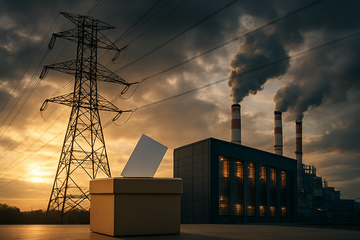
For three years, the AI power build was a permitting story and a FERC cost-allocation fight. Both were decided in hearing rooms that generate no headlines. What changed in 2026 is that the cost stopped being abstract. Residential electricity bills have become a first-order campaign issue, and Reuters' Oct. 31 guide to swing-state energy politics documents why: households in battleground states are paying $50 to $60 more a month for power and gasoline than a year ago, with 77% of surveyed Americans citing rising electricity costs as a chief reason to oppose data centers.
The investable question is not whether the build stops. It is not stopping. The question is which utility gets paid for it, which hyperscaler gets a protected contract, and where the margin ends up — and those are now decided, in part, at the ballot box.
Average US residential power bill increase since 2021
+$45.79/mo
Across all US states, a nearly 40% jump, published Oct. 20, 2026
Average authorized electric utility ROE
9.82%
Twelve months to Mar. 31, 2026; 9.71% in Q1 2026 against 9.84% for full-year 2025
States with an approved large-load tariff
25
As of October 2026, with eight more pending before commissions
Georgia Power generation approved in Dec. 2025
9,885 MW
Unanimous 5-0 PSC vote on a $16.3 billion build, mostly serving large loads
AEP Ohio contracted data-center load
17,861 MW
As of Feb. 12, 2026, against total system peak demand of 8,000–10,500 MW
The Event
The Bill Became a Ballot Issue in One Cycle
Reuters' swing-state energy guide published Oct. 31, 2026 records the first cycle in which household electricity prices could be treated as a voter-level issue rather than a utility-industry issue. Average residential bills across eight key swing states rose about 7% year over year, and between 15% and 58% since 2019. In Pennsylvania, where the November contest for governor sits, the average household now pays roughly $182 a month for electricity, up 12% on the year and 58% since 2019. Ohio's bills rose 9.4% year over year and 53% since 2019.
US electric bills are up 10% since 2024, far outpacing inflation, and both parties now vow to control electricity rates. In the guide, voters in the eight swing states are named among the states seeing the sharpest increases.
The fastest-rising bills sit in the states building the most data centers
Residential electricity bill change versus a year earlier. Georgia is the outlier at roughly +1% after two rounds of rate increases and the resulting voter backlash, and Nevada had the lowest bills of the eight and saw rates fall last year.
Unit: % change vs. a year earlier
Pennsylvania
About $182 a month, up 58% since 2019
12%
Ohio
Up 53% since 2019
9.4%
Michigan
8%
North Carolina
6%
Wisconsin
5%
Arizona
5%
Georgia
Smallest increase of the eight, after prior rate increases and backlash
1%
How the Nov. 3, 2026 map is drawn
States electing officials with rate authority
39
Candidates in nearly every one of those races mention energy affordability, per PowerLines, Oct. 20, 2026
States putting utility commission seats on the ballot
9
Georgia and Arizona elect their commissioners outright
Swing-state governorships that decide who sits on commissions
PA, OH, MI, NV, WI
Elsewhere, governors appoint the commissioners who approve rate increases
Governors signing the White House Ratepayer Protection Pledge
Mar. 4, 2026
Federal pressure to keep data-center costs off residential bills
FERC action on large-load tariffs
June 18, 2026
All six regional grid operators ordered to justify or reform their large-load tariffs
- Georgia and Arizona are the only battleground states where voters elect the regulators outright, which turns a utility commission seat into a direct referendum on the utility's build plan.
- In Pennsylvania, Ohio, Michigan, Nevada and Wisconsin, the governorship decides the commission's composition, so a rate case is now a campaign commitment before it is a proceeding.
- The political direction of travel is uniform across parties: protect the residential bill. The dispute is entirely over who absorbs the cost, not over whether AI load gets served.
The Mechanism
Political Pressure Reprices the Bill — It Does Not Cancel the Build
Here is the mechanism that connects a voter to a turbine order, and it is not the one most people assume. Political pressure on customer bills does not stop capital spending. It re-allocates who pays for it. As of October 2026, 25 states have approved at least one large-load tariff and eight more have tariffs pending, and the architecture is remarkably consistent: a demand threshold, a minimum-bill or take-or-pay provision, an exit fee, and a collateral requirement.
That is the entire answer to the question voters are asking. Instead of a data center paying a wholesale price and leaving the network upgrade with the residential class, the data center signs a regulated contract that pays for the connection it causes, whether or not it ever materialises. The utility keeps building. The bill moves.
| State and utility | Trigger | Core protection | Effect on the build |
|---|---|---|---|
| Georgia — Georgia Power | New customers above 100 MW | Minimum billing requirements, longer contract terms, and payment of utility costs if the customer terminates | Large loads fund their own connections under PSC rules in force since 2025 |
| AEP — Ohio Power | New data centers above 25 MW | Must pay for at least 85% of expected monthly energy even if it uses less | Cut the original 30,000 MW request down to 5,642 MW of signed contracts |
| Dominion Energy — Virginia | New GS-5 class, load of 25 MW and up at a 75% load factor | Mandatory contribution in aid of construction on direct-connect transmission | Residential transmission charge cut to $0.94 a month from $2.90 |
| PPL Corporation — Pennsylvania | Above 50 MW individually or 100 MW in aggregate | Commission-adopted Large Load Tariff Framework, following a settlement | Sets the pattern for a state where bills rose 58% since 2019 |
| NextEra Energy — Florida Power & Light | Projected load of 50 MW and up at an 85% load factor | Take-or-pay minimum bills, exit fees and collateral; effective Jan. 1, 2026 | Only contracted load gets served on these terms |
| Duke Energy — Carolinas, Progress, Ohio | Large-load filings and settlements still before the commissions | Minimum demand charges and high load-factor classes | Rate treatment still unresolved in a swing state |
| FirstEnergy — Ohio Edison, Cleveland Electric, Toledo Edison | Data Center Tariff proposal filed in 2026 | Exit fees and financial assurance | Still before the PUCO, not yet approved |
The second-order effect is on the allowed return itself. S&P Global's survey of major energy rate cases, filed with the Utah Public Service Commission, shows the average authorized return on equity for electric utilities slipping to 9.71% in the first quarter of 2026 from 9.84% for full-year 2025, with the trailing twelve months at 9.82%. The report attributes the direction to customer affordability concerns.
Against a 30-year Treasury that averaged 4.80% over the trailing year, a 9.82% authorized return leaves a spread of roughly 500 basis points, against about 800 basis points in 2020. The cushion over the long bond has already been substantially spent, and regulators are now spending the rest of it on behalf of voters. Volume growth is what is left.
The allowed-return cushion over the long bond is roughly half its 2020 width
Average authorized electric ROE less the average 30-year Treasury yield. The spread widened from just over 400 basis points in 1990 to about 800 in 2020, then compressed to roughly 500 by 2025 and to 489 basis points in the first quarter of 2026.
Unit: basis points
2020
Peak width of the authorized-return spread
800
2025 average
9.84% authorized ROE less 4.78% Treasury
506
Twelve months to Mar. 2026
9.82% less 4.80%
502
Q1 2026
9.71% less 4.82%
489
Georgia
Georgia Is the One Swing State Where Voters Pick the Regulators
On Dec. 19, 2025, the Georgia Public Service Commission voted unanimously, 5-0, to approve a stipulated agreement letting Georgia Power produce 9,885 megawatts of new energy — a build costing roughly $16.3 billion, with most of it serving large new customers such as data centers. At approval, Georgia Power said the plan would deliver about $102 a year in savings for a typical residential customer. By August 2026, with the PSC's approval of an OpenAI contract in Effingham County, that estimate had risen to about $180 a year, part of a portfolio delivering $950 million in annual savings.
Two commission seats are on the Nov. 3 ballot. In District 3, Democratic incumbent Peter Hubbard faces Republican Fitz Johnson; in District 5, Democrat Shelia Edwards faces Republican Josh Tolbert. Politico reported on Oct. 31 that Democrats are using voter anger over power bills and data-center growth to try to break Republican control of utility boards — and that outside Georgia and Arizona, those boards are appointed by the very governors whose races are now in play.
| Item | Figure |
|---|---|
| Approved generation build | $16.3 billion and 9,885 MW, approved unanimously on Dec. 19, 2025 |
| Base rate freeze | Three years from July 2025, excluding storm and fuel filings |
| Next base rate case | 2028 — the first test of the post-election commission |
| Promised residential benefit from large-load revenue | About $102 a year at approval, revised to about $180 a year in August 2026 |
| Georgia residential bill change this year | Roughly +1%, the smallest increase among the eight swing states |
| Commission seats on the ballot | District 3 and District 5, decided Nov. 3, 2026 |
Virginia
Virginia Shows What Direct Assignment Does to a Utility's Earnings
Virginia ran the experiment earlier than Georgia, and the order is the clearest single document in this story. On July 31, 2026, the State Corporation Commission required Dominion Energy to assign certain transmission infrastructure costs directly to the new large-load facilities that made them necessary, including mandatory contribution in aid of construction on direct-connect substations and lines. Dominion had sought to recover about $1.5 billion through the Rider T-1 transmission charge.
- The commission approved an amended allocation factor that cut the proposed monthly cost increase for a typical residential customer to $0.94 from $2.90, a 67.5% reduction.
- The reallocation moved the minimum-demand adjustment from the residential class, whose allocation factor fell 2.84%, to the GS-4 class serving larger loads, whose factor rose 4.33%.
- The commission reserved the right to extend direct assignment to higher-level transmission costs and to a new GS-5 class for customers of 25 MW or more — the template for the next wave of Virginia connections.
Ohio
Ohio Proved the Forecast Was Mostly Speculation — and the Book Is Real
AEP Ohio's large-load funnel: 30,000 MW requested, 5,642 MW signed
The gap between what data centres asked for and what they would sign is the single most useful number in this story. Before the tariff, developers asked for 30,000 MW. After paying for engineering studies and then committing with collateral, 5,642 MW were signed under the new rules, on top of 12,219 MW signed before it took effect.
Unit: MW
Requested before the tariff
30,000
Paid for a step-1 engineering study
Within a 45-day window
13,023
Signed after the tariff took effect
60 days to sign or walk
5,642
Signed before the tariff took effect
12,219
- AEP Ohio's contracted data-center book of 17,861 MW runs roughly 1.7 to 2.2 times the utility's entire system peak demand of 8,000 to 10,500 MW, with projects coming online progressively through 2035.
- The Ohio tariff requires new data centers above 25 MW to pay for at least 85% of their expected monthly energy even if they use less — a take-or-pay obligation that converts a forecast into a contracted revenue stream.
- AEP Ohio has also filed a settlement that would decrease distribution rates by about $1.22 a month for the average residential customer, which is the political price of admitting the load is real.
The lesson from Ohio is that the original load forecast was inflated — AEP cut its large-load forecast by more than 50% — but the surviving book is contract-grade rather than speculative. That distinction is the entire investment case. A utility with a speculative pipeline must ask the residential class for permission every time it builds. A utility with a contracted, collateralised book asks the data center, and the commission's job becomes approving the contract terms rather than the bill.
AEP's own numbers reflect the difference. Trailing diluted EPS of $6.13 and a 10.5% trailing return on equity sit above the 9.82% average authorised electric return — the signature of a utility whose growth is being paid for by its large-load customers.
PJM
The Capacity Market No Longer Clears, So the Build Has to Be Physical
Underneath every bill increase in the PJM footprint is a market that has stopped working. The December 2025 auction for the 2027/2028 delivery year cleared 134,478.1 MW of capacity — just 371 MW more than the prior auction, of which only 774 MW was genuinely new generation and uprates — and it cleared 6,516.6 MW short of PJM's reliability requirement. The July 2026 auction for 2028/2029 came in at 138,318 MW, but at the FERC-approved cap of $325 per megawatt-day, and it still fell 6,831 MW short, leaving a reserve margin of 14.7% against a 20% target.
| Delivery year | Capacity procured | Clearing price | Shortfall vs. reliability requirement |
|---|---|---|---|
| 2026/2027 | 134,311 MW | $329.17 per MW-day, against $28.92 in 2024/25 | Peak load forecast up more than 5,400 MW, largely on data-center expansion |
| 2027/2028 | 134,478.1 MW, up just 371 MW | $333.44 per MW-day | 6,516.6 MW short |
| 2028/2029 | 138,318 MW | $325 per MW-day, the FERC-approved cap, 2.5% below the prior auction | 6,831 MW short, with a 14.7% reserve margin against a 20% target |
Upstream
The Turbine Order Book Is Immune to the Vote
This is where the election matters least and the money is most durable. GE Vernova ended the second quarter of 2026 with a gas-turbine order backlog of 116 GW, up from 100 GW in the first quarter, inside a total backlog of $176 billion. In the first quarter of 2026 alone, data centres generated more electrification orders than in all of 2025 combined. Second-quarter revenue was $11.1 billion with diluted EPS of $2.47 — the build converting into deliveries, not promises.
- GE Vernova — gas-turbine backlog of 116 GW at the second quarter of 2026 and $176 billion of total backlog, with slots booked into 2029 and 2031.
- Doosan Enerbility — 12 US gas-turbine contracts secured, a record seven-unit 380 MW order, and its first export to the United States shipped in October 2026, following a first North American steam-turbine award in March 2026.
- Mitsubishi Heavy Industries — large-frame gas-turbine backlog of 35 GW after selling 35 units worth 16 GW in fiscal 2025, with global gas-turbine orders reaching 100 GW in 2025, the highest in 25 years and roughly 40% of it from the United States.
The non-obvious conclusion is that political risk in this cycle is priced into equity multiples, not into order books. Goldman Sachs expects US data-centre power demand to more than double to 66 GW next year from 31 GW, and PJM's inability to clear its capacity auctions is the physical confirmation. Turbine slots are booked years ahead against utility and hyperscaler commitments; the November vote changes the allowed return on those utilities' rate base, not the schedule at the factory. The equipment layer captures the value of a build that no ballot can cancel, and it does so with the lowest political beta in the chain.
Downstream
The 20-Year Contract Now Carries Collateral
The hyperscalers have responded to the new regime by buying long-dated, contract-grade power from the few suppliers that can offer it. Constellation Energy has signed 20-year nuclear power purchase agreements with Amazon, Alphabet, Meta Platforms and Microsoft. Vistra announced nuclear agreements with Meta on Jan. 9, 2026 supporting three plants in PJM, and its Comanche Peak agreement covers 1,200 MW. Constellation's trailing revenue of $31.3 billion and diluted EPS of $10.29 through the second quarter of 2026 sit against Vistra's $19.2 billion and $5.93.
- Twenty-year nuclear contracts convert merchant power into contracted cash flow, and the counterparties now accept collateral and take-or-pay terms that no wholesale market would have offered.
- The cost of that protection is structural: a 25 MW threshold in Virginia, 100 MW in Georgia and 50 MW in Florida mean the smallest economically viable AI campus just got more expensive to connect.
- Utility counterparties have gained bargaining power over the same contracts, with AEP Ohio's example showing a 30,000 MW request shrinking to 5,642 MW once collateral and exit fees applied.
The loser profile in this cycle is the regulated utility with a thin contracted book and a residential base already angry. Exelon is the clearest case: a trailing return on equity of 8.9% against the 9.82% average authorised electric return, capital expenditure running at 35.6% of revenue, and net debt at 5.8 times EBITDA. Its Potomac Edison subsidiary has filed a PC72 large-load rate schedule in Maryland under the Next Generation Energy Act and Utility RELIEF Act — the fight that matters, because without it Exelon recovers data-centre infrastructure from the residential class, in the one state where that class is already absorbing about $18 a month of capacity-driven increase.
That is the asymmetry. Over one to three years, the utilities that contract their load get paid to build while the political cost is exported to the data centre. The utilities that cannot get contracts are left asking voters for permission, and Nov. 3 tells them how that question is being answered.
Horizons
The Vote Is a Catalyst; the Build Is the Thesis
- Days to quarters: the Georgia PSC result on Nov. 3 sets the tone for every commission, with two seats decided and a third commissioner, Tim Echols, already under scrutiny over data-center rules.
- Near term, the Virginia line-extension rewrite is the template — Dominion must file an amended policy within 90 days of the July 31, 2026 final order, and every other commission will copy its direct-assignment language.
- Watch the next PJM base residual auction: two consecutive auctions have cleared short of reliability with prices pinned at the cap, and another cap-set result would extend the $18 and $16 monthly increases now landing in Maryland and Ohio.
- State rate cases reaching decision in the next two quarters will be the first to price the new affordability regime into authorised returns, with 18 equity return determinations recorded in the first quarter of 2026 alone.
- Over one to three years, rate base growth outruns allowed-return compression, and the spread over the long bond has already narrowed from roughly 800 basis points in 2020 to under 500, so volume replaces price in the equity story.
- Georgia's next base rate case in 2028 is the first full test of a commission's willingness to let a frozen residential class be held harmless while 9,885 MW is built and a 3.2 GW OpenAI contract lands in Effingham County.
- FERC's June 18, 2026 order to all six regional grid operators to justify or reform large-load tariffs will decide whether the 25-state patchwork becomes one federal standard, which would compress utility-by-utility pricing power.
- The main risk to the thesis is that load forecasts prove too high, as they did in Ohio, where AEP cut its large-load forecast by more than 50% — a shock that would hit equipment order intake with a two-to-three year lag, not immediately.
Synthesis
Contracted Load Beats Candidate Promises
The correct reading of the 2026 midterms is not that energy affordability is now partisan, but that it is now structural. A voter who sees a $180 annual saving on a Georgia Power bill, or a $0.94 transmission charge in Virginia, has been handed a specific mechanism for keeping AI load off the residential meter. Regulators, not politicians, wrote those mechanisms; the election decides who administers them.
That produces a hierarchy of exposure. Utilities holding binding, collateralised data-center contracts can grow rate base without a rate fight, and their earnings quality improves as the authorised return compresses. Utilities with a thin contracted book must fund the same build from the class that votes, and their returns sit below the allowed number. The turbine makers are paid either way. And the hyperscalers pay more for power in every state that adopts these tariffs, because a take-or-pay obligation is not free — it is the price of permission.
| Company | TTM revenue | TTM diluted EPS | TTM return on equity | Net debt / EBITDA |
|---|---|---|---|---|
| Dominion Energy | $19.4B | $3.00 | 9.3% | 6.7x |
| Southern Company | $30.2B | $4.14 | 12.6% | 5.1x |
| AEP | $23.3B | $6.13 | 10.5% | 6.0x |
| Exelon | $25.9B | $2.58 | 8.9% | 5.8x |
| Constellation Energy | $31.3B | $10.29 | n/a | n/a |
| Vistra | $19.2B | $5.93 | n/a | 3.0x |
| GE Vernova | $44.0B | $38.00 | n/a | n/a |
Where the political transmission mechanism lands on individual names
- Virginia's July 31, 2026 order cut the residential transmission charge to $0.94 a month from $2.90, shifting direct-connect costs onto the data centers that caused them.
- Trailing ROE of 9.3% against a 9.82% average authorized return caps the upside from a rate case that regulators now treat as affordability relief rather than a growth event.
- Near term, the amended line-extension policy due within 90 days sets the template for assigning cost on the next wave of Virginia connections.
- Over one to three years, 6.7x net debt to EBITDA leaves little room if Virginia fuel costs, up nearly 90% in five years, keep eroding the margin.
- Georgia's Public Service Commission seats for Districts 3 and 5 are decided by voters on Nov. 3, 2026, in the one swing state where the electorate picks the regulators outright.
- Georgia Power's $16.3 billion build is already approved, so a commission flip changes the pace of recovery, not the size of the rate base.
- Trailing ROE of 12.6% and 5.1x net debt to EBITDA give Southern more room to absorb a slower build than peers running six times leverage.
- Watch the catalyst: a Democratic majority would raise the odds of prudence challenges to the 9,885 MW expansion and to the $180 a year savings promise.
- The Ohio unit's contracted data-center book of 17,861 MW runs roughly 1.7 to 2.2 times its entire system peak demand of 8,000 to 10,500 MW.
- The take-or-pay tariff forces new data centers above 25 MW to pay for at least 85% of expected energy, converting forecast load into contracted revenue.
- Trailing diluted EPS of $6.13 and 10.5% return on equity show the book already earning above the 9.82% average authorized electric return.
- The risk is Ohio itself: $16 a month of capacity-driven increases is what the commission is being pressed on, with contracts running to 2035.
- Trailing 8.9% return on equity sits below the 9.82% average authorized electric return, so it earns less on the rate base it builds than the market assumes.
- Capex at 35.6% of revenue against 5.8x net debt to EBITDA leaves no cushion if Maryland's $18 a month capacity increase stays on the residential bill.
- The Potomac Edison PC72 large-load proposal is the fight that matters: without it, data-center infrastructure is recovered from the residential class.
- Over one to three years, this is the most exposed name in a post-Nov. 3 affordability regime.
- Contracted 20-year nuclear agreements with Amazon, Alphabet, Meta and Microsoft lock hyperscaler cash flows through the election cycle.
- Trailing revenue of $31.3 billion and diluted EPS of $10.29 through the second quarter of 2026 put nuclear scale behind the build.
- Near term, a PJM capacity market clearing 6,831 MW short of requirement makes existing nuclear dispatch worth more than new build.
- The risk: merchant nuclear is the most visible generator of the monthly capacity increases now blamed on data centers.
- The gas-turbine order backlog reached 116 GW in the second quarter of 2026, up from 100 GW in the first, inside a $176 billion total backlog.
- Turbine slots booked through 2029 and 2031 make the order book indifferent to who wins in November.
- Second-quarter 2026 revenue of $11.1 billion and EPS of $2.47 show the AI build converting into deliveries rather than promises.
- The risk is valuation and order timing, not demand: a political cap on utility capital plans reaches the backlog with a lag.
- Twelve US gas-turbine contracts are now held and the first 380 MW unit shipped to a US site in October 2026, the company's first US export.
- A record seven-unit, 380 MW order and a first North American steam-turbine award in March 2026 open a non-US supply route.
- Over one to three years, Korean turbine makers take share because GE Vernova and Mitsubishi Heavy cannot fill the slot shortage alone.
- The risk is schedule rather than demand: revenue converts on a project timetable the company does not control.
- The large-frame gas turbine backlog reached 35 GW after selling 35 units worth 16 GW in fiscal 2025.
- Global gas turbine orders hit 100 GW in 2025, the highest in 25 years, with roughly 40% coming from the United States.
- Goldman Sachs expects US data-center power demand to more than double to 66 GW next year from 31 GW, and slot availability is the constraint.
- The risk: utility capital plans trimmed by regulators would show up in order intake with a lag rather than immediately.