
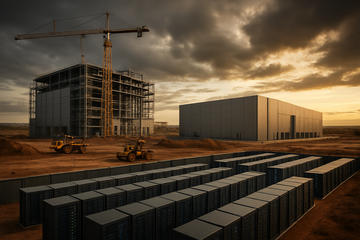
Power was the easy problem. The hard problem now has a queue, a docket and a regulator's name on it. On October 7 the Northern Territory's environment regulator told Energy North it needed longer to set environmental parameters for its 1GW Project Ares, and the developer wiped the June 2028 first-power date rather than publish one it could not stand behind. Three weeks later Microsoft told investors that September-quarter capital expenditures of $45.2 billion fell short of plan because third-party capacity deliveries it had expected in the quarter were delayed. Same mechanism, two continents: capacity that is funded, ordered and even under construction can still arrive late because permission is missing.
Project Ares capacity
1 GW
NT EPA assessment ruling, Oct 7, 2026
First-power date abandoned
Jun 28, 2028
Indicative date in Energy North's referral, withdrawn Nov 1, 2026
Hyperscaler capex, trailing 12 months
$586.6B
Amazon, Microsoft, Alphabet and Oracle combined, through Sep 30, 2026
Microsoft capex, short of plan
$45.2B
September 2026 quarter; third-party capacity deliveries delayed
NextDC one-day share move
-41.7%
Oct 20, 2026; worst single day since its 2010 listing
NEM data centre demand by 2035-36
34 TWh
AEMO 2026 Electricity Statement of Opportunities, Aug 25, 2026
The event
A Regulator Suspended Its Own Deadline, and the Developer Dropped Its Date
Project Ares is Energy North's proposed hyperscale campus at Murranji cattle station in the Barkly Region: 1GW across 191 square kilometres, with a gas turbine system, a solar farm, an airstrip and accommodation for 4,300 construction workers, drawing on as much as four billion litres of groundwater a year. Its environmental referral carried a first-power date of June 28, 2028. After the regulator suspended the seven-week deadline it had set itself to agree environmental parameters, Energy North told Reuters it was no longer working to that June 2028 date and would confirm timing only once the regulator sets the terms of an environmental impact statement.
- The regulator flagged 10 significant impacts, including strains on local water systems and disruption to Aboriginal sacred sites, and found a low level of confidence in the proposed mitigation measures.
- A full environmental impact statement is now required, and the campus must also clear the national environment regulator before construction can begin.
- No new deadline was set, so the approval calendar has no end date.
- The regulator will seek federal advice because the government is drafting policy expectations for AI infrastructure developers.
- Energy North called the June 28, 2028 date indicative at lodgement, which leaves the project with no published schedule at all.
| Project | Developer | Scale | What moved | Date |
|---|---|---|---|---|
| Project Ares, Murranji Station (NT) | Energy North | 1GW; 191 sq km | June 28, 2028 first-power date abandoned; environmental impact statement required | Ruling Oct 7, 2026 |
| M3 Melbourne | NextDC | About a quarter of Ares | Network upgrade works suspended after community opposition; next power pushed to 2028 | Oct 20, 2026 |
| Sydney suburban campus | Goodman Group | Withdrawn | Plan abandoned after local council opposition | Sept 28, 2026 |
| Firmus Grid listing | Firmus (Nvidia-backed) | A$43.7bn sought | Offering price cut 25% to A$8.25, then the listing was withdrawn | Oct 7-9, 2026 |
| Cleveland, Ohio moratorium | City of Cleveland | About two dozen existing sites | Pause on new standalone data centres and expansions extended to Jan 29, 2027 | Oct 21, 2026 |
The constraint
Power Is Being Engineered Around; Permission Is Not
The standard framing of Australian AI data centres, power scarcity and water limits, is already out of date. AEMO's August 2026 Electricity Statement of Opportunities forecasts data centre consumption in the National Electricity Market rising from about 5 TWh in 2025-26 to 34 TWh by 2035-36, and from roughly 3% to about 13% of grid supply. The same document reports no forecast reliability gap before 2030, 9.1GW of new generation and storage connected in 2025-26, and a 40GW pipeline of committed and anticipated projects into the early 2030s.
| Measure | 2026 Electricity Statement of Opportunities |
|---|---|
| NEM data centre consumption | About 5 TWh in 2025-26, rising to 34 TWh by 2035-36 |
| Share of NEM grid supply | About 3%, rising to about 13% |
| Forecast reliability gaps | None before 2030 |
| New generation and storage connected | 9.1GW in 2025-26 |
| Committed and anticipated projects | 40GW pipeline into the early 2030s |
| Method change | Forecast now allows for attrition during the connection process and for connection capacity exceeding actual use |
The decisive detail is methodological. AEMO's 2026 forecast now accounts for project attrition during the connection process and for the gap between connection capacity and actual electricity use. The grid operator has conceded inside its own forecast that nameplate megawatts are not deliverable megawatts. Australia is engineering around its power shortage and has not engineered around its permission shortage, which is why a 1GW campus with a solar farm and a gas turbine system is now waiting on a regulator rather than on a switchboard.
Mechanism
Vendors Are Paid on Order, Operators on Energization
October 2026 produced two guidance statements that look contradictory and are not. NextDC cut FY27 net revenue guidance to A$475-500 million from A$615-640 million and underlying EBITDA to A$245-265 million from A$385-410 million, after Jemena suspended the network upgrade works its Melbourne M3 campus needs following community opposition. Around A$140 million of contracted customer revenue slipped, the next power delivery moved to 2028, and the works will not restart before February 2027. The shares fell 41.7%, the worst single day since the company listed in 2010.
In the same month, Vertiv reported third-quarter net sales of $4,313 million, up 61% year over year, with organic orders up more than 100% and full-year guidance raised. The reason vendors are not punished is not indifference to permits. It is that power and cooling equipment is bought against a build plan, not against a completed approval. Vendors are paid when gear ships; capacity operators are paid when a building energizes. A permitting slip therefore re-times revenue instead of cancelling it, and moves the loss onto whoever carries contracted but unenergized capacity.
| Layer | Example | Paid on | October 2026 evidence |
|---|---|---|---|
| Power and cooling equipment | Vertiv | Order and shipment | Net sales +61%, organic orders above 100%, full-year guidance raised |
| Generation and grid hardware | GE Vernova | Equipment delivery and slot reservations | Orders of $29.3bn, backlog of $197bn, power equipment backlog and slot reservations of 122GW |
| Colocation | NextDC | Energization and occupancy | FY27 revenue guidance cut to A$475-500m; A$140m of contracted revenue deferred |
| Contracted AI compute | CoreWeave | Energization and contract commencement | Revenue backlog of about $104bn at June 30, 2026 against $2.6bn of quarterly revenue |
| Hyperscale cloud | Microsoft, Amazon, Alphabet, Oracle | Energization | $586.6bn of trailing capex; Microsoft's September quarter $45.2bn, short of plan |
The US read-through
The Same Fault Line Is Already Inside the US Capex Calendar
This is why the outback is not an Australian story. On October 28 Microsoft told investors that September-quarter capital expenditures of $45.2 billion came in below plan because some third-party capacity deliveries it expected in the quarter were delayed, and lowered its calendar-2026 spending forecast to roughly $170 billion from about $175 billion. Reuters put calendar-2026 capital spending at $118.1 billion through September. Amazon held 2026 cash capital expenditure guidance at roughly $220 billion after spending $77.3 billion in the September quarter alone, and said 2027 would be meaningfully higher. Alphabet guided to $195-205 billion for 2026 after spending $132.0 billion in nine months, against $63.6 billion a year earlier. Oracle carried $664 billion of remaining performance obligations, up $209 billion year over year, against a fiscal 2027 capital plan of $90-95 billion.
Trailing twelve months of capital expenditure
Amazon, Alphabet, Microsoft and Oracle combined have put $586.6 billion of property and equipment on the ground on the assumption that permits, connections and equipment land together.
Unit: $B
| Company | Guidance | Latest reported spending | The assumption embedded |
|---|---|---|---|
| Microsoft | About $170bn for calendar 2026, cut from about $175bn | $45.2bn in the September 2026 quarter | Third-party capacity deliveries that did not arrive on schedule |
| Amazon | About $220bn of cash capex for 2026; 2027 to be meaningfully higher | $77.3bn in the September 2026 quarter | Every campus energizes inside the fiscal year |
| Alphabet | $195-205bn for 2026 | $132.0bn in the first nine months of 2026 | Google Cloud revenue growth is supplied, not queued |
| Oracle | $90-95bn of capex for fiscal 2027 | $28bn in the August 2026 quarter | A $664bn backlog converts on a schedule that no regulator has approved |
Those four companies spent $586.6 billion on property and equipment in the trailing twelve months. That is the number the read-through has to work on, because a hyperscaler guidance update is now as much a statement about approval and connection calendars as it is a statement about demand. One regulator in the Northern Territory will not change Amazon's income statement. A hundred of them, on the same schedule, will.
Repricing
The Market Sorted AI Infrastructure by Who Can Fund a Delay
Between the June quarter and November 2 the market did not de-rate AI infrastructure as a single trade. It sorted it by who has to deliver before they can collect, and balance sheets, not demand curves, separated the winners.
| Company | Trailing free cash flow | Net debt / EBITDA | Market value change |
|---|---|---|---|
| Microsoft | +$60.0B | 0.51x | +39.9% |
| Amazon | -$46.9B | 0.84x | +1.1% |
| Alphabet | +$19.7B | 0.27x | -20.6% |
| Oracle | -$28.7B | 3.17x | -10.7% |
| GE Vernova | +$17.1B | Net cash | -27.9% |
| Vertiv | +$3.1B | Net cash | -30.5% |
| CoreWeave | -$11.8B | 11.5x | -44.8% |
| IREN | -$1.8B | 56.0x | -41.5% |
Two patterns sit inside that table. First, the balance sheet did the separating: Microsoft converted $168.3 billion of operating cash flow into $60.0 billion of free cash flow after spending $135.9 billion on property and equipment, and its equity added about $1.1 trillion of value in the same window in which Amazon's free cash flow turned negative at $46.9 billion. Second, CoreWeave and IREN, the two names whose revenue literally begins when a building energizes, fell 44.8% and 41.5%, the sharpest moves in the group, on 11.5x and 56.0x net debt to EBITDA, and the market has repriced exactly that fragility.
This is inference, not proof. The same window contained Alphabet's earnings miss and the collapse of the Firmus listing, either of which could move these prices on its own. What the data does support is narrower: the approval layer has become visible enough to move the equity value of companies that had been valued as pure expressions of AI demand, which means the approval layer is now in the price.
Horizons
What Moves First, and What the Calendar Looks Like in 2027
The next five months contain a stack of dated tests, and each one either confirms the thesis or quietly punctures it.
- Microsoft's December quarter, guided to more than $50 billion of capital expenditure, shows whether the capacity slippage is one quarter or a pattern.
- November 20, 2026: NextDC's annual investor meeting, where it promised the first results of its spending-program review, the first hard test of whether an operator can re-phase a build.
- November 28, 2026: the Victorian election, which NextDC said is delaying final approval of the M3 expansion stages.
- January 29, 2027: the expiry of Cleveland's moratorium on new standalone data centres and expansions, a US test of whether local consent is a pause or a rule.
- February 2027: the earliest date the suspended M3 network works are expected to restart.
- March 23, 2027: the Senate committee's reporting date for its inquiry into AI and data centres, moved from November 16, 2026 on October 20, which delays the rulebook for Australian AI capacity by four months.
- 2027: national data centre standards, agreed by every government on August 26, 2026, are due to be legislated.
Over one to three years, the delay does not shrink the pipeline; it changes who owns it. Australia's move to a single national rulebook, plus a Senate report in March 2027, creates one approval regime for a market where AEMO expects data centre demand to rise roughly sevenfold by 2035-36. One rulebook cuts both ways. It removes nine jurisdictions' worth of bespoke risk, which lowers the cost of the pipeline, and it creates one gate that every project must pass, a gate with a demonstrated habit of suspending its own deadlines. Expect capital to concentrate in developers that can fund an approval cycle without a financing window open: IREN's $3.6 billion of investment-grade GPU financing at 6.0% is the template, and even its 800MW Australian campus explicitly ties early works and procurement to regulatory approvals.
Synthesis
The Buildout Has Not Slowed; It Has Moved
The outback ruling is small in dollars and large in signal. A 1GW campus with an airstrip, a solar farm, a gas turbine system and a village for 4,300 workers lost its date because a regulator needed more time to set environmental parameters, not because there was no power, no turbine, no transformer and no money. The binding constraint on AI capacity has moved from engineering supply to granting permission, and it moved while four US companies wrote $586.6 billion of cheques against a schedule that treats permission as a formality.
The investable conclusion is not that the buildout is slowing. It is that the buildout has entered a phase where the winners are paid on order and the losers are paid on energization. That favours the equipment chain, Vertiv and GE Vernova, over the capacity operators carrying contracts against buildings that have not been permitted, and it means every hyperscaler guidance update through 2027 should be read first as an approval-calendar disclosure and only second as a demand signal.
Where the approval risk actually lands
- Q3 2026 organic orders grew more than 100% and net sales rose 61% to $4,313 million: orders are booked against build plans, not approvals.
- Full-year 2026 guidance was raised to $14,650 million of net sales at the midpoint, so a permit slip in Australia moves no line item.
- Horizon: over the next two quarters, watch order intake rather than backlog; at 29.5x trailing EV/EBITDA the risk is the multiple, not the demand.
- Project Ares alone needs gas generation with capacity about three times Darwin's peak demand, and Australia now wants new data centres majority renewable-powered, so firming hardware is the scarce order.
- Power equipment backlog and slot reservation agreements grew from 116GW to 122GW, with orders of $29.3 billion in the quarter: the order book is years ahead of energization.
- Horizon: over 2026 and 2027, watch slot reservations converting into backlog; at 20.6x trailing EV/EBITDA the risk is the multiple, not the demand.
- September-quarter capital expenditures of $45.2 billion came in short of plan because third-party capacity deliveries slipped.
- Calendar-2026 capital spending reached $118.1 billion through September, so every guidance cut is now a capacity-timing statement.
- The counterweight: 0.51x net debt to EBITDA and $60.0 billion of trailing free cash flow let it absorb a multi-year approval cycle without cutting the build.
- Horizon: the December quarter, guided above $50 billion of capex, shows whether the slippage is one quarter or a pattern.
- 2026 cash capital expenditure guidance held at about $220 billion after $77.3 billion in the September quarter alone, with 2027 spending to be meaningfully higher still.
- Trailing free cash flow has turned negative at $46.9 billion against $168.3 billion of operating cash flow, so the build is no longer self-funding.
- Horizon: the A$20 billion Australian commitment through 2029 is the clearest test of whether a hyperscaler accepts a regulator's date instead of its own.
- 2026 capital expenditure guidance of $195-205 billion follows $132.0 billion spent in nine months, more than double the $63.6 billion of a year earlier.
- The equity fell 20.6% from Jun 30 to Nov 2 while capex guidance was held, which suggests the market now charges for capacity promises.
- Horizon: over the next two quarters, watch whether guidance is raised on supply commitments or only on signed contracts.
- Remaining performance obligations of $664 billion, up $209 billion year over year, against a $90-95 billion fiscal 2027 capital plan turn backlog into delivery risk.
- Trailing capital expenditure of $75.7 billion against $46.9 billion of operating cash flow means delivery, not demand, sets the funding gap.
- Horizon: the 2027 watch item is whether backlog growth slows while capital spending stays at $90-95 billion, the signature of a slipped build.
- Trailing revenue of $7.6 billion sits against $75.5 billion of enterprise value and 11.5x net debt to EBITDA, with a 0.46 current ratio: no room for a dateless approval cycle.
- A revenue backlog of about $104 billion at June 30, 2026 converts only when a building energizes, so a permit slip pushes this revenue right.
- Horizon: next two quarters, watch backlog conversion and financing terms; the market has already cut the equity 44.8% since Jun 30.
- Its 800MW Bundey campus in South Australia targets energization from 2028, and IREN ties early works and procurement to the satisfaction of regulatory approvals.
- Trailing revenue of $707 million against 56.0x net debt to EBITDA and capex at 9.8x depreciation means financing access, not megawatts, is the binding constraint.
- The offset: $4 billion of contracted ARR for 2026 capacity, $3.6 billion of investment-grade GPU financing at 6.0%, and Sweetwater in Texas where development is progressing.
- Horizon: the catalyst is the approval terms attached to Bundey's transmission agreement; until they are published, the 2028 date carries no floor.