
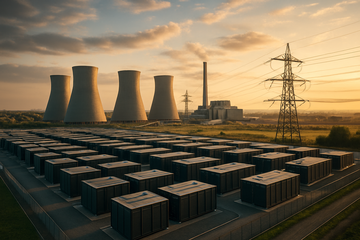
On 3 November 2026, Drax Group, Brookfield, Brookfield's UK compute platform Radiant and Qai — the AI infrastructure company backed by the Qatar Investment Authority — announced a partnership to build more than 1GW of AI data centre capacity on the Drax power station estate near Selby in North Yorkshire. The programme could exceed £20bn, with £2.5bn committed to a first phase of up to 100MW targeted for commercial operation from Q1 2028. Phase 1 draws electricity directly from the national grid through the site's existing 4GW connection, so it adds compute without adding a power plant.
Total programme value
£20bn+
Could exceed £20bn (US$26.8bn), per the partners' announcement, 3 November 2026
First-phase capital
£2.5bn
Initial part of Phase 1, per the same announcement
Phase 1 capacity
100MW
Targeting commercial operation from Q1 2028
Grid access already on site
4GW
Existing connection at the Drax power station, per Drax
Dispatchable generation and cooling
2.6GW
Existing on-site capacity behind the campus, per Drax
UK connection demand vs peak
72GW vs 45GW
Connection requests against national peak demand, BBC News, 2 November 2026
Drax share reaction
+9%
Early trading on the day of the announcement, per Reuters
The deal
£20bn Signed as a Framework, Not as a Contract
This is a strategic partnership agreement, not a construction contract. The first phase — up to 100MW, commercial operation targeted from Q1 2028 — is conditional on planning progress, regulatory and network approvals and, decisively, a suitable tenant that has not been named. Drax contributes land, power and grid access; the Brookfield–Qai joint venture provides the backing; Radiant, the vertically integrated platform Brookfield created in February 2026 by merging with the UK cloud operator Ori Industries, designs, builds and operates the facility.
| Phase | Capacity | Timing | Power source | Gating conditions |
|---|---|---|---|---|
| Phase 1 | Up to 100MW | Operational from Q1 2028 | Imported directly from the grid | Planning progress, regulatory and network approvals, a suitable tenant |
| Phase 2 | Ramp to 500MW | 2028 to 2031 | Could be served from Drax's own dispatchable generation | Phase 1 delivery and commercial take-up |
| Phase 3 | Additional capacity | Post-2031 | Not specified | Commercial and subsidy decisions beyond March 2031 |
The bottleneck
Britain's AI Power Crunch Is a Connection Crunch, and Policy Now Prices It
Ofgem's connection data shows developers seeking 72GW of capacity against a national peak demand of 45GW, with some told to wait up to ten years for the upgrades they need. NESO's connections reform has already replaced first-come, first-served with a readiness test, leaving a queue roughly four times what is needed by 2030 and double what is needed by 2050. The 2026 Autumn Budget then turned that scarcity into policy: the Data Centre Covenant published on 28 October reserves and reallocates connection capacity, and lets pre-2030 data centre connection contracts transfer to strategically important projects.
- Behind-the-meter generation is now permitted while a developer waits for a connection, but only under a tightly controlled framework reserved for exceptionally strategic projects that cannot secure capacity in time.
- Strategic data centres can have connections reserved for them, and can inherit pre-2030 data centre connection contracts transferred from other developers.
- New facilities are expected to hit a power usage effectiveness of 1.3 or better, and the government estimates the UK needs 6GW of AI data centre capacity by 2030.
- Off-site examples show how hard the constraint bites: 49.5MW of gas engines at Acre Slough, a proposed 200MW gas plant at Wapsey's Wood, and 49.9MW of turbines in Cardiff.
- AI Growth Zones are designed to cut time to power by up to five years and to save a 500MW data centre up to £80m a year.
The campus plugs into an asset far larger than itself
The Selby campus against the connection and generation already sitting on the Drax power station site
Unit: MW
Grid access on site
Existing connection
4,000
Dispatchable generation and cooling
Existing on-site plant
2,600
Phase 2 target
Ramp 2028-2031
500
Phase 1 target
From Q1 2028
100
The economics
Drax Sold the Scarce Input; Its Shareholders Kept the Optionality
Drax's first-half numbers set the scale. Revenue was £2,481.2m and adjusted EBITDA £279.8m, down from £460m a year earlier, with net debt of £1,025.3m and £84.5m of capital expenditure in the half. The first phase alone, at £2.5bn, is roughly ten times Drax's own £210m–£250m capital expenditure budget for 2026 and 2.4 times its net debt. The cheque is not Drax's to write.
| Measure | H1 2026 | Reference point |
|---|---|---|
| Revenue | £2,481.2m | Six months to 30 June 2026 |
| Adjusted EBITDA | £279.8m | Down from £460m in H1 2025 |
| Net debt | £1,025.3m | As at 30 June 2026 |
| Capital expenditure | £84.5m | H1 2026 actual |
| Full-year capex plan | £210m–£250m | 2026 guidance, inclusive of BSIF |
| Consensus 2026 adjusted EBITDA | £698m | As at 4 September 2026 |
Biomass still carries the earnings — and the emissions
Drax adjusted EBITDA by business, six months to 30 June 2026 (£m)
Unit: £m, H1 2026
Biomass generation
159.1
Pellet production
63.9
Flexible generation
50.2
Energy solutions
27
Innovation, capital projects and other
-19.6
That arithmetic explains the market's reaction. Drax shares rose 9% in early trading on 3 November — a fraction of what a £20bn headline might imply — because Drax is not funding the build; Brookfield and Qai are. What Drax sells is land, power and connection. JPMorgan reads the announcement as increasing expectations that the power station will keep operating beyond the March 2031 expiry of its subsidy scheme, and that is where the option value sits: the low-carbon contract covering Drax Power Station runs only to March 2031.
Supply chain
The Electrical Stack Gets Paid; the Turbine Book Does Not
This is where the brownfield template breaks the usual AI-power trade. A 100MW campus converted inside an existing power station buys switchgear, power trains, busway and cooling — it does not buy a gas turbine, because the connection and the generation already exist. A brownfield conversion buys the electrical stack and skips the turbine. Vertiv, which sells that electrical and thermal content into data centres, reported third-quarter net sales of $4,313m, 61% higher year on year, organic orders more than doubling, and full-year guidance lifted to $14,650m.
| Company | Position in the chain | The evidence | What the Selby template means |
|---|---|---|---|
| Vertiv | Upstream: electrical and thermal plant | Q3 2026 net sales of $4,313m, organic orders more than doubling | Direct beneficiary: brownfield conversion is electrical content |
| GE Vernova | Upstream: turbines and grid equipment | Gas equipment backlog plus slot reservations of 116GW rising to 122GW | Displaced in Phase 1; still levered to the wider UK build |
| Doosan Enerbility | Upstream: gas turbines and plant engineering | 11 gas turbine units worth 6GW secured; data-centre-driven demand seen 3.2x prior forecasts | Same tension at smaller scale; brownfield lowers content per megawatt |
| Drax Group | Upstream: land, power and the 4GW connection | H1 2026 adjusted EBITDA of £279.8m; 4GW grid access, 2.6GW dispatchable generation | Sells the scarce input and keeps the optionality |
| Brookfield, Radiant and Qai | Downstream: capital, development and operation | £2.5bn of first-phase backing via the Brookfield–Qai joint venture; Radiant valued at $1.3bn in February 2026 | Owns the compute economics once a tenant signs |
| NVIDIA | Downstream: compute into whoever signs | Revenue of $96.2bn in the quarter ended 26 July 2026 | Nothing lands until a tenant is named |
The turbine queue the Selby template walks around
GE Vernova gas equipment backlog plus slot reservation agreements (GW)
Unit: GW
Q2 2026
116
Q3 2026
122
Guided year-end 2026
130
- GE Vernova is a UK-queue story rather than a Selby story: third-quarter orders reached $29.3bn, up 96% organically, with total backlog of $197bn, but the Selby first phase orders no turbine.
- Doosan Enerbility carries the same tension in miniature: the gas power market view was raised to 496GW by 2030 from 314GW, with up to roughly 12 units or 5.8GW of turbine orders a year expected from 2026.
- Downstream, NVIDIA is the terminus of the chain — accelerators are bought by the tenant, so the compute order arrives with the signature, not with the groundbreaking.
- The IEA's warning frames the timing: gas turbine deliveries now face lead times of several years, potentially pushing commissioning of new plants beyond 2030.
What breaks it
Three Failures That Would Turn a Scarcity Premium Into a Sunk Site
- No tenant. Both phases are conditional on securing a suitable tenant and none has been named. Until one signs, the campus is a planning application attached to a power station.
- Planning has not started. Drax said in September that it is developing a planning application for a roughly 100MW front-of-the-meter data centre and aims to submit it in the coming months, with community consultation to begin first.
- Carbon and consent. Drax emitted 14.1 million tonnes of carbon dioxide equivalent in 2025, and the same site's 1.2GW AI Growth Zone bid was rejected by the government in October 2026 for failing selection criteria that included credible plans for energy delivery.
The rejection is the most important fact in the file. Brookfield and Qai are underwriting a site whose 1.2GW version was refused by the government in October 2026 on energy-delivery grounds. That does not make a 100MW version impossible — it makes the tenant, the emissions plan and the planning committee the three things that have to be solved in public rather than in a boardroom.
Horizons
Short Term Is a Planning Application; Long Term Is a Merchant Plant
Two clocks run here, and they are priced very differently.
- Weeks to quarters: the planning submission for the roughly 100MW front-of-the-meter first phase, which Drax says it aims to file in the coming months once community consultation is under way.
- Weeks to quarters: the anchor tenant, the only disclosure that converts a £20bn framework into a financed project.
- Weeks to quarters: Drax's 2026 adjusted EBITDA, guided to the top of the £698m consensus range, against a £210m–£250m capital plan.
- Weeks to quarters: how the market keeps repricing the connection — a 9% share move on announcement is the first, partial answer.
- One to three years: Phase 2's ramp to 500MW between 2028 and 2031, and whether its power is served from Drax's own dispatchable generation or from new build.
- One to three years: the post-2031 question, since the low-carbon contract covering the power station runs only to March 2031 and a contracted campus is what turns the site from a subsidy case into a commercial one.
- One to three years: whether the brownfield template spreads to other ex-generation sites, which would keep value in connections rather than in new machines.
- One to three years: whether UK-sited capacity becomes a hedge against US power scarcity, which depends on a UK tenant and UK grid policy rather than on capital.
The investable read-through: who captures a brownfield AI campus
- Sponsor and operator: the Qai joint venture backs the £2.5bn first phase, while Radiant designs, builds and runs the facility.
- Capital-light for the group: the joint venture writes the cheque, so the platform grows fee-bearing assets without the group funding the build.
- Horizon: a signed tenant and a submitted planning application re-rate the platform; the UK leg is one of three alongside the $100bn Paducah campus with NextEra Energy and 6.5GW in India.
- Radiant, the operating platform built from the Ori Industries merger and valued at $1.3bn in February 2026, is where the compute economics sit.
- Most direct beneficiary: third-quarter net sales rose 61% to $4,313m with organic orders more than doubling, and full-year guidance lifted to $14,650m.
- Horizon: Selby scales from 100MW in Q1 2028 to 500MW by 2031, and each phase carries a full electrical and thermal bill of materials.
- Captures the conversion spend that turbine makers never see in a template that plugs into an existing 4GW connection.
- Covenant tailwind: new UK facilities are expected to hit power usage effectiveness of 1.3 or better, pulling thermal and power-density engineering into the design.
- Bull case: 72GW of UK connection requests against 45GW of peak demand forces new build somewhere, and gas equipment backlog plus slot reservations rose from 116GW to 122GW, with at least 130GW guided for year-end.
- Bear case: Phase 1 orders no turbine, because power comes from the grid through a connection that already exists.
- Mix shift: brownfield conversion needs grid and electrification kit rather than turbines, and the Electrification segment grew revenue 51% to $3.9bn at a 19.1% margin.
- Horizon: IEA notes turbine lead times of several years can push commissioning beyond 2030, so brownfield wins the 2027-2030 window while new-build slips.
- Demand is genuine: data-centre-driven gas power demand is now seen growing 3.2 times prior forecasts by 2030, with 11 gas turbine units worth 6GW already secured.
- Risk to that pipeline: brownfield conversion cuts turbine content per megawatt, because existing generation replaces new machines.
- Horizon: order flow runs through Gulf and US AI campuses, including the Brookfield–Qai programme in Qatar, rather than through a single UK site.
- Up to roughly 12 units or 5.8GW of gas turbine orders a year are expected globally from 2026, so the swing factor is the template, not the backlog.
- Not yet an order: no tenant is named, so no accelerator order is attached to the 100MW first phase.
- Scale check: revenue of $96.2bn in the quarter ended 26 July 2026 makes one 100MW phase immaterial, while the 500MW Phase 2 template is the order that matters.
- Converts only when an anchor tenant signs, so the catalyst is a signature rather than a construction milestone.
- Horizon: 2027-2030, UK-sited sovereign compute is optionality for the franchise rather than share gain.