
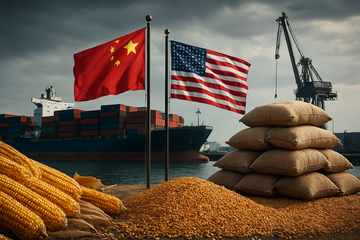
For six weeks the market treated the trade deal as two separate stories: a $60 billion tariff cut framed as a consumer-goods story, and grain that moved on Chinese purchase targets. Beijing's Nov. 5 condition splices them together. Farm purchases are now a term in the tariff negotiation, not an independent outcome of it — and the condition arrives two days after Democrats took both chambers of Congress and three weeks before farmers were due to see whether the $17 billion pledge had any purchase behind it.
The useful question is no longer whether China buys. It is which number breaks when the condition binds, and the answer is not the one the soybean headline suggests.
Reciprocal tariff-cut package
$60B
Proposed package, including roughly $17B of U.S. farm goods China imported in 2024
Annual U.S. farm purchase pledge
$17B
Pledged for 2026-2028 and prorated for 2026; soybeans sit under a separate 25M metric ton commitment
Non-soybean U.S. farm goods bought
$7.2B
January-September 2026; lowest January-September since 2019
U.S. soybeans bought by Chinese state buyers
12M+ MT
Against the 25M metric ton target for 2026-2028
Urea, India IPL tender, East Coast CFR
$352.10/MT
Oct. 8, 2026 lowest offer, against $959.00 in April 2026
Corn basis, Ohio River vs. December futures
-$0.67/bu
Lowest on record for the date; Southeast Iowa at -$0.53/bu
Nov. 5, 2026 · Beijing
The Farm Leg Becomes a Term in the Tariff Negotiation
Commerce ministry spokesperson Huang Ling said China is open to buying U.S. farm goods only on the condition that the two sides reach an agreement on reciprocal tariff cuts, describing a $60 billion package that includes roughly $17 billion of U.S. farm goods China imported in 2024. The May 2026 White House commitment — $17 billion a year of agricultural purchases from 2026, prorated for 2026 — now reads as a payoff rather than a promise.
Beijing has already published the concession list, and its shape is the tell. The Sept. 27 product lists cover 1,619 U.S. products entering China and 77 Chinese products entering the United States, built on 2024 bilateral trade, with roughly 90% of covered goods expected to be cut back to most-favored-nation rates. Whole soybeans are not on it.
- Corn, wheat, sorghum, rice, beef, pork, poultry, dairy, vegetable oils and soybean meal all sit on the reduction list; whole commercial soybeans were excluded, leaving the additional 10% levy in place on top of the 3% base rate.
- China's tariff commission was set to begin scrapping duties of up to 15% on some U.S. farm goods from Nov. 10, but the published list itself did not specify effective dates for individual lines.
- State buyers have taken more than 12 million metric tons of U.S. soybeans against the 25 million metric ton commitment for 2026-2028, close to half the target, with 7.76 million metric tons of 2026/27 sales still outstanding as of Aug. 27.
- The roughly $30 billion figure attached to the framework is the value of goods covered by tariff reductions, not a Chinese purchase commitment — the distinction is the whole point of the Nov. 5 condition.
The pledge vs. the purchases
A Seven-Year Low Was Set Before the Condition Ever Bit
The condition is an accelerant, not the cause. China's non-soybean farm purchases from the United States ran $7.2 billion from January through September 2026, the weakest first nine months since 2019, even with the pledge in place since May. Annualizing that pace implies roughly $9.6 billion a year against a $17 billion target — a gap of about $7.4 billion.
Which of the $17 billion is available is a function of Chinese domestic supply, not of Washington. Corn is the clearest case: Chinese state buyers forecast only about 900,000 metric tons of U.S. corn for the 2026/27 marketing year, because domestic supply is ample and U.S. corn is uncompetitive on landed cost.
| Category | Commitment or benchmark | Latest evidence | What it says about the pledge |
|---|---|---|---|
| Soybeans | At least 25 million metric tons for 2026-2028 | More than 12 million metric tons bought by Chinese state buyers; 7.76 million metric tons of 2026/27 sales outstanding at Aug. 27 | Roughly half the target, and the buying is directed rather than commercial |
| All non-soybean farm goods | $17 billion a year from 2026, prorated for 2026 | $7.2 billion in January-September 2026, the weakest nine months since 2019 | An implied $9.6 billion annual pace, about $7.4 billion short |
| Corn | U.S. corn peaked at $5.6 billion, roughly 20 million tonnes, in 2021 | About 900,000 tonnes forecast for 2026/27; COFCO says U.S. corn is uncompetitive | Under 5% of the peak volume; domestic Chinese supply is the binding constraint |
| Sorghum | U.S. sorghum peaked at 6.5 million tonnes, worth $2.1 billion, in 2021 | Brazil shipped 1.7 million tonnes to China this year with nearly 1 million tonnes more planned | Brazil took the slot while U.S. sorghum sales dried up over four months |
| Beef | More than 400 U.S. plants re-licensed in May | About half of U.S. fed-cattle slaughter capacity ineligible on residue rules | Licence count and eligible capacity are not the same thing |
| Pork and poultry | Inside the tariff-reduction list | Chinese pork and chicken oversupplied domestically | Price is not the constraint; Chinese supply is |
U.S. agricultural exports to China fell 66% in 2025 to $8.4 billion, and USDA's May trade forecast put fiscal 2026 at about $12 billion against $16.2 billion in fiscal 2025. Washington is negotiating for a number that is now below its own government's baseline estimate, and the South American supply chain has been re-routed around Beijing for most of a year.
That is why the Nov. 5 statement landed where it did. The condition lets Beijing hold the tariff schedule — which is what actually prices U.S. beans into Chinese crushers — while making the purchase contingent on the schedule moving.
Cash basis
Basis Cracks Where China Is Absent — and It Is Not Cracking in Soybeans
The consensus reads the Sept. 28 tariff-exclusion headline as the first break, and the flat price duly fell: November soybeans closed at $12.88¼ a bushel, down 30¾ cents, and futures were back under $13 by early October, though still up more than $2.30, or 22%, since the end of 2025. The basis tells a different story, and it is the story that matters for margins.
Soybean basis is holding. In late September it was above its two-year historical average in all but three reporting districts, with Ohio soybean processors paying an average of 43 cents and Iowa processors 31 cents over November futures. Record U.S. crushings — forecast at 2,780 million bushels for 2026/27 — are what is paying that bid, not Chinese demand.
Corn basis, week ended Oct. 16, 2026
Inland corn discounts widened while the Gulf export point held a premium. Cash bids versus December futures, U.S. cents per bushel.
Unit: U.S. cents/bu vs. Dec. futures
Gulf Louisiana
Export point held the premium
78.2
North Carolina elevator
37.2
Atlantic Coast 30-day
20.2
Indiana elevator
-24.8
Ohio elevator
-26.8
Illinois elevator
-31.8
Nebraska elevator
-36.8
Iowa elevator
Widest inland discount in the Midwest
-40.8
South Dakota elevator
Deepest discount on the board
-66.8
- Corn basis was the first leg to break: Southeast Iowa sat at -$0.53 per bushel and the Ohio River at -$0.67, both the lowest on record for that point in the year, and the discounts widened further through mid-October.
- The wedge is the signal. Gulf Louisiana corn bid $0.78 over December futures while Iowa elevators paid $0.41 under and South Dakota $0.67 under — a $1.19 spread between the export point and the interior that does not exist in a balanced market.
- Corn futures broke first and hardest: December corn fell from $5.29 in late September to $4.668 on Oct. 16, a12% slide in four weeks, while USDA held its $4.70 season-average forecast on Oct. 9.
- Corn is where China is absent — roughly 900,000 forecast tonnes against a 2021 peak near 20 million — so the cash market, not the futures market, is where the missing Chinese bid actually shows up.
Inputs
Beijing's Other Lever Is Urea, and It Already Took $607 a Ton Out of the Curve
The most consequential condition in the trade is not written in the tariff list. China controls global nitrogen export availability, and the WTO's data team documented the sequence: China tightened controls on urea and sulphuric acid, then permitted limited urea exports under a quota system. International urea ran from roughly $400 a tonne to above $850 in April 2026 before easing to $453 in June.
By Oct. 8, Indian tenders cleared at $352.10 a tonne on the East Coast and $356.25 on the West Coast, against April's $959.00 and $935.00 — a $606.90 collapse on the East Coast, and the direct reason China's expanded export availability is squeezing international suppliers.
India IPL urea tender offers, April vs. Oct. 8, 2026
CFR prices from the Oct. 8, 2026 Indian tenders. WTO data separately show global urea spiking above $850 in April 2026 and easing to $453 by June.
Unit: $/metric ton
East Coast, April 2026
959
West Coast, April 2026
935
East Coast, Oct. 8, 2026
China's export availability pressure
352.1
West Coast, Oct. 8, 2026
356.3
CF Industries gross margin by quarter
Quarterly gross margin swung with the nitrogen spike and then gave it back as Chinese export quotas pulled supply back into the market.
Unit: Gross margin
Q3 2025
38.1%
Q1 2026
37.6%
Q2 2026
Peak nitrogen pricing
51.5%
Q3 2026
Margin almost fully surrendered
38.7%
The margin damage is already in reported numbers. CF Industries' gross margin fell from 51.5% in the June quarter to 38.7% in the September quarter, and operating income went from $1.05 billion to roughly breakeven. Mosaic reported a third-quarter operating loss of $96.6 million on a 2.7% gross margin, and a trailing twelve-month net loss of $440.3 million.
For American growers, cheaper nitrogen is welcome relief and it underwrites the acres the purchase pledge is supposed to guarantee. For the producers of that nitrogen, Beijing is running the same playbook it runs on grain: turn a policy switch to set a price. Export licensing could affect up to 15% of world fertilizer exports, with an upper limit of 23.3% if the Strait of Hormuz stays closed, and 18 economies are particularly exposed to Gulf nitrogen disruption.
Ethanol and protein
Record Ethanol Exports and a Pork Glut Pull in Opposite Directions
Ethanol is where the American side of the trade actually looks strong. U.S. ethanol exports set volume and value records in both 2024 and 2025, ran ahead of that pace through June 2026, and cleared the one-billion-gallon mark in the 2025/26 marketing year by April, 13% above the prior year. Brazil's own strong domestic demand cut its exportable supply and let the United States take share.
The catch is the co-product. USDA's Beijing office reports that expanding Brazilian sorghum and distillers dried grains with solubles exports to China, alongside Argentine corn, are increasing competition for U.S. exporters. Ethanol economics are a corn story with a Chinese tail, and the tail now belongs to Brazil.
- U.S. ethanol exports reached a record 2.38 billion gallons in 2025, worth $4.8 billion, and the 2025/26 marketing year finished10.1% higher at2.38 billion gallons on final tallies.
- Iowa ethanol plant basis rose 14 cents per bushel in late September and Ohio ethanol plant basis ran 10 to 20 cents above its historical average — cheap inland corn is a margin tailwind for the ethanol grind.
- Chinese pork and chicken are oversupplied domestically and U.S. beef prices are high on herd declines, so the protein leg of the pledge cannot be bought with tariffs.
- More than 400 U.S. beef plants were re-licensed in May, but roughly half of U.S. fed-cattle slaughter capacity remains ineligible over residue rules, which caps realized value regardless of duty.
The pork chain shows the cost of getting the policy wrong in the other direction. Smithfield Foods' Fresh Pork segment sales fell $371 million, or 17.0%, in the September quarter, with segment operating margin at negative 4.9% against positive 0.5% a year earlier, and China accounted for about 2% of total sales with tariffs of 25% to 47% on products shipped there.
Those 47% duties matter far less than the tariff list suggests, because China's own supply glut, not American pricing, is what keeps its imports of U.S. pork small. Tariff relief in a market with no import demand relieves nothing.
Washington
Democrats Now Own the Purchase Decision, Which Changes What the Condition Is Worth
The midterms reset the negotiating table. Democrats took both chambers, flipping the Kansas Senate seat for the first time for a Democrat in nearly a century, and winning Iowa's 3rd District with Sarah Trone Garriott at 54.6% against 45.4% for Zach Nunn with 91% of votes counted. The party's stated targets included high prices tied to the Iran war and to the tariff agenda, at a moment when farmers had spent a year paying record diesel prices and waiting on a farm bill that never came.
That is what converts a condition into leverage. Beijing's purchase pledge can only be enforced by an administration willing to spend money to make Chinese buying happen, and the $15 billion farm-purchase plan announced in the final weeks before the vote now sits with a new majority in the House and Senate. American Action Forum's read was that tariffs should be slashed no later than the mid-November APEC summit in China.
- Farm country flipped for Democrats on tariffs and fuel costs, which means appropriations — not trade authority — decide how much the $17 billion pledge gets enforced.
- A $15 billion federal purchase commitment in the weeks before the election is the shadow price of the Nov. 5 condition: whatever Beijing withholds from the tariff list, Washington proposes to buy outright.
- The mid-November APEC summit in China is the first hard date on the calendar, and the first test of whether a condition survives contact with a Democratic-controlled appropriations process.
- Southern Hemisphere supply is now the binding constraint on the purchase leg, with Brazil over 60% of global soybean exports and the United States down to 22% from roughly 40% a decade ago.
Horizons
What Breaks First, What Breaks Later
| Horizon | What to watch | The number that decides it | Why it matters first |
|---|---|---|---|
| Days to weeks | Nov. 10 implementation of the 15% duty removals on non-soybean lines | Whether soybean imports from the U.S. resume, and at what discount to Brazil | Whole soybeans stay at 13% all-in, so nothing in the soy complex re-rates on Nov. 10 |
| Days to weeks | Weekly export sales and Chinese state buying pace | Whether outstanding 2026/27 sales to China build past7.76 million metric tons | Directed buying, not commercial crushing, sets the pace; that is the load-bearing assumption |
| Weeks to a quarter | December corn futures against USDA's $4.70 forecast | Whether cash basis follows futures down to the Gulf or inland discounts keep widening | The $1.19 Gulf-to-Iowa spread is the cleanest measure of the missing Chinese bid |
| Weeks to a quarter | Nitrogen realizations with urea near $350 | CF's gross margin holding near 39% or sliding further | Cheap nitrogen underwrites acreage but resets producer earnings now |
| One to three years | Whether the 25 million metric ton soybean commitment converts to commercial demand | Whether Chinese crushers pay a 13% duty for U.S. beans when Brazil charges 3% | A state-directed program does not create demand; it relocates cost |
| One to three years | China's nitrogen export quotas and Brazil's feed share | Whether urea re-tightens and whether Brazilian sorghum and DDGS keep displacing U.S. exporters | Two Chinese supply levers, one farmer budget, and a shrinking U.S. share of global exports |
The honest version of the trade is narrower than the headline. China has bought American soybeans roughly half the way to its target and is buying them because the state tells it to, at a duty that a commercial crusher would not pay. It has bought almost nothing else, for reasons that live inside China. Beijing has held the soybean tariff while offering relief on products it does not need, and it has used nitrogen export quotas to reset a curve that would otherwise have supported American growers.
The numbers that break first are therefore the ones closest to the missing bid: inland corn basis, already at record lows for the season, and nitrogen margins, already surrendered. Soybean futures, which look insulated because crush is doing the work, are the last place this shows up — not the first.
Exposure
Who Carries the Exposure
| Company | Latest period revenue | Gross margin | Net debt/EBITDA | Trailing P/E | Nov. 5 close |
|---|---|---|---|---|---|
| Bunge Global | $93.47B trailing | 5.1% | 5.68x | 16.3x | $97.01 |
| ADM | $84.06B trailing | 7.4% | 1.97x | 13.8x | $70.84 |
| Green Plains | $1.84B trailing | 10.0% | 1.53x | 7.6x | $13.66 |
| The Andersons | $11.09B trailing | 7.9% | 2.76x | 12.1x | $55.35 |
| CF Industries | $7.94B trailing | 42.6% | 0.25x | 8.7x | $112.19 |
| Mosaic | $11.53B trailing | 7.8% | 4.23x | n.m. (loss) | $21.61 |
| Smithfield Foods | $15.11B trailing | 12.4% | 0.84x | 8.6x | $19.72 |
| Deere | $47.68B trailing | 35.7% | 4.72x | 37.5x | $676.34 |
| WH Group | $28.03B FY2025 | 20.2% | 0.75x | 6.9x | HK$6.62 |
| Yihai Kerry Arawana | CNY 252.66B trailing | 6.0% | 6.20x | 44.7x | CNY 25.97 |
Two inferences carry most of the weight here, and both run against the intuitive reading of the headlines.
First, Chinese soybean buying flatters the crush margin without clearing the crusher. A Chinese crusher that buys a 13% all-in U.S. bean when Brazil charges 3% can pass the cost through only if refined-product prices hold — and the tariff reduction list puts imported soybean oil and meal on the way down to most-favored-nation rates. Yihai Kerry Arawana earns a 6.0% trailing gross margin on CNY 252.7 billion of revenue with net debt at 6.2 times EBITDA. There is no cushion in that structure if the tariff relief on the output side arrives while the input side stays expensive.
Second, the tariff concession that matters most to Washington is one China has already given away: the removal of the 10% levy on corn, sorghum, meat and dairy. Those lines were never going to clear on price, because Chinese corn supply is ample, Brazilian sorghum has the slot and Chinese pork and chicken are oversupplied. The tariff was not the binding constraint on any of them, which is why the pledge in those categories is running at a seven-year low.
Stocks this trade condition actually touches
- State-directed Chinese buying of more than 12 million metric tons already secures origination volume, but at a 13% all-in duty a commercial crusher would not pay.
- Record U.S. crushings of 2,780 million bushels and soybean oil at 70.00 cents carry processing margins that do not depend on China.
- Net debt of 5.68 times EBITDA against negative $2.66 billion of trailing free cash flow limits how long the balance sheet can wait out a condition.
- ADM carries 1.97 times net debt to EBITDA against Bunge Global's 5.68 times, so it can fund the wait without trading on the balance sheet.
- Trailing free cash flow of $2.08 billion covers $1.02 billion of buybacks and a 2.9% dividend yield while the condition is negotiated.
- Over one to three years, China's non-soybean buying tilting toward corn, sorghum and meat favors a diversified origination book over a bean-only one.
- Corn basis at record lows for the season is margin relief for a corn ethanol producer, not a problem.
- Gross profit swung from a $58.3 million loss in the December2025 quarter to $113.0 million in the June 2026 quarter as inland corn basis fell.
- At 5.6 times EV/EBITDA and 7.6 times trailing earnings the market prices ethanol as if cheap corn closes, even as Brazilian distillers grains displace U.S. product in China.
- Urea falling from $959.00 in April to $352.10 on Oct. 8 is a direct hit: gross margin fell from 51.5% in Q2 2026 to 38.7% in Q3 2026.
- At 8.7 times trailing earnings with net debt at 0.25 times EBITDA, the balance sheet can wait, but the earnings reset has already started.
- Days to quarters: another leg down in nitrogen prices. One to three years: China's export quota is the swing factor for the entire global curve.
- A 7.8% trailing gross margin and a $440.3 million trailing net loss leave no room for the phosphate cycle to stay this depressed.
- Third-quarter operating loss of $96.6 million on a 2.7% gross margin shows how fast Chinese export availability and weak crop prices turned the fertilizer cycle.
- Over one to three years, the outcome depends on Chinese export policy rather than U.S. acreage, which is why 4.23 times net debt to EBITDA is the constraint to watch.
- Not really a China-tariff trade: China is about 2% of sales, so the 25% to 47% duty wall is mostly noise in the profit and loss.
- Fresh Pork sales fell 17.0% to $371 million and segment operating margin went to negative 4.9% from positive 0.5%, driven by global pork oversupply rather than trade policy.
- At 8.6 times trailing earnings with a 6.4% yield the stock carries its own downside protection, but the driver over one to three years is hog supply, not tariffs.
- WH Group owns both ends of the trade: Chinese hog economics on one side, Smithfield's U.S. herd on the other.
- FY2025 revenue rose 8.0% to $28.03 billion while net income fell 2.8% to $1.57 billion, and the shares sit 39% below the 52-week high of HK$10.84.
- A 14% dividend yield and 3.8 times EV/EBITDA fund the wait, but Chinese pork oversupply plus a 47% duty on U.S. pork caps the upside over one to three years.
- China's soybean pledge feeds Chinese crushers with13% all-in beans while Brazil charges 3%, a cost Yihai Kerry Arawana cannot pass on.
- A 6.0% trailing gross margin on CNY 252.66 billion of revenue and 6.20 times net debt to EBITDA leaves no cushion if crush spreads compress.
- Tariff cuts on imported soybean oil and meal squeeze the output side over one to three years, and at 44.7 times trailing earnings the multiple offers no protection.