
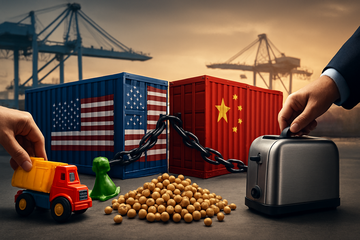
The Trump-Xi summit Sep 25-26 in Washington produced eight points of consensus — but the section the rest of the market is skipping is the 36 pages of tariff-line schedules both sides quietly released Sunday Sep 27-28. The headline number, $60B of reciprocal cuts ($30B each way), is misleading on its own. The real story is in the lists: a tightly curated US basket of 77 tariff codes that targets consumer goods where Chinese factories dominate, paired with a sprawling 1,619-line Chinese basket of US agriculture — a basket that conspicuously excludes soybeans, the largest single US agricultural export to China at $16.2B in 2025.
The two lists are not the same shape — that's the whole point
The US published 77 tariff lines concentrated overwhelmingly in finished consumer goods: small kitchen appliances (coffee makers, toasters, microwaves, electric irons, shavers, flashlights), children's car seats, highchairs and play yards, toys (wheeled toys, dolls, models, puzzles — explicitly excluding RF/WiFi/Bluetooth-connected products), sports equipment (billiards, playing cards, tennis balls, footballs), Christmas decorations, tableware, vacuum flasks, and household scales. The schedule covers roughly 30% of US imports from China based on 2024 trade data, USTR Jamieson Greer said.
China's list is 21x larger at 1,619 lines and reads like a US farm-belt wish list: corn, wheat, sorghum, barley, rice; beef, pork, lamb, poultry and offal; milk, cream, butter, cheese, whey; tuna, salmon, cod, lobster, crab, shrimp; logs, timber and processed wood; cosmetics, tobacco and a deep medical-device category spanning MRI machines, ultrasound systems, surgical robots and pacemakers. The single most telling omission: non-seed soybeans, which the American Soybean Association immediately flagged as a non-starter given the $16.2B2025 trade flow.
The tariff math: ~90% of covered products slide to MFN rates
Neither government published the precise per-line rates, but US officials said about 90% of covered products will move to most-favored-nation (MFN) rates once the cuts take effect. Against an effective US tariff on Chinese goods of roughly 37.5% (12.5% Section 301 forced-labor baseline plus reciprocal and stacked additions, per trade-compliance trackers as of mid-September 2026), that represents a dramatic reset for the affected lines — and aligns with what trade analysts projected even before the deal: a $6B-$17B annual windfall for Chinese vendors of these categories, depending on whether the cuts sweep across the broader consumer-goods basket or stop at the 77 lines.
How US tariff stacks compress Chinese consumer-goods unit values, Jul 2024 → Jul 2026
Declared customs unit values on selected Chinese consumer tariff lines — pre-tariff (Jul 2024) vs latest (Jul 2026). Bigger drop = bigger tariff-driven absorption by the exporter.
Unit: % change
Video game consoles
HTS-10 weighted avg
-67
Upholstered wood seats
HTS-10 weighted avg
-54
Headphones / earphones
HTS-10 weighted avg
-43
Toys (ages 3–12)
HTS-10 weighted avg
-31
Computer monitors
HTS-10 weighted avg
-31
Made-up textile articles
HTS-10 weighted avg
-25
Metal household furniture
HTS-10 weighted avg
-16
Christmas ornaments
HTS-10 weighted avg
-14
The aggregate picture: across roughly 2,550 Chinese consumer-product tariff lines, declared unit values are already 15% below their pre-tariff summer of 2024. That gap is where the 77-line reset reopens pricing power — but only for the categories the White House actually carved out. RF-connected toys, electronics with WiFi/Bluetooth, semiconductors and a long list of strategic goods remain at full stacked rates.
US retailers with deep China sourcing collect the biggest gross-margin tailwind
The five US importers whose China exposure most directly maps onto the 77-line list — small appliances, toys, holiday décor, tableware, children's products — saw their stock narrative dominated by tariff costs over 2025. That framing inverts on Monday.
| Company | Ticker | TTM revenue | China exposure / category fit |
|---|---|---|---|
| Five Below | FIVE | $5.31B | ~60% of merchandise from China; toys, home décor, small appliances — direct77-line overlap |
| Dollar Tree | DLTR | $20.07B | ~40% of sales rely on imports; toys, housewares, seasonal — broad 77-line overlap |
| Target | TGT | $107B+ | Higher China-sourcing share than Walmart per company disclosures; home, toys, seasonal |
| Hamilton Beach Brands | HBB | $610M | Small kitchen appliances (toasters, coffee makers, irons) — pure 77-line play; fell -19% in 2025 tariff shock |
| Funko | FNKO | $933M | Pop-culture collectibles largely China-manufactured; toy sub-list applies |
| SharkNinja | SN | $6.91B | Already moved ~all production out of China; residual MFN benefit on remaining lines |
Five Below is the cleanest expression of this trade. The discount retailer halted China imports in April 2025 when rates peaked at 145% and only resumed them after duties were cut. With about 60% of merchandise sourced from China and toy/home categories covering most of the 77 lines, the MFN reset shifts pricing from absorption back to margin. Dollar Tree is broader: an estimated 40% of sales are import-dependent per analyst notes, and the toy/seasonal/houseware mix matches the US schedule line-for-line.
Hamilton Beach is a pure small-appliance OEM play. TTM revenue of $610M is essentially toasters, coffee makers, irons and kitchen electrics — every product category specifically named in the US list. The stock already took a -19% hit during the 2025 tariff shock; the77-line reset directly addresses the categories that drove that drawdown.
Chinese exporters get a second wind — but unevenly
On the other side of the Pacific, the 77-line reset hands pricing power back to Chinese vendors whose US-bound unit values had been compressed by 14-67% since 2024. The bigger the compression, the bigger the potential rebound.
Midea Group 2025 revenue
RMB 456.4B
+12.1% YoY; 43% overseas, FY2025 results, Apr 2026 filing
Midea overseas e-commerce (OBM) growth
+30% YoY
H1 2025, Midea H1 Press Release, Aug 28, 2025
Joyoung 2025 revenue
RMB 9.61B
Small kitchen appliance OEM/brand, FY2025 results
Pop Mart H1 2026 revenue
RMB 17.17B
+23.8% YoY, ad. net profit RMB 5.16B, H1 2026 interim, Aug 20, 2026
Pop Mart 2025 full-year revenue
RMB 37.12B
+185% YoY, FY2025 results, Mar 2026
Midea Group is the giant in the room but with a footnote: management has repeatedly described its direct US revenue exposure as \"limited\", and overseas growth has tilted toward Europe, the Middle East and self-owned-brand e-commerce — much of it from factories outside China. The 77-line cut benefits Midea mostly via third-party OEM contracts that route through US retailers, not Midea-branded imports.
Joyoung and Bear Electric Appliance are smaller but more directly leveraged to US small-kitchen-appliance shelves. Soy milk makers, blenders, rice cookers and toasters are exactly the categories named in the US schedule. For Pop Mart International Group, the toy sub-list (dolls, models, puzzles) covers the Labubu/blind-box universe — though Pop Mart's H1 2026 deceleration to +23.8% YoY (from +204% in H1 2025) shows that the toy franchise has its own demand story independent of tariffs.
The conspicuous losers: soybean farmers, Hasbro, Mattel
Every asymmetric deal creates losers, and the Sep 27-28 lists leave three clear ones.
- US soybean farmers — China excluded non-seed soybeans from the 1,619-line schedule despite the $16.2B 2025 trade flow. The American Soybean Association publicly objected; this is the single largest US agricultural export to China by value, and it stayed on the sidelines of the carve-out.
- Hasbro and Mattel — both have spent two years diversifying out of China precisely because of tariffs. Hasbro plans to cut China sourcing from 50% to under 40%; Mattel is targeting under 15% of global production in 2026 and 10% in 2027. The 77-line reset rewards companies that stayed exposed; Hasbro and Mattel get less of the benefit because they already paid the diversification cost.
- US-listed toymakers still on China — Funko ($933M TTM revenue, mostly China-made collectibles) keeps full exposure to the toy tariff reset. Spin Master and the remaining private-label makers also fall in this bucket.
There's a fourth, structural loser: the entire electronics/WiFi/Bluetooth toy category, which the US list explicitly excludes. Connected products stay at full stacked rates, which protects US semiconductor and connected-device supply chains but leaves smart-toy makers on the wrong side of the carve-out.
What moves Monday — and what the 2-month truce really means
Treasury Secretary Bessent confirmed the trade truce was extended only two months, to January 10, 2027 — far shorter than Beijing wanted. The 77-line schedule is therefore a temporary, conditional carve-out: if talks break down by mid-January, full stacked tariffs snap back, and the windfall evaporates.
- Days–quarters (immediate): The cleanest plays are pure-China-sourcing US retailers whose stock has been tariff-discounted (Five Below, Dollar Tree) and pure-play small-appliance OEMs (Hamilton Beach). Expect Monday to price the MFN reset into the most exposed names before the Jan 10, 2027 cliff is fully discounted.
- Quarters–1 year: Holiday-season order books for toys and Christmas decorations are already locked — the 77-line reset flows into 2027 cost of goods, not 2026 retail pricing. Watch Q4 2026 retailer earnings for commentary on China sourcing changes and 2027 margin guides.
- 1–3 years (structural): The deal formalizes the U.S.-China Board of Trade, established during Xi's visit. If the Jan 10, 2027 deadline gets extended again, the 77-line carve-out becomes a template for broader sector-by-sector normalization. If it doesn't, the entire schedule unwinds on a known date — a much cleaner risk than the open-ended threat regime of2025.
The base case, and what would break it
Base case: the 77-line MFN reset takes effect on the announced timeline, US retailers report a 100-300bps gross-margin tailwind on impacted categories into FY2027, and the 2-month truce extends into 2027. Risk case: a January 2027 impasse causes the carve-out to lapse, snapping back stacked tariffs on toys and small appliances in time for the 2027 holiday season.
What would break the bull case fastest: a single US-China rhetorical flare-up (Taiwan, fentanyl, AI chip restrictions) inside the 60-day truce window. What would extend it: a clean Bessent–He Lifeng technical agreement in Q4 2026 turning the two-month bridge into a six-month or annual deal.
Stocks to trade on the 77-line carve-out
- About 60% of merchandise sourced from China — direct overlap with the 77-line toy/home/small-appliance basket
- Halted China imports at the April 2025 145% peak; MFN reset removes the operational cliff that forced the pause
- Tuesday Q3 FY2026 print (latest quarter Jul 31, 2026) is the first chance to frame 2027 China sourcing on tariff relief
- ~40% of sales rely on imports; toys, housewares, seasonal categories map onto 77 of the 77 US lines
- Two-year run of $70M-$200M quarterly tariff hits now resets to MFN, freeing FY2027 cost of goods
- Both Dollar Tree and Family Dollar banners overlap with the Christmas-decoration and tableware sub-list
- Pure-play small-appliance OEM — toasters, coffee makers, irons are explicitly named in the US schedule
- Stock fell -19% in the 2025 tariff shock; 77-line reset directly reverses the tariff drag on the cost base
- Top five customers are 62% of revenue — most-favored-nation rates improve margins on every shipped unit
- FY2025 revenue of RMB 456.4B with 43% overseas — world's largest small-appliance exporter by volume
- Direct US revenue exposure described by management as \"limited\"; benefit flows mostly via OEM contracts to US retailers, not Midea-branded imports
- Captures upside from unit-value normalization in the broader small-appliance basket through Q4 2026 order books
- Soymilk makers, blenders, rice cookers are explicitly named in the US small-appliance sub-list
- 2025 revenue of RMB 9.61B with growing overseas footprint — US-bound shipments have been hit by stacked tariffs
- MFN reset restores pricing power on US-bound kitchen-electrics categories over the 2027 order cycle
- Already cutting China sourcing from 50% to under 40% — gets less of the 77-line windfall than stay-exposed peers
- $60M-$70M in 2025-26 tariff costs partially reverse on remaining China-sourced toy volume
- Wizards of the Coast and digital gaming exposure is unaffected; structural growth thesis is intact
- Plans to reduce China share of US imports to <15% in 2026, <10% in 2027 — diversification already paid for
- Q2 FY2026 net loss of $18M (filed Aug 6, 2026) was partly driven by stranded China inventory costs
- 77-line reset becomes the watch catalyst for FY2027 commentary on margin recovery — re-rate if Mattel confirms a $200M+ tariff reversal
- Pop-culture collectibles heavily China-manufactured; toy sub-list applies cleanly
- FY2025 net loss of $67M (filed Mar 12, 2026) reflects full tariff-stack pricing pressure on US-bound shipments
- MFN reset on dolls/models/puzzles is the cleanest cost-of-goods tailwind in the listed-toy space