
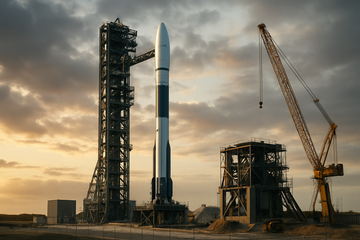
Blue Origin moved New Glenn's return to flight to January 2027, telling staff on Nov. 4 that pad reconstruction at Cape Canaveral ran long; the slip is about 10 days against a December target, and it zeroes out 2026 as a flying year for a rocket that has flown three missions since November 2025. What makes this a cadence story rather than a rocket story is the split in the evidence: the failure analysis is done, while the ground system that has to support dozens of flights a year is still being rebuilt. For investors, the consequence is not about New Glenn's design but about who gets to fly when.
Return-to-flight target
January 2027
CEO Dave Limp's memo to employees, Nov. 4, 2026
Slip versus earlier target
~10 days
Against a December 2026 launch date, reported Nov. 5, 2026
Annual cadence: allowed vs. requested
12 → 50
FAA vehicle operator license VOL24-133 and the Sept. 29, 2026 draft environmental assessment
Florida upper-stage expansion
$330M
Blue Origin announcement, Oct. 16, 2026; up to 150 upper stages a year
Failure analysis
The Rocket Problem Is Solved. The Pad Problem Is Not.
The May 28 failure was narrow: a static fire destroyed the fourth New Glenn vehicle and substantially wrecked LC-36A, and the investigation has traced the root cause partly to a faulty liquid-oxygen main valve in a BE-4 first-stage engine. Blue Origin manufactured the replacement hardware itself and expected it by the end of August. What it has not yet solved is the building, so Blue Origin has effectively traded a rocket problem for a construction problem.
- The blast destroyed the vehicle and much of the pad; debris at LC-36A was cleared in nine days.
- New liquid-oxygen valve hardware was expected by the end of August, and a fresh static fire is required before any launch.
- The same fix reaches a rival's manifest, because BE-4 engines on ULA's Vulcan share the heritage.
- The launch sequence must now run in order: fix, verify, certify, static fire, fly.
This small adjustment doesn't diminish what we've accomplished or the importance of the work still ahead. Returning New Glenn to flight remains our top priority — it's worth it.
Cadence
Nine Months on the Ground Is a Cadence Problem, Not a Calendar Problem
New Glenn: what has flown, what it may fly
Missions achieved since November 2025 against the annual rate Blue Origin's operator license allows and the rate it has asked the FAA to permit.
Unit: launches
Flights achieved, Nov. 2025–Apr. 2026
3
Flights in 2026 to date
1
Authorized annual rate at LC-36A
12
Requested annual rate
50
Three flights in five months, then nothing since April 19, 2026: that is the record the January date has to live with. The gap is not idle time for the constellation operators waiting on slots; it is an interval in which Blue Origin books no New Glenn flight revenue in 2026 while the fixed costs of a new factory, a second pad and a rebuilt tower keep running.
| Date | Event | Why it matters |
|---|---|---|
| November 2025 | New Glenn's first missions fly; a booster is recovered and later reused | Establishes the reuse program and the first launch-services revenue |
| Apr. 19, 2026 | NG-3 lifts off at 7:25 a.m. on a reused booster; the upper stage fails and AST SpaceMobile's BlueBird 7 misses its target orbit | The program's first mission failure and a lost customer payload |
| May 28, 2026 | The next vehicle explodes in a static fire; LC-36A is substantially destroyed | Ground systems, not the flight vehicle, became the binding constraint |
| Aug. 12, 2026 | Blue Origin starts building LC-36B, a second pad for the 9x4 vehicle | Adds capacity while the first pad is rebuilt |
| Sept. 29, 2026 | FAA draft environmental assessment proposes lifting the LC-36A rate from 12 to 50 launches a year | Cadence now waits on a federal decision |
| Oct. 26, 2026 | LC-36A's vehicle access tower is re-assembled; the company still aims for a December flight | Topping out the tower was not the same as being ready to fly |
| Nov. 4, 2026 | Limp tells staff the return to flight moves to January 2027 | Blue Origin will fly zero New Glenn missions in 2026 |
Ground systems
The Real Gate Is a Federal License and a Second Pad
Cadence is now a licensing question. Blue Origin's FAA vehicle operator license caps New Glenn at 12 flights a year at Space Launch Complex 36, and the draft environmental assessment released Sept. 29 proposes lifting that to 50, with the comment period closing Oct. 30 and no decision published. So the company is adding a second pad for the larger 9x4 while the rate that would make two pads meaningful is still pending. Until the license moves, the launch rate stays capped at 12 a year no matter how quickly the tower is finished.
The ground program at a glance
Rebuilt vehicle access tower
~700 feet, nine re-assembled modules
LC-36A, topped out Oct. 26, 2026
Structural steel for the tower
2,500 tons of columns
Formed into 50-by-50-by-50-foot modules, per Blue Origin, Aug. 2026
Debris clearance after the blast
9 days
Reported completion of cleanup at LC-36A
Second pad
LC-36B, for the 9x4 with nine first-stage BE-4s
Construction began Aug. 12, 2026
Upper-stage factory expansion
$330M, up to 150 upper stages a year
Blue Origin, Oct. 16, 2026; due summer 2027
Payload processing facility
Built with the U.S. government
Serves New Glenn variants and national security launch providers
- The 50-per-year case is a manufacturing case: the $330M expansion targets 150 upper stages a year and LC-36B exists to keep two vehicles flying in parallel.
- NASA added the New Glenn 9x4 to its Launch Services II contract on Sept. 29 through an on-ramp clause, with ordering running through June 2030 — agency payloads now queue behind the same pad.
- Blue Origin says it wants multiple New Glenn missions a week by the end of the decade, which on a 50-per-year license is a step change rather than an increment.
- Reported Florida investment of roughly $3 billion means the cadence story is funded by a private balance sheet, not by listed suppliers.
Supply chain
Listed Exposure Sits Upstream of the Vehicle, Not the Pad
The rebuild is Blue Origin's own capital expenditure, and that is where most read-across goes wrong. The steel, concrete and engineering behind LC-36A and LC-36B are largely private work; the listed exposure is to launch-vehicle hardware and launch services, not to pad construction. Karman Holdings makes the point cleanly: its launch-related revenue fell year over year in the very quarter Blue Origin was rebuilding its tower.
| Karman Holdings (krmn) | Q3 2026 | Q3 2025 | Change |
|---|---|---|---|
| Total revenue | $201.6M | $121.8M | +65% |
| Space and Launch segment revenue | $37.9M | $40.7M | -6.9% |
| Funded backlog | $1.67B | $758M | +120% |
| Largest single program as share of sales | Below 11% | Below 11% | Unchanged |
- Karman's IPO filing names Blue Origin's New Glenn and ULA's Vulcan as the launch programs behind its Space and Launch revenue, which reached $92.8M in the first nine months of 2024, up 30.9%.
- United Launch Alliance is the private competitor that absorbs demand when Blue Origin cannot fly, and it flies the same BE-4 lineage, so Blue Origin's valve fix lands on a rival's manifest.
- CSD Structural Engineers, a private structural firm, says it helped build the original Launch Complex 36 — the structure now being re-assembled in modules.
- The U.S. government is an upstream partner: the new payload processing facility is being built with it and will also serve national security launch providers.
Downstream
Amazon Leo and AST SpaceMobile Now Carry the Delay
Two constellation operators have claims on New Glenn's manifest. Amazon Leo contracted 12 New Glenn flights with options for 15 more, inside an 83-launch portfolio that also includes 38 Vulcan and 18 Ariane 6 flights — enough other capacity to absorb some slippage. AST SpaceMobile has fewer options: its BlueBird satellites ride New Glenn under a multi-launch agreement, and BlueBird 7 was lost to a wrong-orbit insertion on the April flight.
| Requirement | Date | Status |
|---|---|---|
| Deploy 1,616 satellites (half of Gen 1) | July 30, 2026 | Missed; limited license waiver granted June 5, 2026 |
| Processing-round priority restored | Earlier of March 30, 2028 or 50% deployed | Temporarily reassigned for satellites deployed after July 30, 2026 |
| Optional acceleration | Oct. 30, 2027 | Available if Amazon certifies satellite construction and procured launches |
| Deploy 3,232 satellites (Gen 1) | July 30, 2029 | Unchanged; the waiver does not extend the final milestone |
| Surety bond | On missing the half-constellation | Requirement not waived |
- AST SpaceMobile's last reported quarter, Q2 2026, produced $31.5M of revenue against a trailing-twelve-month net loss of $618.8M.
- Cash and equivalents stood at $2.29B at June 30, 2026 while trailing free cash outflow ran $1.64B, mostly satellite construction rather than operating losses.
- Every quarter of delay pushes the next BlueBird deployment right and extends the period before service revenue begins.
Read-across
The Read-Across Is Narrower Than the Headline Suggests
The obvious trade is that a grounded New Glenn hands share to other US launchers. The numbers say otherwise. Rocket Lab slipped its own Neutron debut into 2027 on Oct. 14, so the medium-lift window opens for nobody this quarter; and in Q2 2026 its launch services revenue was $44.6M against $189.5M of space systems revenue, with $2.36B of total backlog of which $940.2M sits in launch services. The pad problem at LC-36A is not yet a revenue event for other launch providers.
- Rocket Lab's Neutron first stage tank is targeted for delivery to the pad in Q4 2026, with management describing the year-end launch window as narrowing.
- ULA's Vulcan is the real fallback for Amazon Leo, and it inherits the same BE-4 valve fix — the schedule risk migrates into a private joint venture rather than into listed small-launch names.
- NASA's Sept. 29 on-ramp of the New Glenn 9x4 into Launch Services II means agency payloads can queue for a vehicle whose pad is being rebuilt.
Evidence
Facts, Inferences, and the Unknown That Decides the Story
- Fact: the return-to-flight date moved to January 2027 in a Nov. 4 memo, the May 28 static fire destroyed LC-36A, and the FAA license caps New Glenn at 12 flights a year.
- Fact: the failure analysis points to a liquid-oxygen main valve in a BE-4 engine, and the same fix must be carried onto ULA's Vulcan engines.
- Inference: the binding constraint has moved from the vehicle to the ground system, because the fix path and the rebuild path now run on different clocks.
- Inference: constellation operators carry most of the cost of the delay; launch hardware suppliers carry almost none of it.
- Unknown: whether the FAA grants 50 launches a year, and whether the January static fire passes.
Horizons
What Moves by Year-End, and What Moves by 2029
The next two quarters are about gates, not growth.
- Days to quarters (Q4 2026–Q1 2027): a successful static fire at LC-36A is the gate; until it passes, January is a target, not a schedule.
- The FAA's decision on the 50-per-year rate is the second gate; without it, even a perfect January flight caps the program at 12 a year.
- Amazon has to decide by the October 2027 certification window whether its satellites and launch procurement support the shorter FCC priority timeline.
- AST SpaceMobile's next BlueBird launch slips by at least a quarter, and its cash burn continues through the wait.
The 2027–2029 window is about whether the ground system can carry the ambition.
- One to three years: LC-36B comes online for the 9x4 and the $330M second-stage factory completes in summer 2027 — the path to 50 flights a year runs through both.
- Blue Origin's stated goal of multiple flights a week by the end of the decade needs a 50-per-year license, two pads and a 150-upper-stage factory running at once.
- Amazon Leo's final milestone — 3,232 satellites by July 30, 2029 — is where any launch slip finally becomes a regulatory event rather than an operational one.
- For listed suppliers the payoff window is 2027–2028 order flow, not the January 2027 flight itself.
Where the delay actually shows up in listed stocks
- Karman's IPO filing names Blue Origin's New Glenn and ULA's Vulcan as Space and Launch programs; Blue Origin's 50-per-year request and $330M factory are the order book behind them.
- Space and Launch revenue fell 6.9% year over year to $37.9M in Q3 2026, so any volume payoff is a 2027-plus story, not a 2026 one.
- Over one to three years, two pads and 150 upper stages a year multiply the build rate Karman sells into, while no program exceeds 11% of sales.
- New Glenn is a launch slot AST cannot easily replace: BlueBird 7 already missed its target orbit on the April 19 mission.
- Trailing free cash outflow of $1.64B against $2.29B of cash at June 30, 2026 means each quarter of delay consumes real liquidity.
- Near term the January 2027 window pushes the next BlueBird deployment right by at least a quarter; over one to three years coverage slips against competing broadband constellations.
- Watch the FCC certification: if Amazon certifies construction and procured launches by Oct. 30, 2027, it recovers half-constellation processing priority five months early.
- Twelve contracted New Glenn flights with options for 15 more sit inside an 83-launch portfolio that also includes 38 Vulcan flights, so capacity can be re-routed.
- Trailing capex of $215.2B dwarfs the launch question, but the July 30, 2029 milestone for 3,232 satellites, not a rocket, is what converts delay into penalty.
- Neutron's debut slipped into 2027 on Oct. 14, 2026, so the medium-lift window a grounded New Glenn opens is shut for now.
- Launch services revenue was $44.6M of $234.1M in Q2 2026, and only $940.2M of $2.36B backlog is launch services — the read-across barely touches the P&L.
- Over one to three years a nine-month US heavy-lift gap widens the market Rocket Lab sells into; near term, Neutron's first stage tank reaching the pad in Q4 2026 is the only live milestone.