
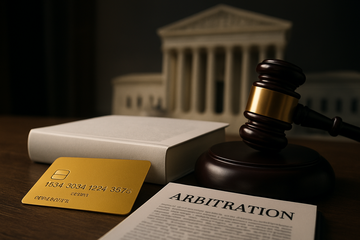
Supreme Court review granted
Nov. 6, 2026
Goldman Sachs Bank USA v. Brown, No. 25-1408; no argument date set
Consumer bankruptcy filings
594,057
Twelve months ended Sept. 30, 2026, up 11.4% year over year
Apple Card portfolio in transition
>$20B
Transition to Chase expected in approximately 24 months — a book Goldman is defending and selling at the same time
Goldman Sachs Q3 2026 net revenues
$18.68B
EPS $17.01; annualized return on common equity 18.7%
The Nov. 6, 2026 grant
The Court Took a Consumer-Stay Case, Not a Counterparty-Default Case
The Supreme Court granted review on Nov. 6, 2026 in Goldman Sachs Bank USA v. Brown, No. 25-1408, and the question it accepted is narrow but consequential: whether a bankruptcy court may override a valid arbitration agreement when the claim is a debtor's Section 362(k) claim for willful violation of the automatic stay. The grant resolves a circuit split the Fourth Circuit opened in March between states that stay-violation claims belong in bankruptcy court and the Second Circuit, which requires them in arbitration.
Two consumers who filed personal bankruptcy in 2023 say Goldman Sachs kept pursuing their card debt after the court had enjoined collection. The bank moved to compel arbitration under the marked clause in their cardholder agreement; the bankruptcy court, the district court and a divided Fourth Circuit panel all said no. The case is about who pays for post-petition collection conduct, not about who owns claims when a bank's counterparty fails — and nothing in the record speaks to dealer balance-sheet capacity, counterparty credit or a claims waterfall among banks.
| Date | Event |
|---|---|
| Jun. 2023 / Nov. 2023 | Rhea Ann Brown files Chapter 13; Gregory Kevin Maze files Chapter 7; both list Goldman card debt |
| Jul. 2024 | Bankruptcy court denies Goldman's motion to compel arbitration |
| Mar. 18, 2026 | Fourth Circuit affirms denial of arbitration, 2-1; Judge King dissents |
| Jun. 16, 2026 | Goldman petitions the Supreme Court for certiorari |
| Jul. 23, 2026 | American Bankers Association files an amicus filing supporting Goldman |
| Nov. 6, 2026 | Supreme Court grants review |
Case file
Petitioner
[Goldman Sachs](gs) Bank USA, which does business as Marcus
Respondents
Rhea Ann Brown; Gregory Kevin Maze
Claim
Willful violation of the automatic stay, 11 U.S.C. § 362(a)(3) and (6)
Relief sought
Compensatory and punitive damages, attorney's fees, injunctive relief under § 362(k)
Class alleged
All U.S. consumers in or formerly in bankruptcy who received a post-petition demand for pre-petition debt (Fed. R. Bankr. P. 7023)
Clause in dispute
Marked arbitration provision in the Apple Customer Agreement, claims to be resolved individually, no class joins
Panel below
Fourth Circuit, 2-1; the dissent argued the Second Circuit requires arbitration of stay claims
The asset in the case
Goldman Is Defending the Arbitration Clause in a Book It Is Handing to Chase
The clause Goldman Sachs is defending did not come from a Goldman card agreement. The bank's own petition states that the two debtors signed the Apple Customer Agreement, which contains the marked arbitration provision governing claims against the card issuer. On Jan. 7, 2026, Goldman Sachs announced an agreement to transition the Apple Card program and associated accounts to JPMorgan Chase, expected to take approximately 24 months, with Goldman continuing to operate the program until it completes. A bank is asking the Court to lock in the enforceability of a clause on a portfolio it has agreed to hand to a competitor.
Platform Solutions net revenues, $ millions
Platform Solutions net revenues collapsed from $610 million in Q1 2025 to $170 million in Q3 2026 as the Apple Card portfolio was marked down and moved to held for sale.
Unit: $ millions
Q1 2026
411
Q2 2026
221
Q3 2026
170
| $ millions | Q3 2026 | Q3 2025 | 9M 2026 | 9M 2025 |
|---|---|---|---|---|
| Net revenues | $170 | $598 | $802 | $1,827 |
| Provision for credit losses | $0 | $286 | $1 | $796 |
| Operating expenses | $265 | $334 | $869 | $1,023 |
| Pre-tax earnings (loss) | $(95) | $(22) | $(68) | $8 |
| Net earnings (loss) to common | $(80) | $(26) | $(71) | $(16) |
- Goldman Sachs is monetizing the book it is litigating over: the Apple Card loan portfolio moved to held for sale in Q4 2025, and the resulting net markdowns cut segment net revenues 72% year over year to $170 million in Q3 2026.
- The consumer credit engine has stopped absorbing losses: Platform Solutions posted a pre-tax loss of $(95) million in Q3 2026 against $(22) million a year earlier, and a $(71) million loss for the first nine months.
- Because the program moves to JPMorgan Chase, the successor issuer inherits the cardholder agreements and the collection practices that generate stay-violation claims. Goldman's conduct stays behind; the portfolio does not.
- Goldman's petition cites more than 530,000 nonbusiness bankruptcy petitions filed in fiscal2025 as the scale of the dispute it wants to keep in arbitration.
The economics of the fight
Arbitration Caps the Bill for Banks; Section 362(k) Is a Deterrence Machine
Two legal regimes sit behind the case. Section 362(k) lets a debtor who proves a willful stay violation recover the greater of $5,000 or actual damages, plus attorney's fees, with punitive damages available; the statute exists to make ignoring the stay expensive. Arbitration does the opposite for the creditor: it forces the debtor into an individual forum, and the clause Goldman relies on bars class arbitration outright. Goldman is asking the Court to keep the cost of sloppy post-petition collection capped at individual claims, and the Fourth Circuit's majority answered no, reasoning that arbitration would send the statute's deterrent effect into the dark.
| If the Court rules for Goldman | If the Court rules for the debtors | |
|---|---|---|
| Forum for stay-violation claims | Private arbitrator; claims decided one at a time | Bankruptcy court; the debtor's own forum |
| Class exposure | Blocked by the clause's no-class-join terms; the Rule 7023 class left open below collapses | Open: a putative class of every consumer filer who received a post-petition demand |
| Cost driver for issuers | Per-claim defense cost, capped and predictable | Class defense and settlement cost, sized by a claimant pool of 594,057 consumer filings |
| Most exposed | Consumer plaintiffs' bar | Card issuers, debt buyers, and the bureaus that carry their reports |
It was not her job to call his bankruptcy counsel, but it was his job to pay his bills.
The cycle underneath
The Claimant Pool Is Growing While Charge-Offs Fall
The Supreme Court is being asked to price a legal regime in a consumer-credit market that is healing on charge-offs and deteriorating on filings. Consumer bankruptcy filings reached 594,057 in the twelve months ended Sept. 30, 2026, up 11.4% from the prior year, while the seasonally adjusted charge-off rate on credit card loans at all commercial banks fell to 3.82% in Q2 2026 from 4.19% a year earlier. A falling loss rate alongside a rising filing count points to distressed borrowers staying on the books — exactly the population that files bankruptcy and then receives post-petition collection calls.
Charge-off rate on credit card loans, all commercial banks
Seasonally adjusted, annualized. Federal Reserve charge-off release data, published quarterly.
Unit: % of balances, annualized
Q2 2025
4.2%
Q3 2025
4.2%
Q4 2025
4.1%
Q1 2026
3.8%
Q2 2026
3.8%
| Issuer | Net charge-off rate | Comparison |
|---|---|---|
| Synchrony Financial | 4.79% | 5.16% a year earlier; 6.06% in Q3 2024 |
| Capital One | 4.01% | Total credit card net charge-off rate, Q3 2026 |
| All commercial banks (Federal Reserve) | 3.82% | Q2 2026, seasonally adjusted, down from 4.19% |
- Synchrony Financial is the cleanest read on the exposure: a 4.79% net charge-off rate in Q3 2026 on a trailing return on equity near 20% makes litigation cost, not credit, the swing factor.
- Capital One runs the same clause architecture at larger scale, earning $3.5 billion in Q3 2026 with a 4.01% card charge-off rate.
- The American Bankers Association's amicus filing puts more than half of all cardholders under an arbitration agreement, so the clause at issue is the market standard, not a Goldman innovation.
- Scale of the claimant pool, three ways: more than 530,000 nonbusiness petitions in fiscal 2025 per Goldman's own petition; more than 565,000 in the year ending March 31, 2026 per the bankers' association; 594,057 consumer filings in the twelve months ended Sept. 30, 2026.
The chain
The Exposure Runs From Apple's Agreement to Chase's Book and the Bureaus' Screens
Trace the chain and this stops looking like a two-debtor dispute. Upstream, Apple wrote the agreement containing the clause; Goldman Sachs was only the issuer standing behind it. The conduct at issue runs through the credit-reporting screens: Goldman Sachs told both debtors that their accounts might be reported as charged off to the credit bureaus, which is how a post-petition collection attempt becomes a permanent credit-record injury. That is why the decision lands on the bureaus as much as on the issuers, and why the successor issuer matters.
- Upstream — Apple: the litigated clause sits in the Apple Customer Agreement, and Apple and JPMorgan Chase announced on Jan. 7, 2026 that Chase becomes issuer of the Apple Card in approximately 24 months.
- Upstream — Equifax and TransUnion: the reporting channel named in the complaint, whose furnishers' obligations change if post-petition reporting is ruled unlawful.
- Downstream — JPMorgan Chase: takes over a card portfolio of more than $20 billion and the collection practices attached to it.
- Downstream — Synchrony Financial and Capital One: carry the same marked arbitration architecture on charge-off rates of 4.79% and 4.01%.
Statutory damages per willful stay violation
$5,000
Greater of $5,000 or actual damages, plus attorney's fees, under 11 U.S.C. § 362(k)
Platform Solutions net revenues
$170M
Q3 2026, down 72% from $598M a year earlier
Platform Solutions pre-tax result
$(95)M
Q3 2026, against $(22)M in Q3 2025
Equifax USIS revenue
$599.1M
Q3 2026, up 13% year over year
TransUnion revenue
$1,312M
Q3 2026, up 12%; net income $242M
Goldman litigation and regulatory provisions
$23M
Q3 2026, down from $131M a year earlier
For the bureaus, the effect is a servicing problem rather than a revenue problem. Equifax grew USIS revenue 13% to $599.1 million in Q3 2026 and TransUnion grew total revenue 12% to $1,312 million, driven by volumes that have nothing to do with consumer disputes. A ruling that makes reporting a post-petition charge-off a stay violation would let furnishers demand recalls and corrections of consumer records. Expect dispute volume, not lost fee revenue — that inference follows from the reporting channel in the record, and it is not something the bureaus have quantified.
Horizons
What Moves in Quarters, and What Moves in Years
Nothing in Goldman Sachs's reported numbers moves on this case. Third-quarter net revenues were $18.68 billion, earnings per share were $17.01 and the annualized return on common equity was 18.7%, while the firm's litigation and regulatory provisions were $23 million, down from $131 million a year earlier. The ruling is a legal-regime event, not an earnings event, so the near-term trading surface is the consumer-credit complex and the argument schedule, not Goldman.
- Next two quarters — argument calendar: review was granted on Nov. 6, 2026 with all filings in, no date set, and the matter listed for argument in the current term.
- Next two quarters — segment run-rate: Goldman Sachs's fourth-quarter results are the first clean look at Platform Solutions after the Apple Card portfolio left the balance sheet; $170 million of net revenues and a $(95) million pre-tax loss are the baseline.
- Next two quarters — claimant pool: the twelve-month consumer filing count, 594,057 through Sept. 30, 2026, is the size of the potential plaintiff pool for any issuer.
- Next two quarters — copycats: if bankruptcy courts can hear stay-violation claims as classes, other issuers with marked arbitration clauses become targets, and the first motion to compel in a competing case would be the signal.
- One to three years — the transition completes roughly24 months from Jan. 7, 2026, moving issuance of the Apple Card program to JPMorgan Chase and relocating the collection-conduct question to a different balance sheet.
- One to three years — class certification, not the Goldman litigation, is where the value lands: individual claims carry a $5,000 statutory floor, but a certified class covering every consumer filer who received a post-petition demand resets the cost of the regime for every issuer.
- One to three years — a decision for Goldman Sachs hardens arbitration as the standard US consumer-credit template and slows the plaintiff bar's bankruptcy-court strategy; a decision for the debtors pushes more disputes into the one forum the plaintiff bar already knows how to use.
Falsifiers
What Would Break This Thesis
The likeliest way to be wrong here is a narrow ruling. The record gives the Court an easy path to resolve the case on these facts rather than on the general question: Goldman argues that Maze's Chapter 7 was closed and Brown's Chapter 13 plan confirmed before the motion to compel was filed, so arbitration could not interfere with either estate — a point Judge King pressed in dissent. A ruling on those facts leaves the industry regime untouched.
- No class: even a loss for Goldman Sachs leaves individual claims capped at the greater of $5,000 or actual damages, which may be too small to attract class counsel.
- A shrinking book: Goldman Sachs's Apple Card portfolio is already held for sale, so the number of affected accounts keeps falling regardless of the outcome.
- A healing cycle: industry card charge-offs fell to 3.82% in Q2 2026 from 4.19% a year earlier and Synchrony Financial's rate fell to 4.79% from 5.16%; fewer distressed accounts means fewer stay-violation claims.
- Filings turning: the 11.4% increase in consumer filings is the single input most likely to reverse if the labor market softens or credit tightens, which would shrink the claimant pool again.
- A different clause: the case concerns the Apple Customer Agreement provision; a decision about that clause does not automatically govern every issuer's card agreement language.
Where the precedent actually lands
- Q3 2026 net revenues of $18.68 billion, $17.01 EPS and 18.7% annualized ROE leave this case immaterial to the earnings that set the multiple.
- Platform Solutions, the segment holding the card programs, lost $95 million pre-tax in Q3 2026, so the litigation attaches to a runoff asset.
- Over one to three years, a win for Goldman hardens arbitration as the default US consumer-credit template, a modest positive for the retained card book.
- Catalyst: Chase takes over the Apple Card program in roughly 24 months from the Jan. 7, 2026 announcement, so around early 2028.
- The litigated clause sits in Apple's own customer agreement, making Apple's contract terms the upstream variable that decides which issuers inherit it.
- Apple's card credit exposure leaves with the program, so this is a legal-footprint question for Apple rather than a credit one.
- Chase inherits a portfolio of more than $20 billion and the collection practices that produce stay-violation claims.
- Scale absorbs the conduct risk: at JPMorgan Chase's size, the inherited book prices below any level that moves firm earnings.
- Over the next two years the transition, not the Supreme Court, changes JPMorgan Chase's consumer card economics.
- Loses its cheapest defense if bankruptcy courts can override arbitration clauses, because a class spanning every consumer filer who received a post-petition demand escapes the clause's no-class-join terms.
- A 4.79% net charge-off rate in Q3 2026, down from 5.16%, means credit is not the risk; litigation cost is.
- Over one to three years, a ruling for the debtors forces peer issuers to reserve for class defense while filings run 11.4% higher.
- Watch the Court's argument date and the first class certification motion in the bankruptcy case.
- Carries the same clause architecture at larger scale, with a 4.01% card net charge-off rate and $3.5 billion of quarterly net income absorbing what a class defense would cost.
- A growing card book inside a falling industry charge-off rate of 3.82% expands the pipeline of accounts that could join a stay-violation class.
- Over one to three years the exposure shows up as a reserve and disclosure item rather than an earnings event.
- USIS revenue of $599.1 million in Q3 2026, up 13%, shows bureau demand is driven by mortgage and non-mortgage volumes rather than card disputes.
- Carries furnishing-remediation cost, not revenue risk, if courts hold that reporting a post-petition charge-off violates the automatic stay and require recalls.
- Short term, watch dispute and correction volumes after the ruling; longer term, tighter furnishers are a modest servicing opportunity.
- Third-quarter revenue of $1,312 million, up 12%, with $242 million of net income, keeps the reporting franchise growing through the case.
- Gains remediation workload without matching revenue, because recalled post-petition reports are servicing cost rather than fee income.
- Watch whether card and banking growth decelerates as issuers tighten post-petition reporting policies.