
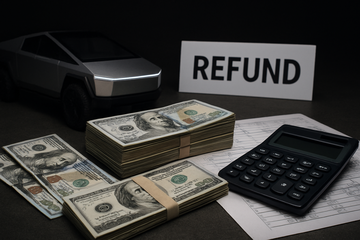
Two announcements in four days reset Tesla's truck business. On Nov. 6 Elon Musk said Cybertruck production at Gigafactory Texas winds down around mid-2027 to make room for Cybercab; on Nov. 9 he said Tesla \"will have to return deposits for a lot of people\" while adding a shift to fill what orders it can before the line dies.
The deposit refund is not the story. The cash is large relative to a $1,000 deposit and trivial relative to $45.4B of cash and short-term investments. What the shutdown does create is a first-time refund obligation on a model that sold 20,237 units in 2025 on a line built for 250,000 — a write-down nobody has sized yet, bolted onto a balance sheet already funding a roughly $20B capital program.
Cash and short-term investments
$45.4B
Q3 2026 balance sheet, as of Sept. 30, 2026
Customer deposits
$1.88B
Accrued liabilities note, Sept. 30, 2026, up from $1.31B at Dec. 31, 2025
Q3 2026 free cash flow
$1.53B
Q3 2026, reported Oct. 21, 2026
2026 capital spending plan
~$20B
Guidance as of Oct. 21, 2026, cut from a plan above $25B in April 2026
Cybertruck units sold in 2025
20,237
Kelley Blue Book tally, versus 38,965 in 2024
Cybertruck nameplate capacity
250,000/yr
Giga Texas line, of which roughly one-tenth has been sold
Nov. 6-9, 2026
Tesla Retimed a Factory Line and Made Its Own Order Book Refundable
Tesla's shutdown is a capacity decision dressed as a product decision. Musk's stated reason for ending the Cybertruck is that the truck's order rate \"far exceeds\" what the line can build, and that the Texas line is needed for Cybercab expansion around June or July 2027. So the company is shutting a line that sold about one-tenth of its nameplate in order to run a different program on the same real estate.
That is the opposite of a demand collapse being papered over. It is management choosing which product gets the capital — and choosing the one whose revenue is not yet in the income statement.
- Nov. 6, 2026: Tesla confirms Cybertruck production ends at Giga Texas around mid-2027 to free capacity for increased Cybercab output.
- Nov. 6, 2026: US prices rise up to 10% and the base Dual Motor AWD trim stops taking new orders the same day.
- Nov. 9, 2026: Musk says Tesla \"will have to return deposits for a lot of people\" while working an extra shift to build what it can before the line stops.
- Late 2027: the line is dismantled for Cybercab expansion around June or July, with Tesla running a night shift to clear the order book first.
We will try to make as many as possible before shutting down the line in about 8 months, but will have to return deposits for a lot of people.
Sizing the exposure
The Refund Is a Rounding Error; the Write-Down and the Warranty Tail Are Not
Customer deposits are the liability a refund would draw down, and they stood at $1,881M at Sept. 30, 2026 against $1,311M at the end of 2025 — cash Tesla collected from customers that it now has to hand back to some of them. Even in the extreme case of refunding every dollar of that balance at once, Tesla would return 4.1% of its $45.4B cash pile and give up 57% of trailing free cash flow of $3,303M. The Cybertruck slice of that balance is smaller than the whole of it.
So the refund does not constrain anything. Tesla has not disclosed how many orders it will refund, and it is worth assuming the number is large: with an order rate that exceeds build rate, an eight-month run-out and a line that has built roughly 71,000 trucks since 2023 against Cox Automotive's sales tally, the book of undelivered orders is plainly bigger than the remaining build.
| Scenario | Basis | Cash out | % of $45.4B cash | % of $3.3B trailing FCF |
|---|---|---|---|---|
| 25,000 deposits | 25,000 orders at the $1,000 deposit | $25M | 0.06% | 0.8% |
| 100,000 deposits | 100,000 orders at the $1,000 deposit | $100M | 0.22% | 3.0% |
| Entire deposit balance | Every dollar of Tesla's customer deposits | $1.88B | 4.1% | 57% |
| 10,000 fully paid trucks | 10,000 units refunded at the $92,490 list price | $925M | 2.0% | 28% |
| 25,000 fully paid trucks | 25,000 units refunded at the $92,490 list price | $2.31B | 5.1% | 70% |
Working capital, not the deposit, is where the shutdown bites. Accrued liabilities and other current liabilities reached $17,205M, up $3,926M from Dec. 31, 2025, with customer deposits inside that line up $570M — money in hand that Tesla may have to return. Inventory rose $1,700M over the same period to $14,092M, and that is where unsold Cybertrucks sit before anyone takes a write-down. Accrued warranty reserves climbed to $10,138M from $8,075M a year earlier.
Pricing
A 32% Price Hike the Day Before the Refunds Is Harvesting, Not Demand
Tesla raised US Cybertruck prices on the same day it announced the shutdown, and stopped taking orders for the base trim. The base Dual Motor AWD moved from $74,990 to $82,490 and closed to new orders; Premium AWD went from $84,990 to $92,490; Cyberbeast from $99,990 to $102,490. The cheapest Cybertruck a customer can still order is therefore $92,490, up 32% from $69,990 in early August.
Read it as harvesting, not demand. With a line that dies in June or July 2027, every unit still sellable is worth more at a higher price; a 32% higher new price also props up the used market that the deposit refunds will feed. Tesla is pricing to clear inventory and protect residuals, not because it has suddenly found pricing power.
| Trim | Early Aug. 2026 | After Aug. hike | Nov. 6, 2026 | Change vs. August | New orders |
|---|---|---|---|---|---|
| Dual Motor AWD | $69,990 | $74,990 | $82,490 | +$12,500 (+17.9%) | Closed |
| Premium AWD | $79,990 | $84,990 | $92,490 | +$12,500 (+15.6%) | Open |
| Cyberbeast | $99,990 | $99,990 | $102,490 | +$2,500 (+2.5%) | Open |
| Cheapest orderable | $69,990 | — | $92,490 | +$22,500 (+32.2%) | Open |
Unit economics
The Truck's Economics Died Before the Truck Did
The margin arithmetic behind the shutdown is visible in the Q3 statements. Research and development rose $1,131M year over year to $2,761M while gross profit rose only $440M to $5,494M, and operating income fell to $718M from $1,624M on flat revenue of $28,046M. Tesla is spending on autonomy at a rate the car business cannot cover.
Against that, 20,237 trucks sold in 2025 at list prices up to $92,490 is roughly $1.9B of gross billings, under 2% of the $103.6B trailing revenue. A business that small, running at about 8% of its nameplate, cannot carry its share of a $2.8B quarterly research bill. The Cybertruck did not die because customers stopped loving it; it died because its margin stopped covering the cost of Tesla's priorities.
Giga Texas nameplate versus what the Cybertruck actually sold
Nameplate capacity of the Giga Texas Cybertruck line against annual and cumulative sales. Tesla sold roughly one-tenth of the line's rated capacity.
Unit: units
Line nameplate
Rated units per year
250,000
Sold in 2024
Kelley Blue Book tally
38,965
Sold in 2025
Kelley Blue Book tally
20,237
Sold since 2023
Cox Automotive estimate, roughly
71,000
- Automotive gross margin held at 18.5% in Q3 2026 while operating income fell 56% year over year to $718M.
- Energy generation and storage revenue of $2,881M on 13.7 GWh deployed is now the profit engine, with energy gross margin at 33.1%.
- Robotaxi rides started in Austin on Sept. 3; unsupervised miles grew eightfold quarter over quarter and the Austin fleet grew tenfold since launch.
- Optimus is targeted at 20,000 units per week within about a year, with AI5 integration planned for around April 2027.
Cash and capex
The Refund Will Never Compete With Robotaxi Money, but the Cash-Flow Math Will
Tesla's quarterly capital spending
Capital expenditure by quarter. Tesla spent more than operating cash flow in Q2 2026, the quarter that produced negative free cash flow.
Unit: US$ millions
Q1 2025
Free cash flow $664M
1,492
Q2 2025
Free cash flow $146M
2,394
Q3 2025
Free cash flow $3,990M
2,248
Q4 2025
Free cash flow $1,420M
2,393
Q1 2026
Free cash flow $1,444M
2,493
Q2 2026
Free cash flow -$1,092M
5,789
Q3 2026
Free cash flow $1,531M
4,732
Tesla cut its 2026 capital spending plan to about $20B on Oct. 21, from a plan above $25B announced in April, and said the program would be funded primarily from operating cash flow, with capacity to borrow up to $30B secured. Nine-month capital spending of $13,014M has already pushed nine-month free cash flow down to $1,883M from $4,800M a year earlier, and trailing free cash flow stands at $3,303M against trailing operating cash flow of $18,710M.
Reaching the roughly $20B guide therefore requires roughly $7.0B of Q4 capex, about 48% above Q3's $4,732M and well above the $3,813M of operating cash flow Tesla generated in Q4 2025. That is the tension worth watching, and the deposit refund is nowhere near it.
Tesla's funding stack behind the robotaxi and Optimus build
Cash and short-term investments
$45.4B
Sept. 30, 2026
2026 capex plan
~$20B
Revised Oct. 21, 2026
Secured borrowing capacity
Up to $30B
Disclosed on the Q3 2026 call
Trailing operating cash flow
$18.7B
Twelve months through Sept. 30, 2026
Trailing free cash flow
$3.3B
Twelve months through Sept. 30, 2026
Nine-month 2026 free cash flow
$1.88B
Versus $4.80B a year earlier
Upstream
Upstream, the Contracted Money Is Cells and Actuators — Not Truck Steel
The capital Tesla is redirecting lands on specific suppliers, and they are the ones attached to storage and robots rather than to a pickup body. Storage is the funding engine: energy revenue of $2,881M in Q3 2026 on 13.7 GWh deployed, with Megapack nearly sold out through 2027. The 33.1% energy gross margin, up from 20.4%, was flattered by tariff refunds and cell warranty reimbursements, so the quality of that margin deserves a discount.
On the robot side, Tesla has been auditing actuator candidates. Bloomberg reported Tesla auditing Chinese robotics suppliers including Tuopu Group and Sanhua Intelligent Controls for Optimus production, and Teslarati reported those audits including Joyson Electronics, alongside an initial 5,000-unit order. LG Energy Solution separately signed a $4.3B agreement, confirmed by the US government in March 2026, to supply LFP cells for Tesla's Megapack 3 from 2027 through 2030.
- LG Energy Solution holds a $4.3B cell agreement with Tesla covering Megapack 3 output from 2027 to 2030.
- Tuopu Group and Sanhua Intelligent Controls were audited by Tesla as Optimus mass-production partners, with an initial 5,000-unit order reported.
- Megapack inventory is nearly sold out through 2027, which is why storage — not vehicles — is funding the capex.
Downstream
Downstream, the Vacuum Goes to Hybrids, While Rivian and the Used Market Absorb the Damage
The demand Tesla vacates does not vanish; it changes form. Ford's third quarter produced $49.5B of revenue and $2.7B of adjusted EBIT while US sales slipped 6.6% to 509,764 vehicles, and its Maverick Hybrid set a third-quarter record at 27,793 trucks, up 59.6% — hybrids are absorbing the pickup demand that no longer goes electric. Ford had already killed the F-150 Lightning. General Motors took $50.0B of revenue, $4.1B of EBIT and $3.3B of net income, up 151%, even as US EV sales collapsed 62% to 25,213 units and it booked a $238M EV realignment charge.
Rivian is the cleanest casualty of the read-through. It shipped 19,248 vehicles for $2.155B of revenue with $176M of gross profit and burned $1,124M of free cash flow in Q3, ending with $5,502M of cash, and its own best-seller is now the R2 crossover rather than the R1T truck. Tesla's exit is the sector admitting that electric pickups do not scale.
| Model | End of production | Used price change | Average used price | Market benchmark |
|---|---|---|---|---|
| Model X | 2026 | +17.5% | $60,950 | All used cars -1.3% |
| Model S | 2026 | +13.1% | $52,787 | All used cars -1.3% |
| Cadillac CT5 | End of 2026 model year | +10.5% | $36,613 | All used cars -1.3% |
| Chevrolet Camaro | Dec. 2023 | +8.4% | $34,994 | Used gas cars -4.4% |
| Ford F-150 Lightning | Dec. 2025 | +4% | About $50,000 | No comparable source |
| Chevrolet Malibu | Nov. 2024 | -3.1% | $18,619 | All used cars -1.3% |
| Ford Escape | Dec. 2025 | -3.8% | — | All used cars -3.8% |
| Chevrolet Bolt EV | Dec. 2023 | -18.3% | $17,863 | Used EVs about -25% |
The Cybertruck's used-market problem is not the shutdown; it is that the order book, the fleet and the price floor all move at once. Kelley Blue Book values a 2026 all-wheel-drive Cybertruck at $73,600 resale and $69,800 trade-in, against roughly $8,002 of average annual depreciation and about $40,014 of depreciation over five years. A wave of cancelled orders would push trucks into the channel Tesla itself uses to sell used cars, and the pre-emption is a 32% higher new-vehicle price.
Horizons
Two Quarters to Test the Math, Three Years to Test the Thesis
- Q4 2026 results and the 10-K: watch the customer-deposit line for a refund accrual and inventory for a Cybertruck charge.
- Cash test: hitting the roughly $20B capex guide needs about $7.0B of Q4 capex, 48% above Q3's $4,732M, funded from operating cash flow.
- Residual marks: used Cybertruck auction prices and Tesla's own certified pre-owned inventory show whether the 32% hike holds the used market.
- Robotaxi proof points: Dallas service launch, the Austin fleet ramp, and unsupervised miles off the Sept. 3 start.
- The refund clock itself: about eight months of build left, with a night shift added before the June or July 2027 line changeover.
| Milestone | Window | What it settles |
|---|---|---|
| Giga Texas retooled for Cybercab | June-July 2027 | Whether the freed truck line converts into robotaxi volume |
| Optimus at 20,000 units per week | Within about a year of Oct. 2026 | Whether audited actuator capacity turns into real orders |
| AI5 silicon in production | Around April 2027 | The compute roadmap behind the R&D step-up |
| Megapack 3 cell deliveries begin | 2027 | Whether storage cash flow keeps funding the build |
| Cybertruck used values settle | 2027-2028 | Whether roughly 71,000 trucks clear near $70,000 or lower |
| Q4 2026 free cash flow | January 2027 | Whether the refund and the write-down land in a cash-flow quarter that can absorb them |
The bottom line for investors: the Cybertruck shutdown is a small, tidy capital reallocation wrapped in a large, scary headline. Tesla gives up a truck line that never covered its share of the research bill, frees Giga Texas for robotaxi production, and refunds deposits it can afford to refund. What it does not give up is the obligation to fund roughly $20B of annual capital spending with $18.7B of trailing operating cash flow, an $14.1B inventory book, and a warranty reserve that keeps compounding on a fleet whose newest member is being retired.
Watch the write-down, the Q4 cash flow and the used-Cybertruck marks. The deposit refund is noise; the inventory and warranty consequences of killing a model with11 recalls and 71,000 trucks on the road are not.
Where the Cybertruck exit actually transmits
- Refunding the entire $1.88B customer-deposit balance equals 4.1% of $45.4B cash and 57% of trailing free cash flow of $3,303M.
- Nine-month free cash flow of $1,883M versus $4,800M a year ago leaves a roughly $20B capex plan leaning on operating cash flow and up to $30B of borrowing.
- A Cybertruck inventory write-down above roughly $1B, or a Q4 customer-deposit accrual, would be the first hard signal that the exit costs more than it saves.
- Over one to three years, 20,000 Optimus units a week and AI5 around April 2027, not the truck, set the multiple.
- Ford already exited electric pickups with the F-150 Lightning, so Tesla's departure leaves no electric-truck rival to defend.
- Maverick Hybrid sold a third-quarter record 27,793 trucks, up 59.6%, as hybrids absorb the pickup demand Tesla vacates.
- Q3 2026 revenue of $49.5B and adjusted EBIT of $2.7B grew even as US sales fell 6.6% to 509,764 vehicles.
- Longer term, used F-150 Lightning prices rose about 4% after its discontinuation, showing scarcity can beat share.
- Q3 2026 net income of $3.3B, up 151%, and EBIT of $4.1B were earned while US EV sales fell 62% to 25,213 units.
- A $238M EV realignment charge shows the retrenchment is deliberate, leaving Silverado and Sierra hybrids to take the pickup demand.
- The mirror risk is the one Tesla took: GM is also shrinking EV capacity rather than fighting for electric pickups.
- Rivian burned $1,124M of free cash flow in Q3 on $2,155M of revenue and $176M of gross profit, with $5,502M of cash left.
- Tesla's exit is the sector admitting electric pickups do not scale: 20,237 units sold in 2025 against a 250,000 nameplate.
- Its own best-seller is now the R2 crossover, so the R1T's addressable niche is smaller than the segment Tesla abandoned.
- Used Cybertruck supply at a $69,800 trade-in sets a lower anchor for used electric pickup values.
- Carvana sold a record 217,385 used vehicles in Q3 2026, up 39%, but gross profit per unit slipped $365 to $6,997.
- Cheaper used EVs should lift unit volumes, so a Cybertruck resale wave is a margin question rather than a demand question.
- Catalyst to watch: Tesla's certified pre-owned liquidation of unsold Cybertrucks and the first gross profit per unit print that includes them.
- LG Energy Solution locked a $4.3B LFP cell agreement running 2027 to 2030 for Tesla's Megapack 3.
- Tesla's storage arm generated $2,881M of Q3 2026 revenue on 13.7 GWh deployed and is nearly sold out through 2027.
- The risk sits on Tesla's side of the margin: the 33.1% energy gross margin was lifted by tariff refunds and warranty reimbursements.
- Tesla audited Tuopu Group as an Optimus mass-production partner and placed an initial 5,000-unit order.
- Optimus targets 20,000 units a week within about a year, and the freed Giga Texas line releases capital for that ramp.
- The order book is early: a 5,000-unit trial is a fraction of Tesla's roughly $20B 2026 capex, so nomination and volume awards remain the catalyst.
- Sanhua Intelligent Controls was audited by Tesla for Optimus production alongside Tuopu and Joyson Electronics.
- Actuator content per robot is what turns a 20,000-unit-per-week Optimus target into real supplier revenue.
- Watch the timing: AI5 integration around April 2027 and external Optimus deliveries around end-2027 set the volume window.