
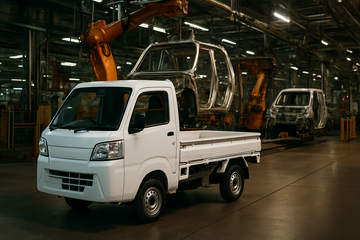
Toyota's mini truck is not a truck in the American sense, and it is not a $30,000 assault on Ford's profit pool. It is a right-hand-drive, 25-mph vehicle with a 600-pound payload, built in Princeton, Indiana, for $34 million and about 50 jobs, and it goes to fleets first through a brand Toyota retired in 2016. Toyota is buying a tariff bypass rather than a truck market, and the announcement says more about how Japanese automakers now answer a tariff wall than about Ford's profits.
Announcement date
Nov 10, 2026
Toyota USA Newsroom, Scion by Toyota brand and KEI-01
Plant investment
$34M
Toyota Motor Manufacturing Indiana, plus about 50 new jobs
On sale
2H 2027
Assembly starts in Princeton, Indiana
Top speed
25 mph
FMVSS No. 500 low-speed-vehicle limit
Payload
600 lb
Car and Driver specification for the KEI-01
Toyota North America operating income
¥166.1B
Half-year to Sept 30, 2026, against a ¥192.5B operating loss in FY2026
The announcement
Toyota Is Selling a 25-Mph Vehicle, Not a Small Pickup
Everything that matters about this vehicle is in its regulatory class rather than its sheet metal. Toyota's own release says the KEI-01 is a right-hand-drive vehicle designed to comply with FMVSS No. 500, the federal safety standard for low-speed vehicles, and that it is assembled in Indiana from the second half of 2027 and sold first through a fleet-focused pilot run by Scion by Toyota dealers drawn from the existing Toyota network. The program is deliberately small, deliberately cheap, and deliberately legal.
| Specification | KEI-01 as announced |
|---|---|
| Price in the US | Not disclosed; Car and Driver estimates $28,000 |
| Length and width | Just over 11 ft long, under 5 ft wide |
| Top speed | 25 mph, the FMVSS No. 500 low-speed-vehicle limit |
| Payload | Up to 600 lb |
| Powertrain | 660 cc three-cylinder, CVT, selectable four-wheel drive |
| Cab and bed | Extended cabin with raised roofline, three-way fold-down cargo bed |
| Production | Toyota Motor Manufacturing Indiana, Princeton, from 2H 2027 |
| Channel | Fleet pilot through Scion by Toyota dealers drawn from the Toyota network |
| Program cost | $34 million and about 50 new jobs |
- Toyota says the vehicle is intentionally low-volume and niche, and that limited retail sales may follow the fleet pilot depending on market conditions and demand.
- The brand is the shell, the channel is the asset: Scion by Toyota is described as a \"freedom lab,\" and its pilot dealers are selected from the existing Toyota dealer network.
- Two concept vehicles, the SxS and BKE, were shown alongside the KEI-01, which points to a multi-vehicle programme rather than a one-off truck.
- The powertrain is a 660 cc three-cylinder with a CVT and selectable four-wheel drive, a close relative of the kei hardware Toyota has sold in Japan since December 2011 as the Pixis.
The premise
The $30,000 Figure Belongs to a Different Truck
The number that has been circulating for Toyota's small truck, about $30,000, came from Motor Trend's estimate for a separate 2028 compact pickup that has never been confirmed for the US. The KEI-01 is a different vehicle in a different legal class, and Toyota has not published a US price for it at all. What the numbers do show is that this truck is priced against the bottom of America's market, not against a $40,000 compact pickup.
Where a KEI-01 would sit on America's price ladder (USD)
Toyota has not set a US price. The KEI-01 estimate is Car and Driver's; transaction prices are Kelley Blue Book averages for October 2026.
Unit: USD
Average pickup transaction price
Kelley Blue Book, October 2026
67,912
Average new-vehicle transaction price
Kelley Blue Book, October 2026, a record high
51,109
KEI-01 estimated price
Car and Driver estimate, Nov 10, 2026
28,000
Kei car price in Japan, top of range
Japanese kei cars average $6,000 to $11,000
11,000
Kei car price in Japan, bottom of range
The same Japanese kei price range
6,000
The market fact that makes the announcement worth reading is not the vehicle. It is that America has lost its bottom. According to Cox Automotive, only five new-vehicle models now carry an average transaction price below $25,000, and several sub-$25,000 nameplates have been discontinued since the end of 2024. Toyota is one of the few manufacturers still willing to build something for the cheapest rung of that ladder, and it did so by finding the one federal class where such a vehicle can legally exist.
Mechanism
Toyota Took the Only Regulatory Door That Was Open
Cheap Japanese vehicles were never kept out of America by tariffs alone. They were kept out by certification. As Covington & Burling set out in December 2025, a new kei truck designed for highway use is effectively banned, because a new vehicle manufacturer or importer must certify compliance with all applicable federal motor vehicle safety standards and exemptions are granted only in narrow cases, typically capped at 2,500 vehicles a year. The 25-year rule that lets hobbyists import kei trucks covers only vehicles more than 25 years old, and most modern kei trucks are too large or too powerful to qualify for the low-speed-vehicle pathway at all.
- The narrow door is FMVSS No. 500, the low-speed-vehicle standard, which permits compliance with a limited set of safety rules and caps top speed at 25 mph.
- Toyota re-specified its kei hardware to fit that door: 25 mph limiter, 600 lb payload, right-hand drive, and certification to FMVSS No. 500 confirmed in its own announcement.
- The political opening came in the same week as the December 2025 proposal to reset corporate fuel economy standards, and NHTSA finalized that reset on Sept 28, 2026.
- Because the vehicle is built in Indiana rather than imported, it carries no import duty on a Japanese-built truck and no duty on the 15% tariff applied to Japanese-assembled cars.
Why now
Tariffs Took ¥1.38 Trillion Out of Toyota, So It Rebuilt the Cheap End
Toyota absorbed US tariffs at a scale that changed how it builds. In FY2026 the company booked a ¥1,380.0 billion negative impact from US tariffs on consolidated operating income and swung North America to a ¥192.5 billion operating loss. Six months later the position had reversed: North America earned ¥166.1 billion in the first half of FY2027 on ¥11,922.1 billion of revenue, and management raised full-year operating income guidance to ¥3.9 trillion from ¥3.4 trillion, citing reduced tariff-related costs. Five days after that guidance change, Toyota announced it would build a new vehicle class in America.
What moved Toyota's half-year operating income (¥bn change vs. prior year, April to September 2026)
Operating income rose ¥185.5 billion to ¥2,191.1 billion in the half-year to Sept 30, 2026, on sales revenues of ¥26,962.4 billion. Currency contributed more than three times the net gain.
Unit: ¥ billion
Exchange rates
685
Marketing efforts
165
Cost reduction
-340
Other
-305
Expense changes
-20
Net change in operating income
185
The two forecast changes are worth reading together: Toyota cut its full-year sales revenue forecast by exactly ¥500 billion, to ¥53.5 trillion, while raising its operating income forecast by exactly ¥500 billion, to ¥3.9 trillion. Group unit sales fell 0.5% in the half-year to 4.76 million vehicles. Profit recovered on currency and cost, not on volume, which is precisely why a ¥34 million programme aimed at the cheapest end of the market is an unusually cheap way to build optionality.
Supply chain
Who Actually Moves When This Truck Ships
The chain here is shorter than it looks, and that is the point. Toyota owns the kei platform outright, owns the Indiana plant, and sells through dealers it already pays. The exposure is not to a new supplier or a new logistics network; it is to the low-speed-vehicle channel that has so far belonged to golf-cart makers, and to the truck segment that two Asian competitors are vacating.
| Position | Entity | Why it is exposed |
|---|---|---|
| Upstream | Daihatsu Motor, a Toyota subsidiary | The kei content comes from inside Toyota's own Japanese kei line: the Pixis truck has been a rebadged Daihatsu Hijet since December 2011, and the KEI-01 is a further evolution of that hardware |
| Upstream | Toyota Motor Manufacturing Indiana, Princeton | $34 million and about 50 jobs added to a plant that produced 427,844 vehicles in 2025 on $8.2 billion of cumulative investment |
| Downstream | Toyota's US dealer network | Scion by Toyota pilot dealers are selected from existing Toyota stores, so the channel re-opens without rebuilding a brand from scratch |
| Downstream | US fleet operators | A fleet-first launch targets landscaping, campus, municipal and last-mile buyers who today buy golf carts and used pickups |
| Downstream | Polaris and the golf-cart majors, Club Car and E-Z-GO | They supply the street-legal, 25-mph utility-vehicle class the KEI-01 enters; golf carts are projected at 42.2% of the global low-speed-vehicle market in 2026, and North America is put at $11.87 billion in 2026 |
| Downstream | Hyundai Motor | It discontinued the Santa Cruz with no replacement pickup before summer 2029, leaving the low end of the US pickup market open |
| Downstream | Honda Motor | It owns the kei franchise, with the N-BOX going battery-electric in FY2027, but has no US kei programme and no US plant to build one |
The competitive read
Ford's Truck Pool Is Too Big to Touch, but Its Price Floor Is Moving
Nothing in the KEI-01 touches the F-Series. Ford sold 561,508 F-Series trucks through September 2026, held 12.1% retail share, extended its lead over the Chevrolet Silverado by more than 140,000 units, and spent less on incentives per vehicle than any other brand in the segment. A 25-mph fleet micro-truck with a 600-pound payload does not compete with a pickup whose average transaction price is $67,912. The honest reading is that the announcement is a threat to the floor of the price ladder, not to the profit pool.
| Trailing twelve months to Sept 30, 2026 unless noted | Ford | General Motors |
|---|---|---|
| Revenue | $186.97B | $186.95B |
| Operating income | $3.51B | $4.34B |
| Net income | -$7.79B | $3.93B |
| Q3 2026 revenue | $49.53B | $50.02B |
| Q3 2026 net income | $2.05B | $3.34B |
| 2026 adjusted EBIT guidance | $10.5B to $11.0B | $14.5B to $15.5B |
- For Ford, the truck pool is the whole equity story: trailing net income is negative $7.79 billion on $186.97 billion of revenue, because the truck franchise carries everything else.
- For General Motors, the same revenue produced $3.93 billion of trailing net income and a $20 billion buyback, so a new low-end product is an option rather than a necessity.
- Ford's fastest-growing truck line is its cheapest one: Maverick Hybrid set a third-quarter record of 27,793 units, up 59.6%, Ranger XL sales rose 14.6%, and the three together reached 112,627 units through September.
- That mix matters more than the KEI-01 does. Every point of mix that migrates from an F-150 to a Maverick moves the industry's profit pool down the price ladder, and a cheaper vehicle at the bottom makes the migration easier to justify.
Horizons
What Moves First, and What to Watch Over Three Years
In the next two quarters nothing in the reported numbers will change because of this vehicle. There is no price, no order book, no dealer count and no volume target. What moves first is narrative and positioning: whether analysts treat the KEI-01 as a product announcement or as a template, and whether Ford or General Motors feel the need to answer at the entry end of the market.
- Pricing is the first disclosure that matters: a published US price near the $28,000 estimate would signal a genuine attempt to own the bottom rung, while a price far above it would signal a compliance exercise.
- Toyota's own numbers are the check on the strategy: North America earned ¥166.1 billion in the half-year to Sept 30, 2026, and full-year guidance of ¥3.9 trillion on ¥53.5 trillion of revenue has to be held.
- Both Ford and General Motors report fourth-quarter and full-year results in early February 2027; any move to defend the cheapest end of the market would show up there first.
- Regulation is the tail risk in both directions: NHTSA's Sept 28, 2026 reset of corporate fuel economy standards is the template for the next small-vehicle action, and a widening of low-speed-vehicle rules would enlarge the class beyond fleets.
Over one to three years the question is whether Scion becomes a channel rather than a curiosity, and whether the kei platform travels. A US-assembled kei passenger car would be worth an order of magnitude more to Toyota than the truck, because it would compete in the volume segment where the Japanese cost advantage lives. The ceiling is equally clear: 25 mph and 600 pounds cap the addressable market, and a fleet-only channel produces no consumer halo.
- Scion as a channel: if the fleet pilot converts to retail, Toyota gains a low-price brand on dealer infrastructure it already owns, at a fraction of the cost of launching a new nameplate.
- A kei passenger car: nothing has been announced, but it is the natural second vehicle for the same Indiana line and the same certification work.
- A response from Honda Motor: with the N-BOX going battery-electric in FY2027, a US kei programme from Honda is the single most likely competitive reply.
- The downside case: the class stays a fleet curiosity, the volumes stay in the thousands, and the programme remains a rounding error on a plant that built 427,844 vehicles in 2025.
Conclusion
What Would Change This Read
| Claim | Status | What would settle it |
|---|---|---|
| Toyota is buying a tariff bypass rather than a truck market | Inference from the announcement | A second US-assembled kei programme, or a published US price with retail conversion |
| The KEI-01 will not dent Ford's truck profit pool | High confidence | Any F-Series discounting or pricing response within 12 months of the 2H 2027 launch |
| Toyota has regained US pricing power | Established by reported results | North America operating income holding above ¥166 billion in the second half of FY2027 |
| Japanese automakers will keep re-sourcing rather than absorbing tariffs | Inference | US footprints at Honda Motor and other Japanese peers, and the next tariff schedule |
| The kei class can scale beyond fleets | Speculation | Retail conversion and the pace of new low-speed-vehicle certifications |
The investable read
- North America went from a ¥192.5 billion operating loss in FY2026 to ¥166.1 billion of profit in the half-year to Sept 30, 2026, as full-year operating income guidance rose to ¥3.9 trillion.
- The kei programme costs $34 million and about 50 jobs at a plant that built 427,844 vehicles in 2025, so near-term earnings impact is negligible and the programme is optionality rather than risk.
- Over one to three years the option is a US-assembled sub-$30,000 platform and a revived Scion channel; a US-built kei passenger car would be worth far more and has not been announced.
- The KEI-01 cannot dent the profit pool: 561,508 F-Series trucks sold through September 2026 at a 12.1% retail share, with the lowest incentive spending in the segment.
- Ford's fastest-growing line is its cheapest truck, with Maverick Hybrid at a record 27,793 units in Q3 2026, up 59.6%, so a cheaper on-road utility vehicle attacks the floor of the price ladder rather than the profit pool.
- Over the next 12 months the constraint is the full-year adjusted EBIT guidance of $10.5 billion to $11.0 billion if Ford ever chooses to answer at the entry end; fourth-quarter results in February 2027 are the first checkpoint.
- On almost identical trailing revenue, $186.95 billion against $186.97 billion, GM earned $3.93 billion while Ford lost $7.79 billion, which is why GM can treat the entry end as optional.
- 2026 adjusted EBIT guidance of $14.5 billion to $15.5 billion and a $20 billion buyback give GM the capacity to answer without a new truck platform.
- The competitive risk over one to three years is not a 25-mph kei truck but Toyota testing the bottom of the price ladder with a dedicated low-price brand while GM's own entry pickups sit well above it.
- Discontinuing the Santa Cruz leaves the US compact pickup segment open until summer 2029, with no replacement planned.
- The offset is that Hyundai set a record first half in the US, selling 450,568 vehicles for a 3% increase, so ceding the pickup line costs it volume little in the near term.
- Over one to three years the risk is having no answer if the KEI-01 turns into a retail product; the catalyst to watch is any new US pickup announcement before 2029.
- Honda owns the kei franchise, with the N-BOX going battery-electric in FY2027, but has no US kei programme to answer with and no US plant to build one.
- Japanese automakers' combined bill from US tariff, EV write-down and emissions changes has been put at $28 billion, which limits how much any of them can spend to catch up.
- The catalyst is an announced Honda US kei programme, most plausibly alongside the FY2027 N-BOX battery-electric launch; nothing has been scheduled.
- Polaris is one of the three manufacturers the low-speed-vehicle market is built around, alongside Club Car and E-Z-GO, and posted third-quarter 2026 revenue of $2.04 billion on a 21.2% gross margin.
- A Toyota-badged kei truck does not undercut electric low-speed vehicles on price, but it puts a national manufacturer behind the street-legal 25-mph class, and with a $206.2 million trailing net loss Polaris has little room to outspend a manufacturer on dealer incentives.
- Over one to three years the risk is buyer confusion in the category rather than price; the catalyst is FY2026 results in February 2027 and any on-road pricing response.