
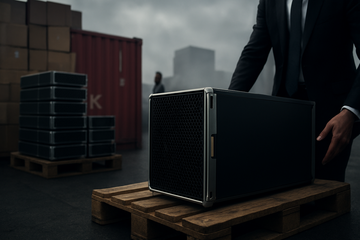
Three events landed inside five days. Reuters found that Northwestern Polytechnical University, a PLA-linked member of China's \"Seven Sons of National Defense\" that sits on the US Entity List, had bought two H200 processors through a local reseller for $123,000. Reuters also reported roughly 600,000 H200s worth $20 billion to $30 billion sitting in Hong Kong warehouses because Beijing has not approved their import. And in New York on Nov. 10, Treasury Secretary Scott Bessent told the National Committee on U.S.-China Relations that Washington and Beijing \"should harbor no illusions about the differences between the United States and China.\"
H200s held in Hong Kong
600,000
Awaiting mainland import approval, reported Nov. 6, 2026
Value of the stranded pile
$20B–$30B
Reuters estimate at public prices, Nov. 6, 2026
NVIDIA China Hopper shipments
Under 1%
Share of Q2 FY2027 Data Center revenue; none assumed in outlook
The enforcement layer
A $123,000 Purchase Outlived a $4.9 Billion Compliance Regime
The licence architecture is what failed. The H200 requires a US export licence, and those licences are normally denied to blacklisted institutions; the administration's case-by-case allowance for some H200 exports did not lift the separate Entity List restriction covering the university. Two chips closed a transaction that sat outside a regime that has already cost NVIDIA $4.9 billion in China-related charges — $4.5 billion on H20 excess inventory and purchase obligations, then $0.4 billion on H200. Enforcement that leaks two chips at a time cannot set a price for 600,000.
| Control | When | What it actually produced |
|---|---|---|
| US export licence for H20 into China | April 2025 | $4.5 billion charge for excess inventory and purchase obligations; Hopper shipments to China stopped |
| Case-by-case H200 licences | February 2026 | Licences for named China buyers; China shipments stayed under 1% of Data Center revenue in Q2 FY2027 |
| Inspection of licensed chips in the US | 2026 | Every licensed H200 and MI325 must clear US inspection before it ships |
| 25% tariff on inspected chips | 2026 | NVIDIA says it cannot pass the tariff on to customers |
| Chinese import approval | Nov. 2026 | More than 400,000 chips conditionally approved, and most of them still unshipped |
| Entity List | October 2026 | A blacklisted university bought two H200s through a reseller for $123,000 |
| New \"superintelligence\" dialogue | Nov. 10, 2026 | A standing channel on model testing and incident alerts, with no chip content attached |
Beijing's side of the ledger
Beijing Holds 600,000 Chips It Has Refused to Take In
Beijing's hold is not a shortage of permission; it is a shortage of willingness. More than 400,000 of the stranded chips carry conditional purchase approvals from Chinese cloud buyers, including Alibaba, and most have not shipped. What changed since July is the price, not the licence count: an eight-card H200 server was offered for more than 6 million yuan by the end of October, roughly three times its year-earlier price, while a server built on newer Blackwell chips was offered for more than 20 million yuan. Beijing can now set the clearing price of a chip it refuses to release.
The Hong Kong shelf, line by line
Chips held
≈600,000 H200
Awaiting mainland import approval, Nov. 6, 2026
Estimated value
$20B–$30B
Reuters estimate at public prices, Nov. 6, 2026
Conditionally approved
400,000+ units
Chinese cloud buyers; most shipments have not happened
Approvals reported in July
Fewer than 200,000 chips
The Information, cited Nov. 6, 2026
Eight-card H200 server
Over 6 million yuan
About 3x the year-earlier price, end-October 2026
Blackwell server
Over 20 million yuan
Same grey market, late October 2026
Delivered to large Chinese internet firms
≈10,000 each
In recent months; the bulk of the pile is unsold
- Roughly 600,000 H200s sit in Hong Kong warehouses, locking up an estimated $20 billion to $30 billion of inventory
- More than 400,000 chips hold conditional approvals from Chinese cloud buyers, including Alibaba, yet most have not shipped
- An eight-card H200 server cleared 6 million yuan by end-October 2026, about three times its year-earlier price
- Each major Chinese internet company took roughly 10,000 H200s in recent months, leaving the bulk of the pile idle
- Officials told firms in July that approvals would stay limited and that Chinese processors should be prioritised for inference
Washington's turn
Bessent's 'No Illusions' Is the First Admission That Controls Are Negotiable
We should harbor no illusions about the differences between the United States and China.
Bessent used the remarks to announce a bilateral dialogue on \"superintelligence\": the two governments will exchange best practices for evaluating and testing advanced models before release, keep \"human judgment firmly in command\", and use a direct channel to alert each other to serious incidents, the last of which Trump and Xi agreed in September. He paired it with a trade message of \"de-risk, not decouple\" and a proposed Board of Trade that would set mutual tariff cuts on $30 billion of non-sensitive goods in each direction. Washington and Beijing now price AI access instead of banning it.
- A standing \"superintelligence\" channel on model testing, human oversight and incident alerts — the first AI mechanism that is not about chips
- No compute content: Bessent did not tie the new channel to any commitment on export licences
- A proposed Board of Trade with $30 billion of mutual tariff cuts on non-sensitive goods in each direction
- A June 2026 suspension of foreign-national access to Anthropic's Mythos and Fable 5 models, restored weeks later, shows the toolkit already reaches model access
- Bessent travels to Shenzhen for Trump's third meeting with Xi this year, on the sidelines of the Nov. 18-19 APEC leaders' summit
Who holds which veto
US export licence
[NVIDIA](nvda), [AMD](amd)
Granted case by case since February 2026, and only for named buyers
US inspection
Commerce Department
Licensed chips must be inspected in the United States before shipment
Tariff
25%
Charged on entry to the US for inspection, and not passed on to customers
Entity List
Commerce Department
A blacklisted university routed around it with a $123,000 reseller purchase
Chinese import approval
Chinese regulators
More than 400,000 chips conditionally approved and still unshipped
Model access
Anthropic Mythos, Fable 5
Foreign-national access suspended in June 2026 and restored weeks later
Summit
Shenzhen, Nov. 18-19
Third Trump-Xi meeting this year, on the APEC leaders' sidelines
The hidden economics
A Licence Without the Tariff Cannot Make China Profitable
The number that matters most in the China disclosure is the tariff, not the volume. Licensed H200s must be inspected in the United States before shipment and attract a 25% tariff on entry, which NVIDIA says it cannot pass on to customers. That penalty attaches to every licensed shipment, so the more Washington licenses, the more cost it absorbs to satisfy Beijing. AMD faces the identical mechanic on MI325, licensed in the first half of 2026 and carrying the same inspection and the same 25% tariff. A licence win without tariff relief restores optionality, not margin.
| NVIDIA H200 | AMD MI325 | |
|---|---|---|
| Licence status | Granted February 2026 for named China buyers | Granted in the first half of 2026 for named China buyers |
| Inspection | Required in the United States before shipment | Required in the United States before shipment |
| Tariff | 25% on entry, which the company says it cannot pass on | 25% on importation for the inspection |
| Extra condition | None disclosed | US officials expressed an expectation of a 15% revenue share on licensed MI308 sales in August 2025, never published as a rule |
| Revenue realised | Under 1% of Data Center revenue in the quarter ended July 26, 2026 | Not separately disclosed |
Upstream
The Memory Layer Is Collecting the Margin While the Chip Designer Watches
The upstream effect of the standoff has been the opposite of a slowdown. NVIDIA's supply and capacity commitments jumped from $119 billion to $279 billion in a single quarter, \"primarily related to the procurement of memory\", and inventory rose from $25.8 billion to $31.6 billion ahead of Vera Rubin. SK hynix posted record third-quarter revenue of 104.6 trillion won at an 80% operating margin and expects HBM4 to overtake HBM3E in both volume and revenue in the fourth quarter, with the memory shortage running through 2030. Micron closed fiscal 2026 with $133.2 billion of revenue and $85.0 billion of net income. Memory now earns more per dollar of revenue than the chip designer.
Trailing gross margin across the AI compute chain
Trailing-twelve-month gross margin through each company's latest reported quarter. The memory layer now out-earns the chip designer on every dollar of revenue.
Unit: %
- Nvidia's $366 billion of total commitments is roughly 2.7 times its $134 billion of trailing operating cash flow, with memory the largest single line
- SK hynix trades at 4.1 times enterprise value to trailing EBITDA on a 20% earnings yield, against 17.5 times for NVIDIA
- Nvidia's inventory now stands at 150 days of sales, up from 105 days a year earlier, so the cycle is being stocked rather than rationed
- SK hynix's own outlook has the memory shortage running through 2030, with next year's investment set to rise significantly
Downstream
The Order Book Moved West, and the Buyers Left on the Shelf in Hong Kong
Demand did not disappear; it changed hands. CoreWeave reported third-quarter revenue of $3.66 billion, up 168% from a year earlier, with a contracted backlog of about $132.5 billion at Sept. 30 against $104 billion at June 30, and full-year 2026 capital expenditure guided to $37 billion to $39 billion. For Chinese buyers the relocation went the other way: Alibaba and its peers hold approvals for chips they cannot import, at a server price three times last year's. The neocloud order book is what replaced China demand.
| Buyer of H200-class compute | Where the chips are | What it costs |
|---|---|---|
| Alibaba and Chinese cloud platforms | About 400,000 units held in Hong Kong under conditional approval | Eight-card server above 6 million yuan, roughly three times a year earlier |
| CoreWeave and US neoclouds | Delivered, with a $132.5 billion backlog at Sept. 30, 2026 | 2026 capex guided to $37–39 billion against a $26.9 billion market cap |
| AMD licensed MI325 buyers | Held under US licence, inspection required in the United States | A 25% tariff on entry that the vendor has not passed on |
| NVIDIA direct licences | Under 1% of Data Center revenue in the quarter ended July 26, 2026 | A $0.4 billion H200 charge in the first half of fiscal 2027 |
| Broadcom custom silicon | Subject to neither control | Revenue up 33% to $29.6 billion in the quarter ended Aug. 2, 2026, at a 69.1% gross margin |
Valuation
The Market Already Took the China Premium Out
The equity market has made most of this adjustment, and not because the business disappointed. Nvidia's market capitalisation fell 23%, from $5.26 trillion on Apr. 26, 2026 to $4.07 trillion on Nov. 11, while trailing-twelve-month revenue rose about 20% to $303.0 billion. The shares closed at $168.89 on Nov. 10, down 5.5%, after dropping more than 4% on Nov. 9 when the Huang affair became public and leaving the stock roughly 11% below the previous Wednesday's close. The market has stripped the China option out of the multiple and priced a policy discount instead.
Nvidia's quarterly revenue has doubled while China went to zero
Nvidia revenue by fiscal quarter, Q2 fiscal 2026 through Q2 fiscal 2027. China Hopper shipments were under 1% of Data Center revenue in the final quarter, and no China compute revenue is assumed in guidance.
Unit: $ billion
Q2 FY2026
Quarter ended Jul. 27, 2025
46.7
Q3 FY2026
Quarter ended Oct. 26, 2025
57
Q4 FY2026
Quarter ended Jan. 25, 2026
68.1
Q1 FY2027
Quarter ended Apr. 26, 2026
81.6
Q2 FY2027
Quarter ended Jul. 26, 2026
96.2
Enterprise value to EBITDA
17.5x
Trailing twelve months through Jul. 26, 2026
Earnings yield
4.7%
Trailing twelve months through Jul. 26, 2026
Gross margin
75.0%
Q2 FY2027, quarter ended Jul. 26, 2026
Free cash flow
$127.0B
Trailing twelve months through Jul. 26, 2026
Inventory
$31.6B
As of Jul. 26, 2026, up from $25.8B a quarter earlier
Horizons
What to Watch Between Now and 2028, and What Would Break This
- Nov. 18-19: the Shenzhen summit. Watch the inspection tariff on licensed H200 and MI325 shipments, not the number of new licences
- Whether the \"superintelligence\" dialogue acquires a compute annexe, which would formalise chip access as a bargaining item
- Whether Beijing releases any of the roughly 400,000 conditionally approved H200s, and what the eight-card server price does afterwards
- NVIDIA's fiscal third quarter, ended in late October, will show whether the $0.4 billion H200 charge grows or converts into shipments
- The counter-case: reporting suggests revoking the H200 licence is judged unlikely in the short term, so the base case is a managed standoff rather than a tightening
Over one to three years the structural question is whether AI compute becomes a managed bilateral good, priced by negotiation, the way memory and rare earths already are. The evidence is on the page: the memory layer earns 87% trailing gross margins while the chip designer earns 75%, and Beijing has moved the clearing price of an eight-card H200 server by three times without shipping a single unit. The counter-argument is that scarcity is a wasting asset, because the premium that makes the hold valuable erodes as substitutes improve and the administration has signalled that tighter export rules are moving through the legislative pipeline.
Synthesis
The Bottom Line for Each Side of the Chain
One clarification for the record: this is not a forecast of the Nov. 18-19 summit, and the Huang affair on its own changes no rule. It is a statement of what has to be true for NVIDIA's China numbers to matter again. The licence has to exist, the 25% inspection tariff has to go, and Beijing has to actually release the chips. Until then, the second derivative — memory pricing, custom silicon substitution and Western neocloud backlog — is where the earnings are, and the stocks that carry that exposure are the ones the committee should size up first.
Where the Exposure Actually Sits
- Data Center revenue hit $89.0 billion in the quarter ended July 26, 2026, up 117% year over year, while China Hopper shipments stayed under 1% of it
- China is now a diplomatic option rather than an earnings line, with no Data Center compute revenue from China assumed in the outlook
- The balance sheet carries the strain: $366 billion of total commitments against $134 billion of trailing operating cash flow, with memory the largest line
- Near term, only removal of the 25% inspection tariff at the Nov. 18-19 summit changes the China number; over one to three years, that is the whole optionality
- Third-quarter revenue of $13.4 billion at a 53.9% gross margin shows the accelerator ramp does not need Chinese demand
- MI325 volume to China carries the same inspection-and-tariff penalty as Nvidia's H200, so a rival's licence win is not a relief valve
- Licensed MI308 sales also carry a US expectation of a 15% revenue share that was never published as a rule
- Over the next year, the upside rests on non-China accelerator shipments rather than on licence wins in Beijing
- Revenue jumped 33% to $29.6 billion in the quarter ended August 2, 2026 at a 69.1% gross margin, and custom silicon sits outside both controls
- Custom silicon absorbs the demand that export controls push away from merchant GPUs
- Over one to three years, sovereign compute programmes add a second pool of accelerator demand independent of any licence
- The risk is concentration in a handful of custom-chip programmes, not policy
- Fiscal 2026 closed with $133.2 billion of revenue, an 86.7% gross margin in the fourth quarter and $85.0 billion of net income
- Nvidia's $279 billion supply commitment, mostly memory, underwrites Micron's HBM ramp independent of Chinese demand
- The near-term risk is that 600,000 stranded H200s defer HBM3E orders without cancelling them
- Trailing inventory of 189 days of sales shows the cycle is being stocked into scarcity, which cuts both ways
- Third-quarter revenue of 104.6 trillion won, an 80% operating margin and 98.7 trillion won of net cash mark the strongest quarter on record
- HBM4 overtaking HBM3E in the fourth quarter locks in pricing that China's import hold cannot undercut
- At 4.1 times enterprise value to trailing EBITDA on a 20% earnings yield, the shares price a shortage the company expects to run through 2030
- Over the next year, the watch item is whether stranded H200s defer HBM3E shipments into inventory
- More than 400,000 approved H200s cannot be imported, and an eight-card server now clears 6 million yuan, about three times a year earlier
- Approved but undeliverable chips inflate the cost of every unit of AI capacity Alibaba adds
- The June 2026 quarter produced 267.8 billion yuan of revenue at a 38.0% gross margin, so the cash is available and the hardware is not
- Over one to three years, domestic accelerator substitution is the only offset; until it scales, the import hold costs more than it saves
- The contracted backlog reached about $132.5 billion at September 30, 2026 from $104 billion at June 30, and third-quarter revenue rose 168% to $3.66 billion
- A $132.5 billion backlog against a $26.9 billion market cap prices financing risk, not demand
- 2026 capital expenditure of $37–39 billion against $3.66 billion of quarterly revenue keeps the funding question live
- Over one to three years, this neocloud order book is the structural replacement for the China demand Nvidia can no longer serve