
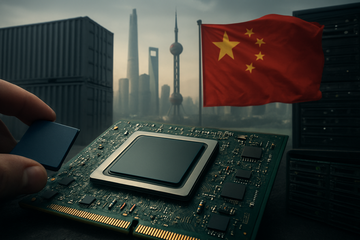
The scandal coverage has treated this as a governance story about one CEO and one affair. It is really a channel story: Nvidia is booked as selling to Southeast Asia while the end users are Chinese, and the rules in force regulate shipments rather than remote access to rented capacity. Read as a supply-chain problem, the failure mode is not a founder's reputation — it is a roughly $37–47 billion revenue pool whose legality depends on a technical distinction Washington is about to erase.
Nvidia hardware bought through the Malaysian affiliate of its Singapore partner
$4.8B
Three-year total, reported Nov 12, 2026
Nvidia GPUs imported by that Singapore partner, 2023–2025
136,000
Bloomberg reporting, Dec 22, 2025
H200 shipments to China as a share of data center revenue
<1%
Nvidia Form 10-Q, quarter ended July 26, 2026
Estimated China-linked revenue, direct and indirect
$37–47B
Up to 10% of FY2027 consensus revenue of $411B
Nvidia Q3 FY2027 revenue guidance
$108.0B
Plus or minus 2%, issued Aug 26, 2026
Next scheduled disclosure
Nov 17, 2026
Nvidia Q3 FY2027 results, first under interim leadership
The exposure
The exposure sits in the channel, not on the invoice
Nvidia's own accounting explains why the China story is invisible in the China line. Revenue is assigned by the headquarters location of the direct customer, so a Singapore- or Malaysia-based buyer books as Asia-Pacific revenue even when the workload sits in Shanghai. In the quarter ended July 26, 2026, customers headquartered outside the United States generated 38% of total revenue.
| Revenue bucket | Share of FY2027 revenue | Approximate size |
|---|---|---|
| Legal sales into China and Hong Kong | 6% | ~$25B |
| Booked outside China, physically diverted into China | 2% | ~$8B |
| Booked offshore, used by Chinese-controlled offshore capacity | 2% | ~$8B |
| Total China-linked exposure | up to 10% | $37–47B |
The filings put a hard ceiling on the direct channel: Hopper shipments to China were less than 1% of data center revenue in the quarter ended July 26, 2026, and licensed H200 shipments to specific China-based customers accounted for less than 1% of data center revenue. That is why the market is not pricing this as a lost-china-sales story. The risk is the 4% that is booked offshore.
Nvidia quarterly revenue kept compounding through the channel debate
Quarterly revenue in $B, Q2 FY2026 through Q2 FY2027
Unit: $B revenue
Q2 FY2026
Reported Aug 27, 2025
46.7
Q3 FY2026
Reported Nov 19, 2025
57
Q4 FY2026
Reported Feb 25, 2026
68.1
Q1 FY2027
Reported May 20, 2026
81.6
Q2 FY2027
Reported Aug 26, 2026
96.2
The route
How $4.8 billion of restricted silicon reached Chinese data centers
The mechanism is neither exotic nor secret. It is the standard neocloud business model run one step too far: buy accelerators in a permissive jurisdiction, rent the compute to whoever wants it, and let the end customer's location sit outside every license condition. What made Megaspeed a focal point is that it scaled this into a hub for the Chinese AI market.
- Megaspeed, a Singapore-based neocloud, is an Nvidia Cloud Partner for the Asia-Pacific region and operates data centers in Singapore and Malaysia's Johor state.
- Its Malaysian affiliate Speedmatrix received more than 200 shipments of restricted Nvidia technology between June 2024 and June 2025, and Megaspeed and its affiliate bought at least $4.8 billion of Nvidia AI equipment and processors.
- Those systems power data centers built by Shanghai Century Litong in Shanghai and Shenzhen; Huang Yu, sister of the former Megaspeed executive at the center of the U.S. case, is a founding shareholder of that builder.
- Alibaba and Tencent are named as customers of the AI capacity that Chinese data centers built with these systems.
- Because the chips were rented rather than sold to the end user, the current rules — which restrict shipments — were largely bypassed rather than broken.
Two consequences follow, and neither requires a spy to be true. First, enforcement has been slow and selective: Singapore authorities interviewed the former executive and impounded her passport in 2025, and in February found insufficient evidence against her personally, while probes into Megaspeed and six other individuals continue over servers shipped via Singapore. Second, the throughput was large enough to matter commercially: Bloomberg counted more than 136,000 Nvidia GPUs imported by Megaspeed between 2023 and 2025.
The filings
Nvidia's own documents bound how bad this can get
The company has been neither invulnerable nor exposed in the numbers. In the Form 10-Q for the quarter ended July 26, 2026, Nvidia disclosed that H200 shipments to licensed China-based customers accounted for less than 1% of data center revenue, that Hopper shipments to China in the quarter were also less than 1% of data center revenue, and that it had booked a $0.4 billion charge in the first half of fiscal 2027 for H200 excess inventory and purchase obligations as demand diminished.
| Disclosure | Figure | Source and period |
|---|---|---|
| H200 shipments to China | Less than 1% of data center revenue | Form 10-Q, quarter ended July 26, 2026 |
| Hopper shipments to China | Less than 1% of data center revenue | Form 10-Q, quarter ended July 26, 2026 |
| H200 inventory and purchase obligation charge | $0.4B | First half of fiscal 2027 |
| Tariff on H200s routed through U.S. inspection | 25%, not passed on to customers | Form 10-Q, quarter ended July 26, 2026 |
| Revenue from customers headquartered outside the U.S. | 38% of total revenue | Form 10-Q, quarter ended July 26, 2026 |
| Case-by-case H200 and MI325X licence review | Permitted with conditions | Commerce Department policy, Jan 13, 2026 |
Nvidia has also shown it can see the problem. According to policy analysis published Nov 13, 2026, the company reviewed its pre-approved buyer list and removed more than half of its Asian buyers, and instructed cloud partners not to rent more than half of their computing power to Chinese companies — a restriction no U.S. regulation actually requires. Its hardware-level tracking, which can geolocate chips, is enrolled voluntarily and covers only cloud partners. Voluntary compliance is a policy choice, not a constraint, and it is the choice Washington now appears unwilling to leave to the vendor.
Washington
The next rule targets renting, and it lands before the Shenzhen summit
The policy response has accelerated in a way that was not true three weeks ago. On Nov 12, 2026, Senate Finance Committee ranking Democrat Ron Wyden and House Ways and Means Committee ranking Democrat Richard Neal wrote to Commerce Secretary Howard Lutnick demanding preservation of records on the H200 arrangement, in which chips manufactured in Taiwan were routed to the United States for inspection before export and a share of the revenue went to the government. The same week, lawmakers moved chip-control vehicles through the National Defense Authorization Act, including the AI Overwatch Act, the Chip Security Act and the MATCH Act, with Senate Democratic leader Chuck Schumer calling for their passage and House China committee chairman John Moolenaar pressing for limits in the defense bill.
- Commerce is finalizing a rule that would prevent Chinese AI firms from remotely accessing advanced chips through data centers in other countries — the precise mechanism Megaspeed used.
- Wyden and Neal are asking Commerce to preserve records rather than merely explain, which converts a policy debate into a documented investigation.
- Beijing has already framed the allegations as a pretext for a technology blockade, which raises the cost of tightening rules right before the Nov 18–19 Trump-Xi meeting in Shenzhen.
- The precedent already exists in the revenue-share arrangement: Nvidia and AMD agreed in August 2025 to give the government 15% of China chip revenue in exchange for export licences.
Supply chain
Who absorbs the shock if the rental channel closes
The shock does not travel up the chain; it travels down. Wafer demand is set by what Nvidia ships, not by who ultimately uses the capacity, and China-bound shipments are already less than 1% of data center revenue. What changes is the economics of Chinese AI compute: if offshore rentals of restricted accelerators are prohibited, the alternative is domestic silicon or paying for compliant capacity at a much higher price.
| Layer | Entity | Evidence | Exposure if remote access is barred |
|---|---|---|---|
| Upstream — fabrication | Taiwan Semiconductor Manufacturing | Advanced chips in the H200 program are manufactured in Taiwan; Q3 2026 revenue NT$1,493B | Limited — rules redirect routing, not wafer starts |
| Upstream — channel | Megaspeed and Speedmatrix | More than 200 restricted shipments; $4.8 billion of purchases | Severe — direct target of the criminal investigation |
| Downstream — capacity | Shanghai Century Litong | Builds and operates data centers in Shanghai and Shenzhen | Loses access to imported accelerators |
| Downstream — demand | Alibaba and Tencent | Named customers of that AI capacity | Higher compute cost, or substitution |
| Substitute | SMIC | China's domestic advanced-node foundry | Demand shifts from imported to local silicon |
That is why the second-order read is bullish for the foundry layer and for domestic Chinese silicon, and bearish for the companies whose AI ambitions depend on cheap frontier compute today. It also explains why Taiwan's foundry queue is not the trade: Taiwan Semiconductor Manufacturing grew revenue to NT$1,493 billion in the third quarter of 2026 on a gross margin of 66.4%, and nothing in the current rule set reduces that demand.
Horizons
Two weeks of policy risk, then a two-year substitution cycle
| Horizon | Catalyst | Who moves | What to watch |
|---|---|---|---|
| Days — Nov 13–19, 2026 | Commerce remote-access rule text; Trump-Xi meeting in Shenzhen | Nvidia, Chinese cloud buyers | Whether the rule covers rental from data centers in Singapore and Malaysia, and Beijing's retaliation on rare earths |
| Weeks — Nov 17–30, 2026 | Nvidia Q3 FY2027 results, its first under interim leadership | Nvidia, AMD, TSMC | Any new inventory charge, and whether China or Hong Kong revenue lines move |
| Quarters — through 2027 | Wyden and Neal inquiry into the H200 licensing and revenue-share records | Nvidia, AMD | Whether the 15% revenue-share model survives scrutiny or is unwound |
| One to three years | Domestic Chinese accelerator and foundry scale-up | SMIC, Alibaba, Tencent | How much of the $37–47 billion pool is substituted rather than lost |
The honest uncertainty is on the enforcement side, not the demand side. No charges have been filed against Megaspeed, the company says it cooperated with Bureau of Industry and Security inspections and has retained a U.S. law firm to run a census of its GPUs, and Singapore found insufficient evidence against the former executive personally. A rule can be written and enforced far faster than an investigation can be closed.
Governance
The leadership vacuum is real, but it is the second-order problem
On Nov 12, 2026, Jensen Huang resigned as president and chief executive and Nvidia named chief financial officer Colette Kress as interim CEO, after the board opened an investigation into reports that Huang was the target of a foreign intelligence effort. Shares fell 4.3% on Nov 9 to $178.67 and closed Nov 12 at $166.19, leaving a market value near $4 trillion.
What actually changes for the business is the compliance architecture. If chip-location verification becomes mandatory before export, and remote access to controlled chips is regulated as an export of the compute itself, then the Southeast Asian neocloud model has to rebuild itself around disclosed end users. That is a revenue-mix event for Nvidia, not a solvency event for the foundry chain, and it is the reason the channel, not the résumé, is the story of the next two weeks.
Where the channel debate actually lands
- Up to 10% of FY2027 revenue is China-linked, and the 4% booked offshore carries the regulatory risk if remote access is barred
- Fundamentals are accelerating against the headline: Q3 FY2027 guidance of $108.0B, plus or minus 2%
- Near term: the Nov 17 results and the Nov 18–19 Shenzhen summit; one to three years: mandatory chip-location verification
- Its MI-series chips are already licensed case by case alongside H200, so tighter rules land on both vendors at once
- AMD's Q3 FY2026 revenue of $13.4 billion rose 45% year over year, and 15% of China revenue goes to the government under the 2025 deal
- Longer term, a constrained Nvidia channel is the only credible source of share gains in China for AMD
- Export controls redirect where chips are made, not how many are made, leaving wafer demand untouched
- Q3 2026 revenue reached NT$1,493 billion at a 66.4% gross margin, with no China-diversion discount
- Near term: Nov 17 results; longer term: whether any rule adds Taiwan-origin routing friction to compliant supply chains
- If Chinese AI firms lose offshore rentals, domestic foundry and packaging demand steps up as the substitute path
- The trigger is Commerce's remote-access rule finalization, not the Shenzhen summit
- One to three years: substitution of part of the $37–47 billion pool is the swing factor for orders
- Alibaba is a named customer of the Chinese AI capacity built with diverted hardware, so a closed rental channel raises its training cost
- The offset is its own silicon program, which remains sub-scale against imported accelerators
- Over one to three years the effect is a margin question on AI workloads, not a demand question
- Tencent rents capacity from the same Shanghai data-center build-out, so it faces the same substitution bill without a captive foundry
- Trailing revenue of roughly CNY 787 billion is not the issue; the cost of frontier compute is
- Watch the final rule's country list: Singapore and Malaysia coverage determines how fast this reprices