
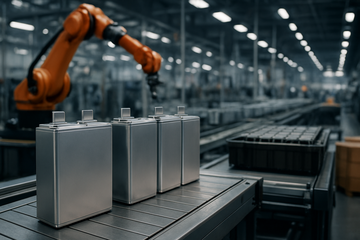
On Nov. 18, 2026, Ford confirmed that the first lithium-iron-phosphate prismatic cells had left BlueOval Battery Park in Marshall, Michigan and arrived at the Louisville Assembly Plant to power Fathom pickup prototypes. Cells began rolling off the line in October 2026; the lines run at 40 cells a minute, targeting about 20 GWh a year, and the Fathom pickup is due on sale in late 2027 at a starting price of $28,350.
The plant is wholly owned by Ford. The chemistry, the cell design and the manufacturing know-how are licensed from CATL under a limited technology-licensing and services agreement. Ford pays CATL a per-cell royalty; the rate has not been disclosed.
Nameplate cell capacity
~20 GWh/yr
2027 target for BlueOval Battery Park Michigan; down from an earlier plan of up to 40 GWh
Line speed
40 cells/min
Ford, Nov. 18, 2026
Implied 45X cell credit at full ramp
~$700M/yr
20 GWh at the statutory $35/kWh battery cell credit rate
Michigan jobs
1,700
Ford's Marshall, Mich. estimate; ~70% from Calhoun County
Fathom pickup MSRP
$28,350
Cheapest all-electric vehicle Ford has offered; on sale late 2027
Ford Model e EBIT, Q3 2026
-$1.06B
On $1.2B of segment revenue; loss narrowed $352M year over year
The plant
Ford Owns the Assets, Beijing Owns the Recipe
The ownership structure is the whole point. Ford owns the $3.5 billion asset, employs the workforce and books the depreciation, while CATL licenses the cell design and process knowledge rather than taking an equity stake or running the line. Ford pays for that access with a per-cell royalty, so the toll on every American-made LFP cell leaves the United States even though the plant sits 100 miles west of Detroit.
| Item | Figure | Detail |
|---|---|---|
| Capital invested | $3.5B | Announced February 2023; reported at $3B at the plant opening |
| Floor area | 2M sq ft | Marshall, Michigan |
| Cell output rate | 40 cells/min | Fastest LFP prismatic lines outside China, per Ford |
| Annual capacity target | ~20 GWh | Reduced from an earlier plan of up to 40 GWh |
| Cells per battery pack | ~100 | Per MLive reporting on the Louisville line |
| Pack plant readiness | Spring | Cell line runs first; pack plant not fully operational yet |
| Expected battery life | 15–20 years | Ford estimate for the LFP pack |
| Local property taxes | ~$5M/yr | $2M to the city of Marshall, $383K to Marshall Township |
- Ford says the licensing and manufacturing support arrangement let it put mainstream LFP cells into U.S. consumer vehicles faster than building the process from scratch.
- The first units are prototype-grade Fathom cells for Louisville Assembly; volume output for the Fathom ramp is a 2027 event.
- The Marshall line also feeds Ford's battery storage business, which is being aimed at data-center and grid customers alongside the vehicle program.
The economics
The Credit Is Worth More Than the Cells
Battery cells earn a statutory 45X advanced manufacturing production credit of $35 per kWh under 26 U.S. Code §45X, with modules adding $10 per kWh. Applied to 20 GWh of nameplate cells, that is roughly $700 million a year of federal credits once the plant runs at rate, against a $3.5 billion build cost.
That is the arithmetic that made licensing look rational in 2023 and still makes it rational now: Ford does not need to earn a battery-cell margin at scale to justify the plant, because the credit, not the spread, carries the return. The cost of that shortcut is a royalty on every cell and a permanent dependency on a foreign licensor.
Ford's gross margin has recovered before the battery business arrives
Gross margin by quarter, computed from reported revenue and cost of revenue. The LFP plant does not contribute yet — the recovery is mix and cost, and the cell business arrives in 2027.
Unit: % gross margin
Q3 2025
Revenue $50.53B, gross profit $4.52B
8.9%
Q1 2026
Revenue $43.25B, gross profit $7.94B
18.4%
Q2 2026
Revenue $48.30B, gross profit $6.08B
12.6%
Q3 2026
Revenue $49.53B, gross profit $7.38B
14.9%
The corporate backdrop makes the plant less optional than it looks. Ford lost $1.06 billion of EBIT in Ford Model e in Q3 2026 on $1.2 billion of segment revenue, with EV wholesales down 31% to 34,000 units, and the company wrote down $19.5 billion on its EV business in December 2025. Full-year 2026 capital spending guidance is $9.5 billion to $10.5 billion, and adjusted EBIT guidance was raised to $10.5 billion to $11 billion. A $28,350 pickup built on cells Ford makes itself is the first vehicle designed to close the Model e margin gap rather than one more compliance-driven EV program.
Policy
Washington Wants the License Broken, Not the Plant
The political attack on the plant has never been about jobs or emissions. Transportation Secretary Sean Duffy wrote to CEO Jim Farley on Sept. 3, 2026 saying he was deeply alarmed that Ford was intertwining its future with Chinese state-backed enterprises and urging the company to prioritize technological sovereignty over short-term arrangements. Rep. John Moolenaar of Michigan, who chairs the House Energy and Commerce panel, had already written on Jan. 27, 2026 asking whether Ford's CATL licensing terms were expanded to cover energy storage and data-center batteries, and whether Ford had corrected them for the new credit restrictions.
- Ford told Reuters in 2025 that the Michigan plant was on track to qualify for production tax credits after the final legislation revised the language to preserve auto-related advanced manufacturing credits while barring Chinese companies themselves from eligibility.
- The trigger for the 2025 legislation was language that would have denied credits for batteries made under a license agreement with a Chinese firm — the exact structure Ford chose.
- Ford told Reuters in January 2026 it remains confident its batteries meet tax credit eligibility requirements, while declining to disclose the credit amounts claimed so far.
- The White House has publicly commended Ford for domestic manufacturing and jobs, which is why the plant survives scrutiny but not why it is safe.
Supply chain
Ford Took the Chemistry, Not the Chemistry Chain
Ford's licensing deals cover the cell, not the material chain. Jiangxi Lopal agreed to supply LFP cathode material to Ford's U.S. battery plant through its subsidiary Liyuan, which operates a cathode plant in Indonesia — a structure that keeps the FEOC-sensitive steps offshore while the credit-sensitive step happens in Michigan. Lithium, iron and phosphate precursor supply for the Marshall ramp was not disclosed.
| Plant | Owner | Capacity | Chemistry / focus |
|---|---|---|---|
| BlueOval Battery Park, Marshall, Mich. | Ford | ~20 GWh | LFP for vehicles and storage, 2027 ramp |
| Lansing, Mich. | LG Energy Solution | >35 GWh | LFP for energy storage; production started Aug. 2026 |
| Holland, Mich. and others | LG Energy Solution | >50 GWh combined | LFP cell-making capacity in North America by end-2026 |
| De Soto, Kansas | Panasonic Holdings | ~32 GWh | High-nickel cells for EVs |
| Indiana / Taylor, Ind. | Samsung SDI | LFP expansion underway | Stationary storage LFP supply from 2027 |
Downstream, the cells are already committed. Ford's Louisville Assembly Plant consumes the Michigan cells for the Fathom. LG Energy Solution's Lansing output goes to utility customers including DTE Energy and to the 2027 Toyota Highlander EV assembled at Toyota Motor Manufacturing Kentucky. Samsung SDI has signed a three-year LFP energy-storage supply deal worth more than 2 trillion won for U.S. installations starting in 2027. The U.S. LFP cell market Ford entered is therefore already contested by two incumbents with the same problem Ford has — volume that is real and pricing that is falling.
Who gains, who loses
Ford's Margin Structure Improves; the Korean Toll on U.S. Cells Tightens
CATL is the licensor, and licensing income does not require a single dollar of U.S. capital expenditure. CATL's third-quarter 2026 revenue was 165.2 billion yuan, up about 59% year over year, with net income of 21.2 billion yuan. But gross margin fell to about 20.7% from 25.8% a year earlier as cell prices fell. A per-cell royalty on Ford's American output is a structurally higher-margin revenue line than selling cells into a softening market — which is precisely why the license is worth defending politically and worth monetizing commercially.
- LG Energy Solution grew third-quarter 2026 revenue 69% year over year to 9.64 trillion won, yet still posted a 296.9 billion won net loss; trailing-twelve-month net loss stands at 2.45 trillion won.
- Its Lansing plant puts 35 GWh of LFP capacity in the same state as Ford's 20 GWh, so the two producers are now competing for U.S. grid and data-center demand rather than for a protected OEM channel.
- Panasonic Holdings is investing in high-nickel Kansas capacity into a market where the growth chemistry has shifted to LFP, which is the one segment Ford can now serve without Panasonic.
- Ford's position is the opposite of the incumbents': no overseas battery capex, no Korean supplier margin, no joint-venture partner — and no independence.
Horizons
What Moves in Quarters, and What Moves in Years
The non-obvious read is that Ford has traded a technology risk for a policy risk and probably improved its position in both directions — but only if the license survives. Building LFP from scratch inside the United States would have cost more, arrived later, and probably not cleared the capital test. Licensing bought speed and kept the plant inside the credit rules. It also made Ford's highest-value EV asset dependent on the goodwill of two political actors who have already asked, in writing, for the arrangement to change.
Where the toll actually lands
- 45X at $35/kWh on 20 GWh of cells is worth about $700M a year, roughly offsetting the $3.5B plant cost and the -$1.06B Q3 2026 Model e EBIT drag.
- The Fathom at $28,350 MSRP is the first vehicle designed around Ford-made cells, so cell cost lands in segment margin from 2027.
- Trailing-twelve-month net loss of $7.8B and EV wholesales down 31% in Q3 2026 leave no room for a credit-policy mistake.
- Horizon: cell ramp through 2027 versus a binary policy trigger — a change to the license test under 45X is the single largest downside.
- The per-cell royalty monetizes Ford chemistry without U.S. capital expenditure, adding a high-margin annuity to a business whose Q3 2026 gross margin slipped to about 20.7% from 25.8%.
- Q3 2026 revenue of 165.2B yuan rose about 59% year over year with 21.2B yuan of net income, confirming license income is not masking a collapsing franchise.
- Ford's 20 GWh Michigan plant gives CATL a credential in a market where its own construction would have been blocked.
- Horizon: the royalty scales with Ford's 2027 volume, but a U.S. licensing restriction would remove it — CATL owns none of the Michigan assets.
- Its Lansing plant opened with more than 35 GWh of LFP capacity in the same state as Ford's 20 GWh, so the two now bid for the same U.S. grid and data-center buyers.
- Q3 2026 revenue rose 69% to 9.64T won while net loss widened to 296.9B won, and trailing net loss is 2.45T won.
- Ford's licensed LFP takes OEM share in the segment where LG Energy Solution historically captured supplier margin.
- Horizon: with more than 50 GWh of North American LFP capacity by end-2026, price erosion precedes any volume benefit in 2027.
- Its pivot of U.S. capacity toward LFP energy storage — including a three-year supply deal worth more than 2T won from 2027 — confirms LFP is now the growth chemistry in America.
- That pivot means Samsung SDI is no longer primarily competing with Ford for EV cells but for stationary storage demand against a growing LFP supply base.
- Watch catalyst: conversion of the 2T-won U.S. LFP storage order book into shipments from 2027.
- Ford's data-center storage ambition adds a third bidder for the same U.S. LFP volume from 2027.