
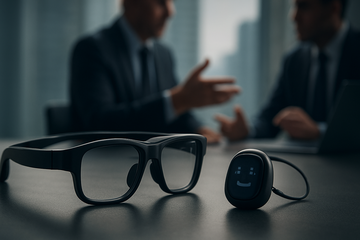
Meta Platforms used its annual Connect keynote on September 23, 2026 to do something it has spent a decade failing at: turn a wearable into the front door of consumer AI. The company launched three new smart-glasses SKUs, a 100-gram VR headset, and — most consequentially — a pocket-sized \"Muse Charm\" that turns its AI agent into a Tamagotchi-style companion that follows you around on a 5G connection.
The product floor matters more than any single device. Meta is now selling or pre-selling glasses at $349 (no camera), $449 (Gen 3), and $799 (the in-lens Display), with the company promising \"over 100 styles of AI glasses\" by year-end. That is not a beta test. It is a five-form-factor assault on the only consumer-electronics category still growing triple digits.
The lineup
Five glasses SKUs and a VR headset — the smartest framing of AI is wearable
Connect2026 reads as a wholesale bet that the AI interface lives on your face, not behind a screen. The keynote stretched from $349 camera-free audio frames all the way up to a spring-2027 100-gram VR headset at $1,299.99 — and crucially, every new device ships with Meta's Muse AI agent onboard.
| Device | Price (USD) | Avail. | Key specs | Differentiation |
|---|---|---|---|---|
| Ray-Ban Meta Audio | $349 | Oct 13, 2026 | 43 g, 12-hr battery, open-ear audio, no camera, no display | Cheapest on-ramp; privacy-first positioning |
| Ray-Ban Meta (Gen 3) | from $449 | Available now | 9-hr battery, 12 MP camera, 3K video, 6 mics, Dolby Atmos, slimmer frame | Refresh of the bestseller; adds Aviator and Zena styles |
| Meta Ray-Ban Display | from $799 | Existing + 5 new markets | In-lens color display, Neural Band EMG control | Premium SKU; gets holographic avatar in this update |
| Meta VR Glasses | $1,299.99 | Spring 2027 | 100 g, dual 120 Hz micro-OLED, Snapdragon Reality Elite in tethered puck, IMAX Enhanced | Apple Vision Pro at<35% the price |
| Muse Charm | Not yet priced | December 2026 | ~2-inch OLED, 5G modem, fingerprint sensor, fingerprint-tap to talk, cannot make calls | Phone-free always-on agent device |
The pricing spread is the strategic tell. Meta is no longer asking whether you want a face computer; it is asking which price tier. That is the same playbook Apple ran on the iPhone, and it forces every competitor — Snap's Spectacles, the long-rumored OpenAI/Ive speaker, even Alphabet's Android XR — to defend a category Meta just expanded.
The habit loop
Muse Charm turns Muse into a companion, not a chatbot — and changes the competitive frame
The Muse Charm is the smallest device onstage and the largest idea. It is a keychain-sized pendant with a roughly 2-inch OLED display, built-in 5G modem (no Wi-Fi or phone required), cameras, mics, speakers, and a fingerprint sensor in one corner that wakes the agent. It ships in December 2026; pricing was not disclosed at the event.
The \"Jolly\" avatar — a cream-colored, beady-eyed creature Meta designed for the device — is the headline. Meta is no longer pitching Muse as a chat surface or a search bar; it is pitching a creature you check on, talk to, and carry. The Verge separately confirmed the Charm will \"recognize and interact with other nearby Charms\" when it launches, which means Meta is designing a social graph for the device itself.
OpenAI, by contrast, is reportedly building a screen-free smart speaker designed with Jony Ive — priced at $200–$300, with a February 2027 ship date per reporting. Anthropic has no consumer hardware at all. Meta's head start on both is two-fold: it has a $1.9 trillion balance sheet to subsidize losses, and it has a hardware stack (Ray-Ban/Quest) already selling in the seven figures. The Charm is a third form factor on top of an existing distribution moat — not a standalone moonshot.
The VR reset
Meta reset the VR price tag to $1,299 — and went five times lighter
The Meta VR Glasses — previously rumored as \"Project Phoenix\" — are the first VR headset Meta has launched since deciding last quarter that the standalone-Quest business would not scale. The specs are the punchline: 100 grams (about five times lighter than the Meta Quest 3), dual 120 Hz micro-OLED panels at 2,412 × 2,288 per eye, a 70° × 66° field of view, and a tethered compute puck carrying Qualcomm's Snapdragon Reality Elite chipset, 12 GB of RAM, and 128 GB of storage.
The price — $1,299.99 — is the real story. Apple's Vision Pro starts at $3,699 after a June 2025 hike. Meta is essentially competing on a 65% discount and a five-times-lighter chassis. Whether the puck design feels like a clever workaround or a compromise will determine whether this is a credible Vision Pro alternative or another Reality Labs write-down.
The Reality Labs ledger
Reality Labs just booked another $4.62B loss — and the smart-glasses line is finally paying for it
Connect 2026 is the first time Meta has walked on stage while its smart-glasses business was a real revenue line. EssilorLuxottica, the Meta eyewear partner, told investors in February 2026 that the Ray-Ban/Oakley Meta line moved 7 million units in 2025 — triple the 2023–2024 combined. In Q2 2026, EssilorLuxottica's AI-glasses revenue nearly doubled year-over-year.
The Reality Labs segment still lost $4.62B on $431M of revenue in Q2 2026, per Meta's July 29, 2026 press release — slightly worse than the $4.53B loss on $370M in Q2 2025. Cumulative Reality Labs losses now sit north of $88 billion since the segment was created.
Reality Labs Q2 2026 revenue
$431M
vs. $370M Q2 2025; +16.5% YoY, per Meta's Q2 2026 earnings release (Jul 29, 2026)
Reality Labs Q2 2026 operating loss
$(4.62)B
vs. $(4.53)B Q2 2025; first-half 2026 loss $8.6B
Cumulative RL operating losses
~$88B+
Since segment inception, through Q2 2026
Meta smart-glasses unit sales (2025)
7M+
Ray-Ban + Oakley Meta, per EssilorLuxottica FY2025 results (Feb 11, 2026)
The math is starting to bend. RL revenue is up 16.5% YoY in a quarter when cumulative smart-glasses shipments grew 167% YoY globally (IDC, Q1 2026), and Q2 2026 brought 3.547M smart-eyewear units worldwide — up 35.3% YoY, with smart glasses taking roughly 85% of all XR shipments. Meta still owns 68.7% of the smart-glasses market per IDC's Q2 2026 tracker. The losses are getting bigger because Meta is shipping more, not because the unit economics are deteriorating — though that distinction will not satisfy the bear case.
The supply chain
The quiet winners: Qualcomm on silicon, BOE/Seeya on micro-OLED, EssilorLuxottica on frames
Connect 2026 confirmed — and in places created — the smart-glasses supply chain. The most under-appreciated beneficiary is Qualcomm, which quietly anchors every Meta wearable: the Snapdragon AR1 Gen 1 powers Ray-Ban Meta Gen 3 (and Samsung/Google's competing eyewear); the Snapdragon Reality Elite — internally an XR2 Gen 3 — drives the VR Glasses puck. In Qualcomm's own Q3 FY2026 earnings presentation, the company called out AR1 as powering \"Samsung and Google's new intelligent eyewear\" and reaffirmed IoT as a 28% YoY growth contributor (Q3 FY2026 revenue $9.9B).
Meta smart-glasses market share, IDC tracker (Q1–Q2 2026)
Meta's share of the global smart-glasses category by quarter
Unit: % share
Q1 2026
Source: IDC Worldwide AR/VR tracker
69.2%
Q2 2026
Source: IDC, Sep 2026 release
68.7%
The second quiet winner sits at the panel layer. Meta's Quest VR line historically sourced micro-OLED from Sony, but the next-gen headsets — including the VR Glasses shipping spring 2027 — are reportedly dual-sourced to Seeya Technology and BOE Technology's BMOT microdisplay division. The pivot matters: Sony is the dominant incumbent in micro-OLED for AR/VR, and Meta just opened a second front against it with two Chinese suppliers that have been aggressively pricing panels.
Frames and assembly remain EssilorLuxottica's franchise. The eyewear partner carries 100+ years of optical manufacturing, all of Meta's prescription-lens capability, and exclusive Ray-Ban/Oakley brand rights. As Ray-Ban Meta moves from 2 million units (2023–24) to 7 million (2025) to a multi-millions-unit 2026 with three new SKUs, every frame ships through the Luxottica wholesale and retail stack — which is why the company trades at a 6% Q2 2026 revenue jump whenever the AI-glasses line accelerates.
- Qualcomm: Snapdragon AR1 Gen 1 is the de facto smart-glasses SoC for Ray-Ban Meta Gen 3, Meta Ray-Ban Display, and Samsung/Google eyewear; Snapdragon Reality Elite anchors the Meta VR Glasses puck.
- BOE Technology + Seeya Technology: reportedly dual-sourced for the OLED microdisplays inside Meta VR Glasses, displacing the prior single-source arrangement.
- EssilorLuxottica: exclusive Ray-Ban/Oakley frame manufacturer and prescription-lens integrator for Meta's glasses; AI-glasses revenue nearly doubled in Q2 2026.
- Sony: incumbent micro-OLED supplier to prior Meta headsets; losing socket share on the next generation but still a display-tech option for Meta's Display-tier glasses.
What it means
The short read: Meta built a category, the suppliers get paid, and the AI-agent race moved to your keychain
Connect 2026 reframes three races at once. Against Apple, Meta is now arguing that $1,299 and 100 grams beats $3,699 and ~600 grams, and the Vision Pro's June 2025 price hike only widened that gap. Against Snap, Meta has 68.7% market share versus Snap's Spectacles which IDC does not even break out — a chasm, not a contest. Against OpenAI's screen-free speaker (reportedly $200–$300, shipping February 2027 at the earliest), Meta has form-factor breadth, distribution, and a working AI agent on shelves first.
For the supply chain, the read is simpler: every shipped Ray-Ban Meta Gen 3 is a Qualcomm chip, a BOE/Seeya OLED (in the Display and VR tiers), and an EssilorLuxottica frame. Volumes are the variable; Meta's own goal of10 million smart glasses per year by 2026 means the order book at each of those suppliers is now baked in.
Stocks this event actually touches
- Smart-glasses volume pulled forward — Meta holds 68.7% share in Q2 2026 (IDC) and is the only player with five SKUs at $349–$1,299 across audio, camera, display, VR, and agent device.
- Reality Labs still burns $4.62B a quarter (Q2 2026) — every cycle of smart-glasses growth has so far been paired with deeper losses, capping the upside despite the volume win.
- Muse Charm's habit-loop bet matters more than any single SKU: if December shipments show repeat engagement, RL's revenue line bends higher without a matching loss expansion — the catalyst that would re-rate the stock.
- Snapdragon AR1 Gen 1 anchors Ray-Ban Meta Gen 3 plus Samsung/Google eyewear — Qualcomm's Q3 FY2026 earnings deck flags AR1 as an IoT growth driver (combined Automotive+IoT +28% YoY).
- Snapdragon Reality Elite powers the Meta VR Glasses puck; if Meta hits its10M glasses/year target, AR/VR silicon becomes a real QCT line, not a rounding error.
- Each Meta smart-glasses generation reduces Apple's silicon autonomy argument — Qualcomm's wearable footprint widens at the exact moment Apple pushes more custom silicon.
- Meta VR Glasses at $1,299 vs Vision Pro at $3,699 redefines the price/weight benchmark — Apple needs a lower-cost, lighter follow-up or the category belongs to Meta by default.
- No smart-glasses SKU of comparable breadth in Apple's lineup; the Vision Pro's June 2025 price hike narrowed the value case rather than expanding it.
- Apple Intelligence remains phone-tethered; Meta's Muse Charm (Dec 2026) and Always-On5G approach is a structural counter-position Apple has no answer to yet.
- Exclusive Ray-Ban/Oakley frame manufacturer for every Meta glasses SKU; AI-glasses revenue nearly doubled YoY in Q2 2026 (per company earnings).
- 100+ styles of Meta AI glasses promised by year-end 2026 — every new frame flows through EssilorLuxottica's wholesale and Lens/Optical Instruments segments.
- Snap's Spectacles and Alphabet/Samsung eyewear use different frame partners, so EssilorLuxottica's exposure is concentrated in the market leader with 68.7% share (IDC, Q2 2026).
- Incumbent micro-OLED supplier for prior Meta Quest headsets; loses socket on next-gen to BOE Technology and Seeya per industry reporting.
- Still a credible Display-tier panel option — the in-lens display on Ray-Ban Display relies on Sony-class OLED microdisplays, where Sony retains technology lead.
- Long-term threat is structural: Meta dual-sourcing to Chinese suppliers at the panel level is the playbook every hyperscaler is now running.
- BMOT microdisplay division reportedly signed as a dual-source OLED microdisplay supplier for Meta's next flagship VR headset.
- Smart-glasses category growing 167% YoY (IDC, Q1 2026) means panel volumes scale faster than any other component — BOE is positioned at the bottleneck.
- Counterweight to Sony in micro-OLED; winning sockets at Meta is the proof point that re-rates BOE's display franchise outside LCD.
- Snap Spectacles is the only other consumer smart-glasses line with brand recognition, but IDC does not break it out of the long tail — Meta's 68.7% share leaves Snap with sub-3% by inference.
- Snap's Q2 2026 results showed $6.35B TTM revenue and a still-unprofitable core ad business — capacity to compete on hardware R&D is limited.
- Watch Catalyst: Snap's AR glasses roadmap announcements at its next partner summit; if Snap stays in AR-only mode, the gap to Meta's audio/camera/display ladder widens.