
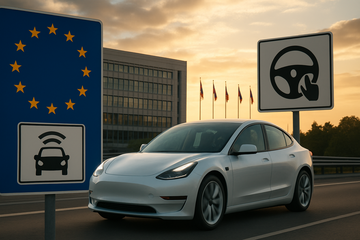
Rename date on European sites
Oct 9, 2026
FSD → \"Tesla Assisted Driving\"; US brand unchanged
EU countries with national FSD approval
8 of 27
NL, LT, EE, DK, BE, SI, CZ, HR — 12.6% of EU population
EU-wide vote requirement
15 states, 65% pop.
Qualified-majority threshold in TCMV
Tesla services & other revenue, Q2 2026
$4.58B
+50% YoY, 14.1% gross margin, $648M gross profit
Active FSD subscriptions, Q2 2026
1.48M
+56% YoY; 55% NA attach; 12B cumulative miles
European FSD subscription price
€99/mo
UK £99/mo; €7,500 one-time purchase ended May 2026
Deferred revenue on Tesla BS, Jun 30 2026
$7.50B
Current $3.43B + non-current $4.07B; prepaid FSD/Autopilot
Tesla Q3 2026 deliveries
486,532
Topped ~461k consensus; +5% next day; TSLA -21% YTD
Germany Forced the Edit — and Now Owns the EU Vote
Germany's Federal Ministry of Transport (BMV) published a statement on October 6, 2026 calling Tesla's flagship \"Full Self-Driving\" brand \"somewhat misleading\" because the system does not take over the full driving task and the driver must remain attentive at all times. Within 72 hours, Tesla's Slovakia, France, and Germany FSD URLs redirected to a \"Tesla Assisted Driving\" page; the US version of the same site still reads \"Full Self-Driving (Supervised)\" for a $99/month subscription. German Transport Minister Steffen Bilger said Tesla offered the rename during September talks, and Germany will now advocate for approval of the relabeled system across the bloc. The move converts Berlin from an obstacle into a December vote — the first time a major EU car market has formally backed an Tesla ADAS product.
Why Germany Drew the Line: Speed Limits and Liability
The brand fight is downstream of a technical fight. Belgium road-safety testers found FSD (Supervised) exceeded 30 km/h limits on 55% of tested segments, averaging 44 km/h in those zones — a speed at which the WHO says a pedestrian's risk of death is roughly six times the risk at 30 km/h. Germany has now agreed to support a version that goes up to 10% over the detected speed limit; the Dutch-approved envelope allows up to 50% over. Sweden and France want tighter, not wider, limits — which is why the TCMV's October 6 agenda listed only 25 minutes of \"continued discussions\" and pushed any vote to December. The BMV's underlying point is liability: the driver \"must remain attentive and is fully responsible,\" a condition that pushes the product out of the \"Full Self-Driving\" definition and into \"assisted\" naming.
- BMV \"misleading\" statement: Oct 6, 2026; Tesla European sites began redirecting to \"Tesla Assisted Driving\" within 72 hours.
- Belgium road tests (Sept 24, 2026): FSD exceeded 30 km/h on 55% of segments; avg 44 km/h in 30 zones; cyclist-overtake failures reported.
- Germany accepts up to 10% over the detected limit; the Dutch-approved envelope allows up to 50% over — Sweden and France want tighter limits.
- Reuters investigation (Oct 7, 2026) documents Tesla's year-long pressure campaign on RDW, French, and Norwegian regulators to scale back review intensity — Germany is now the first government to publicly push back on the brand language.
The EU Math: Eight Countries In, Germany Is the Pivot
EU-wide rollout requires a qualified majority in the Technical Committee on Motor Vehicles (TCMV): at least 15 of the bloc's 27 member states representing 65% of the population. Eight countries have already granted national approvals — Netherlands, Lithuania, Estonia, Denmark, Belgium, Slovenia, Czechia, and Croatia — covering 12.6% of EU population. The October TCMV meeting had no vote on the agenda; the next plausible vote date is December. The decisive swing states by population weight are Germany (18.6% of EU pop), France (15.2%), Italy (13.1%), Spain (10.8%), and Sweden (10.6%). Even a German yes adds 18.6% — short of the 65% threshold — meaning Tesla needs Berlin plus at least France plus Italy, or Berlin plus France plus Spain, to clear the bar.
EU FSD Supervised national-approval progress vs. December vote thresholds
Population share needed: 15 of 27 states AND 65% of EU population. Eight countries approved so far cover 12.6%.
Unit: % of EU population
8 approved states (NL, LT, EE, DK, BE, SI, CZ, HR)
Current count: 12.6% of EU pop.
12.6%
+ Germany (in review)
12.6% + 18.6% — still short of 65%
31.2%
+ France (in review)
+ 15.2% — still short of 65%
46.4%
+ Italy (in review)
+ 13.1% — still short of 65%
59.5%
+ Spain (in review)
+ 10.8% — clears 65% threshold
70.3%
Why a Brand Edit Hurts the Services Line
Tesla does not break out FSD revenue separately, but the services-and-other segment tells the story: $4.58B in Q2 2026, up 50% year over year, with a record 14.1% gross margin and $648M of gross profit. The growth engine is 1.48 million active FSD subscriptions (+56% YoY), a 55% attach rate on new North American deliveries, and 12 billion cumulative FSD miles. Tesla's balance sheet carries $7.50B of deferred revenue ($3.43B current + $4.07B non-current as of June 30, 2026) — almost entirely prepaid FSD and Autopilot subscriptions waiting to be recognized. Europe was the missing leg: until May 2026, Tesla sold FSD only as a one-time €7,500 purchase, then switched to a €99/month subscription (or £99 in the UK, €49 for existing Enhanced Autopilot owners). A regulator-imposed \"assisted driving\" label weakens the price-discrimination argument that lets Tesla charge €99/month for SAE Level 2 hardware, because buyers are being told by the regulator what the product is.
Services revenue, Q1 2026
$3.74B
$344M gross profit, 9.2% gross margin
Services gross profit, Q2 2026
$648M
Record; +88% from Q1 2026
Deferred revenue balance, Jun 30 2026
$7.50B
Prepaid FSD/Autopilot subscriptions on the balance sheet
EAP upgrade subscription (Europe)
€49/mo
Discounted tier for legacy Enhanced Autopilot owners
The Robotaxi Has the Same Problem
Tesla launched the Cybercab — a two-seat, no-steering-wheel, no-pedal electric — in Austin on September 3, 2026, with paid service and a fleet of 45 registered vehicles in Texas. The Cybercab brand carries \"Cyber\" and \"cab\" in the name but no explicit \"self-driving\" claim, and Tesla has not yet put it on sale to consumers. The Europe concession matters because every regulator Tesla has now placated has set a precedent for how \"autonomous\" can be marketed in their jurisdiction. If Germany's \"assisted\" framing wins the December TCMV vote, French and Swedish regulators have a written template to apply to any Cybercab-style service in 2027 — and the US National Highway Traffic Safety Administration has parallel leverage on the US FSD brand language. The Cybercab's sub-$30,000 price target and dedicated ride-share economics remain intact, but only if regulators let the \"autonomous\" word survive in the product literature.
- Tesla Cybercab launched in Austin on Sep 3, 2026 with paid rides and 45 registered vehicles; production started April 2026 and was described as \"very slow\" initially.
- Tesla's US site still labels the consumer feature \"Full Self-Driving (Supervised)\" — an inconsistency NHTSA could target with parallel disclosure-based enforcement.
- Europe's \"assisted driving\" rebrand gives French and Swedish regulators a written template for how to constrain the Cybercab marketing in 2027.
- Sub-$30,000 Cybercab pricing stays viable only if regulators let \"autonomous\" survive in product literature; the hardware economics don't change with the brand edit.
Who Inherits the Europe Lane
Three competitors are best-positioned to fill the lane Tesla is conceding. Alphabet's Waymo is registering in Germany, France, Spain, and the Netherlands and has confirmed Munich as its first European robotaxi launch city, targeting commercial service by the end of 2027. Mercedes-Benz is rolling out MB.DRIVE ASSIST PRO in German cities by the end of 2026 with a U.S. and China expansion in 2027 — a product the German regulator has no reason to rename. Mobileye is selling its SuperVision and Chauffeur platforms to OEMs that want ADAS and autonomy without the marketing baggage, reporting Q2 2026 revenue of $508M at a 46.3% gross margin but still net-loss-making on the bottom line. Pony AI is expanding pilots in Europe and Asia but remains unprofitable on a TTM basis. NVIDIA sells DRIVE Orin and Thor silicon into all of the above — every ADAS entrant replacing Tesla FSD in Europe adds to NVIDIA's data-center and automotive platform revenue.
| Company | European product | Launch timing | Regulatory status |
|---|---|---|---|
| Tesla | Tesla Assisted Driving (was FSD) | EU vote Dec 2026 (earliest) | Brand concession made Oct 9, 2026 |
| Alphabet (Waymo) | Waymo robotaxi service | Munich, end-2027 | Registering in DE/FR/ES/NL |
| Mercedes-Benz | MB.DRIVE ASSIST PRO | German cities, end-2026 | No brand pushback reported |
| Mobileye | SuperVision / Chauffeur | OEM integrations ongoing | Supplier, brand-neutral |
| Pony AI | PonyAI robotaxi service | Select EU/Asia pilots | Limited Europe footprint |
| NVIDIA | DRIVE Orin / Thor silicon | Continuous shipments | Supplier to all ADAS entrants |
Short-Term vs. Long-Term: What to Watch
Near-term (days to quarters): the December TCMV vote is the binary catalyst. A qualified-majority yes — 15 states representing 65% of population — opens a €99/month subscription lane across roughly 450 million consumers and an installed base of more than 1 million Tesla vehicles in Europe. A no, or a rebrand-only approval that lets individual countries opt out, holds the line at eight national approvals. Tesla's Q3 2026 earnings report on October 21 is the next company-specific data point: Visible Alpha consensus is $27.7B of revenue. Tesla shares jumped 5% the day after the Q3 delivery beat (486,532 vehicles, topping the ~461,100 consensus), but the stock is still down 21% YTD through early October against megacap-tech peers.
Long-term (1–3 years): the Cybercab launch in 2027 will test whether the \"assisted\" naming precedent travels. If the EU mandates \"assisted\" for SAE Level 2 systems and reserves \"automated\" for Level 3, Tesla's brand premium evaporates in Europe while the underlying technology can still earn subscription revenue — but at lower price points and slower attach rates than the US. The bigger structural question is whether the services-and-other segment — 50% YoY growth in Q2 2026, 14.1% gross margin, $7.50B of prepaid deferred revenue — can compound at that pace without the FSD name, or whether the company has to fight for every euro against Mobileye, Mercedes-Benz, and Alphabet/Waymo. The supply chain implication is that every ADAS competitor that gains a foothold in Europe funnels additional silicon demand to NVIDIA's DRIVE platform, even as Tesla routes its own AI training through the in-house Dojo and AI5 stack.
Investable names exposed to the FSD-rebrand outcome
- December TCMV vote is the binary catalyst: a yes unlocks €99/month FSD for ~1M European vehicles, a no caps services growth in the region at the current ~50% YoY rate.
- Q3 2026 print on Oct 21 (consensus $27.7B revenue) is the next inflection: services & other needs to beat the Q2 $4.58B pace to defend the 14.5x EV/sales multiple.
- NHTSA scrutiny of the US FSD brand is a 2027 risk if the EU precedent spreads; a Cybercab rebrand would compress optionality on the robotaxi thesis.
- OEMs nervous about the FSD-rebrand backlash default to Mobileye's brand-neutral SuperVision and Chauffeur platforms, which delivered $508M of Q2 2026 revenue at a 46.3% gross margin.
- Mobileye's TTM EV/sales of 2.2x leaves room for re-rating as ADAS design wins replace Tesla FSD share in European OEM RFPs.
- MB.DRIVE ASSIST PRO rollout in German cities by end-2026 puts Mercedes-Benz in pole position for the home-market assisted-driving lane the BMV has effectively opened for incumbents.
- Mercedes-Benz is also exposed to the same European EV margin compression Tesla is facing; the ADAS win may not offset weaker S-Class and EQS volume in the back half of 2026.
- Every ADAS entrant replacing Tesla FSD in Europe — Mobileye, Alphabet/Waymo, Mercedes-Benz — buys NVIDIA DRIVE Orin or Thor silicon, keeping the AD/ADAS capex theme intact even as Tesla routes its own AI to in-house silicon.
- NVIDIA's Q2 FY2027 (Jul 2026) revenue of $96.2B at 74.6% gross margin compounds with the broader AD/ADAS super-cycle that the FSD rebrand accelerates outside the US.