
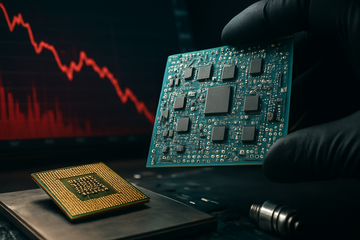
Oct 17 was the day the memory tape snapped. Micron gave up $52.40, or 5.63%, to close at $878.84 — back below the $1T mark for the first time since late May — and SanDisk slid 6.85% to $1,299.30. The Philadelphia Semiconductor Index logged its eighth straight decline (-3.83% on the day to 11,137.29), the longest such streak since the October 2008 financial crisis. In Seoul, the cycle closed with Samsung down roughly 9% over the prior two sessions and the KOSPI triggering a circuit breaker for the first time since July. Across Samsung, SK Hynix, Micron, and SanDisk, more than $700B of market value has been wiped out since Oct 6 — the proximate trigger, a Chinese CXMT architecture disclosure, did not itself ship a chip.
The Oct 17 Print: Eight Days, $700B, and a Cap Re-Lost
The session crystallized a regime change the tape had been warning about for a week. Memory-linked names shed value at a pace normally associated with cyclical peaks: Micron alone is down ~30% from its June 25, 2026 closing high of $1,213.18, while SanDisk has retraced ~45% from its $2,354 52-week peak. A broader basket of 61 semiconductor and storage stocks has lost close to $2.5 trillion over the same stretch, per Yahoo Finance's running tally.
Micron close
$878.84
Oct 17, 2026 — down $52.40 / -5.63% on the day
Micron market cap
$994.3B
Back below the $1T mark; ~30% off June 25, 2026 high of $1,213.18
SanDisk close
$1,299.30
Oct 16, 2026 — -6.85% on the day
SOX losing streak
8 sessions
Longest since Oct 2008; closed -3.83% to 11,137.29 on Oct 16
Broader 61-stock chip basket loss
~$2.5T
Cumulative wipeout across memory + storage since Oct 6
Memory cartel drawdown since Oct 6, 2026 (peak vs Oct 17 close)
Price decline off August-September highs. SK Hynix and Samsung prices in KRW converted to USD at ~1,360 KRW/USD; percentages illustrative.
Unit: %
Micron
$1,213.18 → $878.84
-27.6%
SanDisk
$2,354 → $1,299.30
-44.8%
SK Hynix
₩2,987,000 → ₩1,272,000
-57.4%
Samsung Electronics
₩374,500 → ₩215,500
-42.5%
Why Mugalli Says the Real Threat Isn't CXMT
The most pointed reframe of the session came from Nicholas Mugalli, CEO and principal of World Trade Securities, in a Benzinga interview published Oct 17. Mugalli explicitly inverted the day's narrative: in his view, the danger to Micron and SanDisk shareholders in 2026-2028 is not CXMT's 4F² roadmap but Samsung's confirmed capacity expansion plus the balance sheet to chase share. He also cited the structural constraint that new DRAM fabs take roughly three years to build, putting Samsung's already-groundbroken expansions on a much shorter time-to-market than a still-unproven CXMT architecture.
| Dimension | CXMT (private) | Samsung Electronics |
|---|---|---|
| DRAM market share Q2 2026 (revenue) | ~10% (Counterpoint) | ~38% (industry tracking) |
| Stated HBM4 ramp 2026 | None commercially disclosed; product roadmap only | Sold out 2026 HBM4 supply; ~50% capacity expansion planned |
| Capex firepower 2026 | Tool-access constrained; sixth mega-fab vision vs. EUV limits | ~$73B semiconductor capex; Pyeongtaek P4 expansion |
| Track record on cell density | DDR4 + early DDR5; 4F² paper claim, no shipping silicon specs | 16Gb 4F² VCT demo at ISSCC 2026; mature 1c/1β DRAM in production |
| Mugalli's framing (Oct 17) | Trigger of the slide, not the bear-case driver | \"The real threat\" — within 24 months, on shelf space |
| Verifiable revenue | Private; pre-IPO; July 17, 2026 STAR Board filing | 485T won TTM through Jun 30, 2026 |
The distinction matters because the market has been treating CXMT as a near-term threat and Samsung as an established ally. Mugalli flips the script: CXMT's 10% revenue share (up from 4% a year ago, per Counterpoint) is real, but the constraint on its next leg up is EUV access, not capital. Samsung has both — and the operating cash flow to absorb a price war.
Samsung Has the Balance Sheet to Fight
Samsung's quarterly print released Oct 7 was the foundation for the bear case — but the market read it as a high-water mark. The company pre-announced Q3 operating profit of 107.4 trillion won (~$80B), up 783% YoY, on revenue of approximately 195 trillion won (~$147B), up 127% YoY — both company records. Through Q2 2026, trailing twelve-month operating margin sat at 36.9% on 485 trillion won of revenue (~US$360B), per the company's filed financials — structural earnings power unprecedented for a memory cycle.
- Sold out 2026 HBM4 supply, with the company targeting a roughly 50% capacity expansion (to ~250,000 wafers/month) by year-end — a footprint that puts Samsung directly in NVIDIA's Rubin allocation, displacing Micron in early build shares
- Set to spend ~$73 billion on semiconductor capex in 2026 per company guidance, with Pyeongtaek P4 expansion and continued investment in the Taylor, Texas fab — capital intensity that no Chinese rival can match under current tool-access rules
- Already running a 4F² vertical-channel demo from ISSCC 2026, ahead of CXMT's planned end-of-year RDIMM — Samsung's roadmap puts density gains into production faster than CXMT's unverified cell architecture
- 2026 traditional-DRAM ASP up roughly 326% YoY (NAND +283%) per Goldman estimates, with Q3 commodity DRAM contract prices still rising into the 4Q — the mature-node segment that drives Micron's and SanDisk's near-term earnings is exactly where Samsung is most aggressive
| Metric (TTM) | Micron | SK Hynix | Samsung Electronics |
|---|---|---|---|
| Revenue | $133.2B | ₩189.2T (~$140B) | ₩485.3T (~$360B) |
| Gross margin | ~80.7% | ~76.2% | ~56.9% |
| Operating margin | ~75.0% | ~68.0% | ~36.9% |
| Capex / revenue | 27.6% | 19.1% | 11.3% |
| Days inventory (turns) | 147 days | 146 days | 125 days |
| Stock close Oct 17 | $878.84 | ₩1,272,000 | ₩215,500 |
Mugalli's point lands harder here than in any single quote. Samsung has lower operating margins than Micron and SK Hynix right now — meaning the firm with the most absolute earnings power and the lowest baseline profitability is the one most able to absorb a price war. If Samsung chooses to spend the cycle's peak cash flow on share, the marginal DRAM pricing for Micron and SanDisk compresses before any Chinese wafer reaches the open market.
What CXMT's 4F² Actually Changes (and Doesn't)
The CXMT announcement is real but bounded. The 4F² architecture uses vertical-channel transistors to cut each memory cell's footprint by roughly a third versus today's 6F² baseline, raising die density by up to ~50% on paper. Counterpoint pegs CXMT at 10% of global DRAM revenue in Q2 2026, up from 4% a year earlier. But the company disclosed no per-die speed, capacity, volume timing, or wafer-start run rate alongside the cell announcement.
- Counterpoint Q2 2026 share is 10% of DRAM revenue, up from 4% YoY — the ramp is real and faster than peers expected, but it started from a low base
- Bit-shipment share: ~9% in 2025, projected 12% by 2027 and 18% by 2028 per Korea Herald — that is the time horizon where CXMT becomes a materials threat, not a price-setter
- Targeted sixth mega-fab (per Tom's Hardware) would push CXMT toward 30% global share by 2030, but EUV tool access remains the binding cap on advanced-node output
- First 4F² product: a server DDR5 RDIMM by year-end 2026 — server RDIMMs are precisely where Samsung and SK Hynix sell their highest-margin dies, so a CXMT price-validated 4F² RDIMM by mid-2027 is the milestone that would force Samsung to actually respond
The HBM4 Fork That Determines Who Eats 2027
Whether Micron's share price recovers depends less on commodity DRAM and more on which memory maker captures the NVIDIA Vera Rubin socket. Micron began high-volume HBM4 (36GB 12-Hi) shipments in Q1 calendar 2026, designed specifically for Vera Rubin with >11 Gb/s pin speeds and >2.8 TB/s stack bandwidth. Multiple analyst estimates, however, have Rubin HBM4 volume tilted heavily toward SK Hynix (54-70% depending on firm) and Samsung (25-33%), with Micron capturing the balance and routing its LPDDR5X to the Vera CPU socket instead of the GPU HBM stack.
| HBM supplier | HBM4 share (UBS / Silicon Analysts) | Status |
|---|---|---|
| SK Hynix | ~70% | Dominant share; reported 80% HBM4 yield Aug 2026 |
| Samsung Electronics | ~25-30% | Hit ~33% HBM4 share post mass-production ramp; sold out 2026 |
| Micron | ~18% | Mass-producing for Rubin; LPDDR5X for Vera CPU; reportedly out of initial GPU builds |
The Mugalli thesis hangs on this fork. If Samsung — with the largest HBM capex pool of any maker and a sold-out 2026 book — pushes more aggressively into Vera Rubin in 2027, Micron's HBM revenue trajectory flattens even as DRAM pricing compresses. The market is now treating that scenario as the central case, which is why Micron trades at 7.2x EV/Sales TTM (vs. 19.4x at the end of FY2026 reported quarter) — a haircut that already discounts a meaningful share loss to Korean competitors.
The Spillover: Who Pays, Who Prints
Memory chips don't sit in isolation. The eight-session slide pulled every node of the supply chain with it, but the same Mugalli lens sharpens who gets hurt and who gets helped when Samsung decides to spend.
- Upstream — WAFER FAB EQUIPMENT: ASML, Tokyo Electron, Applied Materials, and Lam Research lose memory-customer capex visibility if Samsung pulls forward or extends its 2026 build — Tokyo Electron carries the most direct DRAM/NAND exposure per company filings; ASML's 2026 €34-39B sales guide assumed continued Samsung leading-edge EUV layers
- Upstream — MATERIALS: photoresist and gas suppliers (Shin-Etsu, JSR) face slower demand growth if Samsung defers Pyeongtaek P4 phases rather than overlapping them with HBM expansion; mature-node expansion by Samsung alone is sufficient to keep consumables growing
- Downstream — AI COMPUTE: NVIDIA is the principal buyer at risk — every $1B of memory oversupply into a Rubin cycle is margin it captures (Q2 FY2027 gross margin was already revised lower on rising component costs); the Oct 17 slide makes a memory-cost tailwind for NVIDIA more probable if not guaranteed
- Downstream — CONSUMER: Apple sits on the opposite side of the trade — Omdia reports global smartphone shipments fell 20% YoY in 3Q26 as Samsung and Apple absorb escalating DRAM/NAND costs (12GB LPDDR5X up several-fold from start-2025 base; Apple reportedly agreed to a 100% price hike on Samsung LPDDR5X for iPhone 17). Memory oversupply would relieve Apple's gross-margin compression; persistent tightness does the opposite
Horizons: Days vs Years
- Short-term (days–quarters): the SOX index is now two consecutive circuit-breaker days removed from a Feb 2026 record high; the eight-session streak often snaps with a single positive tape day, but options positioning and the magnitude of destroyed cap mean any bounce will be sold. Watch Nov 5 Micron FQ1 2027 earnings (consensus expecting 87% margin per analyst notes) for the first read on whether the HBM4 allocation and ASP hold
- Short-term (days–quarters): Samsung's late-October earnings call (Oct 30 expected) will be the test of Mugalli's thesis — if guiding DRAM ASP down materially for 4Q26, the bear case for Micron confirms; if holding guidance, the overshoot has likely run too far
- Long-term (1–3 years): the structural axis shifts to 2027-2028 HBM allocation dynamics — if Samsung takes >30% Vera Rubin HBM4 share, Micron's premium multiple compresses permanently; if it stays ~25%, Micron recovers into FY2027 on volume mix
- Long-term (1–3 years): the CXMT milestone to track is not the architecture announcement but a verified 4F² RDIMM shipment to a Tier-1 OEM at industry-competitive pricing — if that arrives by mid-2027, the inflection in DRAM market share (10% → 15%+) could pull Korean and U.S. capex into a defensive posture
Stocks that move on this memory tape break
- Sold out HBM4 2026 capacity and FQ4 2026 87% gross margin printed Sep 4, but the share is now priced for either a Samsung concession or a Korean allocation loss
- Down 30% from June 25 high of $1,213.18; market cap re-rated from $1.42T to $994.3B on the SOX's longest losing streak since 2008
- Inflection in FQ1 2027 (Nov 5, 2026) earnings: if HBM4 ASP per Gb holds and LPDDR5X sales to Vera CPU ramp, [Micron] reclaims the $1T cap; if Samsung pushes share or cycle ASPs crack, downside to ~$750 is the implied path
- Cross-listing risk — if Samsung allocates more Vera Rubin HBM to itself in 2027, [Micron]'s HBM unit growth flattens relative to consensus +58% 2027 revenue expectation
- Q4 FY2026 revenue $8.97B (Aug 5 report) was the high-water mark; 56.5% net margin with 99% capex coverage is the cleanest balance-sheet story in NAND, but the cycle top appears in
- Closed $1,299.30 Oct 16 (-6.85%) — down ~45% from $2,354 52-week high; trader positioning after recent Rosenblatt $2,400 target reset is one-sided
- Mugalli's framing matters more for [SanDisk] than [Micron]: CXMT has no NAND roadmap disclosure, so the entire bear case for NAND is Samsung's mature-node expansion
- If April 2027 calendar Q1 NAND contract prices roll over with Samsung still at full-utilization, [SanDisk] is the more leveraged downside (FY2027 consensus P/E ~8x is a margin for compression, not for multiple expansion)
- Q3 2026 record operating profit 107.4T won (~$80B), +783% YoY, pre-announced Oct 7 — the very release that framed the cycle peak that drove the Oct 17 selloff
- 50% HBM4 capacity expansion through year-end 2026 and a sold-out 2026 HBM book mean Samsung is the principal price-setter heading into 2027, not a price-taker
- Mature-node DRAM ASP +326% YoY in 2026 (Goldman) and Q3 commodity contract prices still rising into 4Q — gives [Samsung] the cash flow to absorb a price war and the balance sheet Mugalli flagged
- KOSPI 29% index weight means [Samsung]'s capex and pricing commentary single-handedly drives Korean macro liquidity and risk sentiment
- ~70% HBM4 share for NVIDIA Vera Rubin (UBS) and ~27.9% of revenue tied to NVIDIA — HBM4 ramp is the earnings engine even as conventional DRAM pricing rolls over
- 68% TTM operating margin and 146 days inventory are the most aggressive cycle positioning of the three Korean/Japanese makers — bear case is a deeper DRAM pricing reset before HBM4 ramps
- Hit 80% HBM4 yield Aug 2026 per Counterpoint — best-in-class process maturity, but the tape is pricing that as already in the stock
- If Mugalli's Samsung fight-share scenario plays out, [SK Hynix] is the more collateral damage than Samsung — same customer base, lower cushion
- Every $1B of oversupply in DRAM/HBM is direct gross-margin relief — Q2 FY2027 (Aug 26) already lowered gross-margin guidance on rising memory costs; a memory-capex reset reverses that
- Vera Rubin GPU volume depends on HBM4 being available at the contracted price; with the memory cartel losing $700B+ in 12 days, supplier urgency to lock in 2027 contracts is the highest since 2019
- Even in a status-quo HBM4 allocation (SK Hynix 70% / Samsung 25-30% / Micron <5%), sustained memory tightness means NVIDIA holds the leverage in pricing negotiation through 2027
- Counterview: if AI capex digestion begins in 1H 2027, NVIDIA is the more exposed name on the demand side — the memory tape break is a thesis-supportive data point, not a valuation catalyst on its own
- Reportedly agreed to a 100% price hike on Samsung LPDDR5X for iPhone 17 — the Oct 17 selloff reduces the probability that iPhone 18 enters 2027 with a similar hike locked in
- Omdia: global smartphone shipments -20% YoY in 3Q26 on the memory-cost squeeze — Apple gains share at Samsung's expense inside the same dynamic, but unit growth is the binding constraint
- Memory-cost relief on a sustained 4F²-induced supply expansion would let Apple hold iPhone ASPs flat through 2027 — a multi-quarter gross-margin tailwind if confirmed
- Service revenue and iPhone replacement cycle (~1.2B active base) make Apple the more consumer-cycle-sensitive name than NVIDIA; the memory tailwind alone isn't enough to re-rate Apple
- TTM operating margin 41% and the strongest DRAM/NAND capex exposure in equipment (RPT/Coater/Developer units for HBM4 via EUV layers)
- If Samsung chooses price-war over volume-build, Pyeongtaek P4 phase ordering into 2027 flattens — Tokyo Electron loses the primary marginal capex customer
- Memory customers a meaningful share of FY26 sales per company commentary — the Oct 17 micro-shift in capex expectations is incremental margin headwind even before order book revisions
- Japan-listed so indirectly held by U.S. investors; ADR TEL gives the cleanest exposure