
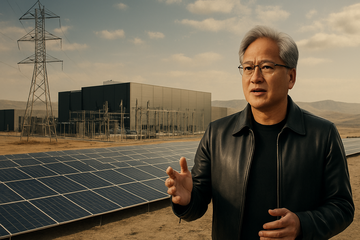
The headline from Astana was about sovereign AI and compute. The numbers underneath it were about electricity, and that is the part that changes how the AI trade should be modelled. Kazakhstan has allocated 300 megawatts of power capacity at Data Center Valley in Ekibastuz, has a five-gigawatt long-term target, and is discussing a dedicated long-term tariff of roughly 2.5 US cents per kilowatt-hour for the site's investors. It also has 26.8 gigawatts of installed generation against 17.5 gigawatts of peak demand. The binding variable in Kazakhstan is a tariff on electricity, not an order for chips.
Power capacity allocated at Data Center Valley
300 MW
Ekibastuz; five-gigawatt long-term ambition stated by Jensen Huang, Oct 23, 2026
Proposed data-centre electricity tariff
2.5 US¢/kWh
Long-term fixed contour for Ekibastuz investors; mechanism under study, no adopted act named as of Oct 8, 2026
Kazakhstan grid headroom
9.3 GW
26.8 GW installed capacity less 17.5 GW peak demand, 2025
Grace Blackwell GPUs licensed for Kazakhstan
45,000
US export license to Firebird, announced by NVIDIA, Oct 22, 2026
NVIDIA data-centre revenue
$89.0B
Q2 FY2027, quarter ended July 26, 2026; up 117% year over year
Data-centre copper demand
2.5 Mt
S&P Global Market Intelligence estimate for 2040, up from 1.1 Mt in 2025
The visit
What Was Actually Signed in Astana
Huang's first Kazakhstan visit, on October 23, 2026, was a fireside chat with Deputy Prime Minister and artificial-intelligence minister Zhaslan Madiyev, plus a meeting with President Kassym-Jomart Tokayev at the Alem.AI gathering. He pitched the country as an AI factory hub serving Europe, urging Kazakhstan to turn its \"energy into intelligence.\" The concrete commitments that followed were narrower than the rhetoric: a US export license covering 45,000 Grace Blackwell GPUs for Firebird, a first phase under construction with Kazakhtelecom, and a target commercial launch in the third quarter of 2027. The announced capacity and the energised capacity are now separated by a gap that runs through the grid.
| Item | What was said | What is documented | Status |
|---|---|---|---|
| Firebird GPU license | US export license for 45,000 Grace Blackwell GPUs for Kazakhstan | Announced by NVIDIA, Oct 22, 2026 | Licensed, undelivered |
| Data Center Valley first phase | Commercial launch targeted in Q3 2027 | Under construction with Kazakhtelecom; Firebird's Kazakhstan potential put at about 500 MW | Building |
| Power capacity | 300 MW allocated; five-gigawatt long-term plan | Per Huang's interview with Qazinform, Oct 23, 2026 | Allocated at 300 MW |
| Electricity price | About 2.5 US cents per kWh for site investors | Separate tariff contour for Ekibastuz; mechanism under study | No adopted act named |
| Deal value | Up to $250 billion of investment, $1 trillion of economic activity | NVIDIA's Qazinform interview; \"Each gigawatt is $50 billion\" | Huang's arithmetic |
| Second operator | GK Hyperscale: two hyperscale sites, $1.5 billion, 200 MW of IT capacity | Signed with the digital development ministry; first module targeted 2027 | Signed, pre-construction |
| Kazakhstan's AI champion | NVIDIA and TCV invested in a Higgsfield AI Series B extension | $400 million Series B at a $5.4 billion valuation in August 2026 | Closed |
Two details in NVIDIA's own announcement matter more than the dollar figures. First, Kazakhtelecom has already deployed 400 H200 and 480 B300 GPUs in Astana and Almaty, and plans more than 1,000 additional GPUs at Data Center Valley plus more than 1,000 Vera Rubin GPUs in the Ekibastuz region next year. Second, and more telling, NVIDIA said it intends to invest in Firebird itself. The chip vendor is now putting capital behind the cluster operator, not just selling it accelerators, which is what a vendor does when it believes demand is not the binding constraint.
Each gigawatt is $50 billion. It will generate a trillion dollars of economy.
The real product
The Product Being Sold Is Cheap Firm Power
Kazakhstan's advantage is a power surplus with an export angle. Installed generation capacity was 26.8 gigawatts in 2025 against peak demand of 17.5 gigawatts, leaving roughly 9.3 gigawatts of headroom, and renewables supplied only 14.6% of generation. That is a fossil-fuelled surplus grid, and the proposed carve-out would sell it to data centres at about 2.5 US cents per kilowatt-hour — a level no US or European site can approach. A 5 gigawatt campus would absorb more than half of Kazakhstan's current spare capacity, which is why the tariff is the strategic asset.
Electricity price: the proposed Kazakh data-centre contour against the alternatives
Kazakhstan's advantage is structural — a fossil-fuelled surplus grid with spare capacity — and the carve-out for data-centre investors is a proposal rather than law.
Unit: US cents per kWh
Ekibastuz data-centre contour (proposed)
Mechanism under study; no adopted act named as of Oct 8, 2026
2.5
Kazakhstan business tariff
March 2026, 43.242 tenge per kWh
9.6
US industrial power
2026, EIA data
9
US average, all sectors
August 2026, EIA Electricity Monthly Update
14.9
- Kazakhstan has created a \"70/30\" offtake rule: data centres and digital miners may take direct offtake of up to 70% of newly added capacity, with the balance reserved for the unified power system, under a law classifying data centres as strategic facilities.
- General regulated tariffs are moving the other way. Energy regulators raised maximum electricity tariffs for 2026-2032, with the Ekibastuz GRES-2 group set at 18.49 tenge per kilowatt-hour, up from 15.67 — so the cheap data-centre rate is a carve-out below the system price, not the system price itself.
- Kazakhstan has, by the datacentermarketinsights count of 8 October 2026, no moratorium or restriction on new data centres in force, unlike Ireland, where data centres passed 20% of national energy consumption by 2021 and triggered a de facto four-year freeze on new applications.
- Site economics are deliberately dense: 200 hectares designated beside Ekibastuz GRES-1, a 215 megawatt substation already acquired, 300 megawatts of step-down substations with 15 kilometres of dedicated lines, 1,400 hectares of land allocated, and a Tier III design target of PUE 1.25.
The real gate
Interconnection, Not Ore, Is What Actually Throttles AI Capacity
The metals argument sounds persuasive and is weaker than it looks. Copper is genuinely scarce — LME cash copper traded at $14,751 a tonne on October 14, 2026, after an intraday record of $14,875 on September 10 — and a 1 gigawatt campus is genuinely metal-hungry. But S&P Global Market Intelligence has data-centre copper usage rising from 1.1 million tonnes in 2025 to 2.5 million tonnes by 2040, with a range of 1.7 to 2.7 million, and Reuters reported in June that fibre substitution in interconnect could remove another 4 to 5 tonnes per megawatt. Copper intensity per megawatt is falling just as AI megawatts are accelerating.
Copper intensity of a data centre, tonnes per megawatt
S&P Global Market Intelligence estimates cited by Reuters, Jun 3, 2026. The fibre-shift bar is the reported 5-tonne reduction applied to the AI training case.
Unit: tonnes of copper per MW
Crypto data centre
21
Conventional data centre, low end
30
Conventional data centre, high end
40
AI training cluster, China
47
AI training cluster, after fibre shift
47 less the reported 5-tonne fibre substitution
42
| Constraint | Evidence | Why it binds harder than ore |
|---|---|---|
| Grid interconnection | Average US grid connection wait of four years between 2018 and 2023, against an 18-24 month data-centre build | A queue that cannot be bought with money or accelerated with silicon |
| Local opposition | Ireland's data centres passed 20% of national energy consumption by 2021, producing a de facto four-year moratorium on new applications | Politics can close a market that is fully built |
| Transformer and turbine lead times | Vertiv reported temporary supply-chain congestion and multi-phased project execution shifting revenue between quarters | Hardware with multi-year lead times caps the build rate regardless of GPU supply |
| On-site generation | HD Hyundai Heavy Industries won a $674 million order for 1,000 MW of generation equipment for Big Tech US data centres, Aug 10, 2026 | The only reliable way to bypass an interconnection queue |
| Copper | Data-centre copper demand of 1.1 Mt in 2025 rising to 2.5 Mt by 2040, with fibre removing 4-5 t/MW | A real but slow-moving variable against a falling intensity |
The filings
The Constraint Shows Up in Company Filings Before It Shows Up in Prices
The clearest confirmation that supply has become the constraint came from the chip vendor's own balance sheet. NVIDIA booked a $985 million provision for inventory and excess inventory purchase obligations in the quarter ended July 26, 2026, and $2.1 billion across the first half, cutting gross margin by 0.8 percentage points in the period. A supplier with a $89.0 billion data-centre quarter still had to reserve for materials it could not place.
| Company | What the filing shows | What it means for AI capacity |
|---|---|---|
| NVIDIA | Q2 FY2027 revenue of $96,221 million and data-centre revenue of $89,023 million; gross margin 75.0%; a $985 million provision for inventory and excess purchase obligations | Procurement and supply risk, not demand, is now what moves the vendor's margin |
| Vertiv | Q2 2026 net sales of $3,274 million, up 24%, with full-year guidance of $14,000 million; management cited supply-chain congestion and multi-phased project execution | Power and thermal equipment is where a constrained build actually gets priced |
| Cameco | Q2 2026 realized uranium price of US$67.79 per pound, production of 3.9 million pounds and sales of 7.1 million pounds; Fuel Services realized C$41.67 per kgU | Firm power for data centres is a fuel-and-services business, not only a generation business |
| MP Materials | Q2 2026 NdPr production of 840 tonnes, up 41%, and sales of 1,006 tonnes, up 127%; magnetics revenue $16.5 million against $108.5 million consolidated; capital expenditure of $230.0 million | Magnets and copper are real inputs but a rounding error next to power at a campus |
| Sumitomo Electric | Quarter ended June 30, 2026: net sales of ¥1,330.6 billion, up 15.9%, operating income of ¥97.1 billion | The cable and fibre inside the campus is a steadier annuity than accelerator cycles |
| HD Hyundai Electric | A KRW 1.12 trillion North America data-centre supply agreement announced Jul 2, 2026, split KRW 553.9 billion of distribution and KRW 567.3 billion of power equipment, delivered in phases through 2028 | Switchgear sells the queue position; grid kit is booked years before energisation |
| HD Hyundai Heavy Industries | $674 million order for 1,000 MW of power generation equipment for Big Tech US data centres, Aug 10, 2026 | On-site generation is the practical substitute for waiting for a grid |
| Constellation Energy | 890 MW of new nuclear capacity underwritten by a 20-year agreement with Alphabet, announced Oct 6, 2026, with more than $4.3 billion of uprate investment | Hyperscalers now buy reactors, the same move Kazakhstan is making with VVER-1200s |
Two smaller signals confirm the pattern. Kazakhstan produced 710,000 tonnes of copper in 2025, enough to rank it among the world's top ten producers, yet KAZ Minerals' first-half 2026 copper output fell 2% year on year to 179.8 thousand tonnes — the metals story for Kazakhstan is about legacy assets and territory, not an imminent supply response. And on the fuel side, Cameco's 40% stake in JV Inkai, where Kazatomprom holds the balance and produced 2.8 million pounds in the quarter, ties the fuel leg of the thesis directly to the country buying reactors: Russia and Kazakhstan agreed in May 2026 to two VVER-1200 units starting construction in 2027 in the Zhambyl region, with a Rosatom engineering, procurement and construction contract signed for Balkhash on September 3, 2026.
Who captures it
The Money Moves Down the Stack, and the Winners Are Already Reporting It
A capex chain is only as good as its least profitable link, so it is worth following where the dollars actually land. Vertiv raised full-year 2026 guidance to $14.0 billion of net sales with 31% organic growth at the midpoint and third-quarter organic growth guided to 34-36%, while explicitly noting that supply-chain congestion and multi-phased project execution moved revenue between periods. That is the sound of a supplier managing a bottleneck rather than a demand cycle. Equipment makers are capturing the constraint that NVIDIA cannot ship its way around.
- Vertiv: Q2 2026 operating cash flow of $1,100 million and adjusted free cash flow of $925 million, up 234%, ending the quarter in a net cash position while raising guidance across every metric.
- HD Hyundai Electric: a KRW 1.12 trillion North America data-centre framework with delivery phased through 2028 — grid hardware booked years before the racks arrive.
- Sumitomo Electric: first-quarter net sales up 15.9% with operating income up about 61% year on year, on management's own attribution of FY2025 growth to expanding data-centre demand.
- HD Hyundai Heavy Industries: a $674 million order for 1,000 MW of generation equipment for Big Tech US data centres, and a KRW 1.07 trillion commitment to a new power-generation engine plant.
- Cameco: 19.5 to 21.5 million pounds of 2026 production guidance on its own share, with Fuel Services guided to 13-14 million kgU — converting ore into the enriched fuel and services that firm power requires.
- MP Materials: NdPr sales of 1,006 tonnes in Q2 2026 against production of 840 tonnes, with magnet manufacturing begun at Independence in December 2025 and the 10X magnet campus in Northlake under construction.
The magnet layer is real but small, and Kazakhstan has a foothold in it. REalloys signed non-binding agreements with AltynGroup Kazakhstan for a ten-year rare-earth offtake and a strategic investment, targeting feedstock from the Kokbulak project, a 127,000 square-kilometre concession in the Karaganda and Kostanay regions, with dysprosium- and terbium-bearing concentrate available from iron tailings and downstream metal, alloy and magnet production planned in Euclid, Ohio. Separately, the International Energy Agency puts global high-performance neodymium-iron-boron magnet capacity at roughly 18 thousand tonnes on a rare-earth-element content basis as of early 2026. That is the constraint the United States and Europe are actually scrambling over, and it is orders of magnitude smaller than the power problem.
Horizons
What Has to Be True, and When You Will Know
| Horizon | Catalyst | Date | What it proves |
|---|---|---|---|
| Days to quarters | An adopted act naming the Ekibastuz data-centre tariff | Not yet dated | Whether 2.5 US cents per kWh is a policy or a proposal |
| Days to quarters | NVIDIA's third-quarter FY2027 results | November 2026 | Whether the $985 million provision repeats or reverses |
| Days to quarters | MP Materials' first commercial magnet shipments | Q4 2026 | Whether the magnet constraint has a commercial supply answer |
| One to three years | Data Center Valley first phase commercial launch | Q3 2027 | Whether 45,000 licensed Blackwell GPUs convert into running clusters |
| One to three years | VVER-1200 construction start in the Zhambyl region | 2027 | Whether Kazakhstan's firm power is coal-backed or reactor-backed |
| One to three years | HD Hyundai Electric delivery completion | Through 2028 | Whether grid kit orders convert into energised capacity |
The risks are unusually legible. If the tariff contour is never legislated, the 5 gigawatt ambition becomes a promotional figure with a 300 megawatt floor. If hyperscaler capital discipline tightens — analysts flagged growing AI fatigue in July as Amazon guided to $200 billion of 2026 capital spending — the cluster demand that justifies dedicated offtake rights can soften. If fibre substitution proceeds faster than the reported 4 to 5 tonnes per megawatt, the copper leg weakens further. And if Chinese and other non-US AI hardware keeps taking share of the export-licensed market, the specific scarcity NVIDIA is monetising in places like Kazakhstan erodes. The thesis fails first on power policy and second on capital discipline, not on ore.
Synthesis
The Losers Model AI Demand as GPU Orders
This is why the framing matters for portfolios. A model that treats AI demand as an accelerator order book asks the wrong question. The right question is how many megawatts can be permitted, connected and financed in a given quarter, because that is what determines when a 45,000-GPU license becomes a working cluster. NVIDIA's own provision, Vertiv's revenue moving between quarters because of supply congestion, and HD Hyundai's multi-year 2028 delivery schedule all point the same way. GPU demand is the observable symptom; energised megawatts are the binding variable.
Kazakhstan is instructive precisely because it has all the inputs — cheap fossil power, 9.3 gigawatts of spare capacity, the world's largest uranium producer, top-ten copper output and a rare-earth foothold — and still has to wait for a law before its tariff is real. That is the discipline the trade needs. NVIDIA is the clearest beneficiary of the current wave, but it is the vendor at the end of the queue rather than the owner of the scarce input, and the companies quoting the constrained input — switchgear, turbines, fuel, cables — are the ones already converting it into backlog. Own the bottleneck, not the demand.
Own the Constraint: Grid, Firm Power and the Vendors of Scarcity
- Q2 FY2027 data-centre revenue of $89.0 billion, up 117% year over year, keeps sovereign buyers like Kazakhstan taking whole clusters, extending the order book well beyond the hyperscalers
- A $985 million provision for inventory and excess purchase obligations in the quarter is the clearest sign that procurement, not demand, now moves the margin
- Horizon: near term, watch the November quarter for a repeat provision; one to three years, the 5 gigawatt Kazakh ambition is the test case for sovereign AI
- Q2 2026 net sales of $3,274 million, up 24%, with full-year guidance of $14.0 billion and 31% organic growth, capitalises directly on the megawatt shortage NVIDIA cannot solve
- Management explicitly flagged supply-chain congestion and multi-phased project execution shifting revenue between quarters, confirming hardware is the binding term
- Horizon: one to three years, every new sovereign campus repeats the same power-and-cooling bill
- A KRW 1.12 trillion North America data-centre agreement, split KRW 553.9 billion of distribution and KRW 567.3 billion of power equipment, turns Korean switchgear into the sellable form of a grid connection
- Deliveries phased through 2028 make this a multi-year revenue annuity rather than a one-quarter spike
- Horizon: near term, watch whether a second hyperscaler framework follows the first
- A $674 million order for 1,000 MW of generation equipment for Big Tech US data centres, moves the bottleneck upstream to where the electrons actually come from
- A KRW 1.07 trillion commitment to a new power-generation engine plant signals management expects on-site generation demand to persist
- Horizon: near term, engine and turbine lead times set the pace of every announced campus
- Realized uranium price of US$67.79 per pound in Q2 2026 with 19.5-21.5 million pounds of 2026 guidance lock in the fuel demand created by firm, nuclear-backed AI power
- Against that, Q2 net earnings fell to C$25 million from C$321 million a year earlier and Westinghouse swung to a C$10 million loss on its share
- Its 40% of JV Inkai ties the fuel leg directly to the country now building its own reactors, with 4.2 million pounds of 2026 allocation still to be delivered
- Horizon: watch the second half of 2026, when the bulk of that allocation is scheduled to ship
- NdPr production of 840 tonnes, up 41%, and sales of 1,006 tonnes, up 127%, prove the feedstock ramp arrives well before the magnet economics do
- Magnetics revenue of $16.5 million against $108.5 million consolidated shows magnet scale is still immaterial to results
- Catalyst: commercial magnet shipments from Independence begin in Q4 2026, the date that decides whether this is a miner or a magnet maker
- Horizon: near term, the risk is $230.0 million of quarterly capital expenditure outrunning the magnet revenue
- First-quarter net sales of ¥1,330.6 billion, up 15.9%, with operating income of ¥97.1 billion, rides the copper and fibre inside the same racks as the accelerators
- Management credits expanding data-centre demand for FY2025 growth in wire and cable
- Horizon: one to three years, cable and optics compound with campus density regardless of which vendor wins the accelerator
- 534,407 tonnes of mined copper in the first half of 2026 and net profit of RMB 39.2 billion, up 68%, show the volume absorber for grid and AI electrification demand
- Kazakhstan's 710,000 tonnes of 2025 output places it in the world's top ten, though local first-half 2026 production fell 2% year on year
- Horizon: near term, LME cash copper near $14,751 a tonne in mid-October sets the revenue backdrop