
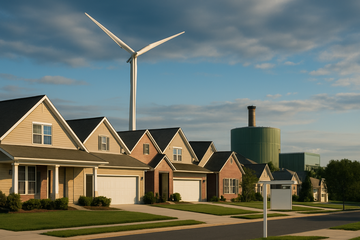
xAI's Southaven buyout is not a land grab and it is not a zoning workaround. It is a lawsuit settlement priced at about $180,000 a house, and the record of the site shows exactly which risk the compute buildout is trying to buy off: the noise and vibration from 69 temporary gas turbines sitting a few hundred feet from a residential street.
Homes in the buyout target
418
Colonial Hills, Southaven, Mississippi; reported Oct 28, 2026
Implied cost of the program
$75.24M
418 homes at the roughly $180,000 local average
Owners already committed
18
Per a realtor's remarks to residents, Oct 28, 2026
Power behind the homes
1.2 GW
Permanent 41-turbine plant replacing 69 temporary units by July 2027
Large-investor trigger
350 homes
Proposed Treasury rule published Oct 23, 2026; effective Jan 7, 2027
What was bought
A $75 Million Settlement With a Gigawatt Power Plant Attached
MZX Tech, the xAI affiliate that runs the turbine plant at 2875 Stanton Road South in Southaven, is offering to buy homes in the adjacent Colonial Hills subdivision. The condition is written into the letter: owners sign a release of all claims tied to the Haley class action, which three residents filed in June 2026 over near-constant turbine noise and vibration. At the roughly $180,000 local average, Forbes put the full program at $75.24 million, and a realtor told residents 18 households have already agreed to sell.
That converts a class-action nuisance risk into a balance-sheet line: settles the buyer's own claims for roughly $180,000 a house, with no public confirmation from the company that 418 is a committed program rather than a realtor's number. Either way, the mechanism is the same as a settlement payment, just denominated in deeds.
| Term | What the record shows |
|---|---|
| Target | Up to 418 homes in Colonial Hills, Southaven, Mississippi |
| Buyer | MZX Tech, the xAI affiliate that operates the Southaven turbine plant |
| Price basis | About $180,000 per home, the local average, implying roughly $75.24 million |
| Condition | Owner signs a release of all claims tied to the Haley class action |
| Committed so far | 18 homeowners, per a realtor speaking to residents |
| Claims released | Noise and vibration from the plant, pleaded in a June 2026 class action |
| What it buys | Dismissal of the seller's own claims, not the class action |
| What it does not buy | Any additional megawatts, or relief from clean-air litigation |
What the program does not do is more important than what it does. It adds no capacity: the site was already an operating gas plant, and the facility record lists MZX Tech's Southaven site at up to 1,240 MW of proposed output. The buyout buys dismissal of claimswithout buying a single megawatt, which means it is not a siting strategy at all. It is a political one, aimed at the people who can turn a permit hearing, a council agenda, or an air-quality complaint into an operating constraint.
The site in numbers
Owner and address
MZX Tech, 2875 Stanton Road S
Facility record lists up to 1,240 MW of proposed capacity
Temporary fleet
69 turbines
Removal announced Jul 30, 2026
Permanent plan
41 turbines, 1.2 GW
Temporary-fleet removal to complete by Jul 2027
Air permit
Approved Mar 10, 2026
Unanimous vote, with emissions-modeling conditions
Clean-air exposure
59 turbines without federal permits
Reuters, Jul 14, 2026
The real constraint
Permits and Consent, Not Silicon, Are the Scarce Inputs
| Date | Event |
|---|---|
| Feb 13, 2026 | NAACP announces intent to sue over Clean Air Act violations at the Southaven turbine site |
| Mar 10, 2026 | Mississippi permit board unanimously approves 41 methane turbines with emissions conditions; Southaven residents oppose |
| Jun 2026 | Three Southaven residents file the Haley noise class action against xAI |
| Jul 14, 2026 | Reuters reports 59 turbines running for Colossus 2 without federal clean air permits |
| Jul 30, 2026 | xAI says all 69 temporary turbines come out, replaced by a permanent 1.2 GW, 41-turbine plant by July 2027 |
| Oct 28, 2026 | MZX Tech offers to buy up to 418 Colonial Hills homes if owners release their noise claims |
Read the sequence and the constraint is obvious. The company did not run out of chips, capital or turbines. It ran into a stack of permit conditions, a Clean Air Act notice of intent to sue, and a class action filed by the neighbors of a temporary power plant, all of it resolvable only by consent that cannot be bought from a municipality.
The July 2026 change makes the problem permanent rather than solving it: the69 temporary turbines are retired, but the replacement plant is 1.2 GW of permanent infrastructure, so retires the temporary noise while doubling the plant behind it. The buyout offer, made three months later, is a response to that fact. A neighborhood that lives next to a permanent gigawatt for the next twenty years needs a durable arrangement with whoever owns it, and deeds are how that arrangement gets made.
The political arithmetic is what makes this worth watching beyond one subdivision. Reuters reported that pollution from the unpermitted turbines fell hardest on the Black communities around the site, and the environmental groups pursuing the air permit are not parties to any of these private releases. Buying418 housessettles the private nuisance channel while leaving the public clean-air channel open, which is why local officials have historically responded to data centers with moratoria, special districts and cost-recovery clauses rather than with kindness.
The rule
Treasury Wrote a 350-Home Trigger With a Carve-Out That xAI Fits
Treasury issued proposed regulations on October 22, 2026 implementing section 1001 of the 21st Century ROAD to Housing Act, which became law in July 2026. Beginning January 7, 2027, a large institutional investor generally may not purchase, or enter into a contract to purchase, a single-family home unless the purchase qualifies as an excepted purchase. The definition has three parts: a for-profit entity, investment control over at least 350 single-family homes, and being engaged in the business of investing in, owning, renting, managing or holding those homes. Comments on the proposal close November 23, 2026.
My Administration will take decisive action to stop Wall Street from treating America's neighborhoods like a trading floor, and empower American families to own their homes.
The third prong is where xAI lives. Treasury's proposed text says an entity is engaged in the business when it holds single-family homes for the purpose of receiving income or financial gain, and it is not engaged when it holds homes solely on a temporary and incidental basis in furtherance of a different bona fide business, only to the extent reasonably necessary, and not as a regular or continuing investment strategy. MZX Tech is not buying houses to collect rent. It is buying them to end a lawsuit against a power plant, and on the face of the proposal that is incidental to a different bona fide business rather than a housing investment. The stack of exceptions around it reinforces the point: build-to-rent purchases within 18 months of a certificate of occupancy, renovate-to-rent homes that failed core code elements at purchase with at least 15% of price spent on improvements, and homeownership programs carrying meaningful financial support with a safe harbor of the lesser of $5,000 or 2.5% to 3.5% of purchase price.
| Holder | Homes | Vs. the 350 trigger | Status under the proposal |
|---|---|---|---|
| xAI's MZX Tech | 418 target | 1.2x | Outside the definition while the purchases stay temporary and incidental to the plant; covered if any home is rented |
| Invitation Homes | 86,192 | 246x | Covered. May keep owning; future purchases must be excepted |
| American Homes 4 Rent | Over 61,000 | 174x | Covered. Lighter exposure because growth is development-led |
Who is actually capped
The Rental REITs Are the Ones With a Ceiling
Once the 350-home line is crossed, the restriction stops being a headline and becomes an operating constraint, because the count that keeps a covered investor covered grows with every purchase that is not an excepted purchase. Invitation Homes owned 86,192 single-family rental homes at the end of 2025, 246 times the trigger, and grew FY2025 revenue just 4.2% to $2,729.3 million. American Homes 4 Rent owned over 61,000 properties as of June 30, 2026 and grew FY2025 revenue 8.0% to $1,866.2 million, mostly by building: 651 deliveries in the second quarter of 2026 and core net operating income up 4.3% to $275.4 million. HousingWire reported that both companies describe build-to-rent capital as returning only slowly, and AMH's own management framed the law mainly as a headwind for competitors that rely on multiple-listing-service acquisitions.
| Invitation Homes | American Homes 4 Rent | |
|---|---|---|
| Single-family homes owned | 86,192 at Dec 31, 2025 | Over 61,000 at Jun 30, 2026 |
| Multiple of the 350 trigger | 246x | 174x |
| FY2025 revenue | $2,729.3M, up 4.2% | $1,866.2M, up 8.0% |
| Trailing-twelve-month revenue | $2,898.2M | $1,879.8M |
| EV/EBITDA, trailing twelve months | 13.7x | 13.7x |
| Net debt to EBITDA | 4.9x | 4.2x |
| Free cash flow yield | 7.2% | 8.2% |
| Growth engine | Acquisition-led, renovation-heavy turnovers | Development-led,651 Q2 2026 deliveries |
| Policy exposure | Direct: every purchase must qualify as an excepted purchase | Lighter: new build sits inside build-to-rent |
Enterprise value to EBITDA, trailing twelve months
Identical multiples for two rental REITs with very different growth mixes; Southern Company through Q2 2026, GE Vernova through Q3 2026.
Unit: x
Gas Power backlog at $130.9 billion
21.5
86,192 homes, acquisition-led
13.7
Over 61,000 homes, development-led
13.7
17 GW of contracted large load
12.5
The exception stack is narrower than the headline suggests, and that is the point. A home qualifies for the renovate-to-rent carve-out only if it failed structural or core-system elements of local building code at purchase and the buyer resolves those deficiencies while spending at least 15% of the purchase price on improvements. On a $180,000 house that is $27,000, but the substandard condition test is the binding one: rent-ready homes, the cheapest inventory for both REITs, do not qualify. The market prices the two companiesat the same 13.7x despite one growing revenue 8.0% and the other 4.2% in the year the ban was enacted, which is a bet that the exception reads wider than the text suggests.
Who gets paid
The Equipment Chain Is Paid Whether the Neighborhood Stays or Goes
Upstream, the argument is much simpler. GE Vernova gas turbines already power the Colossus 1 campus in Memphis, and the Clean Air Act notice of intent to sue filed in February 2026 identifies six GE Vernova 2500 units installed there. The Q3 2026 numbers show what the buildout cycle is doing to order intake: 112 gas turbines and 16.6 gigawatts ordered in the quarter, against 29 units and 7.4 gigawatts a year earlier, with Gas Power revenue of $5,117 million and Gas Power backlog of $130,854 million, up 38% since the end of 2025. Total backlog across the company reached $196,721 million, up 31%.
GE Vernova gas turbine orders
Gigawatts of gas turbines ordered in the quarter, per the Q3 2026 Form 10-Q.
Unit: GW of gas turbines ordered
Q3 2025
29 turbine units ordered
7.4
Q3 2026
112 turbine units ordered
16.6
Mitsubishi Heavy Industries is levered to the same demand from a different angle. Nikkei Asia reported in September 2026 that US data centers are driving group gas turbine orders to a pace of100 gigawatts or more in the first half of 2026, and the company's own order intake rose 12.6% to 5,029.1 billion yen against FY2026 revenue of 4,974.2 billion yen. Like GE Vernova, it is selling power-plant equipment into a queue that politics cannot reorder, which is why the siting fight barely moves the equipment P&L.
The utility layer is the one place where the Southaven template is a direct threat. Southern Company has 17 gigawatts of contracted large load, up 6 gigawatts since the first quarter of 2026, and its 2025 review projects8% annual electric sales growth through 2029 on data center demand, with capital spending running near 25% of revenue. EEI's October 2026 tracker of large customer projects lists a $10 billion, roughly 500 megawatt data center campus at Mississippi Power. But a lab that builds its own 1.2 GW gas plant behind the meter takes the load off the utility's rate base entirely, which turns a multi-decade revenue stream into a customer the utility never gets to serve.
Horizons
Two Deadlines and One Very Loud Number
- Next two quarters: November 23, 2026 is the comment deadline on Treasury's proposal, and the final rule must land before January 7, 2027 for the ban to bite on schedule.
- Next two quarters: watch how Invitation Homes and American Homes 4 Rent describe acquisition volumes and renovation spending, the cheapest available read on how wide the exceptions will be.
- Next two quarters: watch what MZX Tech does with the homes it buys. Renting any of them flips the carve-out and converts a nuisance settlement into a covered position.
- Through July 2027: removal of all 69 temporary turbines and construction of the permanent 41-turbine, 1.2 GW plant, the physical deadline behind every negotiation with the neighborhood.
- One to three years: if the carve-out survives, the buyout becomes a template other compute labs copy, and local consent becomes a priced input at roughly $180,000 a house, cheaper than any interconnection queue.
- One to three years: state and municipal responses are the real risk, since a federal rule aimed at housing investors does little to a county supervisor with a noise complaint.
- One to three years: if institutional buyers retreat from rent-ready existing homes, resale inventory in Sun Belt markets thins and single-family prices get bid up, which is the policy's stated intent and a headwind to rental affordability.
- One to three years: if behind-the-meter gas becomes the default AI power model, the turbine order book gets bigger and the utility rate base gets smaller, a transfer of value from regulated returns to equipment makers.
Falsification
What Breaks This View
- The 418 figure is realtor-sourced, not company-confirmed. Only 18 households were reported committed; the program may be a negotiating posture rather than a pipeline.
- The clean-air exposure is untouched by private releases. If the Clean Air Act litigation succeeds, the 1.2 GW plant faces consent decrees or relocation, and the buyout turns into stranded property.
- If Treasury reads the renovate-to-rent exception broadly, the rental REITs are largely fine and the bearish read on acquisition-led growth fails.
- If the rule is delayed, narrowed or enjoined, the January 7, 2027 deadline loses its force and the REITs regain optionality.
- Turbine conversion is the quiet risk for the upstream case: GE Vernova put2026 tariff costs below $100 million, but delivery slots, gas prices and customer cancellations can still slip cash timing.
Synthesis
The Land-Play Frame Is Wrong, and the Regulatory Frame Is Aimed at the Wrong Buyer
Fact: xAI's affiliate is offering to buy up to 418 Southaven homes for about $75.24 million, conditioned on releases of a June 2026 noise class action, with 18 households committed. Fact: the site behind the homes is a gas plant whose 69 temporary turbines are being replaced by a permanent 1.2 GW facility by July 2027. Fact: from January 7, 2027, a large institutional investor may not buy single-family homes unless the purchase is excepted, and a large institutional investor is defined in part by holding 350 or more of them for income.
Inference from those texts: MZX Tech's purchases are most likely incidental to running a power plant rather than a housing investment, so the January 2027 rule probably does not apply to them at all, while Invitation Homes and American Homes 4 Rent sit squarely inside it, with the asymmetry between them running through their growth engines rather than their balance sheets. Inference with the most teeth: the compute buildout has learned to price political risk in houses, roughly $180,000 per neighbor, which is cheap enough that it will keep happening whatever Washington writes next.
Speculation, flagged as such: that the carve-out survives final rulemaking intact, that other labs copy the template, and that state-level response eventually makes the federal rule the smaller half of the problem. None of it is knowable today. What is knowable is the sequencing, and it favors the owners of the turbines over the owners of the homes.
Who the siting fight actually moves
- Q3 2026 gas turbine orders hit 112 units and 16.6 GW, against 29 units and 7.4 GW a year earlier.
- Gas Power backlog reached $130,854 million, 38% above Dec 31, 2025, with total company backlog of $196,721 million.
- books turbine orders years before the siting fight is settled, so a court order delays revenue without cancelling it.
- Next two quarters, Q4 2026 order prints and the Southaven plant order; over 1-3 years, behind-the-meter gas adds structural demand.
- US data center load is pulling group gas turbine orders to a pace of 100 GW or more in the first half of 2026, per Nikkei Asia on Sep 23, 2026.
- Order intake rose 12.6% to 5,029.1 billion yen against FY2026 revenue of 4,974.2 billion yen.
- turns US data center power demand into two decades of turbine revenue, with order intake the near-term signal and delivery slots the long-term one.
- Risk over 1-3 years: the same permitting friction slows turbine commissioning schedules rather than cancelling them.
- Owns 86,192 homes at Dec 31, 2025, 246 times the 350-home trigger, and every future purchase must qualify as an excepted purchase.
- FY2025 revenue grew 4.2% to $2,729.3 million, the slower of the two large rental REITs in the year the ban was enacted.
- needs a narrow renovation carve-out to keep buying rent-ready homes: 15% of a $180,000 price is $27,000, and the rule also requires the home fail core code elements at purchase.
- Over 1-3 years, the outcome depends on the final rule text and on whether buy-and-flip competitors are squeezed out of the acquisition market.
- Owns over 61,000 properties at Jun 30, 2026, but grew FY2025 revenue 8.0% to $1,866.2 million by building, including 651 deliveries in Q2 2026.
- Q2 2026 core net operating income rose 4.3% to $275.4 million, and management framed the law as a headwind mainly for competitors reliant on MLS acquisitions.
- keeps growing through development rather than acquisition, with an 8.2% free cash flow yield as the cushion against a slower external growth path.
- The offsetting force: state-level copies of the rule and political scrutiny of a 61,000-home footprint.
- Contracted large load reached 17 GW, up 6 GW since Q1 2026, and the 2025 review projects 8% annual electric sales growth through 2029.
- EEI's October 2026 tracker of large customer projects lists a $10 billion, roughly 500 MW data center campus at Mississippi Power.
- risks the Southaven template pulling AI load off its own rate base, since behind-the-meter generation sells no utility electricity at all.
- Capital spending already runs near 25% of revenue, so any shift of load from grid to self-supply is a direct hit to rate-base growth.