
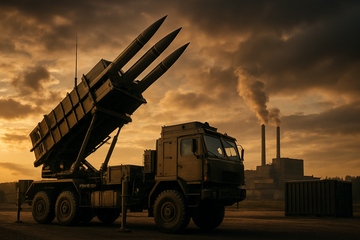
On Oct. 30, 2026 the State Department approved a possible sale of 500 Patriot PAC-3 MSE interceptors to Ukraine at an estimated $2.1 billion, funded entirely by Canada, Germany and Norway through the JUMPSTART program and by national funds financed by the European Union's Ukraine Support Loan. No U.S. money is involved, and the notification came with no delivery schedule attached. The dollars are the least interesting part of this order.
Interceptors approved
500 PAC-3 MSE
Foreign Military Sale notification, Oct. 30, 2026, Transmittal 26-113
Estimated cost
$2.1B
About $4.2 million per missile including spares and support, per the notification
U.S. taxpayer share
$0
Paid by Canada, Germany and Norway via JUMPSTART plus EU Ukraine Support Loan funds
Expected first delivery
Early 2030s
Two people briefed on the decision, reported Oct. 30, 2026
The notification
What Was Approved — and What Was Not
The notification is a step, not a sale. It opens a congressional review period; only after that can the United States and Ukraine sign a letter of offer and acceptance and the Army place the order with Lockheed Martin, the principal contractor. At roughly $4.2 million a missile including spares and support, the headline is real money. What it purchases is a single thing: a position on a production line that is already funded through fiscal 2032.
| Term | What the record says |
|---|---|
| Missiles | 500 Patriot PAC-3 MSE interceptors |
| Estimated cost | $2.1 billion, about $4.2 million per missile including spares and support |
| Who pays | Canada, Germany and Norway through JUMPSTART, plus national funds financed by the EU's Ukraine Support Loan — no U.S. money |
| Principal contractor | Lockheed Martin |
| Legal status | Not a contract: congressional review first, then a letter of offer and acceptance, then an Army order with Lockheed Martin |
| Delivery schedule | None published. Two people briefed on the decision said the rounds are not expected until the early 2030s |
| What Ukraine asked for | A winter package of 100 interceptors a month; the U.S. supplied an average of 12 a month in 2026 |
We are asking our American partners to find a solution for the time when there is a real danger and a real need to use PAC-3 interceptors.
The binding constraint
The Queue Is the Product
Everything downstream of that line is rationed by the line itself. Lockheed Martin says the Camden, Arkansas plant — the sole final all-up assembly site for PAC-3 MSE — can triple from about 600 interceptors a year to 2,000 by the end of 2030, and it is adding roughly 650 jobs there to do it. Against that, the combined Patriot order book of Ukraine, Germany and Poland alone stands above 4,300 rounds, which the Foreign Policy Research Institute calculated as roughly seven years of output at 2025 production rates. Ukraine's 500 rounds are ten months of today's output and three months of the target rate.
Patriot rounds: what one line can make versus what is queued for it
The order approved on Oct. 30 is large for Ukraine and immaterial for the line. That asymmetry is the whole story of the queue.
Unit: interceptors (rounds)
Current PAC-3 MSE output per year
Lockheed Martin, July 29, 2026
600
Target output per year by end-2030
Lockheed Martin, July 29, 2026
2,000
Ukraine, Germany and Poland backlog
Foreign Policy Research Institute, May 18, 2026
4,300
Ukraine's new order
State Department notification, Oct. 30, 2026
500
- At the current rate of roughly 600 rounds a year, 500 interceptors stretch to ten months of the entire Patriot line's output.
- At the 2,000-a-year target, the same 500 rounds add only three months of cover.
- Against the 4,300 rounds Europe has already ordered, Ukraine's order equals 11.6% of the standing European backlog.
- At 12 interceptors a month — the average actually delivered in 2026 — 500 rounds stretch to 42 months of supply.
- At the 100 a month Kyiv asked for, 500 rounds cover five months of the winter.
- At $2.1 billion, the sale equals 3.6% of the $58.62 billion seven-year award that funds the line.
Priority order
Who Is Next in Line
Poland's army commander made the priority order explicit on Oct. 12, 2026. General Ireneusz Nowak said PAC-3 MSE deliveries to Poland are \"going to be delayed for sure,\" on top of delays already scheduled, and attributed the slip to an Iran war that has drawn down American stocks. Washington officials had warned European counterparts that contracted deliveries were likely to slip as that draw continued, and U.S. Patriot stocks in Europe have been described as beyond critical. American inventory moves first, because it is already built and already paid for.
| Order | Who | Evidence |
|---|---|---|
| 1 | U.S. stockpile replenishment | $58.62 billion multiyear PAC-3 MSE award running through fiscal 2032; $52.5 billion of it sits inside Lockheed Martin's backlog |
| 2 | Active Middle East theatres | Roughly two-thirds of pre-war U.S. Patriot inventory consumed in the Iran conflict; European stocks described as beyond critical |
| 3 | Contracted European allies | Poland's general said PAC-3 MSE deliveries are \"going to be delayed for sure\"; the European backlog exceeds 4,300 rounds |
| 4 | Licensed offshore production | Mitsubishi Heavy Industries makes about 30 PAC-3 a year in Japan under license and shipped finished interceptors to the U.S. in November 2025 |
| 5 | Ukraine | 500 rounds, no schedule, appended to a line already funded through 2032 |
None of that makes Ukraine's order worthless; it makes it honest. The order is a standing claim on future output, priced at $4.2 million a round, paid for by allies who cannot substitute for it. What it will not do is pull a single interceptor forward for Kyiv, and it takes none from Poland. Anyone underwriting this sale as a near-term resupply is underwriting a claim on a factory, not on a battlefield.
How a headline becomes profit
Fixed Price, Flat Margin
This is where the contract structure bites. Lockheed Martin's Missiles and Fire Control segment — the home of PAC-3 — grew sales 24% to $4.50 billion in the third quarter of 2026 on PAC-3 and THAAD production ramps, and lifted operating profit 24% to $631 million. Segment margin went the other way, landing at 14.0% against 14.1% a year ago. Volume arrived; price did not.
| Q3 2026 | Lockheed Martin | RTX |
|---|---|---|
| Revenue | $20.71B | $24.97B |
| Gross margin | 11.8% | 23.3% |
| Relevant segment margin | 14.0% in Missiles and Fire Control, on 24% sales growth | 14.1% in Raytheon, up 190 basis points year on year |
| Backlog | $292.0B, of which $52.5B is the PAC-3 MSE multiyear award | $340.0B, of which $164B is defense |
| Queue role | PAC-3 MSE prime; holds the 500-unit Ukraine order | Launchers, radar and sustainment; Patriot cited as a Q3 growth driver |
Lockheed Martin consolidated gross margin by quarter
The two trough quarters are fixed-price catch-ups rather than demand shocks: revenue never dipped, while gross profit fell by roughly 80% and then recovered.
Unit: %
Q4 2024
Form 10-Q for FY2024
3.7%
Q1 2025
Form 10-Q for Q1 2025
12.9%
Q2 2025
Form 10-Q for Q2 2025
4%
Q3 2025
Form 10-Q for Q3 2025
12%
Q4 2025
Form 10-Q for FY2025
11.4%
Q1 2026
Form 10-Q for Q1 2026
11.5%
Q2 2026
Form 10-Q for Q2 2026
12.2%
Q3 2026
Form 10-Q for Q3 2026
11.8%
Supply chain
Who Actually Gets Paid
Fixed-price capacity is paid for upstream, where content is added and pricing is still open. Boeing took a $14.7 billion undefinitized contract from Lockheed Martin on Oct. 5 to scale PAC-3 MSE active radar seeker output, with the seven-year framework calling for triple production and hundreds of jobs in Huntsville. L3Harris won a seven-year undefinitized propulsion contract announced Sept. 8 covering the MSE's two-pulse solid rocket motor, attitude control motors and lethality enhancer. These are the layers where a delayed Ukrainian delivery still produces revenue, because the tooling and the long-lead components are bought before the round is built.
- Boeing triples PAC-3 MSE seeker output under a $14.7 billion undefinitized award, with hundreds of Huntsville jobs.
- L3Harris locks in the two-pulse motor and lethality enhancer on every MSE round built to 2030.
- Both awards are undefinitized, so the price — and the margin — on the ramp is not yet fixed.
- Lockheed Martin's own seven-year award is structured the same way: a $53.86 billion undefinitized modification inside a $58.62 billion multiyear total.
Downstream, the queue is a financing problem before it is a delivery problem. Canada, Germany and Norway pay for Ukraine's rounds through JUMPSTART and the European Union's Ukraine Support Loan covers the rest, so the money arrives as allied donations and a loan rather than a U.S. appropriation. Poland, meanwhile, was selected on Oct. 27 to host Europe's dedicated PAC-3 missile maintenance facility, bringing repair, refurbishment and lifecycle work closer to the operators who need it. Japan's licensed line — the only Patriot capacity outside U.S. control — now exports finished interceptors to the United States. Every ally in the queue is being told what it is buying: a position, not a date.
What Europe buys while it waits
IRIS-T SLM
Diehl Defence (Germany)
Planned capacity of 800–1,000 IRIS-T missiles; ten air defence systems planned for 2026
Chunmoo CGR-080
[Hanwha Aerospace](012450.ks) (South Korea)
$4 billion contract, signed Dec. 30, 2025, to produce guided rockets locally in Poland
PAC-3 licensed line
[Mitsubishi Heavy Industries](7011.t) (Japan)
About 30 PAC-3 interceptors a year under license; first export of finished rounds to the U.S. in November 2025
PAC-3 maintenance
Poland
European missile maintenance facility announced Oct. 27, 2026, moving repair and refurbishment closer to operators
Technology risk
The Interceptor That May Arrive Too Late
The order also carries a technology clock. Lockheed Martin unveiled PAC-3 Edge in October 2026: a next-generation Patriot interceptor with a single-pulse motor in place of the MSE's dual-pulse and a blast-fragmentation warhead, scheduled to begin testing in 2027 with first deployment in 2031, built on the same Camden PAC-3 line. A 500-round order that two people briefed on the approval expect to land in the early 2030s is being bought against a product still in its test phase when the first rounds arrive. Ukraine is not only queuing for old hardware; it is queuing for hardware with a shelf life.
What moves when
Two Horizons
| Horizon | What moves | Who moves first |
|---|---|---|
| Next 12 months | Congressional review closes, a letter of offer and acceptance is signed, and the Army places the order | Order-book optics for Lockheed Martin; further slippage notices out of Warsaw |
| 1 to 3 years | Camden output climbs toward 2,000 a year; the Polish maintenance facility and European licensed lines come online | Upstream content: Boeing seekers, L3Harris propulsion, Mitsubishi Heavy Industries licensed rounds |
Over the next few quarters the only hard dates are procedural: the congressional review period closes, a letter of offer and acceptance is signed, and the Army places an order. Watch for the order itself, because the Army placement, not the announcement, is what a prime books as backlog. Two other things will move: further delivery-slippage notices out of Warsaw, and any decision to release rounds already sitting in American depots to Kyiv and backfill them with new production — the swap Ukraine's defense ministry has formally asked for.
Over one to three years the question is whether 2,000 interceptors a year clears the backlog without another Middle East draw. If it does, European allies get their rounds, Ukraine's 500 arrive on schedule for once, and the industrial base finally scales beyond the600-a-year plateau. If it does not, Europe does what it has already started doing: license production in Japan, build maintenance in Poland, buy German IRIS-T and South Korean guided rockets, and price its patience. The durable trade is with the suppliers who get paid for the ramp, not for the rounds.
Synthesis
What the Record Supports — and What It Does Not
The record is solid on three points: 500 interceptors were approved at an estimated $2.1 billion on Oct. 30, 2026 with no delivery schedule; Camden is the only final all-up assembly site and is scaling from about 600 to 2,000 rounds a year by the end of 2030; and European allies are already absorbing delays. It is inference, not fact, that the line rather than the customer sets the order of delivery — no document states a priority list, but the slippage in Poland, the depleted European stocks and the seven-year funding horizon all point the same way. It is speculation, and should be labelled as such, that a slower ramp or another Middle East draw pushes Ukraine's rounds further to the right; that risk sits with the customer, not the manufacturer. For investors the exposure is to the queue's owners and suppliers, and the queue's owners are already pricing it as scarce.
Stocks on the queue
- Owns the scarce line: $52.5 billion of the $292.0 billion backlog is the PAC-3 MSE multiyear award.
- Missiles and Fire Control sales rose 24% in Q3 2026 while segment margin held flat at 14.0%.
- Guidance was raised twice in 2026; free cash flow for the year now stands at $7.8 billion to $8.0 billion.
- Over 1 to 3 years, the ramp from 600 to 2,000 rounds a year decides whether flat margin becomes operating leverage.
- Raytheon sales rose 14% to $8.03 billion in Q3 2026, with Patriot cited as a driver of land and air defense volume.
- Adjusted Raytheon margin expanded 190 basis points to 14.1% while the Patriot prime's margin did not.
- A $340 billion backlog, $164 billion of it defense, underwrites the non-interceptor content of the queue.
- Over 1 to 3 years, RTX monetises launchers, radar and sustainment rather than the interceptors themselves.
- An undefinitized $14.7 billion award from Lockheed Martin triples seeker output but leaves Boeing's margin on the ramp open.
- Trailing free cash flow to equity is negative $11.2 billion, so the ramp is funded from a stretched balance sheet.
- Over 1 to 3 years, definitization of the seeker contract decides whether the ramp adds profit or debt.
- Supplies the MSE two-pulse solid rocket motor, attitude control motors and lethality enhancer under a seven-year award announced Sept. 8, 2026.
- Every MSE round built to 2030 needs a motor and lethality enhancer, whatever order the interceptors are delivered in.
- Trailing free cash flow to equity of $2.8 billion and net debt near 2.1 times EBITDA fund the expansion without new equity.
- Poland's $4 billion CGR-080 contract with Hanwha Aerospace books production that does not wait on Camden.
- European rearmament budgets flow to non-Patriot systems precisely because Patriot slots run into the 2030s.
- Over 1 to 3 years, localization wins in Poland convert into recurring Polish production revenue.
- Makes roughly 30 PAC-3 interceptors a year in Japan under license from Lockheed Martin, outside the U.S. production queue.
- Japan's first export of finished PAC-3 interceptors to the U.S. added capacity outside the U.S. production queue.
- Over 1 to 3 years, a licensed Japanese line is the fastest way to add PAC-3 rounds without new Camden tooling.