Healthcare
Trial data, approvals, and what they are worth
Readouts, FDA decisions, drug pricing and payer behaviour, sized in revenue rather than in press-release adjectives.
2026-07-28


2026-07-27

Brain-to-Robot Interfaces Won’t Win on Models—They’ll Win on the Sensor-to-Edge Stack
For physical AI, the key shift from “camera + commands” to “neural intent” creates a new bottleneck: who controls the real-time sensor decoding chain and edge compute that turns EEG/BCI signals into robot-safe actions. The investable winners are likely the listed edge-compute and low-latency interface infrastructure providers, but the exact public financial linkage is not yet fully verifiable from primary sources in this run.

Capricor’s Duchenne BLA is back on track—but the FDA’s remaining uncertainty is what investors should price
Capricor’s Duchenne cell-therapy program avoided a dead end when the FDA resumed BLA review and set an Aug. 22, 2026 PDUFA action date after earlier rejection. But the “fix” was not another full clinical re-run; it was an FDA request for complete study reporting—meaning the approval-path durability still hinges on regulator confidence, not just trial headlines.
2026-07-26

2026-07-25

2026-07-24

2026-07-23

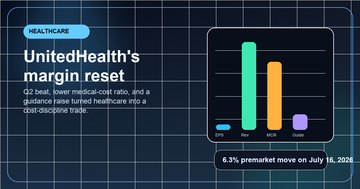
UnitedHealth Isn’t Just Timing the Medicare Advantage Turn—Its Medical-Care Ratio Disappearing Gap Sets Up the Elevance “Peer-League” Test
In UnitedHealth’s SEC filings, the Medical Care Ratio (MCR) moved from 85.5% (2024) to 89.1% (2025), then improved in early 2026 (83.9% in Q1’26). The falsifiable sector thesis for investors is whether that discipline shows up in Elevance Health’s reported Medicare Advantage medical-cost trend and risk-adjustment outcomes as CMS accelerates RADV audits—turning “recovery” into a measurable peer-league pattern rather than UNH-specific timing.

UnitedHealth’s Defensive Re-Rating Depends on One Number: Medical Care Ratio Discipline (and the Policy Path That Can Break It)
For UnitedHealth Group, the market’s “margin discipline” story ultimately hinges on medical-cost math: medical costs relative to premium revenue. In its filings, UnitedHealth reports a consolidated medical care ratio (MCR) of 89.1% in 2025 and 85.5% in 2024, while management’s 2026 outlook implies an MCR improvement to 88.8% ± 0.50%. Investors should treat this as a policy-sensitive underwriting signal—because Medicare Advantage funding math, including risk adjustment and RADV-driven settlement risk, can turn “good quarters” into future reserve pressure.
2026-07-21

Cardinal Health Buys AdaptHealth Diabetes Unit + Strive Medical for $360M Cash — Home-Care Roll-Up Continues
On July 20, 2026, Cardinal Health announced definitive agreements to acquire AdaptHealth's Diabetes Health business (~$235M cash) and Strive Medical — a DME supplier serving 20,000+ patients — for a combined ~$360M in cash. The deals expand Cardinal Health's Cardinal at-Home Solutions segment, deepening its position in diabetes supplies and durable medical equipment. AdaptHealth framed the divestiture as sharpening focus on its core sleep, respiratory, and HME businesses.

3M’s Q2 2026 Setup: A Small EPS/Revenue Miss Is Less Concerning Than the Tariff-Cost Test to Its Back-Half Organic Growth
3M (3M Company) delivered Q2 2026 results that were slightly below consensus on both adjusted EPS and revenue, while reiterating full-year guidance for ~3% organic sales growth. The market focus is whether the post-Solventum footprint can keep the organic-sales pace as tariff drag hits consumer-leaning SKUs and pricing/mix. With recent quarterly revenue running in a narrow band (~$6.0B–$6.5B), the “execution” question is not demand collapse—it’s margin bridge durability.

Scribe Therapeutics’ $100M IPO Is the First Public “Pure-Play CRISPR Risk Read” of 2H 2026—And It’s Valuing Epigenetic Gene Editing Like a Clinical-Stage Bet
Scribe Therapeutics (Scribe Therapeutics) set Nasdaq IPO terms for 7.15M shares at $13–$15, seeking about $100M at the low end and up to $107.2M at the top, with Sanofi participating in a concurrent purchase. The S-1 frames its core value creation around early, in-human data for its lead epigenetic CRISPR program (Scribe Therapeutics STX-1150]) and preclinical progress for two lipid-risk follow-ons funded partly by CIRM grants. For investors, the key question isn’t just CRISPR’s science—it’s whether public markets will underwrite early-stage execution risk after the post-2024/25 biotech window reopened.
2026-07-20

2026-07-19

2026-07-18

Meta's AWS Poach Turns AI Infrastructure Into a Cloud-Business Trial
Hiring a senior Amazon Web Services executive is a small headline with a large read-through: Meta is no longer just buying compute, it is starting to organize itself like a compute platform. That changes the valuation debate around AI capex, cloud economics, and what counts as a durable moat.

Skyroot's Vikram-1 Launch Opens India's Private Orbital Market to the Rest of the Space Stack
India's first private orbital launch is a milestone, but the market implication is bigger: launch access is becoming a commercial market, which matters for Rocket Lab, SpaceX, defense contractors, and every satellite company trying to buy time in orbit.

Skyroot's First Private Orbital Rocket Turns India Into a New Launch-Provider Market
The Vikram-1 launch is more than a national milestone. It shows that India has crossed from a government-led space program into a private launch market, which matters for launch pricing, satellite deployment, and the long-term economics of commercial space.

SpaceX Scrubbed Starship Flight 13, and Launch Reliability Is Now the Real Valuation Test
The abort of Starship Flight 13 matters because the market is no longer valuing SpaceX only on ambition. It is valuing the company on whether the launch system can become reliable enough to support Starlink, NASA, and a much larger future launch cadence.
2026-07-17

2026-07-16
2026-07-14

What to expect
Evidence-first notes with a visible point of view.
This section collects sharp takes on earnings, shareholder meetings, and market structure. Each new piece should make the thesis, the facts, and the implications obvious within the first few screens.
Expect direct analysis, not generic commentary.
Expect the data to be explicit and the argument to be easy to follow.